Showing posts with label 2014 offseason. Show all posts

21 October 2014

2015 Steamer Projections for the Orioles' Arbitration-Eligible Pitchers

The Orioles have a lot of decisions facing them this off-season. They have big name free-agents, the Nick Markakis option decision, important players entering their final year of team control, as well as a number of players in arbitration. These decisions facing the Orioles will get plenty of attention on Camden Depot as we proceed through the off-season. In this post, I'm not going to offer opinions on the decisions facing the team, but instead hope that this creates a useful resource as we proceed into the off-season. A couple other resources that may be helpful are Jon's arrivals and departures post, as well as this salary chart courtesy of Grantland.

The list below are all of the Orioles pitchers facing salary arbitration. In my next post, I'll take a look at the hitters. I've included some 2014 numbers for each players, but just as important are the 2015 Steamer projections for these players, in order to give the arbitration cases some context.

Photo by Keith Allison


Bud Norris
Arbitration year 3
2014 salary: $5.3 million

IP
FIP
fWAR
2014
165.1
4.22
1.5
2015 Projection
182.0
4.34
1.4

Tommy Hunter
Arbitration year 3
2014 salary: $3 million

IP
FIP
fWAR
2014
60.2
3.15
0.8
2015 Projection
35.0
3.55
0.2

Brian Matusz
Arbitration year 3
2014 salary: $2.4 million

IP
FIP
fWAR
2014
51.2
4.00
0.3
2015 Projection
40.0
4.03
0.1

Evan Meek
Arbitration year 1
2014 salary: $800,000

IP
FIP
fWAR
2014
23.1
5.10
-0.4
2015 Projection
1.0*
4.51
0.0
*For players who weren't on the active roster when a team's season ended, they are only give 1 game played for now. This will be fixed after the playoffs, but I believe the rate projections will be unchanged. 

Chris Tillman
Arbitration year 1
2014 salary: $546,000

IP
FIP
fWAR
2014
207.1
4.01
2.4
2015 Projection
202.0
4.64
0.9

Miguel Gonzalez
Arbitration year 1
2014 salary: $529,000

IP
FIP
fWAR
2014
159.0
4.89
0.6
2015 Projection
189.0
4.95
0.2

Zach Britton
Arbitration year 1
2014 salary: $521,500

IP
FIP
fWAR
2014
76.1
3,13
1.1
2015 Projection
65.0
3,29
0.7

These are the 7 Orioles pitchers that are eligible for arbitration this off-season. Like I said, I put this together as a resource, as there is still plenty of time to debate and analyze the decisions facing the Orioles. Feel free to do so in the comments, if you'd like. In my next post I'll take a look at the hitters who are eligible for arbitration. 

16 April 2014

Contemplating the 2016 Orioles

With the offseason signings of Ubaldo Jimenez and Suk-min Yoon, the Orioles have three players (along with Adam Jones) who are signed beyond 2015. Jones's contract runs through 2018, Jimenez's runs through 2017, and Yoon's through 2016. Also, because of MLB's qualifying offer system, the Orioles will forfeit their first- and second-round picks in the upcoming draft because they signed Jimenez and Nelson Cruz. So they will be without those two picks in the 2014 draft, and obviously they currently have all of their draft selections for 2015.

Jones will make $16M in 2016 (photo: Keith Allison)
Nick Markakis (2015 club option of $17.5 million with a $2 million buyout), currently the highest paid O's player, could depart after the 2014 season. The same goes for J.J. Hardy, who is in the last year of a three-year, $22.25 million contract. And Chris Davis and Matt Wieters are scheduled to be free agents in 2016, along with Bud Norris, Wei-Yin Chen, Darren O'Day, Tommy Hunter, Ryan Webb, and Nolan Reimold.

But the Orioles will have a decent amount of cost-controlled talent. That group currently includes Manny Machado, Chris Tillman, Miguel Gonzalez, Brian Matusz, Ryan Flaherty, David Lough, Henry Urrutia, Troy Patton, Steve Lombardozzi, T.J. McFarland, Zach Britton, and Steve Clevenger along with skilled prospects Dylan Bundy, Kevin Gausman, Hunter Harvey, Eduardo Rodriguez, Jonathan Schoop, Mike Wright, and others. Bundy, Gausman, and Harvey finished in the top 100 of most, if not all, noteworthy top prospects lists, and Rodriguez and Schoop were included in a few of them.

In February, Jeff Sullivan of FanGraphs tackled the Orioles' apparent "short-term window." He noted how losing Davis, Wieters, and Markakis would hurt, but that the Orioles would also gain financial flexibility:
Unless Markakis turns things around, the Orioles will happily clear that money, and then they’ll be able to re-invest it, probably better. Between Markakis, Wieters, and Davis, the Orioles could lose a lot of talent over two years, but that talent would've come at a cost of tens of millions of dollars, and dollars are basically wins without a corporeal form. Even if they can’t totally make up the gap in lost wins, they can get a lot of the way there.
If the O's do lose those three, they will have to find suitable replacements at catcher, first base, and right field. If Hardy leaves, that also means finding a new shortstop (unless that new shortstop is Machado, which then means a new third baseman). It's not unreasonable (though unlikely) that Jones could move to a corner outfield position by then. They will also find out soon enough if Flaherty (at second), Lough (in left field), and Urrutia (corner outfield/DH) are everyday players or are more part-time guys (likely the latter).

The O's farm system is rich in pitching that's relatively close to the majors, but they do not have a strong collection of position players. According to some in-depth work from Matt Perez, position prospects are still safer than pitching prospects, though that gap does seem to be shrinking. (You can find more prospect data analysis from Matt here and here.) Obviously having a solid core of young pitching talent is great, but the organization's dearth of young position players is concerning. Schoop is the highest ranked of a group that also includes Michael Ohlman, Chance Sisco, Adrian Marin, Christian Walker, Josh Hart, and Dariel Alvarez. That is not a high-ceiling list, and the Orioles would be lucky if even one developed into a major league regular. (For more on O's prospects, see Jon's 2014 rankings.) It will certainly be possible to improve the organization's position player depth in the next couple of years, but it will be a little tougher without those two high picks in the next draft.

If, say, only one or two of Bundy, Gausman, Harvey, Rodriguez, Wright, etc. turn into good or very good pitchers, then that will still amount to a solid collection of starters along with Tillman and Jimenez. (Tillman won't be eligible for free agency until 2018.) Bundy and Gausman (and perhaps Harvey) all have the potential to become outstanding starters -- obviously there's immense value in having very good and very cheap starting pitching. But Harvey is just 19 years old, and Bundy and Rodriguez are 21. They are not sure things. Neither is Gausman, who's 23. Still, the Orioles could conceivably have a 2016 rotation that consists of Bundy, Gausman, Tillman, Jimenez, and Rodriguez, with Harvey waiting in the wings and Wright and Gonzalez (or any other draft picks) providing depth.

So, in 2016, if the Orioles don't have to focus much on improving their starting rotation, they could then focus on position players, and possibly upgrading the bullpen (if needed). Without the "big three" listed above, the O's would have more than $30 million to plug holes on a young roster. They could have even more than that depending on which veterans they let walk. It won't be easy to find solutions to all of those potential areas of need, but that's also a significant chunk of money to work with.

As the Orioles have demonstrated this past offseason, they are not that interested in chasing the cream of the crop in free agency. They will re-sign their own guys to long-term deals -- Markakis, Jones, etc. -- if they deem it necessary, so it's possible that they could reach agreements with Wieters and/or Davis, depending on the price. It's also possible that they negotiate some kind of extension with Machado that buys out his remaining arbitration years -- something that's becoming increasingly popular because it benefits both the player (guaranteed millions) and the team (saves some money). But in free agency, they will generally go after mid-priced players. They may not go after them with the same apparent strategy used this offseason, but they'll target some and sign some.

Some rambling thoughts:

- Jones will probably still be in center field in 2016.
- Whether the O's eventually want to move Machado to shortstop will affect how aggressively they try to re-sign Hardy. That may also depend on how Machado looks after he returns from the disabled list.
- If the O's don't re-sign Hardy, then offering him the qualifying offer would be a good idea. That may also be a worthwhile option for Cruz (especially if he has a strong year). Those may be two ways to offset the loss of the two 2014 draft picks. The same goes for Wieters and Davis after the 2015 season, if they are still around.
- If Schoop proves that he can hit at the major league level but struggles at second base, he will probably need to play third base. So then what happens at second?
- I'd be surprised if the O's picked up Markakis's option after this season. Perhaps they could bring him back on a smaller deal, but it might be time to move on.
- I don't think the O's will re-sign both Wieters and Davis. I'd be surprised if they brought Davis back over Wieters. Then again, I wouldn't be shocked if they both left, either. (It's worth noting that they are both Scott Boras clients.) Depending on how this season goes, trading one may also be an option to help restock the farm system with some position players (or pitching, which a team can never have enough of). If the season starts to go south and the O's know they won't re-sign one of them, it might not be a bad idea.
- Depending on how Gausman and some of the other young starters eventually look, the O's may be able to deal some of their young pitching down the road for a bat or two. That may end up filling a potential hole at first base, or second, or in the outfield.

-----

There are worse things than having to build a team, position wise, around Jones, Machado, and probably Schoop (and maybe one or two of Wieters, Davis, and Hardy). But that also leaves a lot of questions at other positions. The good news is that the O's have a handful of high-ceiling pitching prospects in the minors. But the bad news is that, barring a trade or two or some miraculous position-player development, they're going to need to spend some serious money on some position players in the near future.

25 March 2014

Picking Up Steve Lombardozzi Is a Smart Move for the O's

Yesterday, the Orioles acquired Steve Lombardozzi from the Tigers in exchange for Alex Gonzalez. The trade makes sense on multiple levels:

Lombardozzi's an Oriole (photo: Keith Allison)
Age. Age isn't everything, but it's something.  Lombardozzi is 25 years old. Gonzalez is 37 and has not been very good for a few seasons now. In fact, he was pretty terrible last season (.177/.203/.230 in 118 plate appearances). With J.J. Hardy healthy and playing every day, the O's do not need a shortstop. That would not have been Gonzalez's potential role on the O's, obviously, but shortstop still seems to be his best position. He played some first and third base for the Brewers last year, and it's possible he could have been the O's starting third baseman for a few games to start the season. But the O's acquired a cheaper, better option in Lombardozzi for depth at both second and third base.

Help at second. Depending on what the Orioles do with Jonathan Schoop, Lombardozzi may end up as the team's starting second baseman on opening day. Since Manny Machado will start the season on the disabled list, presumably meaning Ryan Flaherty will get the nod at third base, the second base options (besides Flaherty) are now Lombardozzi, Schoop, Jemile Weeks, Alexi Casilla, and the recently claimed David Adams. Schoop certainly has the highest upside of that group, but he may be sent to Norfolk to play every day and show that he can perform well at the Triple-A level.

Options remaining. According to Jon, Lombardozzi has three options remaining. Flaherty has two, Weeks has one, Schoop has two, and Adams has one. So that at least provides the O's with some flexibility at their weakest infield position. Lombardozzi is also under team control through 2017.

***

As a player, Lombardozzi is similar to Flaherty. Offensively:

Flaherty: 438 PA, .221/.279/.378
Lombardozzi: 755 PA, .264/.297/.342

And defensively:

Flaherty, 2B (267.1 inn.): 8.0 UZR, +4 DRS; Flaherty, 3B (114 inn.): -0.3 UZR, -1 DRS
Lombardozzi, 2B (774 inn.): 0.4 UZR, +2 DRS; Lombardozzi 3B (142.2 inn.): 1.4 UZR, +1 DRS

Flaherty seems to be the better fielder at second base (note the sample size), while Lombardozzi may be somewhat better at third. Both have also filled in at times at shortstop and in the outfield, but they likely won't be doing so going forward with the Orioles. Both are better options than Weeks because they are above average defenders. Weeks is not; plus, he isn't all that great with the bat, either.

Losing Gonzalez is not a big deal, and his time on the O's roster would have been limited. So in exchange for him, the O's acquired a 25-year-old switch-hitter who can play multiple positions and who can be sent back and forth between the major league club and Triple-A Norfolk as needed. Lombardozzi may not be a very good player, but he could help the O's this season and beyond, and he's still young enough that he could improve. Besides, the price for him was simply an aging player the team had signed to a minor league contract a couple months ago. It's easy to understand the logic of bringing Lombardozzi aboard.

The worst part of the trade is that we all have to get used to spelling Lombardozzi. Good luck to all the fans who still think Matt Wieters's last name is "Weiters."

21 March 2014

With No Ervin Santana on the Way, O's Rotation Likely Set

Last week, Ervin Santana finally decided which team he wanted to play for and agreed to a deal with the Atlanta Braves for one year and $14.1 million. That's equal to the qualifying offer amount for 2013 that he and 12 other free agents turned down in November. With Santana now under contract, two of the 13 who rejected qualifying offers still remain unsigned: Stephen Drew and Kendrys Morales. And two of those 13, Ubaldo Jimenez and Nelson Cruz, joined the Orioles.

The race for Santana seemed to be down to the Blue Jays and Orioles. Santana had apparently turned down a three-year offer from the Twins and was seeking a one-year deal. The O's and Blue Jays both had one-year deals on the table (the O's may have offered a three-year deal as well, though that was disputed), but the Braves entered the fold when starter Kris Medlen injured his elbow. The Orioles' and Blue Jays' offers were both in the $13-$14 million range, but Santana opted for Atlanta's offer instead. Blue Jays general manager Alex Anthopoulos suggested that Santana picked the Braves because he wanted to pitch in the National League, and he probably did. That strategy makes sense for a pitcher who wants to put together a fantastic 2014 season that he hopes will land him a lucrative multiyear deal.

So Ervin Santana will not be joining the Orioles. This is what the O's rotation will likely be on opening day: Chris Tillman, Ubaldo Jimenez, Wei-Yin Chen, Miguel Gonzalez, and Bud Norris. Before the O's signed Jimenez, Kevin Gausman arguably had the upper hand in the fifth starter race. But he will likely start the season in Norfolk, waiting for the Orioles' call if/when needed.

Chris "Ace" Tillman (photo: Keith Allison)
The 2013 Orioles used 14 different starting pitchers. Gone are Jason Hammel, Scott Feldman, Freddy Garcia, Jake Arrieta, and Jair Jurrjens (who combined for 304.1 innings pitched). Zach Britton will start the season in the bullpen, unless he's traded. Josh Stinson will also likely be in the bullpen. Steve Johnson (one) and T.J. McFarland (three) have options left and could both start the season in Norfolk. And Johan Santana will try to regain strength in his shoulder, hoping to be ready by the end of May.

Losing Feldman hurts a bit because he would have helped the back-end of the rotation (presumably bumping Norris). A healthy Hammel could have been nice to have as well; he was solid in 2012 but less so in 2013, and he battled injuries in both seasons. But the Orioles do have a better collection of starting rotation options overall than they did in 2013. The likely starting five listed above is flanked by Gausman, Britton, Johnson, McFarland, Stinson, and Johan Santana in some order. Other names to include are Suk-min Yoon; Brian Matusz the starter; prospects Mike Wright, Tim Berry, and Eduardo Rodriguez; and Dylan Bundy, who is recovering from Tommy John surgery. So the O's should not find themselves in the position of relying on the likes of Garcia and Jurrjens for innings.

As Nate wrote in January, Ervin Santana could have helped the Orioles, but maybe only by one additional win. But the Orioles' situation did change between now and then. They signed Jimenez and Cruz, meaning they will forfeit their first- and second-round picks in the upcoming MLB draft. So signing Santana last week would have meant losing a third-round pick, but since the O's did have an offer on the table, they seemingly had no issue with doing so. A rotation of Tillman, Jimenez, Ervin Santana, Chen, and Gonzalez (with Norris traded or moved to the bullpen) does look better, but not as much as you'd think. Here are the career numbers and 2014 Steamer and ZiPS projections for Santana, Norris, and Gonzalez in 2013:

Ervin Santana career: 7.09 K/9, 2.81 BB/9, 1.22 HR/9, 39.8 GB%, 11.0% HR/FB, 4.19 ERA
... 3 fWAR in 2013, Steamer projects 2 fWAR in 2014, ZiPS projects 1.7 fWAR in 2014

Miguel Gonzalez career: 6.41 K/9, 2.86 BB/9, 1.20 HR/9, 37.4 GB%, 10.8 HR/FB, 3.58 ERA
... 1.7 fWAR in 2013, Steamer projects 1 fWAR in 2014, ZiPS projects 1.5 fWAR in 2014
(Gonzalez much smaller career sample size.)

Bud Norris career: 8.51 K/9, 3.71 BB/9, 1.11 HR/9, 40.2 GB%, 10.8 HR/FB, 4.36 ERA
... 2.7 fWAR in 2013, Steamer projects 0.9 fWAR in 2014, ZiPS projects 2.4 fWAR in 2014

Steamer and ZiPS differ the most on Norris in 2014. Gonzalez has only thrown 276.2 innings in the majors and has outpitched his peripherals (low strikeout rate, BABIP, and groundball percentage) so far.
Gausman in glasses (photo: Eduardo Encina)

Santana is the better pitcher of the three, but it's not an enormous difference. If not for an injury or two to Atlanta's starting rotation, Santana could have decided to pitch in Baltimore in 2014, making the O's marginally better. But it's not like the addition of Santana would have transformed the O's rotation into a superior one. The current rotation, while not great, does look OK, and it will look even better if things start to click for Gausman in Norfolk and then eventually in the majors. Of the O's rotation depth, he's the starter with the most upside right now.

14 March 2014

Should the Orioles Have Gone Gonzo in the Offseason?

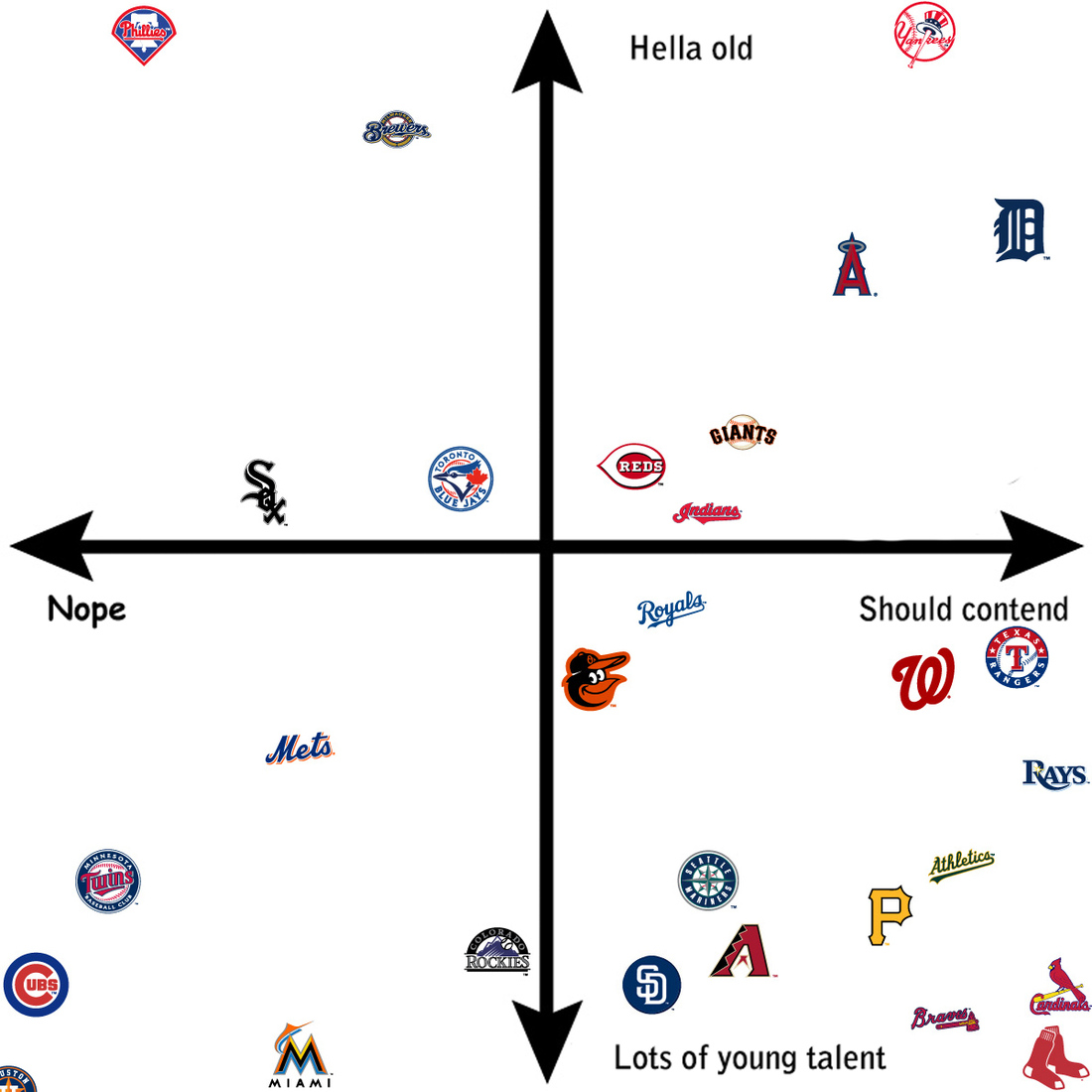
Here at the Depot we tend to write about the process and often struggle at elucidating a clear, succinct way to illustrate how characteristics of a club can affect what direction a franchise may choose to take.  At the end of a season, a team evaluates its players, its league, and determines what course to chart.  This may mean to invest more heavily on the youth side of things, put together a mid-flight team and hope for some luck, or even to go gonzo and invest all of your resources into the here and now.  The whole idea can expressed, as it often is, as a window.  Windows come is all different shapes and sizes and certainly some might be more preferable than others.  Likewise, competitive baseball can take quite a few paths to lead to the same result.  That said, I wanted to try to simplify things.

What I focused on are two variables: success and youth.  For success, I decided that the previous season's Pythagorean Win Expectation was a sufficiently robust metric that could be easily viewed at the end of a season.  For youth, I choose to sum up all 25 and under players who had at least 2 bWAR, players whose rookie status expired but were on the previous season's top 100 prospect ranking list, and a weighted expectation of top 100 prospects to become at least league average players.  That last component was calculated using Matt Perez' recent work on prospect outcome probability.  Additionally, when I put this graphic together, I only had Baseball Prospectus' top 100 list (I ignored the 101st player), so I used that over Baseball America's even though the probabilities that Perez devised were done for Baseball America's list.  Eh, we are dealing with approximates and a process discussion here, so I think it does not matter. 

The result is this:


Note that the above graph looks suspiciously like the thought exercised by a recent article in...I cannot remember.  Maybe Beyond the Box Score or Grant Brisbee, I cannot remember at all.  Anyway, I took a more quantitative perspective, but this kind of evaluation is loose enough that being quantitative does not necessarily mean being more accurate.

UPDATE--Thanks to one of our astute readers, the article I am referring to is indeed one by Grant Brisbee.  You can read that one here. There are some differences of note.  For instance, the method we used classifies Boston as a not young team while Brisbee's suggests that they actually are.  Most teams appear to fall is the same places.

Where a team wants to be is up and to the right.  The graphic above suggests that the two strongest teams in baseball are the Cardinals and the Braves.  The Cardinals' competitiveness puts them in the elite class and they trend younger.  The Braves' appear both elite in competitiveness as well as in youth.  The success they have had with their youth has recently been in the news with the many contract extensions they have been handing out to their 25 year old and younger talent.  It must be great to be a fan in Atlanta with all of that potential in place.

What is also interesting is that you have teams like the Athletics who have a roster that is not spry, but is also not expensive.  However, it is also competitive.  This shows their uncanny knack of late for finding older prospects and players who are useful major leaguers, but have not been put in roles to maximize their success.  Flipping on the x-axis, you have a team like the Phillies who are both old and were not very good last year.  Placement in the bottom left is not a death sentence though, health and major cash influxes can help alleviate some of the pain.  Ask the Yankees.  They have made many a playoff run based on experienced players.

But what about the Orioles?
The Orioles are pretty much a middle of the pack team, which means they need a wise hand guiding them or some luck shine their way in order to sustain their recent success.  They are competitive, but not exceptionally so.  They have youth, but not in any exceptional abundance.  They teeter on the threshold, which that graph probably did not need to tell you.  It is a reason why the discussion of playoff windows is so often mentioned with this team.  A team in the middle can easily wobble either way.  When November dawned upon the Orioles, they really had two major paths to travel down (with many variations):
  1. Go all in, maximize payroll, and improve probability of a meaningful playoff run within this window.
  2. Be shrewd, protect amateur influx, and avoid potential albatross like long-term contracts.
Path one would have been fun, exhilarating, and full of wonderful risk.  It is what the Blue Jays tried to do last season.  For them, unfortunately, it did not work out.  Path two would have been frustrating, but somewhat understandable given the payroll this club works with.  Having so many players in their upper 20s and in arbitration takes up a lot of space on a club.

What we have seen though is the team using both strategies.  Signing Ubaldo Jimenez and, to a lesser extent, Nelson Cruz were those all in, maximize immediate value moves.  He is not really an exceptional pitcher, but he is a good mid-rotation arm on a playoff team.  Cruz is not an exceptional hitter, but he does provide some positive value with the bat.  Better high end moves probably would have meant double the cost expenditure in securing talent like Robinson Cano, Masahiro Tanaka, Shin Soo Choo, or Jacoby Ellsbury.  Regardless, Jimenez and Cruz cost the team a first round pick and a second round pick, respectively.  This probably dings the youth outcome by about a third of a player assuming the Orioles would have selected a top 100 talent this year like they did last year in Hunter Harvey.

The second path saw implementation a few times this off season.  The team refused to pay Nate McLouth 5 MM a year, so they managed to take a spare part and deal it for David Lough who might be capable of doing what McLouth did, but for 4.5 MM less.  The club opened up payroll by dealing out Jim Johnson.  The club also is trying to make some shrewd acquisitions in picking up a player like Suk-min Yoon, a player that no other MLB club values as highly as the Orioles.

With this in mind, I am not exactly sure what the long term plans of this club actually are.  They certainly are pushing the payroll hard in order to put forward the best team possible.  However, that best team possible was achieved by having money leftover to pick up the scraps at the free agent table.  The results were fine, but the process looks miserable. Additionally, one could argue that better foresight would have included a plan to better beef up their offense.  Players like Matt Wieters, Chris Davis, and JJ Hardy are getting older or might well be departing.  The farm system is filled with pitching talent, but is a bit thin on positional talent.  This summer is not going to provide a great opportunity to acquire hitting.  Maybe this means that these players will eventually be sent off to beef up that talent or maybe the minor league pitching will be used to accomplish that.

Below is the table used to construct the graph above:


Youth Expected Prospect Performance 25 and under 2013 Pyth
Arizona 5.07 1.07 4 80
Atlanta 7.56 0.56 7 98
Baltimore 3.77 1.77 2 85
Boston 1.82 1.82 0 100
Cubs 3.21 2.21 1 71
ChiSox 5.47 0.47 5 67
Cincinatti 4.91 0.91 4 93
Cleveland 1.79 0.79 1 90
Colorado 5.38 1.38 4 76
Detroit 2.3 0.30 2 99
Houston 4.81 1.81 3 57
Kansas City 4.07 2.07 2 87
LAD 4.16 1.16 3 89
LAAA 1 0.00 1 81
Miami 5.56 0.56 5 64
Milwaukee 4 0.00 4 76
Minnesota 4.37 2.37 2 63
NYM 4.17 1.17 3 74
NYY 0.26 0.26 0 79
Oakland 1.49 0.49 1 96
Philadelphia 1.51 0.51 1 66
Pittsburgh 4.12 2.12 2 88
San Diego 2.02 1.02 1 72
San Francisco 2.3 0.30 2 74
Seattle 6.03 1.03 5 67
St. Louis 4.21 1.21 3 101
Tampa 5.32 0.32 5 87
Texas 4.9 1.90 3 92
Toronto 1.81 0.81 1 77
Washington 5 1.00 4 84


Average 3.75

81.1
St Dev 1.74

12.2


Here is the graph from the Brisbee article:


06 March 2014

Why Did the Orioles Sign Johan Santana?

Note: Check out our other article on the Santana signing not being a risk free move.

On Tuesday, the Orioles agreed to a minor league deal with Johan Santana. Santana, who turns 35 in a week, would make $3 million if he's added to the 40-man roster. He has a chance to make another $5.05 million in incentives. He also has an opt-out date of May 30 if he is not yet added to the major league roster, which goes along with Dan Duquette's June 1 target date for a decision.

It's hard to find much to dislike about the signing. Santana has pitched very well in the past, and if he's able to overcome his shoulder problems, he could give the O's another decent option to improve the team's pitching depth. Chris Tillman and Ubaldo Jimenez are the O's top two starters, so a healthy Santana could eventually compete with Miguel Gonzalez, Wei-Yin Chen, and Bud Norris for innings. Kevin Gausman could also earn starts down the road, depending on any injuries or how well the back-end of the rotation performs, but Santana would likely get the first chance, assuming he's ready.

Santana is not guaranteed to make that $3 million, as some fans initially suspected. If he is never added to the 40-man roster, he doesn't get that money. He is essentially a lottery ticket, and the Orioles have a couple months to decide if they want to promote him. Santana has time to work his way back in the minors to strengthen his shoulder and potentially return to form. But the odds are stacked against him. Santana has had two major shoulder surgeries since 2010, and he's recently had trouble throwing above 80 mph. That may have been fine for someone like Jamie Moyer to get away with. But Johan Santana is not Jamie Moyer.

Signing Santana doesn't make the O's any worse, but there isn't necessarily much upside with the move. Even if Santana is able to pitch in the rotation, he hasn't pitched all that well since 2010. In 2012, when he threw 117 innings, he posted an 8.54 K/9, his highest since 2007, but he also walked 3 batters per nine (his highest mark since 2002) and allowed 1.31 home runs per nine (his highest since 2007). His numbers weren't quite as bad as his 4.85 ERA indicated, but he certainly wasn't frontline starter material. The O's have a few of those guys already.

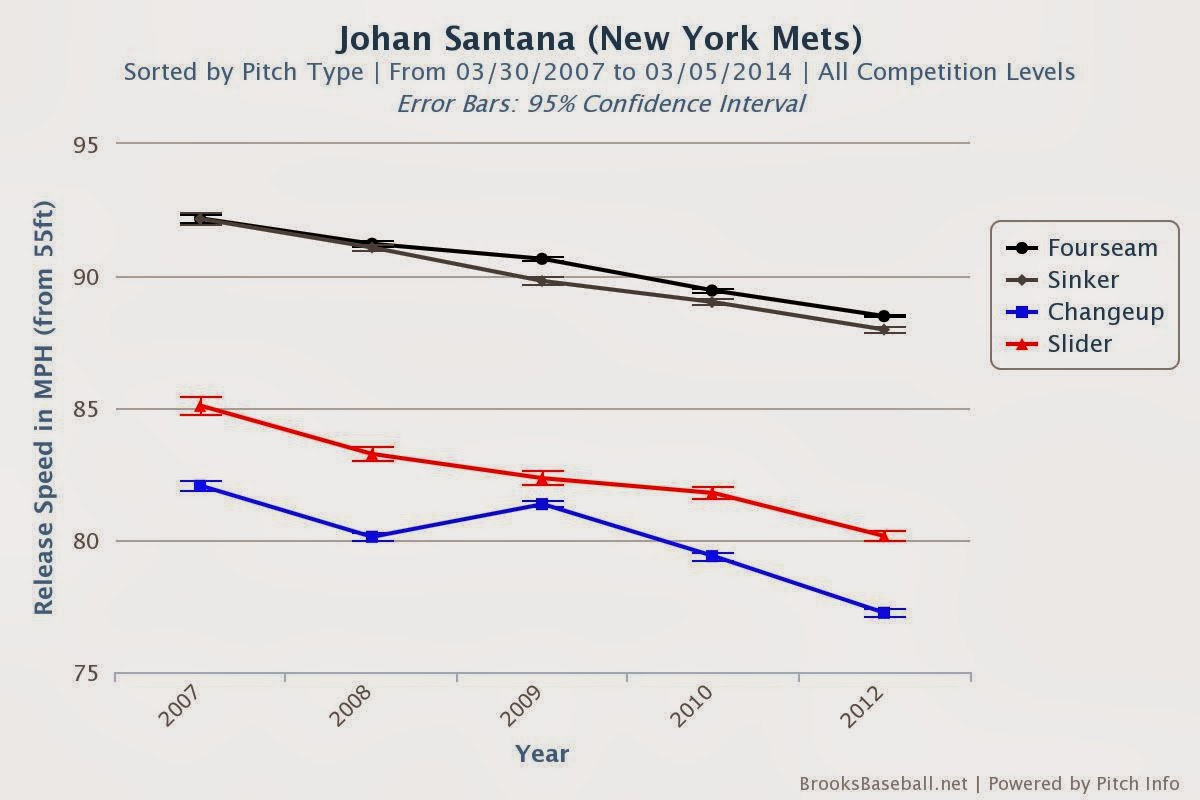
Also, likely because of the combination of injury and age, Santana's pitching velocity has consistently been dropping each season on all of his pitches.

Johan Santana's declining velocity

Santana has been losing about 1 mph on all of his pitches each season -- sometimes more. That has mainly affected the movement on his four-seam fastball, which he throws nearly half the time. He also adjusted in 2010 and 2012 by throwing more sliders and fewer change-ups, despite his slider losing a bit more movement than his change-up. Maybe he wasn't as comfortable throwing as many change-ups as before since he was offering them up at 77 mph. With that level of velocity, Santana will need pinpoint control on all of his pitches.

It's also worth wondering how the Santana signing affects Gausman. Bringing in Jimenez basically forced Gausman to Norfolk, which is fine, because Gausman could certainly use those Triple-A starts to work on improving his slider and his overall command. But if the O's turn to Santana later in the season instead of Gausman, could that stunt his growth? He could make a case for being the O's fifth starter right now, and he could be the shot in the arm the O's need in June or July. Would the O's toy with the idea of moving him to the bullpen again to get him to the majors? I'd say no, but they did use him out of the bullpen last year occasionally in one- or two-inning appearances. That's not really the best use of his services, and it's probably not the best for his development. Granted, Santana pitching well would be a nice problem to have, and Gausman could eventually be promoted and used out of the bullpen even if Santana never pitches for the Orioles. But Gausman's progress is more important to the Orioles than Santana's. This is probably a small gripe, though, and hopefully Gausman's reliever days are over. And perhaps my concerns are more with how -- and why -- the O's jerked Gausman around last year instead of just leaving him alone and letting him start. It's not like the Orioles employed the Earl Weaver long reliever model with Gausman, either.

It'll be interesting to see if Santana can indeed work his way back and pitch in an Orioles uniform this season. It's a long shot, and the O's may not need him anyway. But if he can come back as just a competent starting pitcher, then the signing was worth it.

28 February 2014

Nelson Cruz's Red Flags

On a one-year deal, Nelson Cruz is a useful addition and improves the Orioles' designated hitter situation. In 2013, O's DHs had a dreadful combined slash line of .234/.289/.415. Cruz's slash line in 2013 was .266/.327/.506, which is very close to his career line of .268/.327/.495. He will help by giving the Orioles a boost at DH in nearly every offensive category.

Nelson Cruz (photo: Keith Allison)
Cruz made his major league debut in 2005 with the Brewers, but he did not start playing routinely until 2007, when he appeared in 96 games with the Rangers. He did not hit well in 333 plate appearances (.294 wOBA), and he did not return to the majors until August of 2008. In 133 plate appearances, he raked (.437 wOBA); he's been a regular in the Rangers lineup since.

He put up a .363 wOBA while playing decent defense in 2009, but his best full-time season came in 2010 (.404 wOBA). He even managed to moderately improve his defense and baserunning that season. But his offensive numbers since then have been good, but not close to a .400 wOBA:

2011: .353 wOBA
2012: .335 wOBA
2013: .359 wOBA

After stealing 37 combined bases in 2009 and 2010 (caught eight times), he's swiped only 22 bags the last three years while getting caught 10 times. He would never have been confused with Rickey Henderson and is not that fast anyway, but every little bit helps value wise. Along with his now below average baserunning abilities, Cruz's outfield defense took a sudden plunge in 2011. Take a look:

2009: 8.6 UZR, 0 DRS
2010: 10.1 UZR, +3 DRS
2011: -6.2 UZR, -5 DRS
2012: -3.7 UZR, -13 DRS
2013: -4.3 UZR, -3 DRS

Cruz is not going to be an asset on the basepaths, and he is not a good corner outfielder. Those things all contributed to him not getting the lucrative three- or four-year contract that he was seeking this offseason. Those problem areas (and more) were why Dave Cameron of FanGraphs named Cruz his biggest "land mine" of all the 2014 free agents:
The way that Cruz’s value has been portrayed makes him out to be one of the game’s elite sluggers, when he’s really nothing close to that. While playing half his games in the hitter’s paradise of Arlington, he’s posted OBPs of .312, .319, and .327 over the last three years. Yes, he’s strong, and he hits some impressive home runs, but he also makes a lot of outs in the process.

Toss in poor defense, poor baserunning, always lingering health concerns, a PED suspension, the fact that he’ll be 33 next year, and the draft compensation that is attached because Texas made him a qualifying offer, and Cruz is a DUI away from Red Flag Bingo. It’s one thing to overlook all of these issues because the performance is just so great that the reward is worth the risk, but even a full strength, completely healthy Nelson Cruz is more of an average player than a good one.
Ouch. Granted, Cameron wrote that back in November when many people still figured Cruz would get paid pretty big money on a multiyear deal. Obviously the Orioles did not do that. So Cruz's long-term outlook doesn't necessarily interest the O's much; they are worried about what he'll do in 2014.

The O's would definitely welcome any production from Cruz in the .350 wOBA neighborhood. Adam Jones posted a wOBA of exactly .350 last season, and only three other O's posted wOBAs above .325: Chris Davis (.421), Danny Valencia (.381 wOBA, in 170 PAs), and Steve Pearce (.345 wOBA, in 138 PAs). Valencia's and Pearce's numbers were accumulated in small samples, and while Davis had far and away the best season of his career, there's no guarantee he comes close to replicating his phenomenal numbers. So Cruz's presence should help, since Davis will almost certainly take at least a minor step back.

But even in the short term for Cruz, there are some warning signs to pay attention to. They may not amount to much in 2014, but if he starts to struggle, the following may be some of the reasons why.

Decreasing Fly Balls?

He is not a high OBP guy (career .327), and he relies on power (career .495 SLG). He wants to hit the ball out the ballpark -- something he'll have in common with several of his teammates in Baltimore. He has not had a drastic change in the amount of groundballs and fly balls he's been hitting, but there's been a small one:

Career: 40.1 GB%; 43.0 FB%
2013: 41.9 GB%; 41.2 FB%

(Reminder: Groundballs are more likely to become hits than fly balls, but fly balls have the potential to leave the ballpark.) It's worth noting that his 2012 rates were both around 41%, but in both 2009 and 2010 he was around 45%. So it may not be a major concern yet, but it's worth keeping an eye on -- especially since he'll be playing in another ballpark that welcomes plenty of home runs. Considering Cruz's career 16.6% HR/FB rate, he wants to hit the ball in the air as much as possible. (The 2013 MLB average HR/FB rate was 10.5%.)

Contact and Swing Concerns

Cruz has also been getting worse at making contact on pitches thrown outside the strikezone. His yearly O-Contact percentages since 2009 are 52.5, 61.5, 59.9, 55.1, and 51.6. So he wasn't great at making contact on those pitches in 2009, immediately was better in his career year in 2010, and then has been getting worse each year since. It's an important skill for batters to foul off tough pitches and extend at-bats and eventually get a better pitch to handle.

His overall contact percentages have been a bit above his career mark (72.8%), which is due to Cruz making better contact on pitches inside the strikezone. So that's a positive. But his overall swing percentages have gone from a career high of 50.4% of pitches in 2011 to 47.6% and 46.8% in 2012 and 2013, respectively. That did lead to Cruz not chasing as many pitches outside the strikezone in 2012 (26.6%), but not 2013 (30.5%). (Career O-Swing% of 29.9%.) It also led him to swing at fewer pitches inside the strikezone:

2011: 69.2%
2012: 67.8%
2013: 64%

(Career Z-Swing% of 67%.)

Breaking and Off-Speed Pitch Troubles

This tweet from Buster Olney drew attention to another warning sign:
In 2013, Cruz saw the lowest amount of hard pitches (four-seamers, sinkers, and cutters) and highest amount of breaking pitches (curveballs, sliders, and knuckleballs) since 2009. He's seen mostly the same amount of off-speed pitches (change-ups, splitters, and screwballs). (Note: It's unclear if "off-speed pitches" in Olney's tweet combines Brooks Baseball's breaking and off-speed pitch categories.)

So opposing pitchers have recently started (again) to attack him with more breaking stuff:

Percentage of pitches to Cruz, sorted by year
The 2013 percentages are very close to the pitches thrown to Cruz in 2009. Perhaps Cruz's career isolated power (slugging minus batting average) numbers vs. the three pitch categories has something to do with that:

Hard: .272
Breaking: .189
Off-speed: .196

(Cruz career ISO: .228. 2013 MLB average ISO: .143.)

In 2012, Cruz's ISO was just .116 vs. breaking pitches (though .235 vs. off-speed), and in 2013, Cruz had an ISO of .170 vs. breaking pitches but only .069 vs. off-speed.

Some of those struggles may have to do with the amount of swinging and missing Cruz is doing at non-fastballs. He swung and missed at just 8.5% of hard pitches in 2013, but he whiffed on 18.5% of breaking pitches (about his career average) and 25.2% of off-speed pitches (the most for him since 2007). The steady increase in his whiff percentages on off-speed pitches since 2010 is worrisome. Maybe he's fortunate that opposing pitchers only throw him off-speed pitches 10-11% of the time. Also, for what it's worth, his overall strikeout percentage of 23.9% in 2013 was his highest since 2007.

-----

If the O's had signed Cruz beyond 2014, these issues would be much more worrisome. He could very well have an outstanding season and put himself in position for the payday he thought he'd be getting this offseason (or maybe something close to it). Since he will likely be the O's primary DH, the only thing that matters is if he hits well or not. That's why the O's signed him in the first place.

Stats via Baseball-Reference, FanGraphs, and Brooks Baseball.