Showing posts with label Miguel Gonzalez. Show all posts

08 April 2016

Expanded Roster: Last Year The Orioles Had A LOB Problem

Camden Depot is proud to offer opportunities for writers to share their thoughts on our ESPN-affiliated site. Articles are often one-time things or are an entry into becoming a full-time writer here. Feel free to contact us at CamdenDepot@gmail.com if you wish to inquire on the process.

Last Year The Orioles Had A LOB Problem
by Joe Wantz

photo by Keith Allison
Last week’s release of Miguel Gonzalez marked the end of his mostly successful career as a Baltimore Oriole. From 2012-2015, Gonzalez was third amongst Orioles starters in ERA and inning pitched and came into 2016 as a presumptive member of the starting five. Those solid numbers, however, masked frightening peripheral stats. Gonzalez posted the worst FIP and xFIP of any pitcher who started more than 20 games for the Orioles in that time period, and the wheels began to totally fall off in the second half of 2015.

How, then, was Gonzalez able to be a steady, if unspectacular, starting pitcher for three and a half years? While there are a few possible answers, one of the most glaring issues was Gonzalez’s left on base percentage (LOB%). When runners got on base against Gonzalez, especially in 2014, they almost never scored. That season, Gonzalez posted a LOB mark of 85.5%, which would have led the major leagues if he pitched enough innings to qualify. For comparison’s sake, Clayton Kershaw stranded 81% runners in 2014. Clayton Kershaw was worse at stranding baserunners than Miguel Gonzalez, and not by a small margin.

While this is striking enough, considering the massive skills gap between Gonzalez and someone like Kershaw, it is not an outlier in the Orioles rotation. From 2012-2014, the starters had the seventh best LOB% in all of baseball despite having a generally underwhelming set of arms. They were able to accomplish this despite ranking in the bottom 10 in the league in line drive rate, ground ball rate (dead last), fly ball rate (also the worst in baseball), K/9, BB/9, and HR/9 (last yet again). They also had the third largest gap between staff ERA and FIP of any team in baseball.

Needless to say, this is not the profile of a good starting staff, much less the starting rotation for the team with the most wins in the American League during that time period. Yet, that was exactly what happened. And while LOB% may not be the only reason for their surprising success, it certainly was a driving factor. No team at the top of the rankings in LOB% had a higher WHIP than the Orioles. Essentially, the Os were putting more runners on base than elite pitching staffs like the Nationals but stranding them at the same rate. So, while the Os were putting a ton of runners on, they were able to keep them from scoring.

A lot of that success likely came from an elite defense, which can be extremely helpful in helping pitchers post low batting average on balls in play (BABIP) numbers. The defense fell off a bit in 2015, perhaps correlating with the disaster that was the starting rotation, which went from stranding 77.6% of baserunners (second in baseball) in 2014 to 72.3% (17th best) in 2015. The two biggest culprits in this fall were Chris Tillman and, you guessed it, Miguel Gonzalez. Tillman saw his LOB% drop from 76.7% to 68.2%, with Gonzalez’s fall an even more precipitous 85.5% to 73.1%.

So, what does this mean for 2016? It is certainly reasonable to believe that Tillman can bounce back to being at least the league average mark of about 72%. If Tillman had the exact same stats as last year, but with that LOB mark, his ERA would fall from 4.99 to 4.58. That would certainly be a start, especially if he can get back to around the 200 inning mark. His Opening Day performance, though abbreviated, looked like a great start in that regard. It is likely not realistic for Tillman to maintain an average velocity of 93.1 MPH like he did on Monday, but an increase in his strikeout rate will lessen the overall need for an elite LOB%.

The rest of the current staff did not have the kind of massive change in LOB% that we saw from Tillman and Gonzalez last season, though it is worth noting that Yovani Gallardo had one of his best LOB% seasons in 2015. The rotation turnover that has occurred since the beginning of Spring Training (Gonzalez released, Kevin Gausman on the DL, Mike Wright, Vance Worley, Tyler Wilson all potentially making April starts) makes it difficult to forecast whether 2015 was an anomaly or a sign of things to come this season. That said, with a healthy Jonathan Schoop, JJ Hardy, and Matt Wieters up the middle, along with the emergence of Rule 5 pick Joey Rickard in left, perhaps a return to the defensive greatness (and resulting low BABIP and high strand rate) of 2014 may once again be in order.

31 March 2016

Does Miguel Gonzalez's Orioles Career End Here?

With the regular season only a few days away, major-league teams must make the final moves to prepare their rosters for the 162-game haul. Some clubs must decide who will serve as the fourth outfielder; others will choose the backups for the starting catcher and infielders. And for teams like the Orioles, it means they must conclusively determine their starting pitching situation.

Baltimore knows that Chris Tillman, Ubaldo Jimenez, Yovani Gallardo, and Kevin Gausman will (in some order) occupy the 2016 rotation. Tillman rebounded somewhat in the second half of 2015, and his solid work prior has earned him the Opening Day start for the third straight year. Jimemez and Gallardo have solid resumes and pricey contracts, both of which will grant them some job security, deserved or not. And once Kevin Gausman returns from his shoulder injury, his flame-throwing arm will allow him to take the hill every fifth day.

The doubt comes beyond that. Mike Wright and Tyler Wilson each started some games last season, but neither has really impressed to this point. While Vance Worley has some talent, the fact that the Pirates put him on waivers tells you about his potential. Yet each of these three apparently has more potential than Miguel Gonzalez, with whom the Orioles have decided to part ways. After a solid run for the Birds, it looks as though Gonzalez has reached the end of the road.

Out of the many pitching prospects that Rick Peterson has tampered with developed, Gonzalez stands out as perhaps the biggest success. Before the Orioles signed him in the 2011 offseason, he was an oft-injured 27-year-old farmhand with 5.0 innings in Triple-A and zero innings in the majors. Then he broke out in 2012, twirling a 3.25 ERA over 105.1 innings to support the team's Cinderella run. That kicked off a three-year stretch of solid starting pitching, in which Gonzalez posted a 3.45 ERA in 75 games (69 starts — nice) and 435.2 innings. Dan Duquette and Co. seemed to have found a diamond in the massive minor-league free agent rough.

Then the wheels came off in 2015. Gonzalez deflated to a 4.91 ERA over 144.2 frames. It could have been a fluke, but since he'd outperformed his FIP in the prior years (more on that in a moment), this appeared to indicate that his luck had run out. He sealed his fate with a ghastly stint in Sarasota, stumbling his way to a 9.78 ERA in 19.1 spring training innings. That takes us to where we are now: Gonzalez on waivers and the Orioles looking elsewhere to round out their rotation.

In retrospect, we should note that Gonzalez's decline happened not in 2015, but in 2014. Over the first two years of his career, Gonzalez allowed 3.87 runs per nine innings and tallied a 3.64 DRA, both above-average marks. DRA reflected some of the more advanced areas in which Gonzalez excelled — chiefly, his ability to limit production at the plate. Despite facing difficult competition (he had an opponent TAv of .265 over those two seasons), Gonzalez held hitters to a combined TAv of just .254*. Because DRA focuses so much on plate appearance outcomes, this helped Gonzalez's case immensely.

*TAv is scaled so that the MLB average is .260.

When the success at the plate went away, Gonzalez should have given up more runs. In 2014, batters knocked Gonzalez around to the tune of a .278 TAv, driving his DRA up to 4.91. He didn't have quite as low a BABIP in that year as he did in the preceding ones, and home runs plagued him like never before. But Gonzalez got lucky: He allowed just 3.45 runs per nine innings and cruised through the season (when healthy). Gonzalez had the same problems in 2015 that he had in 2014 — too many hits and long balls leading to an inflated TAv — except his good fortune vanished. His 5.04 RA matched his 4.80 DRA and doomed him to the waiver wire.

For two or three years, depending on your preference of peripherals or results, Gonzalez was a respectable, major league-caliber starting pitcher. That's a phenomenal feat for someone who endured as many hurdles — a recurring knee ailment, Tommy John surgery, numerous trips up and down the minor leagues, and the premature death of his close friend — as he did. Still, 31-year-old pitchers who lose their touch usually won't get it back. While the memories he gave us during the 2012 and 2014 runs make this a painful decision, ultimately it'll benefit the team to run out someone such as Worley or Wright.

29 March 2016

Best And Worst Cases For The Orioles' Rotation

In case you haven't been paying close attention, or are in a constant state of denial, the Orioles have some serious starting rotation question marks. FanGraphs has been posting its 2016 positional power rankings series, and the O's starting rotation options ranked 28th in the majors.

That low ranking should not come as a surprise. With Chris Tillman, Ubaldo Jimenez, Yovani Gallardo, and Miguel Gonzalez, the O's have some decent starting pitchers, but none who should be considered superb or an ace. Then there's Kevin Gausman, who has the highest upside of anyone in the group and the potential to be a front-line arm. But he's also dealing with shoulder tendinitis, and he'll begin the year on the disabled list.

To round out the current starting options, Tyler Wilson and Mike Wright are seemingly in a constant -- but friendly! -- battle to take over for whomever in the group falters or gets injured (depending on Gausman's status in a few weeks). Then, in some order, there's Vance Worley, T.J. McFarland, Odrisamer Despaigne, Parker Bridwell, and Chris Lee. And in the impatient/pipe-dream category, there's Dylan Bundy. The Orioles could always acquire another starter, so things could change quickly.

Besides the rotation, the O's have the makings of a solid team. The offense, which doesn't have a bunch of high on-base types but does have lots of power bats, should feature plenty of homers and still score lots of runs. Defensively, the O's project to be pretty good in the infield. Mark Trumbo's defense is a serious concern in right field, but Adam Jones should at least be adequate in center. Left field is currently a question mark. Joey Rickard, the talk of O's camp, is a lock to make the opening day roster and at least comes with the reputation of a strong defensive outfielder. And despite being heavily relied on yet again, the bullpen should again be one of the best in the American League.

Things don't always go according to plan, but it sure seems like the starting rotation is the main issue holding the Orioles back from competing for the AL East crown. If you read any season preview of the Orioles, it won't take long to get to the team's starting rotation woes.

Anyway, you know what the projections say, and it isn't good. So let's take a hypothetical look at the best and worst cases for the O's projected rotation.

Chris Tillman

Tillman gets the nod on opening day for the Orioles. Because, you know, someone has to do it. The BABIP gods struck back against Tillman a bit last year (.293) after posting below average numbers the two years prior (.269 and .267, respectively). That could have something to do with him slowly becoming more of a groundball pitcher and incorporating a sinker. In his three full-time seasons, he's gone from 39% to 41% to 44%, which is an interesting shift. Still, Tillman doesn't miss enough bats and isn't efficient enough in limiting walks or generating ground balls to be considered anything better than a back-end arm.

You could see things breaking right for him and Tillman posting a similar season to 2014, when he had a 3.34 ERA despite peripheral numbers that suggested he wasn't that good. That year, he had an fWAR of 2.4. That's probably the best case. Worst case? Probably something like last year's 4.99 ERA and 1.9 fWAR, with the frightening potential to somehow underperform even those numbers.

Ubaldo Jimenez

You never know precisely what you're getting with Jimenez. And that should be well documented by now. He's consistently inconsistent (another way of saying he's somewhere between average and above average), and from start to start can look like a completely different pitcher. O's fans have already seen the worst-case version of Jimenez: the 2014 edition, with a 4.81 ERA that essentially matched his performance, a ridiculous amount of walks (5.53 BB/9), and many fewer generated ground balls. That year, he posted an fWAR of 0.4, and it's hard to imagine him being worse.

Jimenez's best-case scenario is something close to 3 fWAR -- so a bit better than last year, when he cut his walks by more than two per nine innings and posted his highest groundball percentage since 2009.

Yovani Gallardo

Gallardo is a good pitcher with a proven track record, and he makes the Orioles slightly better. But looking beyond ERA, his declining strikeout rates are noteworthy, his decreasing velocity is concerning, and a concern with his shoulder that was revealed during the O's physical process led to a restructured two-year deal (with an option).

Gallardo hasn't posted a 3+ fWAR season since 2011, but the Orioles would be thrilled to get anything within the 2.5-3 fWAR range in 2016. But there's always the chance that this is the year when he's unable to limit the amount of damage and his low strikeout totals start to haunt him. In that case, something closer to an fWAR of 1 seems possible, and would be problematic.

Kevin Gausman

Gausman is the youngest of the group, and he also has the biggest chance to be a difference maker. Unfortunately, it's getting dangerously close to that time of worrying if he'll ever live up to his draft position and hype. He'll start the year on the disabled list, but there's optimism that he will be able to pitch pain-free soon. The Orioles are more or less counting on him to take a huge step forward, even if everything they've done with him the past few seasons wasn't exactly in his best interest. It's not like the Orioles deserve the benefit of the doubt when it comes to grooming pitching prospects.

A full season building off what he did last year, while being better at keeping the ball in the ballpark, would surely be welcomed. Gausman's has top-of-the-rotation upside, so an fWAR above 3 is certainly within reason if he's able to come back healthy and avoid any injury concerns. Then again, injury issues could plague him the entire year, or perhaps he starts the year and is ineffective enough to warrant another ride on the Norfolk shuttle. If Gausman's not able to put everything together this year, it may be time to wonder if the O's eventually deal him away.

Miguel Gonzalez

Gonzalez has been awful this spring, and he was some combination of bad and injured last season. Depending on what you believe (and because he can be optioned), he's in a close battle with Tyler Wilson and Mike Wright for fifth starter duties. It's been a marvel to watch Gonzalez outperform his peripherals every year -- until last year, at least. If you want to give him the benefit of the doubt for pitching through pain, that's fine. It's not like his peripherals were all that different from years past, though his inability to limit the damage with runners on base cost him dearly.

Because he never rates well in fielding independent metrics, Gonzalez has never posted an fWAR over 1.6. So that would likely be his best-case scenario: something close to 175 innings and an ERA in the 3.5-3.75 range. The worst case is that he's ineffective early on, quickly loses his rotation spot, and is unable to rekindle what worked for him from 2012-2014. Even if that ends up being the case, he'll be regarded as one of the best finds and surprises of the Buck Showalter/Dan Duquette era.

-----

It's not a good sign when a large portion of a team's starting rotation needs to rebound considerably. And it's tough to overlook the starting rotation woes. But it is possible to still be positive about this team, and that's because starting rotation questions are nothing new for the Orioles under Buck Showalter.

Go back and look at other rotation options during Showalter's tenure. Rotation mainstay Wei-Yin Chen is gone, but there really is not much of substance there. There are names like Jason Hammel, Tillman, Gonzalez, Tommy Hunter, Joe Saunders, McFarland, Jake Arrieta (before he became Jake Arrieta), Scott Feldman, Bud Norris, Freddy Garcia, Jimenez, Gausman, and several others (none of them amazing).

Frustratingly, things have not changed much. It's an uphill battle to overcome a lack of quality starting pitching. But it's hardly impossible, even if it's occasionally hard to watch. And I can guarantee you that it will be very tough to watch at times this season.

03 February 2016

Orioles Again To Rely On Bounce-Backs, Hopes, And Wishes

Before the offseason even started, you could see it coming. Chris Davis was the team's top priority, and the Orioles (with Peter Angelos leading the charge) did everything to ensure his return. They should be commended for that, regardless of whether you think they spent too much money to bring him back. It was likely Davis or no other top free agent, and that does matter.

Still, the Orioles were not going to be able to take care of everything on their shopping list. And to be fair, that is usually the case. The Orioles don't spend enough as a mid-market team to go out and replenish their roster when players depart, and they combine that with having a disappointing farm system that is one of the worst in the majors. That makes it difficult to fill a well-rounded roster with cheap, cost-controlled players. (The Orioles have also had good teams recently, and while that's a positive, they've both dealt away some of their better prospects and dealt with injuries and haven't been able to restock their system.)

The O's have been active this offseason. They re-signed Davis and fought off the Nationals to keep Darren O'Day. They rightly extended the qualifying offer to Matt Wieters, who somewhat surprisingly accepted. They traded for Mark Trumbo and signed Hyun Soo Kim. And they've made a boatload of fringe roster moves in an effort to strike gold with one or two players. But that doesn't seem like enough. After those moves, the O's still may be the worst team in the American League East. And even if they aren't, they don't seem to be more than marginally better than any other team. Realistically, no flurry of moves would have done all that much to alter things. It's not like the Orioles were going to sign David Price, Zack Greinke, or Jason Heyward. They need to get better at developing players, in a hurry.

That brings us back to the apparent flaws of the current roster. The team's corner outfield options - Kim, Nolan Reimold, Dariel Alvarez, Joey Rickard, Henry Urrutia - leave a lot to be desired. Kim is a nice, low-risk signing, but he's unproven in the majors and can't be considered a sure thing. Trumbo needs to be included in that mix, but he's clearly a better option at designated hitter or to spell Davis at first base. Davis could also shift to right field some, but that's probably not what the Orioles have in mind after signing him for so much money. An actual corner outfielder, preferably one who is left-handed, would be a nice addition.

And then there's the starting rotation. Chris Tillman, Kevin Gausman, Ubaldo Jimenez, and Miguel Gonzalez are all locks to start the season in the rotation. That's hardly an inspiring group. Tillman was awful last season; Gausman has showed promise but the Orioles have refused to commit to keeping him in the major league rotation until now; Jimenez was improved last season but is hardly dependable; and Gonzalez finally buckled under the pressure of outpitching his FIP (and, you know, also dealt with elbow and shoulder injuries).

That's without mentioning the upcoming, riveting battle for fifth starter duties between Vance Worley, Mike Wright, and Tyler Wilson. Names such as Mat Latos, Kyle Lohse, Tim Lincecum, Aaron Harang, Alfredo Simon, and even Jeremy Guthrie and other AAAA starters are still out there. Maybe it's best to pursue that route and hope for the best. Or maybe the Orioles will make a trade.

There are still some talented players available on the free agent market, but some are tied to draft pick compensation (including Yovani Gallardo and Dexter Fowler). The Orioles seem set on holding on to their first-round draft pick. That probably has more to do with the money not being there for such signings; after all, the Orioles forfeited two draft picks to sign Ubaldo Jimenez and Nelson Cruz just a couple years ago. And it's not like the Orioles hoard their draft picks anyway.

Right now, it seems pretty foolish that the O's weren't willing to be more flexible to sign Scott Kazmir. Not only was he not tied to draft pick compensation, but he would have filled the left-handed starter void left by Wei-Yin Chen. It's unclear whether the O's were scared off more by Kazmir's injury history or his pursuit of a contract with an opt-out, but he would have been a nice signing -- and could have been considered the team's best starting pitcher.

Teams want more good players. The Orioles aren't any different. Without much to fall back on in the minors, the O's don't have much room for error. They again need a Nate McLouth or Steve Pearce type player to surface, or at least get Miguel Gonzalez to pitch like he did from 2012-2014 or get J.J. Hardy or Tillman to somewhat return to form. (Buck Showalter has acknowledged as much, particularly about his starting pitchers, in some of his comments.) Those types of performances shouldn't be taken for granted, especially when the O's need them as much as they do. Maybe it doesn't lead to exciting offseasons, but the O's again seem like a .500 team that with the right push could again be in the playoff hunt. That's the best-case scenario for this team. The worst case? Maybe you should take a look at that rotation again.

20 October 2015

Miguel Gonzalez Wasn't A Disappointment This Year

Miguel Gonzalez
Miguel Gonzalez.

Yeah, Miguel Gonzalez.

No pitcher was more widely discussed this year than he. Why? Because he outperformed his FIP to an incredible degree last year, leading to a career-best ERA for a division-winning team, only to follow that up with a stinker of a season marked by a 4.91 ERA. Thus, to many Orioles fans, Gonzalez's 2015 was a disappointment, even despite the slight league-wide uptick in offense. The narrative therefore is that Gonzalez struggled this year and every start became a when-will-he-implode bated breath marathon for Orioles fans, press, and (probably) players.

But this narrative is false. Miguel Gonzalez was basically the same pitcher this year as he was last year. In fact he may have even be a little bit better than he was in the Orioles’ 96-win division championship in 2014. How can this be possible? After all, as I wrote above, his ERA jumped by 1.68 runs per nine innings, which is quite a lot over the course of a season. In his 144.2 innings pitched that's an extra 27 runs crossing the plate, or nearly three whole wins, versus if he had put up the same ERA from last year.
Sure, you may say, but Gonzalez pitches in an offense-friendly park and against better hitters than pitchers in the NL. I agree with you. So let’s look at ERA-, which is his ERA adjusted for park and league and compared to the average pitcher, and where 100 is average and lower is better. (Note that ERA- is different from ERA+.)
  • 2014: 82
  • 2015: 119
Even if you believe Gonzalez should be given credit for pitching a lot in offense-friendly OPACY, it sure looks like his ability to prevent runs took a huge hit compared to last year. He must be broken.

But other numbers tell a different story. Taking a look at Gonzalez’s FIP, we start to see some idea of why his 2014-2015 change is closer to "he was the same pitcher" than "break out the pitchforks, let's go on a rampage":
  • 2014: 4.89
  • 2015: 5.01
If we put all our stock in FIP, then Gonzalez’s 2015 appears to be more similar to his 2014 than if we put all our stock in ERA. Instead of 27 runs worse, by FIP Gonzalez would be only two runs worse than last year. Suddenly, the narrative shifts.

Let's take a slight detour here. Talking about FIP brings me to one area in which Gonzalez improved year-over-year. He increased his strikeout rate by 1 percentage point while raising his walk rate only 0.6 pp. As a result, his K-BB rate increased by 0.4 pp. It was still a not-so-good 9.3% this year, but it tells you that overall Gonzalez fooled more hitters in 2015 than he did in 2014. Yet he is vilified by the fanbase and the press.

The other component of FIP, the main one, is home runs. And here, if we measure by HR/9, Gonzalez performed worse than he did last year:
  • 2014: 1.42
  • 2015: 1.49
Gonzalez allowed just one fewer home run this year despite throwing about 15 fewer innings. But that’s not the whole story. Home runs also have a component of random variation that the pitcher cannot really influence.

As a pitcher who doesn’t strike out a lot of batters, what you want to concentrate on is limiting fly balls. And Gonzalez actually did that this year. His fly ball rate (per batted ball) dropped from 41.7% to 35.8%. This is especially impressive considered he allowed fewer batted balls overall, as evidenced by his increased strikeout and walk rates.

So he allowed fewer fly balls, but gave up more home runs? How is this possible?

Sabermetric research would say that Gonzalez just got unlucky. Before this year, Gonzalez had allowed 62 dingers on 551 fly balls for a HR/FB rate of 11.3%. That's a touch worse than average, but given that Gonzalez pitches a lot in OPACY, it’s understandable. It certainly isn’t awful or terrible. 

Then came 2015. Gonzalez allowed 24 HR in 160 fly balls for an HR/FB rate of about 15%. That’s quite an increase, but again, sabermetric research shows that pitchers generally can’t control extreme fluctuations in HR/FB rate. This is why the metric xFIP, or expected FIP, is useful. xFIP debits the pitcher only for the number of home runs he would’ve given up if he had done so at a league-average rate, given how many fly balls he allowed. For our purposes here using the average rate is a bit too low, but it’s helpful and illustrative anyway.

If we look at Gonzalez’s xFIP from 2014-2015, it shows he barely changed as a pitcher:
  • 2014: 4.46
  • 2015: 4.48
Now we're at the heart of the discussion. xFIP shows why 2015 Gonzalez was very, very similar to 2014 Gonzalez. It posits a difference of only 0.3 runs, compared to 2 runs for FIP and 27 for ERA. 0.3 runs is hardly anything at all.

When you account for all the things Gonzalez should be focusing on as a pitcher -- striking out batters and limiting walks and fly balls -- his 2015 was essentially the same as his 2014, instead of the massive disappointment it seemed to be. The runs that crossed the plate while he was on the mound (or after he'd just been yanked) counted on the board and contributed to actual losses in the standings, but Gonzalez shouldn’t shoulder all the blame for them. He did what he was supposed to do.

There’s a footnote to this story, and for folks like Dan Duquette who are trying to build a contending team, it’s a happy one. While Gonzalez was busy being same ol’ same ol’, the entire league got worse around him. This means that Gonzalez suddenly looks a lot better compared to other arms that could be on the hill for the Orioles.

To see this trend we can look at xFIP-, which adjusts xFIP for park and league while comparing to the average pitcher. Here are Gonzalez's numbers:
  • 2014: 118 (18% worse than league average)
  • 2015: 111 (11% worse than league average)
The year-over-year decrease shows that Gonzalez got better (closer to the average of 100) compared to everyone else. This improvement may be cold comfort to Orioles fans this year because the team isn’t measured in the standings by such relative metrics. And Gonzalez is still not a good pitcher, nor even a league-average one. But for fans looking ahead to 2016, hopefully they are less angry when considering Gonzalez as a part of the team’s plans.

All data for this post taken from FanGraphs.

03 September 2015

Has Gonzo's Luck Finally Run Out?

Over the past few weeks, writers for this blog have written a lot about Miguel Gonzalez (there is no truth to the rumor that this blog will be renamed Gonzalez Depot). Earlier in the year, I wrote that Gonzo was successful because he somehow found a way to get batters to hit the ball straight at fielders and I questioned whether that would continue. Now that it’s been a few months, I figured it makes sense to check and see whether that happened.

This first chart (data harvested via ESPN Stats and Information) shows Gonzo’s performance from the start of the year until June 10 (I’ll call this the first half of the sample for brevity) and then his performance for June 10 until September 2nd (the second half). It shows that he has a slightly worse K-BB% and that he’s given up two more home runs in the second half of the sample compared to the first half of the sample. But his main problem appears to be that his BABIP increased from .236 in the first half to .350 in the second half.


The problem becomes even clearer when looking at these numbers based on whether there the bases were empty, there was a man on first base or whether there was a runner in scoring position.  Gonzo was able to reduce the percent of home runs allowed with RISP in the second half of the season compared to the first half as well as improve his K-BB%. But his OPS in those situations increased from .760 to 1.083 probably because his BABIP increased from .088 to .422. All of his numbers are worse in the second half with the bases empty against left-handed batters in the second half and so it’s no surprise they’re hammering him. Earlier this season he was successful because he was able to limit damage with runners on base but that’s not happening anymore.


The explanation isn’t that he’s giving up harder contact or more line drives. This chart shows that he’s given up roughly the same proportion of contact in the first half and the second half.  The problem is that opposing batters have been more successful regardless of what type of contact they’ve made.

This next chart shows that Gonzo has allowed more line drives with runners in scoring position and fewer fly balls. However, batters have finally started having some success with ground balls in the second half and are having far more success hitting line drives with runners in scoring position in the second half.


When looking at his pitch data, it seems clear that his fastball has been hit harder in the second half then in the first half. In part, this is because opposing batters had a BABIP of .208 against his fastball in the first half but a BABIP of .350 in the second half. What’s interesting is that in the first half, opposing batters had a BABIP of .205 and a wOBA of .248 against fastballs slower than 90.8 miles per hour while having a BABIP of .193 and a wOBA of .323 against fastballs between 90.8 and 95 miles per hour. In other words, he was successful when his fastball wasn’t effective.

In the second half of the season, batters have absolutely killed fastballs that were slower than 90.8 mph with a BABIP of .462 and a wOBA of .626 and have been slightly weaker against fastballs that were faster than 90.8 mph (BABIP of .321 and a wOBA of .418).


This seems to suggest that Gonzo’s problem is that his luck has run out. Earlier in the year, he was able to get batters out when throwing slow fastballs. When batters were able to make contact (most of the time), the ball went straight to fielders. In the second half of the season, balls have simply been hit away from fielders.

It makes sense that batters would crush slow fastballs so it seems that Gonzo was extremely fortunate that he wasn't drilled earlier in the season. Going forward, he was probably lucky earlier in the season and probably unlucky in the second half of the season. I would think that Gonzo's true performance is somewhere in the middle. The problem is that being somewhere in the middle of these two extremes will result in an ERA in the high 4's and will probably mean that he won't be successful. This suggests that Gonzo needs to find a new method to outperform his projections or else he’ll be in trouble come 2016.

02 September 2015

Have We Seen The Last Of MiGo In An Orioles Uniform? (Updated)


Update:
https://twitter.com/masnRoch/status/638858545514053632
Of course, MiGo having only inflammation is great news and news that we hope is accurate.  We can certainly still remember that MRIs can be hard to read and the Orioles have had pitchers originally noted as suffering from inflammation who wound up getting Tommy John (i.e., Dylan Bundy).  That said, this article is still a pretty decent thought piece and provides some useful summary of Tommy John surgery.

As of Tuesday evening, the Orioles were waiting on the results of the 31 year old Miguel Gonzalez' MRI on his shoulder.  He experienced soreness in his shoulder last weekend and that transitioned to pain in his elbow.  The greatest concern is whether he will need to go under the knife and have his second Tommy John surgery (his first was in 2009).  Surgery success and cost to retain him in the organization are the two biggest concerns.

The return rate after a player's first Tommy John surgery is likely somewhere in the low 80% area.  You will find studies ranging from 75 to 87%.  Younger pitchers tend to have a slightly higher rate of return (think 85%) while pitchers in their early thirties are a little lower (think 75%).  Of course, success rate is a variable term.  If we think of success as throwing a single pitch in the majors, then that number is accurate.  If you think of success as being good enough to say through 50 IP, then that rate falls to about 65%.  Slide to 100 IP, then you go down to 60%.  Age remains an important variable during this time.  A limitation is that relievers are in this bundle, so I think making general conclusions past 100 IP is highly problematic.

A second wrinkle is that this will be MiGo's second Tommy John surgery.  Again, the studies range a bit.  The return rate (measured by simply throwing an MLB pitch) ranges from 66% to 79%.  The major caveat here is that the number of pitchers with second Tommy John surgeries is quite low.  Additionally, the numbers are so few that age is difficult to control as a variable and it may well be the decreased amount of success might be more a product of that than recovery from a repeat surgery.  My educated guess would be that both play into a likely decreased rate of return, but it is difficult to tease them apart.  However, the "look" of the data makes it appear as much more of an age issue.

I would also like to note another positive is that it appears Miguel Gonzalez does not use tobacco products.  It is something that many people do not recognize as a potential confounder in recovery from many surgical procedures.  For Camden Depot writer and current Pittsburgh Pirates employee Stuart Wallace wrote in Beyond the Box Score
Although the research is thin, the data "lend credence to the idea that smokers might need more time to recover from Tommy John surgery and that perhaps those who suffer a second tear so soon after their first UCL injury might have enough of a history of smoking (or tobacco use in general) that would facilitate a medical staff to take a more conservative, more time appropriate course of rehabilitation in order to compensate for the deleterious effects of smoking on the repair mechanisms of the body."
Again, this concept has not been well evidenced, but it makes sense.  Anyway, it appears unlikely to affect Gonzalez as he has never publicly used tobacco products and likely does not do so in private.

The second issue is the time it takes for recovery from Tommy John and what cost that presents to the Orioles.  The optimistic view is that a return is 11 months away from the date of the surgery, but it can take longer.  That means if the Orioles retain Gonzalez, he could reappear in the Majors mid-August if everything goes right for the 31 year old.  That is optimistic and, I think, difficult to assess.  It is more likely to assume that he is a meaningful member of a MLB organization in 2017.  For the Orioles to retain him, he will likely require a two year investment (his remaining years under control before free agency) through arbitration, which likely would mean an investment of about 10 or 11 MM.

Considering age, a 31 year old pitcher stands roughly a 55% chance of returning to the Majors and putting in 100 or more innings.  Let us be polite and assume that those 100 innings are MLB average, that Gonzalez would be able to put in a full 2017 worth about 2.5 WAR.  In other words (again, we are being optimistic), there is a 55% chance that the Orioles would have a 2.5 WAR pitcher in 2017 for the price of 10 MM.  That is a value of 7.3 MM per win when considering probability and performance.

Is 7.3 MM per win a fair amount?  To answer that, we need to consider what the free agent market bears for wins.  With the Orioles' rather weak farm system, help will likely have to come from outside the organization.  He are the offseason costs of free agents for each upcoming season since 2012:

2012 - 6.5 MM / WAR
2013 - 7.4 MM / WAR
2014 - 7.6 MM / WAR
2015 - 8.0 MM / WAR

Those numbers are based on average, which is largely inflated by elite player contracts.  With Gonzalez being a mid-level pitcher, we need to provide a correction.  That is roughly 20%.  With that assumption, we see the following:

2012 - 5.2 MM / WAR
2013 - 5.9 MM / WAR
2014 - 6.1 MM / WAR
2015 - 6.4 MM / WAR

Our expectation would then follow that the cost per win in 2017 would be roughly 7 MM.

To summarize, if we are optimistic about Gonzalez' ability to perform at a MLB average level when he returns in 2017 then the club would be paying a slight premium for him.  I think there is certainly an argument that scarcity of pitching might make it useful to retain rights of Gonzalez through arbitration, but I find that wasteful for a club that truly needs to maximize its resources in order to compete. 

My suggestion would be to sign Gonzalez to an extension.  My preference would be to sign Gonzalez to a 2 year contract worth 10 MM with a 1 year option at 8 MM or a buyout of 2 MM.  This would enable the club to retain Gonzalez while promising him 12 MM and providing the club the opportunity to retain a potentially useful pitcher at a bargain rate of 8 MM.  I would presume wiggle room on the dollar amount of the option, but I would be largely fixed on 12 MM as the amount of money to dedicate to Gonzalez.  If that is unworkable, then I would non-tender him.

In the end though, I think it is preferred by all parties that the MRI comes back clean and Miguel is ready to go in 2016.

27 August 2015

Is Miguel Gonzalez Broken?

In Matt Perez's solid midseason post on Miguel Gonzalez and his continued ability to outpitch his peripherals, he concluded:
When it comes down to it, Gonzo has been good the past few seasons and is well on his way of having another strong season. Sometimes it’s just better to be lucky than good and no one is going to care about his FIP if he continues to perform at such a high level.
Gonzalez's surprising, confounding success has been a popular and intriguing topic among many O's fans and writers, both on this site and others. The worry with Gonzalez has been: How long can he keep this going? It's possible we've received the answer, and unfortunately it's coming in the thick of the O's hunt for a playoff spot.

Since late June, Gonzalez has been terrible. It's late August now, so he's dealing with a continued stretch of poor results. Overall, Gonzalez is still technically outperforming his FIP -- he has a 4.78 ERA and a 5.08 FIP -- but not nearly to the ridiculous extent of his three previous seasons. I wrote a couple weeks ago for MASNsports.com that Gonzalez hasn't been able to maintain the low BABIP and high strand rate of years past. But it's not like he's been a completely different pitcher. His strikeouts are up a bit, his walks are about the same, he's getting more ground balls, opposing batters aren't hitting the ball as hard against him, he has maintained his velocity, etc. 

That brings us back to Ryan Romano's excellent analysis in the offseason breaking down how Gonzalez pitches with the bases empty vs. with runners on base. Ryan noted that Gonzalez opts for more sinkers instead of four-seamers with runners on base, which led to fewer fly balls and multi-run homers. We obviously know that Gonzalez has pitched much worse this year with runners on base, but let's see if he's altered his pitch usage from years past.

With runners on base this season, Gonzalez has opted for fewer four- and two-seamers and replaced them with sliders. With the bases empty, Gonzalez has thrown even fewer two-seamers and fewer splitters. So maybe it's not surprising that he has allowed a bunch of non-solo home runs in 2015.

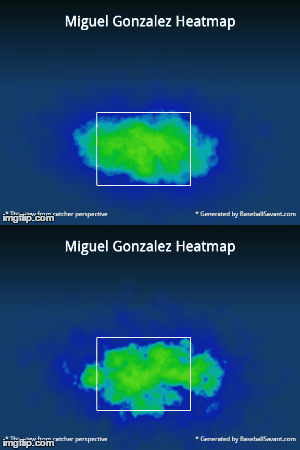
Let's check out his pitch locations from previous seasons to this one.

Bases empty:


And with runners on:


Gonzalez has kept the ball lower than normal with the bases empty, while he's been keeping the ball more in the middle of the plate (along with inside and outside) when the bases are occupied. It's obviously a smaller sample of innings than what Gonzalez had from 2012-2014, but perhaps this partially explains why Gonzalez's BABIP has jumped significantly and his HR/FB rate has more than doubled when runners are on base.

These seem like fixable problems. It would be more concerning if his velocity dipped or he stopped getting strikeouts (not that he's spectacular in either category). Then again, we're also talking about a pitcher who appeared out of nowhere and produced quickly. It wouldn't be that surprising if he slowly flamed out, though it would be disappointing.

Still, it's not like the Orioles have a bunch of great starting pitching options heading into 2016 -- and they definitely don't right now. The O's will likely have to replace Wei-Yin Chen in the rotation next season, and if Gonzalez is no longer the 2012-2014 version, eventually they'll have yet another hole in the rotation to fill.

Gonzalez was a great find, and he's really helped the Orioles these last few years. But if you're worried about him going forward, you're not alone.

15 June 2015

Miguel Gonzalez Is Still Cheating His FIP

In the off-season, a number of Camden Depot writers wrote articles discussing how Miguel Gonzalez has outperformed his FIP. This year has turned out to be no exception so far as he has an ERA of 3.33 and an FIP of 4.60 based primarily upon a .235 BABIP (2nd best out of 106) and an 82.2% LOB (7th best out of 106).

What is interesting is that this year he is outperforming based on performance against hitters when runs are in scoring position. He’s faced 54 batters in that situation and he’s allowed 8 walks (2 intentional), 4 home runs and caused 7 strikeouts. This is pretty awful because pitchers that give up more walks than strikeouts usually struggle and giving up a home run every ten batters on average is awful. He’s allowed seventeen fly balls and given up four home runs for an HR/FB of 23.5%. Simply put, those numbers are dreadful. Two of the remaining thirty-five batters have hit doubles which is pretty reasonable and shows that hitters aren’t struggling to hit for power against him when runners are in scoring position. The area where Miggy has excelled is that he’s only allowed one single with runners in scoring position. That’s absolutely incredible and has allowed him to put up a BABIP of only .083 with runners in scoring position. In addition, he has only given up one unearned run so it’s not like runners are scoring but not counting against him. Batters have been able to put up strong power numbers against him, but can’t seem to hit for average.

With runners in scoring position, Gonzo has a Hard% of 30.8% (75th out of 118 qualified pitchers), which indicates that twelve balls have been hit hard against him. His Med% of 51.3% (51st out of 118) indicates that twenty balls have been hit with medium force against him. His Soft% of 18% (68th out of 118) indicates that only seven balls have been hit softly against him. He isn’t causing weak contact against them, which might explain his low BABIP. Rather hitters are hitting the ball with adequate power but that hasn’t translated to them hitting singles.

ESPNs TruMedia tool claims that Gonzo has thrown 206 pitches with runners in scoring position of which batters swung at 106. Gonzo only had 19 called strikes out of 100 pitches where a batter didn’t swing. Of the 39 pitches put into play, only 8 (21%) were outside of the strike zone.  This seems to indicate that batters aren’t struggling against him because they’re swinging at pitches outside of the strike zone. It seems like they’re swinging at pitches that they’re able to hit.

Part of the reason why Gonzo is doing so well was touched upon by Ryan’s earlier article about Gonzo. Gonzo has thrown a total of 81 combined sliders and splitters with runners in scoring position, allowed 11 batters to put the balls in play and only allowed 1 hit total (a double) with those pitches. By comparison, Gonzo has thrown 13 curveballs with runners in scoring position and allowed both batters to put the ball into play to get hits, thrown 11 changeups and allowed 1 of 3 batters to put the ball into play to get hits and thrown 98 fastballs and given up 3 hits on 23 balls in play. Hitters are simply unable to convert when facing his slider or splitter and have struggled against his fastball. Ryan argued that Gonzo’s improved slider and splitter have allowed him to strike out more batters, but so far it also seems that they’ve helped him by causing a lot of unproductive contact.

The other part of the reason of why Gonzo is doing so well is that he has allowed a low but reasonable six line drives with batters in scoring position of which three were hits. He also has allowed 17 fly balls for which he’s given up four home runs and no other hits, 14 ground balls of which zero were hits and 2 bunts that also didn’t result in a hit. So far, batters have been able to hit fly balls out of the park with a staggering amount of success, but they’ve had limited success when hitting line drives and zero success when hitting fly balls that remain in the park or a ball hit on the ground. Either Miguel Gonzalez has found a way to have batters hit the ball towards fielders or has been the beneficiary of nearly flawless performance by his fielders with batters in scoring position.

It seems that it is unlikely that this will continue. Even if the slider and splitter have legitimately improved, it seems unlikely that batters will continue to struggle as much as they have against his fastball. If the defense has merely over performed, then it is unlikely that they’ll continue to do so to this extent. Then again, a number of writers have been saying for years that Gonzo can’t continue to be this successful and he’s done an excellent job of finding a way to outperform what his peripherals suggest his performance should look like. If some pitchers like Rick Porcello can find a way to mostly underachieve despite strong peripherals then it stands to reason that a few pitchers could find a way to overachieve despite weak peripherals. When it comes down to it, Gonzo has been good the past few seasons and is well on his way of having another strong season. Sometimes it’s just better to be lucky than good and no one is going to care about his FIP if he continues to perform at such a high level.

05 June 2015

How Has Miguel Gonzalez Gotten So Many Whiffs?

A swinging strike is, objectively, the best possible outcome for a pitcher. They account for most of the variation in his strikeout rate, which in turn accounts for most of the variation in his ERA. In the immortal words of Carson Cistulli, "...they're awesome to watch". Thus, when a pitcher dramatically increases his whiff rate, it generally means he'll pitch better overall.

By runs allowed, Miguel Gonzalez has done about as well in 2015 (89 ERA- in 68.2 innings) as he did in the years that preceded it (85 ERA- in 435.2 innings). That's a shame, because his present xFIP- of 100 beats his career mark by a wide margin. A higher strikeout rate has caused this improvement — he's punched out 20.8% of the batters he's faced, as opposed to 17.0% in the three seasons prior. The cause for this? You'll never guess:

Year Gonzalez SwStr% MLB SwStr% Gonzalez SwStr%+
2012 8.9% 9.3% 95
2013 8.2% 9.5% 87
2014 8.1% 9.6% 84
2015 10.5% 9.7% 108

Yes, Gonzalez owns a notably above-average rate of swinging strikes — higher than any other starter on Baltimore's staff. Most pitchers who struggle to top 90 don't post numbers like that; how has Gonzalez done it?

Well, he certainly hasn't used his fastball, since its whiff rate hasn't budged much from previous years. Instead, he's ridden a better slider and splitter to this success; we'll analyze each individually.

Let's start with the splitter. It's always possessed average velocity and movement, which is more than Gonzalez can say for his other pitches. He's also consistently blown it past opposing hitters, but to varying extents by year:


Its swing-and-miss rate has gone from phenomenal to very good to phenomenal again. (Per Eno Sarris, an "above average" splitter gets whiffs 16.3% of the time.)

Zone maps explain this variance. In its first sensational campaign, Gonzalez buried it in the dirt all the time:


He then began to elevate it slightly in the next two years...


...before returning to his original recipe this season:


Low splitters have always excelled for Gonzalez, accumulating many more swinging strikes than anything up in the zone; thus, he now relies on them much more. These pitches have brought him a lot of his overall success this season.

But, lest we forget, he's also bettered his slider, which has never dominated like it does currently:


What's behind this rise? While Gonzalez's slider actually has more velocity and movement than the MLB average, it's only begun to fulfill its potential this year. And as with his splitter, the difference here comes down to location. Through the first three years of his career, Gonzalez threw the splitter low:


He deceived hitters the best, however, when he moved it low and to the left — which he's therefore done much more often in year four:


Hence, the more effective slider, elevated to great heights by a lack of elevation.

As Baltimore's pitchers — chiefly their starters — have struggled somewhat out of the gate, Miguel Gonzalez has pitched better than ever before. Sure, he's sacrificed a lot of home runs, but once his HR/FB% regresses from its current 16.3% mark to something around 11-12%, his ERA could fall even further with it. In the past, he's proven that he can outperform his subpar peripherals to post solid results; if those peripherals become even average, we could see a star.

28 May 2015

The Orioles Were Right Not to Re-Sign Nelson Cruz

This is a guest post by Luis Torres. Read more of his work at Taking Back Baseball. You can also follow him on Twitter.

During the first game of the Mariners/Orioles series at Camden Yards, I was perusing my Twitter feed and came across a conversation between Jon Shepherd and Matt Kremnitzer. They were discussing the frustration that O's fans have had over their team's inability to re-sign Nelson Cruz during the offseason. Their frustration with the organization's lack of major acquisitions this past offseason reached a boiling point when Cruz hit a home run off of Miguel González that night. Meanwhile, Orioles' corner outfielders have all been performing at replacement level this season.

It's easy to overreact when you see that one of the best offensive contributors for your team last season is hitting dingers against that very same team this season. With the AL East being as close and competitive as it has been, one could assume that Cruz could've been a difference maker. However, you can't draw such a conclusion six weeks into the season, and you certainly can't draw conclusions on a four-year contract seven weeks into year one.

Contrary to popular belief, trades and free agent signings are to be evaluated when they are announced. Not during, and not after the contract is up, but before the player's first game is even played. In baseball anything can happen, including good results from bad decisions. The only fair, logical way to evaluate acquisitions is to go by the information that you know at the time. Let's take a look at what we knew about Nelson Cruz when the Mariners signed him.

The Mariners are paying $58 million for the age 34-37 seasons of a player who is a slow, poor outfielder, and is likely to age poorly due to his lack of athleticism. He's basically a DH who is a low OBP, high SLG hitter. I won't go into too much detail as to why I didn't like this deal for the Mariners, suffice it to say that their general manager, Jack Zduriencik, keeps paying for power when his team has finished last in the AL in OBP in four of the last five seasons and were second to last in the other.

By being smarter than Zduriencik, the Orioles avoided paying $58 million to an aging slugger and got a compensation pick in the process. That may be of little consolation to Orioles fans right now, but the thing is that Cruz is grossly overperforming and is going to come back down to earth. Remember him doing the same thing last year? Through May 2014, Cruz enjoyed a 27.9% HR/FB ratio and .324 BABIP, which fueled his outstanding .440 wOBA and 19 HR. Seeing how his career rates consisted of a 16.6% HR/FB and .302 BABIP going into that season, it was obviously unsustainable and proved to be so. From June 1 through the rest of the season, those rates dropped to a 15.9% HR/FB and .272 BABIP, resulting in a .331 wOBA and 20 HR. In other words, he turned back into Nelson Cruz. Not that Cruz playing like himself was a bad thing, especially for only $8 million. It was actually one of my favorite signings prior to the 2014 season.

Cruz is currently hitting .341/.398/.688 with 17 HR, which is good for a .458 wOBA and 2.2 WAR. He's leading the AL in AVG, SLG, HR, Total Bases, and wOBA. His OBP is second only to Miguel Cabrera. He's even better than he was at this point last year, and like last year, it's because of even higher and flukier batted ball stats. He currently has a whopping .376 BABIP and 30.9% HR/FB! This is all without any significant changes to his batted ball rates, too. For how much longer is it reasonable to believe that he's going to continue hitting almost one-third of his fly balls over the fence? Cruz is grossly outperforming even his 90th percentile PECOTA projections of a .351 wOBA by 107 points!

About all those home runs -- let's take a look at the pitchers who gave them up to Cruz. The following numbers are the pitchers' ZiPS projections going into this season.

Pitcher
Location
Handedness
HR
ERA
FIP
WAR
Collin McHugh
at Houston
RHP
2
3.71
3.71
2.2
Miguel González
at Baltimore
RHP
1
4.40
4.92
0.3
Brett Anderson
at Oakland
LHP
1
3.58
3.35
0.8
Wandy Rodríguez
at Texas
LHP
1
4.52
4.76
-0.1
Phil Hughes
Minnesota
RHP
1
3.53
2.73
5.2
Dan Otero
at Oakland
RHP
1
3.41
3.62
0.2
Tyler Clippard
at Oakland
RHP
1
2.88
3.44
0.5
Luke Gregerson
at Houston
RHP
1
3.52
3.54
0.4
Matt Shoemaker
at Los Angeles
RHP
1
3.42
3.49
2.4
David Huff
at Los Angeles
LHP
1
5.04
4.94
-0.7
Brandon McCarthy
at Los Angeles
RHP
2
3.83
3.46
2.3
Ross Detwiler
Texas
LHP
2
4.33
4.30
0.4
Frank Garces
San Diego
LHP
1
3.34
3.53
0.2
Marco Estrada
Toronto
RHP
1
4.44
4.44
0.9

There are a few good pitchers in there, but overall it's an underwhelming group.

At the time of the signing, Dan Szymborski, who is also an Orioles fan, tweeted out his disdain for the deal. In the tweet, Szymborski included the ZiPS projections for Cruz's years with the Mariners, assuming he'd be their primary DH. Remember that projections are not predictions. They are a measure of true talent level. Here's an excerpt from that table:

YearAVGOBPSLGwRC+WAR
2015.250.310.4571182.0
2016.247.305.4501141.5
2017.244.297.4331080.8
2018.240.288.411990.0

While I'm not a fan of the generic $/WAR metrics out there because I believe that they're too oversimplified, $58 million and a first round pick for 4.3 WAR is a pretty bad deal. Furthermore, the ZiPS model may be overestimating the number of games that Cruz will play. He's been a bit injury prone in his career, having played over 130 games in a season only twice. Obviously, getting older isn't going to make that any better. Even with his poor defense, he'd still be an upgrade over the poor corner outfielders that the Orioles have been trotting out there, but it'd come at a high price. By the time his contract enters its third year, Cruz is likely to be just as bad as those guys anyway.

OK, those were the numbers, so now let's take a look at the scouting information. Mark Anderson wrote up a scouting report for Baseball Prospectus this past October. I won't go over it in detail, but I will show the scouting grades. For those of you who are unfamiliar, these grades come from the 20-80 scouting scale.

ToolGrade
Hit
50
Power
70
Speed
40
Glove
40
Arm
60

Nelson Cruz is currently playing like an 80 hitter with 80 power. Those players are incredibly rare. The only player in today's game who fits that description is Miguel Cabrera. There's only a handful of players who fit that description in the past 20 years: Albert Pujols, Manny Ramírez, Barry Bonds, Frank Thomas, and...that's it. It truly is a uniquely special talent to be able to combine an 80 hit tool with 80 power. Is it really reasonable to believe that Cruz has turned himself into this class of player over the course of one offseason? I doubt that these grades come as a surprise to anybody who has seen Cruz play. From a qualitative perspective, he has big power but is only a mediocre hitter, and his speed and fielding have gotten to the point where he should be at DH as much as possible.

I hate to have to discuss this, but because somebody is going to bring it up, I don't believe that steroids have turned Cruz into a completely different player. We know for a fact that he's taken them in the past, and if you check his Fangraphs page, you'll see that he's never hit like this before. In fact, his success on the Rangers is better explained through his hard work and openness to instruction. Out of all the admitted steroid users, none of them ever turned from average to Miguel Cabrera overnight.

It is possible that Cruz has found a way to tap into some more power, though at the age of 34 that's highly unlikely. I can, however, absolutely guarantee you that Cruz didn't suddenly become an 80 hitter. Going from a 50 to an 80 hitter requires an enormous increase in the skills required to hit for average. It just doesn't happen outside of young prospects that are still developing.

Matt Kremnitzer did a nice job of explaining the Orioles' corner outfield problem recently. Even a Nelson Cruz performing at his normal levels would be an upgrade over what the team has been trotting out there, but not as much as you'd think. Cruz gives back a good chunk of his offensive gains as a result of his poor defense. He already has a -5 DRS and -7.6 UZR. His poor DRS adds up to a -0.8 dWAR, which is pretty bad for a full season, let alone seven weeks into it.

It's not like the Orioles don't have their own player who is overperforming. I won't go into the same detail that Matt went into when he wrote about Jimmy Paredes, who has taken over for Cruz this season as the team's primary DH for the most part. He currently has a .394 BABIP and 23.1% HR/FB. Those numbers will certainly regress, but thanks to his work with Robinson Canó during the offseason and changes in his approach, it's possible that his true talent level is better than the 73 wRC+ that ZiPS projected going into this season. However, I'm sure that it's nothing close to his current 155 wRC+.

Regardless, depending on whether you're going by Fangraphs or Baseball-Reference, Cruz has only been approximately half a win to one win better than Paredes so far. The reason why that difference isn't larger is the defense. Although Paredes certainly won't be winning any Gold Glove awards, his defense is a full grade better than Cruz's. It's also worth noting that Paredes is making the league minimum. Cruz, on the other hand, is making $12.5 million this season.

So for those of you out there who are still mad at the Orioles for not signing back Cruz, given all the information that I laid out here, let me ask you: Do you really think that Cruz is going to continue hitting like this for much longer? Would you risk four years and $58 million on an aging slugger to find out? Or would you rather just spend the money elsewhere and take the draft pick instead?

23 January 2015

Looking at Miguel Gonzalez's Clutch Performance

Perhaps no current Oriole fascinates me to a greater extent than Miguel Gonzalez. Over the past three years, he's magnificently outpitched his peripherals, to an incredible extent. Among starting pitchers with 400 innings since 1871 (of whom there are 1,885), he has the lowest ERA-FIP differential, by a massive margin — the distance between first and second is the same as the distance between second and 17th. Unsurprisingly, others at this site share my enamorment for this man.

For Gonzalez, the discrepancy between expectations and reality comes as the result of two things: preventing hits on balls in play, and preventing base runners from scoring. While he's done pretty well in the former regard — in that aforementioned sample, his .264 BABIP ranks 203rd — he's predicated his accomplishments on the latter, in which his 80.3% mark bests every other hurler in the sample. Because of that, I want to analyze the causes of his LOB%, to see if he'll sustain his otherworldly stranding abilities.

Looking at his situational splits, we can see one thing that stands out:

Situation TBF K% uBB% BABIP HR% wOBA
Bases Empty 1111 17.4% 7.1% .258 4.2% .325
Men on Base 706 16.4% 7.7% .275 2.1% .305

When runners get on, Gonzalez's walk rate, strikeout rate, and BABIP decline, but the absence of home runs prevents those runners from scoring.

His batted-ball profile supports this discrepancy, to some extent:

Situation LD% GB% FB% IFFB% HR/FB
Bases Empty 20.6% 37.2% 42.2% 11.0 % 13.5%
Men on Base 22.5% 37.6% 39.9% 14.2 % 7.4%

Fewer fly balls, as well as more popups, will generally beget a lower home run-fly ball rate.

While a difference as large as the 2-to-1 that Gonzalez currently sports will regress in the future, it will probably continue to exist, because his pitching style supports it. Depending on the circumstances, Gonzalez has a different repertoire:

Situation Fourseam Sinker Slider Curve Split
Bases Empty 43.1% 16.3% 13.3% 11.2% 15.9%
Runners On 40.6% 21.3% 13.1% 8.8% 16.0%

His four-seamer — which hitters have knocked out of the park far more than his other pitches — goes down in usage (along with his curveball) when the going gets tough. His sinker steps in to replace it, and as you'd expect, that pitch doesn't lend itself to long balls.

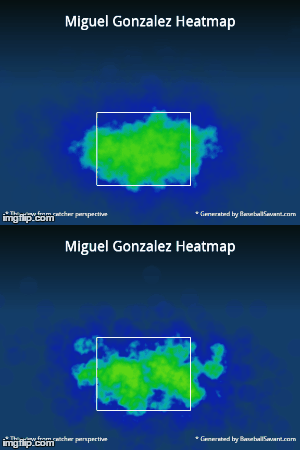
The difference doesn't stop at pitch types, either — he also changes his location:

Bases Empty:


Runners On:


Lower pitches don't go airborne as often as higher ones, which means an approach that prioritizes the latter will lead to fewer long balls.

Again, are any of these monumental differences? No, so going forward, three-fourths of his home runs allowed won't be of the solo variety. But his ability to avoid damage with the long ball seems legitimate, and it probably means that he's a true-talent overachiever.

Steamer projects a 72.2% LOB% for Gonzalez in 2015; for reference, the major-league average in 2014 was 73.0%. While I don't think he'll continue to leave on 80% of his baserunners, I don't see why it'll regress that far, and a solidly above-average rate — and another year of overperformance — strikes me as the likeliest outcome.