Showing posts with label Duquette. Show all posts

27 June 2017

Orioles are on Life Support and Need a Transplant

1991 Orioles were so bad that 45yo Jim Palmer
tried to come back and save them.
They are not dead yet.  The Orioles are only four games out of first in the AL East.  Additionally, they are just 2.5 games back behind the second Wild Card slot.  There are caveats to those numbers though.  For the AL East, three teams sit in front of them and the Jays are a game back.  No one really is out of it and that makes the probability of finishing top lower than that four games back sounds like.  The Wild Card is a bit tougher with five teams in front who are staring at the Indians, who currently hold that slot.  Again, the Jays are breathing down the Orioles' neck there, too.

It is a terrible position to be in.  In that, the club is too close to sell off pieces and probably too far (too many teams in between) to really have a great shot at the playoffs.  They are in more of a no man's land than they were in during the 2013 and 2015 seasons where they dealt away solid pitching for not much of consequence.  Added to that is just the brutality the Orioles have faced the past month as they tied the 1924 Phillies with the most games in a row giving up five runs or more.

Outside of their stellar 2014 season, the Orioles have had below average to poor starting pitching performances.  They have used a top notch bullpen and obscene raw power at the plate to erase their rotation deficiencies.  This year, the starting pitching is one of the worst the Orioles have ever fielded so far.  Below is how they compare amongst the 15 teams in the AL and what the median value is.  This hides some information, such as the rotation's ERA is almost an entire run worse than anyone else's.

IP K/9 BB/9 HR/9 ERA
390.2 6.8 4.15 1.64 5.78
15th 13th 15th 14th 15th
420.1 7.8 3.13 1.42 4.54

To find a starting rotation worse than theirs, you have to go back to 1991.  In fact, when you consider the franchise's entire Browns and Orioles history, this rotation is the second worst all-time.

Year Club ERA-
1991 Orioles 132
2017 Orioles 130
2011 Orioles 128
1910 Browns 126
1939 Browns 125
1988 Orioles 124
2008 Orioles
1937 Browns 120
1909 Browns 119
1987 Orioles

This is an awfully large hole to climb out of and it pales in comparison to the humbug of past seasons where the pitching stumbled.  Last year's "headache" of a starting rotation had an ERA- of 110.  This year's rotation is almost 20% worse than that one.  Added to this, the offense, bullpen, and fielding have all been slightly below average this year.  Add that to all the other teams in competition, it looks more and more like a longshot that this club can be competitive even though, in terms of games back, this club is highly competitive.

So, there comes a time in any organization where succession planning becomes that great, big elephant in the room.  The Orioles find themselves in this place.  It has been there for awhile, but Duquette and Showalter have done well squeezing every drop of blood out of what looked like a bit of a turnip year in and year out.

The initial plan was for this club to continue its winning ways and run hard through 2018, but that seems a bit difficult.  Dan Duquette has squandered years of development by maximizing resources to the MLB roster while trading out compensatory draft picks, depth prospects, and continuing a two decade long practice of bare bones international amateur talent acquisition.  What is now left is an aging hulk of a core in Baltimore and the few younger pieces reaching a point of no return where extensions or a friendly wave goodbye is the final action.

There are two extremes as to what the organization can do.  They can live in the moment and forget about tomorrow.  They can keep pushing and hand out prospects that are irrelevant for 2017 and 2018, clawing their way into a Wild Card or, may I say, another AL East title.  Projection models doubt that path and, based on twitter, so fans.  The other extreme is to cash it all in.  It is an idea proposed by FanGraph's Travis Sawchick and some others online.  I think the main flaw to this idea is that this club is actually not that far from being a playoff contender.  I also think that it is always a mistake to let go of a potentially great player before their 30th birthday.  You simply do not willingly let Manny Machado leave.

That leaves us with a commitment to something in the middle.  This begins by deciding where the club should go.  This article is about the general places the front office might take this franchise.  There are four options:
1) Hands the keys to Dan Duquette for complete control over all baseball operations, signing him to a long term deal.
2) Fire Duquette, and force Buck to transition out of the dugout and into a long term vision baseball operations position with a day-to-day GM under him who he choses.  This includes 2018 as a transition year out of the dugout or starting 2018 up in an office.
3) Remove Duquette and hand it all to Brady Anderson to decide what happens.
4) Clean out the front office and let the new guy decide what is what.

Duquette as King
In this scenario, Duquette no longer feels the pressure of a contract ending as he would likely sign a five year extension.  He will be expected to remain competitive, but he would be given a more free hand.  You would likely expect that he would try to get Buck to resign and, in his place, install a mid-40s assistant coach who would implement everything from the front office that Buck ignored.  This would rub many players the wrong way, but it will be accepted.

My guess would be that an attempt would be made to retool for 2018 and, if things go south, a large scale sell off.  I would also expect in this scenario a strong push to sign Machado long term.  If not, then he would likely be dealt mid-season.

Elevate Buck
Buck has been worn down by this latest stretch of terrible baseball. He is also getting up there in age.  He might prefer a less strenuous schedule with more distance from the clubhouse.  The clubhouse would also be keen with this because many are strong supporters of his tenure.  Likewise, some in the club house have spoken out at times about the distance and aloofness of Duquette's tenure.

I would see two possibilies for who Buck would replace himself with.  First, one of his close colleagues: John Russell or Brian Butterfield.  Second option and a smart one, he could install Brady Anderson as the manager.  Why Brady?  Brady will be in the organization as long as Angelos is around.  Putting Brady in as the manager would keep him fully engaged in managerial duties and unable to stick his finger in everywhere.  Another option would be elevating Ron Johnson and putting Brady in AAA on the guise of training him.

A Showalter tenure would also likely involve a scaling back of the analytics department or perhaps a transition into more qualitative data processing.More resources would likely be engaged into the scouting side of things.  Machado is a big question mark.  Showalter was part of the brain trust that found Alex Rodriguez' contract in Texas to be too much of an albatross on the payroll.  Would he see the same thing with Manny taking up 25% of the Orioles' budget.  Such an arrangement with 40 MM to Manny and 120 MM to the rest of the squad would effective be a median payroll team being gifted Manny.  That really does not sound all that bad.

Brady as Teddy Roosevelt
Even though I have written extensively about Brady, I have no idea what a Brady Anderson tenure as General Manager would mean.  He has largely surfed between the waves and found his own niche.  Some guys like him, others tolerate him, and others think he abuses the social structure by insisting on being treated like a player, coach, and front office executive whenever it best suits his needs.  In that way, he has quickly gained a great deal of experience, but by taking what everyone else seems to neglect, he is not defining himself.

Brady comes across as brash, competitive, and a disruptor.  You could say the same thing about Billy Beane, Jerry DiPoto, and a number of other head honchos.  What differs is that contrary to other guys in the game, I cannot think of which baseball people are automatic fits in the Brady regime.  Anderson simply is a go it alone kind of entity right now.  One who tries hard to be player friendly.

I would expect him to try to keep Buck on, but I am unsure whether Buck would want to stay on with someone who seems to apt to abuse privilege.  I am at a loss at who would be showing up at the MLB level, but guys like Lou Montanez and Nolan Reimold would likely be welcomed into the fold if they sought out managerial careers.  Beyond that, I am at a loss.  Brady has done well at being a disrupter (depending on who you talk to), but he has not truly done much work as a head executive.

Brave New World
Every couple of years, word leaks out about Angelos selling the club.  His sons enjoy the presence and interest their connection to the club brings them.  It would be hard to think of one of his kids getting prime time play about his thoughts on President Trump without being able to hypothetically withhold a first pitch.  That said, their eyes seem wider than team ownership and pulling the money back out of the franchise would enable them to be active kingmakers for politicians or for personally meaningful social projects.  With MASN getting tidied up and the future of these deals looking bleaker and bleaker, it appears that maybe it will be easier to put a value on the club (this has been mentioned as the hang up the two previous times Angelos supposedly almost cashed out).

If the club is sold, then it is a safe bet that the house will be purged.  When the walls talk, they talk of misplaced loyalty.  Individuals who have been employed by the Orioles forever and that their aptitude is highly questioned.  Back when Duquette took over (and even MacPhail), it was noted that certain personnel were effectively made men.  Some could be juggled around in less consequential positions, but most were fixed.  An owner without loyalty to existing personnel, would likely mean wholesale changes.

You could easily imagine a Ripken or Buck being included somewhere in the new regime, but likely not as decision makers.  Neither of them may be interested in serving as figureheads.  Likely, a new ownership group would be heavily influenced by Wall Street, as they all seem to be these days.  This would probably mean the club would enlarge their analytics presence and move into a more uniform and modern approach.

26 September 2012

The Camden Highball: The First Podcast

After discussing the making of a podcast for almost two years now, Camden Depot is presenting the first episode of the Camden Highball.  Here we hope to produce a fairly consistent weekly podcast where the expanded Depot team of Daniel Moroz, Heath Blintiff, Steph Diorio, Jeremy Strain, and Jon Bernhardt will take part in discussing their perspective of things Oriole.  We are quite excited about this offering and look forward to the conversations that will come.  I hope you all enjoy.

On the podcast today, I (Jon Shepherd) am joined by our long standing writer Nick Faleris who is soon leaving to write predominantly for Baseball Prospectus about Minor League and amateur prospects.  We answer two letters from the mailbag: an evaluation of Steve Johnson and a discussion on what Andy MacPhail has meant to the 2012 Orioles.  We then tackle the AL East playoff race, who we think matches up best to the Orioles liking in the playoffs, and how to set up the post season rotation assuming the rest of the season plays out well for the team.  Finally, we add our two cents on the play of Manny Machado.  The recording was made Tuesday night (September 25, 2012).

Episode 1 of the Camden Highball

00:00:00 Introduction
00:01:59 Mailbag
00:11:35 AL East Race
00:14:15 Playoff Matchups
00:19:50 Setting Up the Rotation
00:34:00 Prospect Focus on Manny Machado
00:44:40 Nick Heading to Baseball Prospectus
00:47:51 Camden Depot Expansion


We are tentatively scheduling the next edition of the Camden Highball to post the morning after the final game of the season.  We should be available on iTunes by then.  It stands to be quite an exciting series of games between now and then.  If you have any question you would like to pose to us, feel free to mail them via CamdenDepot@gmail.com or via the Camden Depot Facebook page.

I would also like to thank Mark Brown with Camden Chat who has proved quite helpful in giving pointers to setting up this podcast.  Here at the Depot, we are familiar with appearing on podcasts, but not actually producing them.  We are doing our best to provide you with the best sound and show we can offer.  Any failing in this endeavor obviously should be credited to Mark.  All praise though is clearly to be directed toward the Camden Depot staff and our lovely, pleasant guests.

Catching Up on Players Discarded from 2011

Certainly you have to say that a part of the Orioles' success this year can be attributed to some of the players that Dan Duquette brought in in the off-season. What's a little more interesting, is that as of yet, there are no real regrets over players the O's lost from 2011.

Gone are:

Jeremy Guthrie. Sent to the Rockies in the Jason Hammel trade, which many people panned at the time (incorrectly, in my opinion). Not only has Hammel been quite good with the O's, but Guthrie has posted a 4.80 ERA for Colorado and (after being traded for Jonathan Sanchez and his 7.76 ERA) Kansas City. His vaunted base-hit suppression skills were no match for Coors Field (.318), though they did return to normal in the AL (.273 BABIP). Also seeing a big split was his home run rate; 2.1 HR/9 for the Rockies, and 0.8 HR/9 for the Royals. A Jeremy Guthrie doing what he's done for KC (3.00 ERA, 3.61 FIP, 1.6 fWAR) would have been a nice addition to the Orioles' rotation, but there's no guarantee of that - taken altogether, his 1 fWAR would rank just 5th amongst O's starters (and that's despite having more innings than anyone on the team but Chen).

Luke Scott. He hasn't done much more with the Rays (.227/.279/.438, 0.2 fWAR) than he did with the Orioles last year (.220/.301/.402, -0.1 fWAR). Pretty much every conceivable alternative the O's used this season (Betemit, Reynolds, Davis, Thome, Nick Johnson!) has out-hit him.

Derrek Lee and Vlad Guerrero are out of the Majors (Vladdy played a few games in the minors for the Blue Jays).

Josh Bell (traded to Arizona in May) could theoretically have blocked a Manny Machado call-up when the O's needed a third-baseman, but Machado has outplayed him (Bell's hit .173/.232/.269 in the Majors with -0.5 fWAR, though he has done a nice job in Triple-A as a 25 year-old; .311/.372/.509). Bell still has a chance to turn into something (only 282 career PA in the big leagues), but it's possible that having him in the organization in 2012 could have ended up costing the Orioles a win or so.

Felix Pie is hitting well in the minors for the Braves (.285/.338/.459), but Nate McLouth hasn't been much "worse" than that in Baltimore (.267/.339/.413) and I'm pretty sure the O's are fine with the guy they have of those two at the moment.

Cesar Izturis has been a replacement level player this year (and pretty much the last couple years), though he can still field a little bit and has been better than Omar Quintanilla (-0.4 fWAR for the Orioles) or Robert Andino (-0.3 fWAR). Having an actual second-baseman this season would have been pretty nice, though I doubt there are any fans pining for Cesar in particular.

Craig Tatum has hit .179/.258/.286 in Triple-A for the Yankees, while Taylor Teagarden has approximately 57 game winning hits.

Brandon Snyder took it to the Orioles when the Rangers came to town early this season, but he's been a slightly below average hitter this year (.277/.309/.446, good for a 98 wRC+) and that's with a .417 BABIP. Similarly in the minors, minus 55 points of BABIP (73 wRC+).

I miss Koji Uehara out in the pen, and he's done a nice job in relief for the Rangers; 2.15 ERA, 10.3 K/BB ratio (still has the best mark of all-time at 7.55 K/BB, min. 100 IP). I'd gladly swap out Koji for Kevin Gregg, but it's hard to complain about the O's missing a quality bullpen arm given how things have gone in that area for the team this season.

Similarly, Alfredo Simon is doing well in Cincinatti; 2.48 ERA, 2.95 FIP, and 0.8 fWAR in 54 relief innings. I think Simon is better than Luis Ayala, but - again - don't want to mess with that magical bullpen.

As far as non-Major Leagues players, the O's shipped off Jarret Martin (4.40 ERA, 9 K/9 but 5.6 BB/9 in A-Ball) and Tyler Hanson (.284/.374/.468 in Triple-A) for Dana Eveland (4.73 ERA, 0 fWAR) which was not a well received trade at the time (by me, at least) and has turned out about as expected (not disastrously, but certainly not well).

They also sent Randy Henry (3.38 ERA, 2.1 K/9 in High-A) and Greg Miclat (.275/.350/.394 in Triple-A) to the Rangers for Taylor Teagarden, which is probably not very good in the abstract but fine for the O's when you consider the big hits Teagarden has had.

So overall, the Orioles didn't lose a great deal of talent from the organization since 2011. Maybe they'd take a do-over on a move here or there, but it's hard to think that they're missing a piece that could have actually done much to improve the 2012 club.

14 February 2012

Jorge Arangure Jr. on the Orioles' International Effort

A little less than a year ago I read an article Jorge Arangure, Jr. wrote on Andres Reiner and his role in helping the Tampa Bay Rays establish themselves in Brazil.  What struck me most about the article was this passage:
Even harder to believe is that the Rays have so far spent zero dollars on the construction of the academy [in Brazil near San Paulo].  The 2.5MM project has been subsidized by both federal and local funds.  Tampa Bay's only financial commitment is for the upkeep of the academy, which could be anywhere from 500k to 1MM per year, for the next five years.  Tampa Bay won't even have to spend a dime on players' medical care since all Brazilians are covered through the country's universal health care system.
I do not believe the Orioles have established an academy in any country other than the Dominican Republic.

---

In light of Dan Duquette's effort in acquiring international talent, I decided to ask a few writers, well-versed in these areas, to share some of their thoughts.  Yesterday, I posted an interview with Yoo Jee-ho on the recent troubles experienced by the Orioles when they signed an amateur without informing Korea's amateur governing body, the Korean Baseball Association.

Today, we have the writer mentioned in the short excerpt above, Jorge Arangure, Jr.  He currently is on ESPN's international soccer coverage, but was on the international baseball circuit before then and still dabbles on that subject.  Those with with a steel trap for a memory will recognize him as a former baseball writer for the Washington Post covering the Orioles.

Jon Shepherd: What do the Orioles need to do to make it have a dependable international presence and how long does it realistically take to accomplish that?

Jorge Arangure Jr.: For one, they need to have consistent leadership in that area. For a few years now, they've shuffled around several people with little success. The Fred Ferreira hire probably solves that problem, but you have to wonder whether Ferreira is so far removed from the current Latin American scene that it ends up hurting the team's efforts rather than helping them. A lot has changed in how players are signed in Latin America since the days when Ferreira first stepped foot on the island.

One thing you can't do is simply spend to make the proverbial "statement." I don't think that really works. Several teams have done it and not accomplished anything out of it. What I'd do is increase the team's scouting presence in the DR. For a while, the Orioles have relied on the same group of scouts in the area. That has to change.

I still have my doubts as to whether Peter Angelos really believes in that market. The Orioles have never signed a high-profile, big-name international player. I'm just not sure Angelos likes the risk that comes with that market.

JS: Andres Reiner provided the acclaimed model for acquiring talent out of an emerging market by establishing an academy in Venezuela for the Astros.  Upon leaving the Astros, he set the foundation of a similar plan for the Rays to find useful players in Brazil.  So far, the Orioles appear to be taking a different path by holding try outs and plucking players who perform well.  For a team that is not incredibly cash flush, which approach makes more sense for them?

JA: Well I'd argue with the point that the Orioles aren't flush with cash. I think they are a pretty good revenue team. They simply choose not to spend it in the Latin America area. Having said that, I believe the Orioles have enough money to try both methods. I'd say the Rays vision for Brazil is highly ambitious. It takes a very organized team to pull it off. Everything we know suggests the Rays are that type of team. Everything we know about the Orioles suggests they are not.

JS: The Orioles have been involved in a fiasco by signing a Korean high school player without notifying the country's ruling body.  Why do you think this event has caused more of an uproar than when the Red Sox signed Junichi Tazawa from NPB?

JA: Most importantly, you're talking about two different countries. Tazawa is Japanese, so that's an entirely different baseball federation. The problem is that the Orioles either (a.) Didn't know the rules in Korea, which is troubling in itself because it could suggest that Duquette and the older scouts he's hired will have some catching up to do in regards to learning the regulations of each country, which could essentially back track their hunt for international talent; or (b.) they knowingly broke the rules, which of course is troublesome for all other sorts of reasons.

The Red Sox asked for and received permission from the Japanese baseball federation to sign Tazawa after he had graduated. Not only did the Orioles not ask permission, they also signed a player who had not yet graduated from high school, which is a big misstep.

JS: Do you think the prospects and their families potentially think poorly of the Orioles organization, limiting opportunities for the team to acquire talent in the future?  Have there been comparable events that happened in Latin America?

JA: I'm not sure this fiasco really hurts the Orioles in the eyes of the players themselves, but it makes them targets in the eyes of the baseball federations. The positive for the Orioles is that this type of system really only exists in Asia. Teams don't have to deal with baseball federations in Latin America.

JS: Based on your knowledge, who is doing the best job attracting and developing international talent?  What is this team doing that is so special and remarkable?

JA: I'd say the Rangers are probably at the top of the list. No team spends as much money as they do. But not only are they financially committed to Latin America, they also have the most manpower in the area. It's rare when I make a trip to Latin America and don't see a Rangers scout at a workout. It's rare when I'm in Latin America and I don't see one of their top execs there. They spend the money, but they do so after having done the work.

13 February 2012

An Interview with Yoo Jee-ho About the Orioles and South Korea

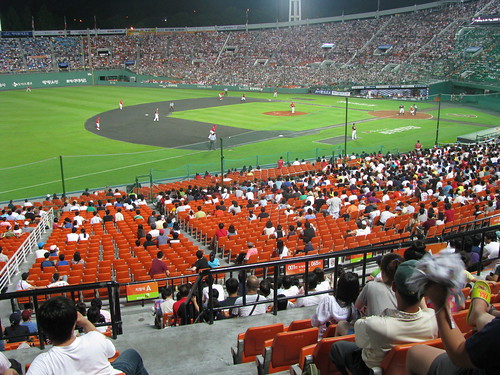
Sajik Stadium in Busan
If you have been following the Orioles' signing Kim Seong-Min and that signings' aftermath, you know the name of Yoo Jee-ho.  He has been reporting for Yonhap News Agency on how the Korean Baseball Organization (KBO), the governing body of two professional leagues in South Korea, and the Korean Baseball Association, the governing body of amateur baseball in South Korea, have reacted to the Orioles not abiding to the agreement in place for MLB teams to sign amateur talent.

Jon Shepherd: How much of a presence does Major League Baseball have in South Korea?

Yoo Jee-ho: A few teams have been sending scouts to Korean high school and college (or university as we’d like to call it here) tournaments in recent years. Some are based in Korea or others may be stationed somewhere in Asia and travel here for some big tournaments. More young players have signed with big league clubs in the last two, three years than in the past (almost a dozen since 2009).
As far as helping KBO developing baseball programs, I am not aware of any MLB involvement in that regard. I personally don’t see it as something MLB absolutely has to do here. But critics of MLB teams’ signing young Korean prospects may feel differently.

JS: Are certain teams viewed more favorably than others by players and families?

YJ: I am not sure if any one particular team is more favored than others by players and parents. But I’d imagine it’s probably the same with kids in other countries dreaming of playing in the majors.  They would all want to play for the Yankees, Red Sox, Dodgers, or other storied ball clubs. Would young players take less money to play for, say, the Yankees, rather than for the Pirates? I doubt it, and it’s not just the money. I think these players will take any opportunity that they can get to join a major league team and have a chance to play in the big leagues someday. 

JS: Can you briefly explain what has transpired between KBO, KBA, and the Baltimore Orioles?

YJ: It really is a long story and I will try to make it short. 

The Orioles signed Kim Seong-min to a minor league deal in January. The KBO, which runs the top baseball league here, claimed that the O’s didn’t go through the “status check” as detailed under the KBO-MLB player contract agreement. An MLB team interested in a Korean amateur or pro must, through MLB commissioner’s office, “check” that player’s status and availability with the KBO.
 
If I may digress a bit and delve a little deeper into this, MLB teams, following the status check, must receive KBO’s approval to sign an active professional player here. But they can sign amateur players as long as they go through the status check. And even KBO officials say status checks are just a formality.  With pros, KBO can say, “Nope, you can’t talk to this guy because he’s under contract and his current team doesn’t want to let him go.” But with amateurs, the most KBO can tell an interested MLB club is, “He will be eligible for the KBO draft next year. We hope you don’t engage this player.” But that doesn’t prevent the MLB team from signing him.  Against this backdrop, the KBO now wants to tweak the agreement to ban MLB clubs from signing amateur players at all.
 
Back to the situation. The KBA, which is the local baseball governing body, has suspended Kim indefinitely from playing or coaching in Korea, and that was in accordance with a local rule. Underclassmen (student-athletes not currently in the final year of their study, at high school or college) must not contact domestic or foreign professional teams. In Korea, a new school year starts in March. Kim was just about to enter his senior year in high school.

The KBA also banned Orioles’ scouts from attending KBA-sanctioned games, such as national high school and college tournaments. It has also warned that other MLB teams that fail to take proper steps in their dealing with prospects will have their scouts banned from Korean games.
I think this will definitely affect MLB’s relationship with KBO and with Korea as a whole. Other teams must have taken notice of this development. KBO and KBA obviously have their own interests, but I think they have taken steps that will likely be seen as being too restrictive.

JS: In your opinion, what changes to the existing agreement between KBO and MLB would be best for the development of baseball as a professional sport in South Korea?

YJ: I don’t think banning MLB teams from signing Korean amateurs is the answer. MLB wouldn’t agree to this sort of change anyway.
 
Here’s the one change that I think may work.  When a player is drafted by a KBO team out of high school, the player has a one-month window to choose between going to college or signing with the KBO team. In my opinion, you can allow MLB teams to engage and possibly sign such players after that one-month period ends. Tampering will have to be prohibited, of course.  KBO teams will reserve the priority to negotiate and sign such players. So MLB teams will be looking at either a KBO rookie or a college freshman to sign.

It’d be easy for big league clubs to lure top talent by coming in with loads of cash, right? Not so fast. Not every teenage player will want to go overseas to play for different reasons (fear of culture shock, language problems, simply wanting to stay home close to family, etc). Plus, top young guns get six figures in signing bonus from KBO teams and MLB teams may or may not want to match that to take them.  In other words, if the money is right and they’d rather stay home, more Korean players than you’d think will choose to stay with the KBO.

This bit of change will mean a limited window for MLB teams to sign. But I think it will work both ways because a) young players, having already been drafted, will have a KBO team to fall back on if talks with MLB teams don’t go well and b) MLB teams will have a better idea of how much they want to pay players given their draft position (i.e. Should we pay this kid $500,000 when he was only drafted 10th overall in Korea? Should we spend that money on some other prospect from elsewhere?)

JS: There has been some debate in the United States as to how good of a player Kim Seong-Min is. Do you have any information on his abilities? 

YJ: He had an excellent 2011. Kim pitched 74 2/3 innings in 21 games, won eight games, and posted an ERA of 1.39. In August, at a national high school tournament, Kim went 3-0 with a zero ERA and 19 Ks in 22 innings to win the MVP.
 
Kim was considered the top lefty in high schools over here and since he had another high school season ahead of him (before the Baltimore deal), local scouts felt that Kim could improve even more and eventually become a first-round draft choice in the KBO.  His fastball tops out at about 89-90 miles per hour, and he also throws above-average changeup and curve. Obviously not overpowering, but he’s got decent command. Any left-hander with his upside and stuff is a valued commodity here, but I myself was surprised to see him snatched up by a major league team. Maybe the O’s scouts saw something in him.

JS: Will this incident affect the Orioles ability to sign premier players from South Korea?

YJ: For the foreseeable future, absolutely. (Poor Dan Duquette. The guy loves Korean players.) Their scouts are banned from going to Korean games and that will obviously limit their ability to assess talent here. Duquette has apologized for “unintentional breach of protocol” but I don’t think the KBO is that much interested in apologies. Rather, the KBO wants to change the agreement to at least limit the outflow of young talent from here. In a way, the O’s move may affect all MLB teams’ ability to scout and sign premier young talent in Korea.

---

To stay on top of the Kim Seung-min situation and Korean baseball in general, follow Yoo Jee-ho on twitter and at Yonhap News

06 November 2011

Come on down, Dan Duquette!


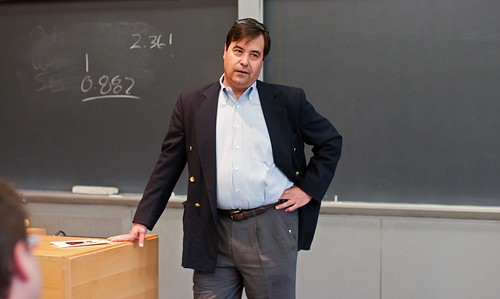
Duquette at a Sabermetrics Seminar in 2011
Dan Duquette will be named the Orioles successor to Andy MacPhail as the head of all baseball operations for the team.  It has been a rough bumpy road.  Jerry DiPoto interviewed and quickly signed on to be the Angels General Manager.  Tony Lacava was offered a position and then declined.  DeJon Watson removed his named from consideration, which probably was not all that important as the Orioles appeared not to like what he had to say in his interview anyway.  Next, several potential candidates turned down interviews ranging from Andrew Freidman to Allard Baird.  It was not a good month for the team who essentially knew back in July that MacPhail was not returning.

Duquette has a tough assignment ahead of him.  He certainly knows a lot of folks, but he is dealing with a rather public shunning of Peter Angelos by many baseball professionals and that many teams have settled the market for scouts and managers.  That leaves the team in a bit of a lurch and may translate into a rather rough off season and, potentially, 2012 draft.  Even though I think the public piling on of professionals and media was a bit much, it is not like it was not deserved.  To some extent, maybe almost completely, it was a justified response to what has seemed like one of the worst episodes in hiring a GM.  Mind you, the worst episode was back in 2005 when Theo Epstein escaped Fenway Park in a Gorilla costume and the Red Sox interviewed five people (including Jim Beattie) before giving Epstein what he wanted.

Duquette has a rather uneven past.  As a director of player development and as a GM for the Montreal Expos, he oversaw that franchise turning into a power house through international signings and player development.  He took the rudderless Red Sox and rearranged them to consistently make the playoffs as well as create the foundation for Theo Epstein to succeed in 2004 with a World Series win.  He also had a rather unfortunate public spat with Roger Clemens and was known for being a bit too blunt at times when giving interviews with the media.  As far as he took the Red Sox, his teams were often a bit limited as well.  He signed players like Jose Canseco and dealt for players like Carl Everett.  The teams had awful clubhouse chemistry (as was reported) and that was associated with the team's collapses.

After being fired, Duquette has not had a lot of interaction with Major League baseball.  He quickly began to work in collegiate player development.  He was involved in owning the Dukes, a summer collegiate team from 2003 to 2009.  He also worked to establish the Israel Baseball League in 2007, which folded due to financial reasons after the season ended.  Also in 2007, he was a finalist to be the Pittsburgh Pirates CEO/President (it eventually went to Frank Coonally).  He is also a frequent guest during seminars about sabermetrics.

What does it all mean?

I am not sure.  Duquette is known to understand the value of international signings and player development.  He was big on that during his Montreal years.  With the Red Sox, he spent more time working on the free agent market.  He also showed during his time there an understanding of sabermetrics that was at most a step or two behind Billy Beane, but a good five to seven years in front of him in understanding the value of foreign players.