Showing posts with label Korea. Show all posts

09 November 2015

What To Expect From Byung-Ho Park And Friends

At the time of writing this article, we have learned that a few teams (including the Orioles) bid on Byung-Ho Park, but did not have the privilege of winning said bid.  The winning bid of nearly 13 MM went beyond our prediction of 6-8 MM as well as our industry source who suggested a bump up to 10-12 MM.  As is typical of any signing, the team who wins is the team who values the player more than anyone else.  At the moment, it is all a mystery, but the three suggestions I got were the Mariners, Rockies, or Padres.  Eh, maybe.

More interesting to us here is what exactly can Park provide.  We had him as a potential full time first baseman or designated hitter in our blueprint series and were willing to bid up to 8 MM with a 4/20 contract, which means we would have lost out on that.  My idea was that his baseline was a right handed hitting Pedro Alvarez with an upside of a right handed poor man's Chris Davis, which is a 2012 Chris Davis.

I decided to try to tease apart the numbers a bit and produce a quantitative projection.  To do this I collected batting data from eleven Korean Baseball Organization players from 2011-2015 who had more than 300 plate appearances in the KBO while also having a ZiPS projection.  In addition to those eleven, I regressed Jung-Ho Kang's last three KBO seasons to generate a projection for a 2015 KBO year and used his 2015 season with the Pittsburgh Pirates.  With this information and accounting for interleague factors, I devised an equivalency between the two leagues.

It should be noted that this equivalence system between the KBO and MLB is rather generic.  For instance, it knows that Kang hit 40 home runs in his last year for Nexen, but it does not know why.  This gray area is what happens when we have a player in AAA who excels at that level, but is outmatched in the Majors.  In other words, there may be difficulty in discerning between Quad-A players and true Major Leaguers.

To that end, devising a system with 11 underperforming former MLBers may introduce a selection bias.  To try to account for that is a horrifically simple way, I devised two different equivalencies.  The first one equally weights all twelve players in the data set, while the second one weights Kang's numbers equal to all of the MLBers.  I call the methods the Korean Approximate Number Guide (KANG).  It is a wonderful acronym with poor source words. Oh well.  Anyway, the first model will simply be call KANG and the latter will be KANG(k+) to signify that KBO originating transfers will be weighted in order to provide 50% of the projection.

600 PA Projections KANG
2B HR AVG OBP SLG
Byung Ho Park 22 27 .234 .302 .426
Ah-seop Son 24 8 .277 .335 .379
Dae-ho Lee * 29 16 .269 .315 .406
Jae-gyun Hwang 31 10 .241 .281 .362
* Lee's numbers used a JPL conversion not discussed here.

Park and Lee are first basemen, Son is an outfielder, and Hwang is a third baseman who is expected to be posted after Son's situation is settled (KBO post agreement is that a team can only post one player at a time).  Based on those projections, Park's numbers seem a bit fringe Major Leaguer and a player for whom you would not want to lay out a large dedicated cost.  In other words, I would be hesitant to put down a 13 MM + 4/20 or more outlay for him because the projection looks a little more Jake Fox than Chris Davis.

However, there may be three things weighing down Park's numbers.  One, in 2007 and 2008, Park was in military service and playing on their club.  It has been suggested that this service can result in a delay in developing a player's skills.  This means the projection system may be using data that does not properly represent Park's actual performance level.  Two, performance is likely somewhat asymptotic.  What I mean by that is Park's 54 HR, 343/436/714 line may be so good that talent is not the limiting factor in his performance.  At a certain point, talent likely brings less additional performance.  A talent to performance graph is likely not linear, but more of an S shaped curve.  I am suspicious of the notion that Park maxed out the KBO, but there is some argument that his performance may not speak true to his abilities.  Finally, as I mentioned before, eleven of the twelve individuals that make up the data set for KANG are failed MLBers, which likely introduces a bit of selection bias to the projections.

Also mentioned earlier, I tried to combat the potential selection bias by making Jung-Ho Kang's contribution to Kang equivalent to the contributory sum of the eleven MLBers.  Again, I called this KANG(k+).

600 PA Projections with KANG(k+)
2B HR AVG OBP SLG
Byung-ho Park 23 27 .247 .305 .441
Ah-seop Son 26 9 .295 .344 .397
Dae-ho Lee * 31 17 .287 .326 .428
Jae-gyun Hwang 34 10 .256 .290 .380
* Lee's numbers used a JPL conversion not discussed here.

Weighting for Jung-Ho Kang did not greatly alter the projections.  These numbers certainly are better than the KANG projections, but the changes are more related to singles hitting.  The increased number of singles boosted up batting average and on base percentage.  This difference does not make me entirely comfortable because it is buoyed by Kang's .344 BABIP in 2015.  That number is not absurd, but it does appear unlikely to be sustainable.  That is a weakness when relying so much on one player's line and it is a weakness that should be corrected in future iterations of KANG(k+) as the number of Korean players increase.

Of the four players projected in this article, I have most interest in Ah-seop Son.  He appears to be a Nori Aoki kind of player with slightly more pop.  I would hesitate putting too much money into him, but I think with Son being 28, that a 4 year deal with a total commitment (post and salary) of 20 MM would be of interest to me.  Dae-ho Lee, a 34 year old first baseman, has less promise with his age, but projects similarly to Park.  Lee's value relies more on contact than power, so there may be more wiggle room for error.  He certainly would not be worth going long term, but he would be an interesting one or two year option at 5 MM per year.  Hwang is interesting, but you have to fully believe that he has yet to find his true talent level because his numbers are not as impressive as the others.

In the end, some may be gnashing teeth that the Orioles were unwilling to post a large sum to win the honor of courting Park, but I am not too concerned.  I think in order to put out as much money as went out for Park a club has to have little concern for money and can shoulder risk or may be too cast strapped to go after free agents with more certain track records.  It will be interesting to see who has won Park and it will be fascinating to see what he can accomplish stateside.

29 January 2014

An Update on the Orioles' Efforts in Korea and Kim Seong-min

Last week, I mentioned that when we tend to have a question that needs answering by someone with their feet on the ground in Korea, Yonhap News' Jee-ho Yoo is that person.  I was introduced to him when the original Kim Seong-min signing occurred and then blew up in the face of the Orioles' front office.  Amazingly, it was Camden Depot that sought out the Korean media before any of the more established news outlets in this area.  Instead, they were reporting simply the words coming out of the front office, which was obviously covering themselves.  Anyway, good times.

Continuing from last week's chat, I also asked Jee-ho for his thoughts on the aftermath of Kim Seong-min fiasco and the future of the Orioles in Korea.

JS: A couple years have passed since the Orioles were punished for their actions in prematurely signing Kim Seong-min.  Is the team still banned from KBA events?  Do it appear that the Orioles are still quite active in scouting amateur baseball in Korea?

JY: They are still banned from the KBA-sanctioned events.  When the Orioles signed a Korean pitcher (i.e., Yoon Jung-hyun) last July, I was just curious about the ban and asked the KBA about it.  I was told that their scouts remained under the ban.  Since then, I have spoken to scouts for other big league clubs.  They told me they have specifically read signs, "No Baltimore Orioles scouts allowed," or something to that extent at amateur tournaments.

I am not sure if they are even allowed to appeal the ban.  But, at the same time, the KBA said last year that it would be "difficult" to enforce the ban anyway.  Unless a scout were to show up wearing a Baltimore cap or a polo shirt with the Orioles logo, I do not think KBA officials or whoever will check IDs of every scout in the seats in every game.

When Yoon signed last July, the Baltimore scout who recruited him said the Orioles will keep looking for players in Korea within the boundaries of the rules.  I had put that in my article at the time.  At this time, though, I am not sure if they are "very active" in watching amateur baseball, but they did sign that kid, who was actually a college dropout in Korea.

JS: Is the Orioles' organization viewed differently than other MLB organizations?

JY: You know how sports fans have short memories?  I get the sense that most fans, except for the really hard-core ones, have long forgotten about the whole Kin Seong-min / Orioles situation from almost two years ago.  So, I am not sure if people here necessarily have feelings about the Orioles one way or the other.  Yes, big baseball fans would still associate the name Orioles with that status check saga, but I think they would be in the minority.

I do not know about "respect" per se, but fans here tend to follow clubs with Korean players for obvious reasons.  So the LA Dodgers were hugely popular over here in 2013, thanks to Ryu Hyun-jin, as they had been in the past when Park Chan-ho pitched there.  Fans also got a heavy dose of the Cincinnati Reds on television with Choo Shin-soo.  Now that Choo has signed with the Texas Rangers, I expect the Rangers to be Korea's favorite American League club in 2014 and beyond.

This probably has nothing to do with respect fans have but you would see a lot of the Boston Red Sox and New York Yankees paraphernalia around these parts, caps, shirts, hoodies, bag packs, what have you.

JS: Kim Seong-min is now in Japan playing baseball.  Have there been any updates on him?  Is he still viewed as a greedy player in Korea or has that view changed?

JY: There has not been much on Kim.  He is apparently still pitching for a Japanese college.

Poor kid.  He was still a teenager when all that circus happened.  As far as the view on him now, I think it is the same situation with the Orioles.  People have mostly forgotten about the young man and they probably do not really care one way or another.  The last time any paper wrote about him was almost a year ago.

-----

As always, good stuff from Jee-ho.  Here at the Depot, we will continue following the Orioles' efforts in Korea and will keep an eye out for Kim Seong-min in the news.  It is still an amazing story that every Orioles' fan should be well-versed in.  Orioles scout a guy and send a positively glowing report home, team signs him for 575k, other teams confused by reported scouting report of High Schooler who was not considered a top draft pick in KBO, deal breaks down as Orioles did not follow well-known signing process and banned from contacting Seong-min for a month or two, KBA bans Orioles from events, team flies Seong-min to USA to scout and finds a player completely different from the international scout's report, Orioles do not sign him and KBA bans Seong-min, and then Seong-min goes to college in Japan to pitch.  In other words, the team was inept and severely messed up a player's life.  Hopefully, the college dropout signing will go better for the team.

24 January 2014

Discussing Korean Free Agent Pitcher Suk-min Yoon with Yonhap News' Jee-ho Yoo

Whenever we have thoughts or questions about Korean baseball, we like to go to someone who knows the situation intimately.  That person for Camden Depot is Yonhap News' Jee-ho Yoo.  For anyone who is an Orioles fan or someone who in interested in sports in Korea, he is a must follow on Twitter.

Anyway, Jee-ho and I discussed Yoon and Korean free agents in general:

JS: How does Suk-min Yoon compare to other pitchers in the Korean Baseball Organization?  Can you compare him to international pitchers in Korea who has had experienced in Major League Baseball?

JY: Yoon was not close to being the best pitcher in the KBO in 2013.  In fact, he was not even the best pitcher on his own team, the Kia Tigers.  He had some shoulder issues that had carried over from 2012 and had a slow start in 2013.  He bounced between the rotation and the pen, ending up with only 87.2 innings pitched, the second-lower total of his career.  Some players have career years in their "contract season" or in the season right before becoming a free agent, but Yoon picked the worst possible time to have perhaps his worst season as a KBO pro.

There are international pitchers here with varying amounts of big league experience.  With some exceptions, most of those guys are No. 1 or No. 2 starters on their clubs (exceptions being closers or relievers).  Take, for example, Dustin Nippert of the Doosan Bears.  He has won 38 games in three seasons here and will be back for his fourth.  He has a 3.05 ERA with 380 strikeouts in 499 innings.  He was slowed somewhat by injuries last year and still went 12-4 with 104 Ks in 118 IP.  He has been one of the most consistent pitcher, foreign or otherwise, in the KBO in the past three years.  Before coming over here, he had been with the Texas Rangers and was on their postseason roster during their run to the World Series in 2010, pitching in one ALDS game against the Rays.

How does Yoon stack up against someone like Nippert?  Just comparing their 2011-2013 stretch, Yoon did win the MVP after claiming the pitching triple crown in 2011, but struggled the following seasons.  Nippert has been the steadier of the two.  Yoon enjoyed that spectacular 2011 season (17-5, 2.45 ERA, 178 Ks in 172.1 IP, 44 BB, 3 SH), but in terms of consistency in the season since, I would not say he has been better than Nippert or other international pitchers.

JS: How involved were MLB teams in scouting Yoon before his free agency?  Why do you think it has taken this long for him to sign a contract?

JY: He had been drawing some scouts, I think, but more of them attended his games in 2013 than in previous years, perhaps.  It was probably difficult for scouts because he was mostly pitching out of the pen and you just did not know when he would take the mound.  I think some teams still may have reservations about Yoon's shoulder issues, though I am sure Scott Boras and company are trying to defuse such concerns.  Also, his peripheral numbers from his most recent season do not really stand out even though I understand scouts will look at more than just stats.  Just by looking at his numbers (strikeout ratio, walk rate, home runs allowed, etc.), you could even argue he has been in decline since winning the 2011 MVP.  Having said that, I know some teams will look past those stats.  I feel that he has the physical tools to succeed in the big leagues, if given a fair chance.

Yoon has also been adamant that he wants to be a starter, which may or may not have thrown off some teams who were considering him as a reliever.

JS: How was Hyun-jin Ryu's departure to MLB viewed in Korea?  Is the country happy to see their players perform in MLB or do they wish they play in their home country?  Do they look at Yoon the same way they looked at Ryu?

JY: With Ryu, I think people were generally happy to see the guy do well.  He has been a big source of pride for KBO fans because he served to validate the quality of this league.  He is the first Korean player to jump from the KBO to MLB and had, by most accounts, a pretty successful rookie season there.  It would not be an exaggeration to say Ryu single-handedly helped change the perception of the KBO.  He has been the best pitcher here for seven seasons and went out there to win 14 games plus another in the NLCS in his first year.  Yes, one player constitutes an extremely small sample size, but I think Ryu proved that the best in the KBO can still make it in the majors.

I think fans would be more than happy to see more KBO guys go play in the big leagues because those players have mostly paid their dues here.  Players must put in the equivalent of seven full seasons to be eligible for posting and nine full seasons to become free agents. (After eight seasons, they need their team's approval to sign with a foreign team.  After nine, they are complete free agents, like Suk-min Yoon.)  With high school or college players, it is probably different.  KBO clubs, first of all, would like to see local kids play for them at least for a few years.  Fans would also want them to play for their home teams first.

But, if there is another KBO player who can make the successful transition to MLB, then fans here will be pretty excited.  Yoon is no exception.  He has put in nine years for the Kia Tigers.  He has started, closed, and pitched in middle relief.  They won the 2009 Korean Series, but they had some terrible seasons, too.  He won the MVP after going 17-5, but there was also one season when he was 7-18 while still managing to keep his ERA under 4.00.  Yoon is probably the oly KBO pitcher to have led the league in wins and in losses in two different seasons in his career.  In other words, you want to talk about a guy who has paid his dues?  Yoon is that guy.

So if/when Yoon signs, people here will be rooting for him to succeed much as they did for Ryu last year.  They will hope that Yoon will further help change the perception or improve the image of the KBO.

-----

Video of Yoon:


-----

Next week, Jee-ho will tell us a bit about what he knows about the Orioles' efforts in Korea.

01 March 2013

2013 World Baseball Classic: Korea

This is the sixth in a series to introduce everyone to teams participating in 2013's World Baseball Classic.  As this series progress, you will find all of the articles under this key world: 2013 World Baseball Classic.  Previously, we reviewed Australia, Brazil, Canada, Cuba, Netherlands, Puerto Rico, and the USA.

The body of the Korea article was written by Jon Shepherd.

Korea
IBAF Ranking (out of 74) 4th
2013 Pool Netherlands

Austrailia

Chinese Taipei
2013 Players of Note Jae Weong Seo, P

Seung Song, P

Tae-Hyon Chong, P

Dae-Ho Lee, INF


2009 Record 6 - 3, Lost Final


2006 Record 6 - 1, Semifinals
Similar to China, Korean baseball began with a missionary.  Phillip Gillet traveled to Korea to spread the word of God in 1905 and did so by focusing on the idea that combining athletics and community was a great approach to spreading religion.  Gillet was part of the Young Men's Christian Association (YMCA) movement that had begun earnestly in the mid 1800s.  Although not originally part of the model (but quickly adopted) physical exercise and the practice of sportsmanship became major tenants of the YMCA movement.  This organization of ideas and incorporation of religion made it a useful model for missionaries when taking the message abroad.  Gillet took the YMCA model to Korea and used it to introduce baseball (as well as basketball) to the country.  He spent the next eight years helping organize various club teams to compete against each other before political issues involving the Japanese takeover of the Korean empire led to his departure where he then helped promote the existing pioneering of baseball in China.

However, baseball did not die with the absence of the Phillip Gillet.  The Japanese, having already embraced America's pasttime, used baseball as a medium in a multifacted to improve relations between Japan and Korea by trying to Japanize Korea.  During colonial rule, the government encouraged the creation of high school baseball tournaments as well as organized games between elite players from Japan and Korea.  This stewardship protected the Korean game from the changes happening in the American game during this era.  As such, Korea's game today focuses on making contact, using speed, pitching deception, and emphasizing managerial strategy as opposed to the sheer power and velocity found in the USA.

However, the tide may be changing.  Researchers in Korea have been asking similar questions that have been posed in the States for over a decade.  There has been a great deal of discussion over Japan's success in the World Baseball Classic, leading to whether or not the Japanese game is superior to the American version.  Of course, anyone who pays attention to the quality of players coming over to the USA notices that the play in the NPB is not equivalent to MLB.  These question lead to attempts to measure the differences.  For instance, this article focused on how "small ball" affected run production in the Korean Baseball Organization (KBO).  What they found was not all that surprising.  As the great Earl Weaver said, "When you play for one run, that is usually all you get."  That article took data from the KBO and found, somewhat, that managers who tend to insert their strategy into the game via events like sacrifice bunts wind up reducing the number of runs they score.  

On the other hand, there is not a great deal of information suggesting that there has in fact been a change in perspective in Korea.  In the Korean Baseball Organization, each of the eight professional teams can sign two foreign players.  Almost without exception, these foreign players are starting pitchers.  The idea is that the way offense is played in the KBO that players in tune with the MLB version poorly adapt to a different style.  Also strange, many of these pitchers are former Orioles (31%): Denny Bautista, Dana Eveland, Radhames Liz, Jo-Jo Reyes, and Rick VandenHurk. 

Korean Players in MLB

Only two position players have ever made it to the Majors:

Rk Player WAR/pos From To G HR BA OBP SLG
1 Shin-Soo Choo 19.9 2005 2012 699 83 .289 .381 .465
2 Hee-Seop Choi 2.2 2002 2005 363 40 .240 .349 .437
Provided by Baseball-Reference.com: View Play Index Tool Used
Generated 2/28/2013.

Shin-Soo Choo has been a solid, above average corner outfielder for the Cleveland Indians for the past several years, showing power, speed, and good plate discipline.  A rising price tag, impending free agency, and some concern over platoon splits led Choo to being dealt to the Cincinnati Reds this past off season.  He will be one of the biggest names on the market after the 2013 season given that the Reds do not sign him long term.

Hee-Seop Choi was signed by the Cubs and became a highly touted prospect, making top 100 prospect lists year in and year out.  Trouble arose for him at the MLB level as he had difficulty with contact and was challenged by pitchers with plus fastballs.  The batting eye remained as well as the power, but was barely sufficient without the contact.  That combined with a less than stellar ability to play the field led him to being bounced from the Cubs to the Marlins to the Dodgers and then released.  He spent the next season in AAA with the Red Sox.  In 2007, he tried to make the Rays out of Spring Training, but failed.  He decided to return to the KBO rather than spending the summer in Durham.

Eleven Koreans, ten if you wish not to count Tommy Phelps, have pitched in the Majors.

Rk Player WAR From To W L SV IP ERA ERA+
1 Chan Ho Park 15.8 1994 2010 124 98 2 1993.0 4.36 97
2 Byung-Hyun Kim 10.0 1999 2007 54 60 86 841.0 4.42 107
3 Jae Weong Seo 5.6 2002 2007 28 40 0 606.1 4.60 94
4 Cha-Seung Baek 0.5 2004 2008 16 18 0 279.2 4.83 86
5 Sang-Hoon Lee 0.3 2000 2000 0 0 0 11.2 3.09 169
6 Tommy Phelps 0.3 2003 2005 4 5 1 120.1 4.34 97
7 Dae-Sung Koo 0.1 2005 2005 0 0 0 23.0 3.91 107
8 Sun-Woo Kim -0.1 2001 2006 13 13 0 337.0 5.31 86
9 Jin Ho Cho -0.4 1998 1999 2 6 0 58.0 6.52 76
10 Jae Kuk Ryu -0.6 2006 2008 1 3 0 39.2 7.49 62
11 Jung Bong -0.8 2002 2004 7 4 1 78.1 5.17 84
Provided by Baseball-Reference.com: View Play Index Tool Used
Generated 2/28/2013.

Jin Ho Cho (who spent time in prison trying to avoid mandatory army service), Sun-Woo Kim, and Sang-Hoon Lee were Dan Duquette's big Korean push signings or at least the ones that made the Majors.  Chul Oh, Seung Song, Tai-In Che, and Byeong-Hak An never made it.

When you look at the numbers, it makes one wonder whether investing in this market is a prudent thing to do.  The Dodgers signed Hyun-Jin Ryu to a six year deal this offseason in committing 62 MM to him.  It is a rather impressive deal to give someone who profiles as a number three pitcher based on industry reported scouting.  The Orioles last year signed Wei-Yin Chen to a deal half as long and less than half of the annual money allotment Ryu will earn for what will seem to be similar performance levels.

2013 World Baseball Classic

The Korean team is expected to move through the first round with ease even though two of their best players, Shin-Soo Choo and Hyun-Jin Ryu will remain in Spring Training with their respective professional clubs.  They will tie their lineup around Dae-ho Lee who was a masher in the KBO and now plays for the Orix Buffaloes in the NPB.  The aforementioned Jae Weong Seo and Seung Song will be notable features of the team's pitching staff.  Baltimore fans may remember side armer Tae-Hyon Chong who almost signed last year with the Orioles on a multiyear, multimillion dollar contract before his medical exam picked up some issues.

13 February 2012

An Interview with Yoo Jee-ho About the Orioles and South Korea

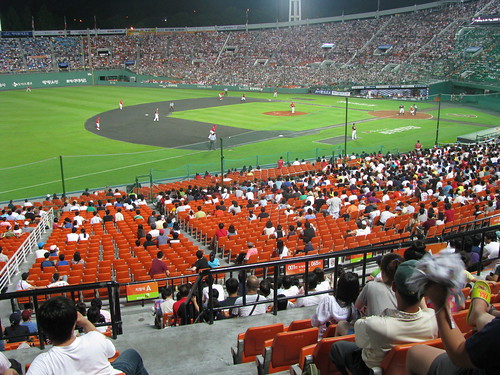
Sajik Stadium in Busan
If you have been following the Orioles' signing Kim Seong-Min and that signings' aftermath, you know the name of Yoo Jee-ho.  He has been reporting for Yonhap News Agency on how the Korean Baseball Organization (KBO), the governing body of two professional leagues in South Korea, and the Korean Baseball Association, the governing body of amateur baseball in South Korea, have reacted to the Orioles not abiding to the agreement in place for MLB teams to sign amateur talent.

Jon Shepherd: How much of a presence does Major League Baseball have in South Korea?

Yoo Jee-ho: A few teams have been sending scouts to Korean high school and college (or university as we’d like to call it here) tournaments in recent years. Some are based in Korea or others may be stationed somewhere in Asia and travel here for some big tournaments. More young players have signed with big league clubs in the last two, three years than in the past (almost a dozen since 2009).
As far as helping KBO developing baseball programs, I am not aware of any MLB involvement in that regard. I personally don’t see it as something MLB absolutely has to do here. But critics of MLB teams’ signing young Korean prospects may feel differently.

JS: Are certain teams viewed more favorably than others by players and families?

YJ: I am not sure if any one particular team is more favored than others by players and parents. But I’d imagine it’s probably the same with kids in other countries dreaming of playing in the majors.  They would all want to play for the Yankees, Red Sox, Dodgers, or other storied ball clubs. Would young players take less money to play for, say, the Yankees, rather than for the Pirates? I doubt it, and it’s not just the money. I think these players will take any opportunity that they can get to join a major league team and have a chance to play in the big leagues someday. 

JS: Can you briefly explain what has transpired between KBO, KBA, and the Baltimore Orioles?

YJ: It really is a long story and I will try to make it short. 

The Orioles signed Kim Seong-min to a minor league deal in January. The KBO, which runs the top baseball league here, claimed that the O’s didn’t go through the “status check” as detailed under the KBO-MLB player contract agreement. An MLB team interested in a Korean amateur or pro must, through MLB commissioner’s office, “check” that player’s status and availability with the KBO.
 
If I may digress a bit and delve a little deeper into this, MLB teams, following the status check, must receive KBO’s approval to sign an active professional player here. But they can sign amateur players as long as they go through the status check. And even KBO officials say status checks are just a formality.  With pros, KBO can say, “Nope, you can’t talk to this guy because he’s under contract and his current team doesn’t want to let him go.” But with amateurs, the most KBO can tell an interested MLB club is, “He will be eligible for the KBO draft next year. We hope you don’t engage this player.” But that doesn’t prevent the MLB team from signing him.  Against this backdrop, the KBO now wants to tweak the agreement to ban MLB clubs from signing amateur players at all.
 
Back to the situation. The KBA, which is the local baseball governing body, has suspended Kim indefinitely from playing or coaching in Korea, and that was in accordance with a local rule. Underclassmen (student-athletes not currently in the final year of their study, at high school or college) must not contact domestic or foreign professional teams. In Korea, a new school year starts in March. Kim was just about to enter his senior year in high school.

The KBA also banned Orioles’ scouts from attending KBA-sanctioned games, such as national high school and college tournaments. It has also warned that other MLB teams that fail to take proper steps in their dealing with prospects will have their scouts banned from Korean games.
I think this will definitely affect MLB’s relationship with KBO and with Korea as a whole. Other teams must have taken notice of this development. KBO and KBA obviously have their own interests, but I think they have taken steps that will likely be seen as being too restrictive.

JS: In your opinion, what changes to the existing agreement between KBO and MLB would be best for the development of baseball as a professional sport in South Korea?

YJ: I don’t think banning MLB teams from signing Korean amateurs is the answer. MLB wouldn’t agree to this sort of change anyway.
 
Here’s the one change that I think may work.  When a player is drafted by a KBO team out of high school, the player has a one-month window to choose between going to college or signing with the KBO team. In my opinion, you can allow MLB teams to engage and possibly sign such players after that one-month period ends. Tampering will have to be prohibited, of course.  KBO teams will reserve the priority to negotiate and sign such players. So MLB teams will be looking at either a KBO rookie or a college freshman to sign.

It’d be easy for big league clubs to lure top talent by coming in with loads of cash, right? Not so fast. Not every teenage player will want to go overseas to play for different reasons (fear of culture shock, language problems, simply wanting to stay home close to family, etc). Plus, top young guns get six figures in signing bonus from KBO teams and MLB teams may or may not want to match that to take them.  In other words, if the money is right and they’d rather stay home, more Korean players than you’d think will choose to stay with the KBO.

This bit of change will mean a limited window for MLB teams to sign. But I think it will work both ways because a) young players, having already been drafted, will have a KBO team to fall back on if talks with MLB teams don’t go well and b) MLB teams will have a better idea of how much they want to pay players given their draft position (i.e. Should we pay this kid $500,000 when he was only drafted 10th overall in Korea? Should we spend that money on some other prospect from elsewhere?)

JS: There has been some debate in the United States as to how good of a player Kim Seong-Min is. Do you have any information on his abilities? 

YJ: He had an excellent 2011. Kim pitched 74 2/3 innings in 21 games, won eight games, and posted an ERA of 1.39. In August, at a national high school tournament, Kim went 3-0 with a zero ERA and 19 Ks in 22 innings to win the MVP.
 
Kim was considered the top lefty in high schools over here and since he had another high school season ahead of him (before the Baltimore deal), local scouts felt that Kim could improve even more and eventually become a first-round draft choice in the KBO.  His fastball tops out at about 89-90 miles per hour, and he also throws above-average changeup and curve. Obviously not overpowering, but he’s got decent command. Any left-hander with his upside and stuff is a valued commodity here, but I myself was surprised to see him snatched up by a major league team. Maybe the O’s scouts saw something in him.

JS: Will this incident affect the Orioles ability to sign premier players from South Korea?

YJ: For the foreseeable future, absolutely. (Poor Dan Duquette. The guy loves Korean players.) Their scouts are banned from going to Korean games and that will obviously limit their ability to assess talent here. Duquette has apologized for “unintentional breach of protocol” but I don’t think the KBO is that much interested in apologies. Rather, the KBO wants to change the agreement to at least limit the outflow of young talent from here. In a way, the O’s move may affect all MLB teams’ ability to scout and sign premier young talent in Korea.

---

To stay on top of the Kim Seung-min situation and Korean baseball in general, follow Yoo Jee-ho on twitter and at Yonhap News