Ubaldo Jimenez is the latest Orioles starter to be (rightly) ridiculed after yet another underwhelming outing. Chris Tillman wasn't very good either on Wednesday, allowing four runs in five innings of work, but at least he actually made it through five innings. Jimenez has only done that three times in eight starts. That's bad!
Kevin Gausman gets the ball tonight in Houston, and here's to hoping that he doesn't one-up Jimenez's awfulness. While Jimenez has been the worst O's starter, Gausman isn't that far behind. Let's take a quick look at their 2017 numbers so far:
Jimenez: 7.17 ERA, 6.71 FIP, 6.75 K/9, 5.27 BB/9, 2.32 HR/9, -0.6 bWAR, -0.5 fWAR
Gausman: 6.65 ERA, 5.23 FIP, 6.85 K/9, 4.18 BB/9, 1.52 HR/9, -0.6 bWAR, 0.1 fWAR
Jimenez has been downright awful and not unlucky on balls in play (.287 BABIP), while Gausman has been pretty bad, too -- what's with the lack of strikeouts? -- but unfortunate on balls in play (.367). Gausman got back on track somewhat with his last start against the Blue Jays. Despite allowing 10 hits (note that BABIP again), he made it through six innings -- no small feat for anyone in this rotation outside of Dylan Bundy -- while allowing two runs while striking out five and walking one. It wasn't pretty, but it was good enough. The Orioles aren't after style points; they just need more good enough outings.
There were some encouraging signs in that start. Gausman got the most whiffs per swing out of his splitter/changeup that he's gotten all season. Plus, his average four-seam fastball velocity reached 96 mph for the first time this season. He even topped a max speed of 99 mph with the pitch, which he hadn't done since the first start of the year.
Gausman believes that he's worked out the kinks, particularly with his fastball command issues. Now he'll get a chance to test himself against an Astros lineup that's been the second-best group in the American League. Gausman was supposed to be the one sure thing in a rotation full of question marks. This would be as good of a time as any to string a few good starts together.
Showing posts with label Ubaldo Jimenez. Show all posts
Showing posts with label Ubaldo Jimenez. Show all posts
26 May 2017
24 May 2017
Swapping In Kendall Graveman For Ubaldo Jimenez
To be fair, Ubaldo Jimenez is doing what he has always done. The performance aspect, runs allowed, look worse, but it really is not much different than what Baltimore has seen from him in the past. He has similar velocity, similar movement in his pitches, and similar placement. Some of the major issues plaguing him are: (1) he appears to be getting squeezed. (2) he has worked the high end of the zone slightly more (which has worked out for him), and (3) he seems to be particularly vulnerable to low middle pitches, which is new. Solutions to those issues would be (1) pair him with Caleb Joseph, (2) well, dealing high requires more control, so, eh (see: Miguel Gonzalez), and (3) maybe Joseph can help here, too.
However, a successful implementation of these strategies does not ensure success. On top of that, how much rope does the club have left if they want to have a strong hand in the regular season march to a playoff position? What else can be done? Well, Jimenez is not a relief pitcher. His issues with control and terrible ability to hold baserunners make him not much more than a junk inning pitcher. As you may have noticed, the Orioles use all corners of their bullpen, so the club would be unable to protect themselves from Jimenez in that manner.
The club could simply designate Jimenez for assignment and release him. Then they would be open to slotting Alec Asher into the rotation. Asher has done well in the opportunities the Orioles have afforded him, but putting him in the rotation hampers the Orioles in needing to replace him in a bullpen that has not exactly been a strength. More long term, the loss of Jimenez also means that the club has likely worse choices for a sixth starter. As it is now, the rotation has six options ranging from Dylan Bundy to Jimenez (yes, I place Asher above Jimenez). The batch in Norfolk simply does not look good. Chris Lee has been revved up on MASN for a lack of runs scored on him lately, but his peripherals look terrible and he has benefited from pitcher's parks.
This leaves the option for a trade. Of course, the Orioles do not have the depth they have had in years past when they had a healthy group of fringe prospects. Based on my conversations with others, last year the team had only two off limits players: Chance Sisco and Hunter Harvey. This year, the list is presumed to include those two plus Cody Sedlock, Ryan Mountcastle, and maybe Jomar Reyes. That does not leave much left to dangle in trade discussions.
What could be done? Well, the Orioles do have one area where they are clogged with talent: 1B/DH/pretend corner outfield. In reality, Chris Davis, Mark Trumbo, and Trey Mancini all occupy the same space. The Orioles need Chris Davis to play well to succeed and he has largely done that. Trumbo is a bit of a luxury piece and is a commodity the Orioles could do without. However, it is difficult to see anyone willing to hand the Orioles anything of note back. A club wanting Trumbo would see themselves as a playoff contender and which playoff contender has an opening at first base, a belief in Trumbo, and quality starting pitcher to hand back? In June? I think it is safe to say that no one fits that description.
That leaves us with Mancini. One of our own. He is a player who has torched Major League pitching since given a cup of coffee last September. His career slash line is 300/338/608 over his first 130 PA. If Mancini has a rubbish career, then he would belong is a very small group of players who did so well so early only to have it fall apart. A name that quickly rises to the tongue is Jeff Francoeur who over his first 274 PA slashed 300/336/549 with the caveat that Mancini does not have the fielding acumen that Francoeur had.
Mancini is also a player who has generated a great deal of confusion among scouts. He does not look all that good. He has regressed in his athleticism and shows less agility. He is too tight and has a swing that can go long at times. Mancini has done alright in the outfield, but he looks barely adequate out there and, long term, his place out there is highly questionable. Basically, the scouting view is a player who is a fringe major leaguer, but his performance bumps him up to a 50. In other words, he does not look good, but he has been getting the job done.
What this all means is that as well as Mancini has done, he is not highly valued. He certainly is valued, but not highly. A 50 rated player in his first year of control is quite valuable. A discussion with some in the industry thought a one for one deal would be for a player like the Athletics Kendall Graveman or Marlins' Dan Straily.
Kendall Graveman would be an interesting target. He is in his last year before arbitration and would not require a salary dump as he makes the same as Mancini. Graveman's three more years of control are valuable with the Orioles' rotation currently in flux. In Oakland, he has shown himself not to be an elite arm, but one capable of competently holding onto the backend of a rotation. Graveman also likely gets a little more love for his use of a sinker. However, a low to mid 4.00 ERA player may not exactly excite anyone when it costs someone who has performed as well as Mancini.
Straily has been similarly valuable to Graveman, but has experienced more ups and downs in his career. His 90 mph four seamer also likely does not inspire much confidence from the Orioles front office. He also has three more years of control as he enters arbitration after this season. He tends to outperform his FIP, which either is a skill or a prolonged period of luck. If skill, he is a mid to high 3.00 ERA pitcher. If not, he is a high 4.00 ERA pitcher.
Picking up either for Mancini would make the Orioles better in 2017 (though maybe not in 2020-2022). The Orioles have a redundancy with Davis/Trumbo/Mancini and are experiencing depth issues at starting pitching. In a vacuum it makes sense to release Jimenez and take on a controllable arm like Graveman. That said, it will be difficult for them to trade away their fourth most productive hitter.for someone who has produced at a level slightly less than Wade Miley this year.
04 January 2017
Has Ubaldo Jimenez Always Struggled In The First Inning?
The calendar has now flipped to 2017, and the Orioles continue to bide their time with respect to offseason transactions. After several years into the Dan Duquette era, it’s something that is unsurprising, yet still frustrating. Without any news or even rumors of substance to inspire, expand on, or elaborate, relevant blog post topics can be in short supply*. So this week, I turned to the beat writers in an attempt to manufacture some inspirado and provide an idea to discuss as I arrived closer to my soft deadline to post an article.
*Note: This sentence was written before the news of the Jesus Montero signing
I found it when reading over Roch Kubatko’s Orioles New Year Resolution article, which ran Monday, as it contained a hypothetical resolution for Ubaldo Jimenez. As Kubatko points out, Jimenez had trouble being effective in the first inning of his starts in 2016. So I thought I would try to take the relatively simple route of trying to explore whether this has been a problem for him in the past, with the hope that it may help us frame expectations in 2017. This was put together pretty quickly, so it’s not very scientific (and possibly not even all that original), but who knows, it may be interesting. It’s not like there is a well of noteworthy Orioles news occurring at the moment.
As you can see from the table below (and from watching games), the first inning was extremely painful for Jimenez in 2016. The table also shows that the other innings were not all that great either.
First off, it’s obvious that there are sample size issues here when comparing the two data sets because of their different sizes. I’m not going to do anything about it because this is just for fun. If you’re able to make it to the very last column in that table, you will have noticed that every metric in the first inning was notably much worse than innings 2 through 9 (except the GB/FB ratio, although more of those flyballs in the first inning were landing on the wrong side of the fence). How bad was Jimenez in the first inning? Every batter he faced was basically Mike Trout, but better (Jimenez 1st inning wOBA against of 0.428 is higher than Trout’s career wOBA of 0.409). Without digging down into the details, the poor guy even appeared to have worse luck in the first inning based on these numbers (look at that BABIP!).
Jimenez’s extremely poor performance in the first inning seems counterintuitive for two reasons. One, he has not started tiring yet, and two, opposing batters are seeing him for the first time (although this is just conjecture). Before we discuss this any further though, let’s move on and see if the rest of his career mirrors his 2016 performance.
Jimenez made his MLB debut in 2006, but he only faced a TOTAL of 30 batters, so I decided to exclude that data. There is a lot going on in that table, so let’s look at a figure that shows how his ERA and FIP compare to each other and change from the first inning compared to innings 2 through 9 over the different seasons of his career.
That’s a little bit easier on the eyes (I think). Jimenez is all over the map here, showing some wild swings between performances in the first inning and the rest of the game throughout his career. And while the 2016 season took it to the extreme, there have been previous years where he’s had trouble at the beginning of the game, although his FIP in those years is either in sharp contrast to his ERA (2007 and 2009) or relatively stable (2012). Additionally, he’s had several other seasons where his production in the 1st inning compared to the others has not varied much.
The fact that Jimenez’s delivery is so complicated means he could require more time than a normal pitcher to find his mechanics and get settled in, but I’m not sure that alone can account for such a large difference in performance. The issues that Jimenez experienced in the first inning in 2016 were serious, but it was also just 24.1 innings. Additionally, he had a pretty big issue with innings 2-9 as well. Based on this limited (and unscientific) look, I don’t think there is strong evidence suggesting that Jimenez needs to specifically pitch better in the first inning compared to the others. He just needs to pitch better, period.
*Note: This sentence was written before the news of the Jesus Montero signing
I found it when reading over Roch Kubatko’s Orioles New Year Resolution article, which ran Monday, as it contained a hypothetical resolution for Ubaldo Jimenez. As Kubatko points out, Jimenez had trouble being effective in the first inning of his starts in 2016. So I thought I would try to take the relatively simple route of trying to explore whether this has been a problem for him in the past, with the hope that it may help us frame expectations in 2017. This was put together pretty quickly, so it’s not very scientific (and possibly not even all that original), but who knows, it may be interesting. It’s not like there is a well of noteworthy Orioles news occurring at the moment.
As you can see from the table below (and from watching games), the first inning was extremely painful for Jimenez in 2016. The table also shows that the other innings were not all that great either.
 |
| 2016 Performance of Ubaldo Jimenez in Inning 1 Compared to Innings 2-9 (click image to enlarge) |
First off, it’s obvious that there are sample size issues here when comparing the two data sets because of their different sizes. I’m not going to do anything about it because this is just for fun. If you’re able to make it to the very last column in that table, you will have noticed that every metric in the first inning was notably much worse than innings 2 through 9 (except the GB/FB ratio, although more of those flyballs in the first inning were landing on the wrong side of the fence). How bad was Jimenez in the first inning? Every batter he faced was basically Mike Trout, but better (Jimenez 1st inning wOBA against of 0.428 is higher than Trout’s career wOBA of 0.409). Without digging down into the details, the poor guy even appeared to have worse luck in the first inning based on these numbers (look at that BABIP!).
Jimenez’s extremely poor performance in the first inning seems counterintuitive for two reasons. One, he has not started tiring yet, and two, opposing batters are seeing him for the first time (although this is just conjecture). Before we discuss this any further though, let’s move on and see if the rest of his career mirrors his 2016 performance.
 |
| Career Performance of Ubaldo Jimenez in Inning 1 Compared to Innings 2-9 (click image to enlarge) |
Jimenez made his MLB debut in 2006, but he only faced a TOTAL of 30 batters, so I decided to exclude that data. There is a lot going on in that table, so let’s look at a figure that shows how his ERA and FIP compare to each other and change from the first inning compared to innings 2 through 9 over the different seasons of his career.
 |
| Click image to enlarge |
That’s a little bit easier on the eyes (I think). Jimenez is all over the map here, showing some wild swings between performances in the first inning and the rest of the game throughout his career. And while the 2016 season took it to the extreme, there have been previous years where he’s had trouble at the beginning of the game, although his FIP in those years is either in sharp contrast to his ERA (2007 and 2009) or relatively stable (2012). Additionally, he’s had several other seasons where his production in the 1st inning compared to the others has not varied much.
The fact that Jimenez’s delivery is so complicated means he could require more time than a normal pitcher to find his mechanics and get settled in, but I’m not sure that alone can account for such a large difference in performance. The issues that Jimenez experienced in the first inning in 2016 were serious, but it was also just 24.1 innings. Additionally, he had a pretty big issue with innings 2-9 as well. Based on this limited (and unscientific) look, I don’t think there is strong evidence suggesting that Jimenez needs to specifically pitch better in the first inning compared to the others. He just needs to pitch better, period.
13 September 2016
Wade Miley Is Not Giving The Orioles What They Need
The Orioles hoped they were, at the very least, getting an unremarkable but adequate starting pitcher when they acquired Wade Miley from the Mariners at the non-waiver trade deadline. They parted with fellow southpaw Ariel Miranda to get the deal done, which certainly wasn't a high price but was something.
The hope was that Miley, as the team's lone left-handed starter, would be serviceable. Passable, average, sufficient, all right, not bad, decent, fine, OK -- any of those would have sufficed. Instead, it would be difficult for the trade to look any worse right now. After eight starts in an O's uniform, Miley's numbers are amazingly bad. He's thrown about 35 innings, and he has an ERA of 8.41. That's not what the Orioles want; that's not what any team wants.
Of course, Miley isn't this bad. Few pitchers are. Besides the home run numbers (1.5 HR/9 with a HR/FB rate of 20%), Miley's peripherals suggest he's been unfortunate. His strikeouts and walk rates are fine, and he has a 4.81 FIP and an xFIP (which assumes a league average home run rate) of 3.99. And like Ubaldo Jimenez early in the season, BABIP has not been Miley's friend. With the Orioles, Miley has a BABIP of .409. His career mark is .307.
Regardless, you probably don't care what Miley's numbers should look like when the O's are clinging to that second wild card slot. And it's hardly unreasonable to expect better than what they've received from Miley.
Miley's stretch seems particularly terrible, even when comparing his performance against some of the underwhelming pitchers the Orioles have employed the last decade or two. So I went to the Baseball-Reference Play Index to investigate. I wondered which pitchers had so many consecutive terrible outings in a row to start their Orioles' career. The Orioles have had a lot of bad pitchers, and Miley is doing his best to join them.
I searched for consecutive pitching outings in O's history with the following criteria: at least one inning pitched, at least two earned runs allowed, and at least seven baserunners allowed (for starters only). And Miley is quickly working his way up the list. Miley has amassed eight such outings in a row (Baseball-Reference hasn't updated yet this morning), tied for seventh in this group with some names you've heard before (Garrett Olson, Pat Rapp, Wayne Garland) and a couple that maybe you haven't (Bill Trotter, Joe Giard). The leaders of this group are Jason Johnson and Julio Bonetti, at 16 straight games. Carl Fischer had 10 such outings, followed by Jose Mesa, Erv Palica, and Don Larsen (all with nine).
That set of criteria, it's worth noting, doesn't necessarily lead to all negative results. Giving up two runs in five or six innings while limiting the damage is not ideal, but it's not terrible, either. You probably need some luck and/or a good defense behind you. And Miley has not been lucky (and if you watched the beginning of last night's game against the Red Sox, the O's defense did him no favors).
Considering Miley's BABIP and high home run rate, you'd figure some positive results are on the horizon. It's hard for any pitcher to sustain an ERA over 8 over this many starts. But at this point, there isn't really a whole lot the Orioles can do. Because of the wear and tear on Chris Tillman, the high workload of Dylan Bundy, and the uncertainty of Yovani Gallardo and Jimenez, the O's best course of action may be to proceed with their flawed collection of six starters.
Fortunately for the O's, after the season, Miley... oh, right. He's under contract next year for about $9 million. That's more than a fair price for an average starting pitcher, so perhaps that figure won't look so bad in a couple months. It would be tough, though, for it to look much worse.
07 September 2016
Without Tillman And O'Day (For Now), O's Sit One Game Back In The East
Chris Tillman hasn't pitched since August 20. He hasn't pitched well since August 11. Darren O'Day also hasn't made an appearance since mid-August. And yet, despite missing two of their most effective pitchers, the Orioles currently sit one game out in the American League East and one game up in the second wild card slot.
The overall struggles of the O's rotation is well-worn territory. As of right now, O's starters combined are t-24th in ERA (4.83) and 25th in FIP (4.69). But without Tillman in the rotation, things have not fallen apart. Over the past 14 days, O's starters are 14th in ERA and 17th in FIP. And over the past 30 days (which includes nine innings by Tillman), O's starters are 17th in ERA and 21st in FIP. Considering the unpredictable nature of a chunk of the rotation, those are quite acceptable results. And while far from dominant, the rotation has done enough to keep the Orioles in games.
The starter who has stepped up the most? Kevin Gausman. In the past month, he's made six starts and posted an ERA near 2 with a FIP near 3. As Ryan Romano noted over at MASNsports.com, Gausman has been particularly adept at limiting damage with runners on base.
The next best has been Ubaldo Jimenez, because of course. Not only is Jimenez doing a solid job of filling in for Tillman, but he's making Buck Showalter at least consider the notion of a six-man rotation after Tillman returns from the disabled list. Besides Jimenez's latest success, perhaps the best argument in favor of an expanded rotation is Dylan Bundy's declining velocity.
Jimenez has made three starts since rejoining the rotation and hasn't looked very Ubaldo-like. Perhaps that's because he threw a stunning and much-needed complete game on Labor Day against the Rays. He's mostly pitched to contact, limiting both strikeouts (5.4 K/9) and walks (1.25 BB/9) while running a BABIP of only .153. Jimenez seems to be receiving some good fortune that he lacked while recording a very high BABIP early in the season, but good luck extrapolating any kind of long-term meaning in his recent performance. Just enjoy Good Ubaldo while he's here, because his success could be fleeting (though not meaningless!).
It's also not hard to see where the O's have missed O'Day. Zach Britton has been amazing all season, but Brad Brach has taken a step back after the all-star break. That doesn't make Brach ineffective; it just means he's not as good as he looked in the first half, which you probably figured anyway. But it has mattered without O'Day around.
Mychal Givens has still been deployed often and has been useful, though he's maybe not as dominant as you hoped (especially if you're greedy). One bright spot has been Donnie Hart, who has yet to allow a run despite a strikeout rate slightly over 5. That's hard to do! Still, the O's clearly need O'Day, who adds one more reliable arm to the Britton, Brach, and Givens group. Hart isn't there yet, and who knows what Tommy Hunter has left in the tank.
Losing Tillman for any significant stretch was supposed to be a death knell for the 2016 Orioles, but it hasn't turned out that way. The Orioles are in the thick of the playoff race, and it's anticipated that Tillman will come off the disabled list and pitch on Sunday. Obviously there's no guarantee that Tillman returns completely healthy or effective. Still, the O's have shown that for weeks at a time they can win games without him. They're just hoping they don't have to do that anymore very soon.
24 August 2016
Ubaldo Jimenez Is Back In The Rotation, For Now
Chris Tillman is indeed headed to the disabled list. He received a cortisone injection in his shoulder to combat the discomfort, but the injury is apparently not severe enough to warrant an MRI. Tillman could be back to full strength in a couple weeks, or perhaps not. The Orioles and Buck Showalter don't seem overly concerned, but that doesn't always mean a whole lot. You know better than to just believe everything a manager says.
So out with Tillman, and in steps Ubaldo Jimenez -- or, at least, he'll get the first crack at replacing Tillman. There's a lot of hyperbole surrounding Tillman (comparing him to Mike Mussina? Come on), but he's meant a lot to a starting rotation that has a few holes. Tillman has been the team's best starter this season, and now the O's will need to go on and win without him for a while.
They can do that, by the way. Any team can get by without a single player for a couple of weeks, or even longer than that. Weird things happen in baseball. The Dodgers can win a bunch of games without Clayton Kershaw. It's not advised, but it does happen. And Tillman is certainly nowhere near Kershaw. It's easy to look at the performance of the O's rotation in the first half of the season and then wonder how they're even still in the playoff race.
Oh, yeah -- so, Ubaldo is back. Jimenez hasn't started a game since the O's July 28 makeup game in Minnesota against the Twins. In those five innings of work, he allowed just one run and struck out eight, but he allowed eight baserunners (five hits, three walks). That's typical Ubaldo stuff, except with less runs scoring. If the O's get that kind of performance in the next couple of starts, they'd be thrilled. Since that outing, Jimenez has only pitched three times out of the bullpen at a few innings per appearance. It's not surprising that the O's would be trying to hide someone with an ERA near 7 and a walk rate again over 5.5.
You probably don't need to hear yet again that Jimenez has had some bad fortune on balls in play and that he's not this terrible. That is true, but the O's are in a tight race for the AL East crown, and if not that, then the consolation prize of a wild card spot. We're not talking about Jimenez's long-term outlook (hint: not good), just about what he can do for the next couple of weeks (if that). So the sympathy probably won't be there for someone with a two-run gap between his ERA and FIP.
The O's could use a couple of good outings from Jimenez. But also from Wade Miley (who pitches tonight and has been terrible) and Yovani Gallardo (who pitches Friday and has also been bad). Everyone who has started a game for the Orioles this year not named Tillman, Gausman, and Bundy has an ERA of 4.50 or above in those starts. The O's have been dealing with these concerns all year. Just be glad that Bundy is filling in admirably, or else things would, amazingly, be much worse.
01 August 2016
Orioles Count On A Collection Of Swingmen Because They Have To
Teams with an average to decent starting rotation don't really have a need for more than, say, one long reliever. The Orioles, though, have a bad rotation and currently have several swingmen on the roster: Dylan Bundy, Ubaldo Jimenez, Vance Worley, Odrisamer Despaigne, and Tyler Wilson. Yes, Bundy is slated in the rotation right now and is firmly in the team's long-term starter plans, but he was used as a multiple-inning reliever earlier in the year and it's at least possible he shifts back to that role before the end of the season.
Jimenez is in the swingman role for two reasons: 1) He's been terrible and lost his regular starting gig; and 2) He's only still on the team because the Orioles still haven't figured out a convenient way to unload his contract (which they've been trying to do since late 2014).
Besides Bundy, the real hero of the long relief corps is Worley. In 62.1 innings out of the bullpen and in four starts, he's posted a 2.89 ERA and has been getting a bunch of ground balls (48%). His peripheral numbers aren't as good, with a FIP near 4, but that's hardly awful. And considering the O's plucked him from waivers and are paying him $2.6 million this season, those are decent, and much-needed, results.
Despaigne has a strikeout rate under six and a walk rate of nearly five, but somehow he's managed to pitch 24 innings without being a complete disaster. And Wilson has had his ups and downs, but in limited duty has been more effective out of the bullpen - when he's not asked to work through a lineup more than once or twice.
This is far from a perfect situation, and it's something the Orioles have been dealing with all season. Ideally, the O's would employ starters capable of pitching six innings and then handing the ball off to Mychal Givens, Darren O'Day, Brad Brach, and Zach Britton. Surely that's what Dan Duquette hoped for when bringing aboard Jimenez in 2013 and Gallardo this past offseason. And obviously, that's not the case this season. O's starters have thrown the third fewest innings in the majors. Enter the team's collection of long relievers.
It's unclear exactly how the addition of Wade Miley will change things. Most likely, he'll be slotted into the rotation with Chris Tillman, Kevin Gausman, Yovani Gallardo, and Bundy (for now). The Orioles need to create a spot on both the 25- and 40-man rosters, and the O's have also been working with a three-man bench lately. Wilson and Despaigne are the two long relievers who have options, so likely one of them will be sent down. You'd have to think the O's would prefer to jettison Jimenez from the roster, but that appears unlikely.
Buck Showalter will need to keep going to this cast of characters, and unfortunately, this could be the case next year as well. The only real hope is that this version of Tillman is for real (a dangerous assumption), and that Gausman and Bundy both stay healthy and continue to progress. Gallardo is somehow getting a pass that Jimenez never received, and Miley is the very embodiment of a back-end starter. If the Orioles don't develop a starter or pull another Miguel Gonzalez out of their hat, there really isn't much relief in sight. It's not like the O's are going to start paying top dollar for starting pitching, which they maybe shouldn't do anyway because of the risks involved.
The Orioles have constructed a flimsy bridge from the rotation to their dominant group of relievers. It's no sure thing this collection of starters can even get the ball to any of their relievers with a lead intact, but these long relievers will play an important part in how the O's fare the rest of the year. It's hard to expect a lot from them, because if they didn't have flaws in their game, they'd be in a starting rotation somewhere instead of a bullpen. But that's more or less what the O's have excelled in these last few successful seasons: getting helpful performances out of unlikely places. They'll need more of that.
28 July 2016
The Three Outcomes For Ubaldo Jimenez
 |
| Ubaldo is Mr. F. |
For the Orioles. their regretful commodity is Ubaldo Jimenez. A pitcher who teams were unwilling to commit money to two and a half years ago because his mechanics are temporal, an annual salary requirement over 10 MM, and a lost draft pick. He was the final pitcher the Orioles targeted in an offseason full of pitchers they were targeting. I christened him Plan F as a designation of how far down the list we knew he was and as a statement that this was highly unlikely to work out. Jimenez' first season was a mess. His second season was adequate. His third season so far rivals many of the largest tire fires. There is still one more season to go at 13.5 MM.
For the Padres, they were saddled with Melvin Upton, a once promising star player who over the past year experienced a modest performance revival. Upton is a true left fielder, but is capable of playing center field and adequate in right field. Over the past year, Upton has punished left handed pitching and has performed slightly below average against right handers. He has amassed an fWAR of 3 over that time period with 1.9 this year (for comparison, Chris Davis sitis at 2.2). Even with an annual salary of 16.45 MM that lasts through next season, he seems like an expensive but useful player. Particularly, if the end result is a highly capable second division outfielder for 2.95 MM in 2017. Upton is really what some people around Baltimore think Joey Rickard is.
Allegedly, the deal was:
Ubaldo Jimenez, Garrett Cleavinger, and Jhon Peluffo
for Melvin Upton
Garrett Cleavinger is a left handed pitcher who was selected out of Oregon in the third round of last year's draft. Cleavinger has the promise of a backend bullpen arm, but has some considerable hurdles in his way. He works in the low 90s though has creeped into the mid-90s at times. He also employs a hard slider that is highly effective when he actually gets it across the plate. His main issue is that there is inconsistency in the quality of his pitches as well as a general inability to locate them. Promoted mid-season to Frederick, batters appeared to be forcing him deeper into counts and exposing his weaknesses. The hope is that he could be a late inning complement to Mychal Givens, but he will need considerably more developmental time.
Jhon Peluffo is a 19 year old who has been turning heads in the Gulf Coast League. The Orioles are not a major player on the international amateur market and typically play in the low cost fringes. Occasionally, this strategy of spending less than any other team in baseball on this type of talent still winds up being successful. When the Orioles signed the 16 year old in March 2014, he was not considered a valuable prospect. Valuable 16 year olds sign within a few years of the yearly active date of July 2nd. Just within Colombia, Peluffo was considered somewhere around the ninth or tenth best pitching prospect that year with players like David Ayala (Reds), Erick Julio (Rockies) and Erling Moreno (Blue Jays) receiving far more attention and money.
After two decent yet unspectacular seasons in the Dominican Summer League, Peluffo, who is 6'3 with a considerable frame that has yet to fill out, broke out in the Gulf Coast League. I was told that he works around 90 with a good breaking ball and that Peluffo will emerge from the farm wasteland to be recognized as a top five arm in the organization's minors. I was then reminded that the Orioles system is quite barren and that Peluffo would be a ten to fifteen arm in a top rated farm below what Hansel Rodriguez was. Beyond that, I do not know much about Peluffo. He appears like your typical low minors pitcher with current success and a lot of projection.
Beyond that there was some talk of money exchanging hands, but that has been a pretty loose and vague rumor. Some love the oldies and are playing the vinyl Peter Angelos is Cheap even though the current perspective in front offices is that the Orioles are desperate and that they are willing to take on more money than most mid-season. That makes this analysis a bit uncertain. Also uncertain is that it simply is difficult to get good information on Peluffo or someone among my circle who both is qualified and has seen him pitch.
With all that in mind, I would have leaned in favor of this deal happening. A Hyun Soo Kim / Melvin Upton platoon in left field would have been remarkable. Kim has a 147/-22 wRC+ RHP/LHP split. Meanwhile, Upton carries a 85/143 wRC+ RHP/LHP split (2015's split was 102/124). A leftfielder with a 140 wRC+ would be equivalent to fielding someone like Kris Bryant or Yoenis Cespedes out there. To get that kind of production out of less than 10 MM in cost would be impressive. However, that was simply not done and Upton now plays for the Blue Jays.
This leads us to consideration of the Three Outcomes for Ubaldo Jimenez:
1. Designation for Assignment
The argument to release Jimenez has nothing to do with cost. Cost is considered sunk into him and that simply is that. The true argument for his release is that there is no one appreciably better as a fifth starter or as the last man in the bullpen. Rumor mill suggests that Peter Angelos is willing to let Jimenez go free and swallow the rest of the contract. There is a growing feeling in the industry that Jimenez will not be an Oriole on August 1st. This is due to Jimenez' struggles with command and control for all of his pitches. He was described to me as a AA starting pitcher with no option in the pen as his fastball simply is not fast or deceptive enough to be overly relied on when his struggles with the strike zone deepen his counts.
However, the other lingering question is what else do the Orioles have. Tillman and Gausman have been solid members of the starting rotation. Dylan Bundy has shown glimpses of being a strong middle of the rotation starter. Yovani Gallardo unimpressively is putting out some adequacy and profiles at this point in his career as a solid 5th starter on a playoff team, a guy who gets left off post-season rosters typically. Then your fifth starter options consist of Jimenez, Vance Worley, Mike Wright, and Tyler Wilson.
Amongst that final rotation slot group is an abundance of underwhelming talent. Wright has been the darling of several organizations who are enamored with his velocity and think a few personalized tweaks can turn him into a solid MLB pitcher or, at worst, find him as a 7th or 8th inning arm. Tyler Wilson lives on the edge of effectiveness and is no stranger to good and poor games, unlikely to ever see much positive consistency. Worley exists in a similar space. You can dream on a few of his innings, but those dreams tend to dissipate into a cruel reality. Jimenez fits the same bill, but with such an issue with control that the pen is not an option. This hurts the club because it cannot do what teams generally do when all they have to offer at a slot is trash, which is riding the hot hand. Jimenez simply cannot be stored in the pen for a start or two.
2. Every Fifth Day, Praying for a Miracle
Based on his many ups and downs in the past few seasons, projection models had to cover their bases with Jimenez. His stretch of respectability last year resulted in him being perceived by the models as having a 25-30% chance of delivering above average performances over the course of the entire season. After a horrific first half, the model I use revised its estimate to about a 2% chance of a resurrection to above average performance. Worley, Wright, and Wilson all sit in the 5-15% range. For this year alone, it is difficult to argue that Jimenez should remain. Indeed, if he was sitting on a walk year, he would be gone.
He is not on a walk year though and another season is left on his contract. A season that will probably see him as a one in ten chance of being a positive pitcher, which would be in line with the W crew vying for that last rotation slot. With that in mind, it makes a little sense to keep him around simply in order to have him available next Spring Training. It is a meager hope.
3. Find Another Melvin
The third option is to find another bloated contract and get something that is at least of some use to the Orioles. Who would that be? I am unsure. Upton's deal fit well for what the Orioles need to shore up: outfield defense and another strong bat against left handers. Other options, like Upton's former teammate Matt Kemp, simply fall into a category of pointlessness for the club by providing little defensive value and a bat that comes and goes. Maybe something is out there, but I am unsure what.
So what Now?
I lean slightly to the idea that the Orioles lost out on an opportunity with Melvin Upton, assuming the money difference was not much, Peluffo is not some wunderkind, and Upton would be cool with remaining as a platoon player. Moving on from that situation, I frankly am at a loss to see another trade opportunity appearing. I think the club is unable to ride a hot hand with one of their other options, so the only option I see is the difficult one of letting him go to be the beautiful butterfly he could be. Jimenez would be a useful piece in Spring Training next year, but is that worth suffering through four starts in August before rosters expand? Maybe it is. Maybe four horrible starts is not a major trauma against the club's post season hopes. I think it might well be.
06 July 2016
Ubaldo Jimenez Wasn't Always Terrible
Your first memories of something are always the most vivid ones. The ones that stick the longest, that you judge the coming ones against. I started getting deeper into baseball in 2010, the year that Ubaldo Jimenez finished third in NL Cy Young voting. With a wicked fastball that averaged 96 and touched 100 MPH at times, a devastating slider and a change that kept hitters honest, Jimenez was the last true ace I can remember getting it done at Coors. By using park and time adjusted statistics, Jimenez' 63 ERA- in 2010 equals what Noah Syndergaard is doing this year, and he kept it up for 221 innings. In Coors!
So that's why sometimes I look at Ubaldo Jimenez' player page on Baseball Reference sometimes. It feels almost like visiting an old friend's grave. Yesterday I was paying my respects, and came across this fun fact. After serving up a grand slam to the Mariners' Seth Smith on Sunday, July 3, Jimenez now has the same home run total in 80 IP this season as he did in 221 IP in 2010. That total is ten.
The back half of the O's rotation is an on-fire garbage can, and Ubaldo likely won't recapture anything close to his 2010 peak down the stretch. Nobody should expect him to. He currently leads all of baseball in earned runs after a few implosions, and he leads the AL in walks. His 4 year/$50M contract is up after next season, and at age 33 with rapidly declining velocity the market for his arm will be thin.
Basically, things are looking down for Ol' Ubaldo, so I thought I would take some time to look back on his dominance with some numbers and GIFs. The first thing that made me fall in love with him is his unique delivery in which he literally looks like he's reaching back for more. The backwards rock and arm extension have always been there, and he experimented with an over the head movement before his delivery in 2015 that was funky.

1. The No-Hitter
The crown jewel of any legendary pitching season is a no-hitter. Jimenez didn't win the Cy Young, but the no-no sure helped smooth over some of his bumps (he ran a 3.7 BB/9 in 2010; some things never change) and make him compare more favorably against prime Roy Halladay and Adam Wainwright.
Jimenez needed 128 pitches (throwing just 72 for strikes and walking six batters) to throw the first no-hitter in Rockies history against a Braves offense that was a hell of a lot better than this year's scrubs. He had trouble locating his offspeed and breaking stuff (which led to the six walks) but his fastball was the money pitch, touching 100 MPH several times. Here are some nasty examples.
A young, pre-faceguard Jason Heyward. So innocent.
And a particularly devastating splitter to Eric Hinske for good measure.

Other great moments from the no-hitter: Jimenez helped out his own cause with an RBI single, and Dexter Fowler made an incredible diving catch in center to keep it intact. There's something about Dexter Fowler and no-nos.
2. The Scorching Start
If you like wins, Jimenez won 15 of his first 16 starts in 2010. Since the five-man rotation became the norm, only Pedro Martinez, Greg Maddux, Steve Carlton, and Joaquin Andujar have accomplished that feat. The gaudy win totals were somewhat aided by the Rockies' potent offense, but he was a straight up workhorse, reeling off 14 consecutive quality starts out of the gates.
Looking at his first 11 starts through April and May, he was completely unhittable.

According to WPA (Win Probability Added), Jimenez alone accounted for over three wins for the Rockies in just 80.1 IP. The stretch included the no-hitter, two complete game shutouts, a 13 strikeout gem, and eight outings with Game Scores of 70 or higher. Perhaps the most impressive part of this stretch is that he managed to keep his ERA under 1.00 for 80 IP while posting a very average 2.7 K:BB ratio.
Jimenez dropped off considerably after the first two months, posting a 4.41 ERA in June and a 6.04 ERA in July. But as Jake Arrieta showed last year, Cy Young voters love otherworldly hot streaks. Especially when they happen at Coors
3. The First and Only Coors Workhorse
The no-hitter pitch count ran up to 128 pitches, and Jimenez followed it up five days later with a scoreless 121-pitch outing. Maybe Manager Jim Tracy was possessed by the spirit of Dusty Baker, or maybe this was normal in 2010, but Jimenez threw 120+ pitches in nine starts that season. He made three of those 120+ pitch starts in a 17 day period in August. All you need to see to understand the kind of toll that takes on an arm is this velocity chart.

Jimenez was not impervious to fatigue or the thin Rocky Mountain air. His home ERA was 0.56 higher than on the road, his OPS allowed was a full .100 higher at home, his K/9 was 0.5 lower at home. He was human, and humans get shelled at Coors occasionally, but he was also the first and only workhorse to ever pitch for Colorado.
Here is a complete list of Rockies pitchers who have surpassed 200 IP in a season, sorted by their ERAs. Notice how by ERA+ many of those seemingly pedestrian seasons were actually well above league average when you factor in the Coors effect.

And this is a complete list of Rockies pitchers who have posted sub-3.00 ERAs and qualified for the ERA title.

The Colorado Rockies have only existed for 25 years, but it's safe to say that Ubaldo Jimenez owns the most (only?) dominant season in the team's history. That doesn't change the fact that the O's are paying him $13 million for what's shaping up to be a -2 WAR season, but it makes it a little easier to swallow knowing that Jimenez is kinda, sort of a legend.
So that's why sometimes I look at Ubaldo Jimenez' player page on Baseball Reference sometimes. It feels almost like visiting an old friend's grave. Yesterday I was paying my respects, and came across this fun fact. After serving up a grand slam to the Mariners' Seth Smith on Sunday, July 3, Jimenez now has the same home run total in 80 IP this season as he did in 221 IP in 2010. That total is ten.
The back half of the O's rotation is an on-fire garbage can, and Ubaldo likely won't recapture anything close to his 2010 peak down the stretch. Nobody should expect him to. He currently leads all of baseball in earned runs after a few implosions, and he leads the AL in walks. His 4 year/$50M contract is up after next season, and at age 33 with rapidly declining velocity the market for his arm will be thin.
Basically, things are looking down for Ol' Ubaldo, so I thought I would take some time to look back on his dominance with some numbers and GIFs. The first thing that made me fall in love with him is his unique delivery in which he literally looks like he's reaching back for more. The backwards rock and arm extension have always been there, and he experimented with an over the head movement before his delivery in 2015 that was funky.

He might be worth negative 1.3 WAR as of this writing, and he might flame out of the league in a few years, but Ubaldo Jimenez was pretty awesome and it's worth looking back at some of the highlights from his stellar 2010 campaign.
1. The No-Hitter
The crown jewel of any legendary pitching season is a no-hitter. Jimenez didn't win the Cy Young, but the no-no sure helped smooth over some of his bumps (he ran a 3.7 BB/9 in 2010; some things never change) and make him compare more favorably against prime Roy Halladay and Adam Wainwright.
Jimenez needed 128 pitches (throwing just 72 for strikes and walking six batters) to throw the first no-hitter in Rockies history against a Braves offense that was a hell of a lot better than this year's scrubs. He had trouble locating his offspeed and breaking stuff (which led to the six walks) but his fastball was the money pitch, touching 100 MPH several times. Here are some nasty examples.
 |
| Exhibit A |
97 MPH painted on the inside corner.
 |
| Exhibit B |
 |
| Exhibit C |
2. The Scorching Start
If you like wins, Jimenez won 15 of his first 16 starts in 2010. Since the five-man rotation became the norm, only Pedro Martinez, Greg Maddux, Steve Carlton, and Joaquin Andujar have accomplished that feat. The gaudy win totals were somewhat aided by the Rockies' potent offense, but he was a straight up workhorse, reeling off 14 consecutive quality starts out of the gates.
Looking at his first 11 starts through April and May, he was completely unhittable.

According to WPA (Win Probability Added), Jimenez alone accounted for over three wins for the Rockies in just 80.1 IP. The stretch included the no-hitter, two complete game shutouts, a 13 strikeout gem, and eight outings with Game Scores of 70 or higher. Perhaps the most impressive part of this stretch is that he managed to keep his ERA under 1.00 for 80 IP while posting a very average 2.7 K:BB ratio.
Jimenez dropped off considerably after the first two months, posting a 4.41 ERA in June and a 6.04 ERA in July. But as Jake Arrieta showed last year, Cy Young voters love otherworldly hot streaks. Especially when they happen at Coors
3. The First and Only Coors Workhorse
The no-hitter pitch count ran up to 128 pitches, and Jimenez followed it up five days later with a scoreless 121-pitch outing. Maybe Manager Jim Tracy was possessed by the spirit of Dusty Baker, or maybe this was normal in 2010, but Jimenez threw 120+ pitches in nine starts that season. He made three of those 120+ pitch starts in a 17 day period in August. All you need to see to understand the kind of toll that takes on an arm is this velocity chart.

For some reason the time axis is messed up, but the sudden drop off in velocity lines up perfectly with the beginning of his 2011 season. We can probably thank Jim Tracy for the 90-92 MPH garbage heaters that we're used to now.
Jimenez was not impervious to fatigue or the thin Rocky Mountain air. His home ERA was 0.56 higher than on the road, his OPS allowed was a full .100 higher at home, his K/9 was 0.5 lower at home. He was human, and humans get shelled at Coors occasionally, but he was also the first and only workhorse to ever pitch for Colorado.
Here is a complete list of Rockies pitchers who have surpassed 200 IP in a season, sorted by their ERAs. Notice how by ERA+ many of those seemingly pedestrian seasons were actually well above league average when you factor in the Coors effect.

And this is a complete list of Rockies pitchers who have posted sub-3.00 ERAs and qualified for the ERA title.
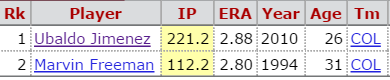
The Colorado Rockies have only existed for 25 years, but it's safe to say that Ubaldo Jimenez owns the most (only?) dominant season in the team's history. That doesn't change the fact that the O's are paying him $13 million for what's shaping up to be a -2 WAR season, but it makes it a little easier to swallow knowing that Jimenez is kinda, sort of a legend.
06 June 2016
Is Jimenez A Disappointment?
Ubaldo Jimenez is not having a particularly good season. His ERA is a high 6.59 and he has just a 2-6 record. In May, his ERA was 8.28 and had just one start when he allowed fewer than 5 runs. As a result, people are asking what to do with Ubaldo Jimenez and whether the Orioles should just get rid of him, send him to the bullpen or see if he’s willing to accept a minor-league assignment. All of this begs the question if the Orioles wouldn’t have been better off signing a different pitcher in free agency that signed a similar contract. Has Jimenez been a disappointment?
Using the MLBTRs transaction tracker, I found all starting pitchers that signed deals between 3 and 5 years and received between $10 and $15 million per year from 2011 to the present. There were thirteen starting pitchers that met this requirement including Ubaldo. When I looked at their numbers, I found something interesting.

With a 4.74 ERA, Ubaldo has one of the worst ERAs in the sample, ranking 10th out of 13. But he’s also averaging roughly 1.54 fWAR per year, which puts him 6th out of 13. Depending on how one measures performance, one could argue that he’s been better than one should have expected. Indeed, it shockingly wouldn’t be absurd to call him a good signing.
For example, Ubaldo’s performance may leave much to be desired, but he hasn’t been chronically injured like Brandon McCarthy and Jorge de la Rosa. Those pitchers averaged less than 80 innings per year and it’s hard to be successful when you can’t pitch. Other starters like Edwin Jackson and Scott Feldman were converted from starters to relievers while Ricky Nolasco hasn’t performed well since 2013. Nolasco’s injury in 2015 hasn’t helped his cause either.
The pitchers with the most similar performance to Jimenez have been Kyle Lohse and Matt Garza. Garza has a slightly better ERA than Jimenez over the length of the sample, but the difference between 4.74 and 4.59 isn’t particularly meaningful. In addition, Jimenez has thrown nearly 50 more innings and has been worth .3 more wins. It’s reasonable to say that these two pitchers have had similar performance over their contracts.
Kyle Lohse provided two solid years of service for the Brewers before crashing and burning in year three. Lohse had a superior ERA than Jimenez over the course of their contracts so far, but Jimenez is on pace to provide more value than Jimenez. Given their contracts, Lohse almost definitely outperformed Jimenez, but the difference may be less than one might think.
J.A Happ, Francisco Liriano, Mark Buehrle, Ian Kennedy and Ervin Santana have been clearly better than Jimenez over their most recent contracts. Ervin Santana has unquestionably performed better than Jimenez. He has a much lower ERA and is on pace to have a considerably higher WAR. On the other hand, he tested positive for PEDs in 2015. If Santana can maintain his performance without testing positive for PEDs, then he’ll likely be much better than Jimenez.
Happ and Kennedy have both started their contracts with strong years. But each of them has only completed the first two months of their contracts. It’ll be hard to judge whether they’re worth their contracts until 2018.
Francisco Liriano and Mark Buehrle are the best pitchers in this group and the teams that signed them clearly picked well or got lucky. So far, both pitchers have stayed healthy, been extremely effective and certainly strengthened their teams’ rotations. It is unlikely that Jimenez will perform as well as either of these pitchers, but their performances’ were highly optimal and rare. Most free agent starting pitchers that signed a similar contract weren’t as good as these two pitchers. It isn’t reasonable to expect Jimenez to perform that well, even if it was a reasonable hope.
It is true that Jimenez has had a tough May. To a large extent, this is because batters had extremely good luck putting hard pitches into play. In April, batters had a 19.4% foul rate and a 15.2% in play rate. In May, batters had a 12.9% foul rate and a 22.25% in play rate. Batters do well when they put pitches into play. Likewise, batters had a 10.9% miss rate, 9.4% foul rate and 18.8% in play rate against soft pitches. This means that they put nearly 50% of the soft pitches they swung at into play. Obviously, pitchers can’t be successful if that happens. But on the other hand, it certainly didn’t help that batters had a .432 BABIP in May against his soft pitches and a .357 BABIP against his hard pitches. That’s probably bad luck and it’s unlikely that batters will continue to put the same proportion of swung-at pitches into play. If so, he isn’t as bad as his May performance suggests, and bad pitchers have bad months. I wouldn’t give up on him quite yet.
If the Orioles had better options, then perhaps it would be a different story. But the Orioles have minimal pitching talent in Norfolk. In the majors, the Orioles’ have little quality starting pitching aside from Gausman and Tillman. It’s possible that Gallardo might bounce back or that Wilson and Wright will be effective. But it’s not particularly likely. And the trade market for starting pitching doesn’t look good this year.
The bottom line is that $12 million a year doesn’t buy quality in the free agent market. On average, it pays for a below average, but capable pitcher. The Orioles have received exactly what they paid for. Of course, this also illustrates the necessity of developing quality starting pitching and being able to find acceptable starting pitching via waivers and in the cheap free agent market.
29 March 2016
Best And Worst Cases For The Orioles' Rotation
In case you haven't been paying close attention, or are in a constant state of denial, the Orioles have some serious starting rotation question marks. FanGraphs has been posting its 2016 positional power rankings series, and the O's starting rotation options ranked 28th in the majors.
That low ranking should not come as a surprise. With Chris Tillman, Ubaldo Jimenez, Yovani Gallardo, and Miguel Gonzalez, the O's have some decent starting pitchers, but none who should be considered superb or an ace. Then there's Kevin Gausman, who has the highest upside of anyone in the group and the potential to be a front-line arm. But he's also dealing with shoulder tendinitis, and he'll begin the year on the disabled list.
To round out the current starting options, Tyler Wilson and Mike Wright are seemingly in a constant -- but friendly! -- battle to take over for whomever in the group falters or gets injured (depending on Gausman's status in a few weeks). Then, in some order, there's Vance Worley, T.J. McFarland, Odrisamer Despaigne, Parker Bridwell, and Chris Lee. And in the impatient/pipe-dream category, there's Dylan Bundy. The Orioles could always acquire another starter, so things could change quickly.
Besides the rotation, the O's have the makings of a solid team. The offense, which doesn't have a bunch of high on-base types but does have lots of power bats, should feature plenty of homers and still score lots of runs. Defensively, the O's project to be pretty good in the infield. Mark Trumbo's defense is a serious concern in right field, but Adam Jones should at least be adequate in center. Left field is currently a question mark. Joey Rickard, the talk of O's camp, is a lock to make the opening day roster and at least comes with the reputation of a strong defensive outfielder. And despite being heavily relied on yet again, the bullpen should again be one of the best in the American League.
Things don't always go according to plan, but it sure seems like the starting rotation is the main issue holding the Orioles back from competing for the AL East crown. If you read any season preview of the Orioles, it won't take long to get to the team's starting rotation woes.
Anyway, you know what the projections say, and it isn't good. So let's take a hypothetical look at the best and worst cases for the O's projected rotation.
Chris Tillman
Tillman gets the nod on opening day for the Orioles. Because, you know, someone has to do it. The BABIP gods struck back against Tillman a bit last year (.293) after posting below average numbers the two years prior (.269 and .267, respectively). That could have something to do with him slowly becoming more of a groundball pitcher and incorporating a sinker. In his three full-time seasons, he's gone from 39% to 41% to 44%, which is an interesting shift. Still, Tillman doesn't miss enough bats and isn't efficient enough in limiting walks or generating ground balls to be considered anything better than a back-end arm.
You could see things breaking right for him and Tillman posting a similar season to 2014, when he had a 3.34 ERA despite peripheral numbers that suggested he wasn't that good. That year, he had an fWAR of 2.4. That's probably the best case. Worst case? Probably something like last year's 4.99 ERA and 1.9 fWAR, with the frightening potential to somehow underperform even those numbers.
Ubaldo Jimenez
You never know precisely what you're getting with Jimenez. And that should be well documented by now. He's consistently inconsistent (another way of saying he's somewhere between average and above average), and from start to start can look like a completely different pitcher. O's fans have already seen the worst-case version of Jimenez: the 2014 edition, with a 4.81 ERA that essentially matched his performance, a ridiculous amount of walks (5.53 BB/9), and many fewer generated ground balls. That year, he posted an fWAR of 0.4, and it's hard to imagine him being worse.
Jimenez's best-case scenario is something close to 3 fWAR -- so a bit better than last year, when he cut his walks by more than two per nine innings and posted his highest groundball percentage since 2009.
Yovani Gallardo
Gallardo is a good pitcher with a proven track record, and he makes the Orioles slightly better. But looking beyond ERA, his declining strikeout rates are noteworthy, his decreasing velocity is concerning, and a concern with his shoulder that was revealed during the O's physical process led to a restructured two-year deal (with an option).
Gallardo hasn't posted a 3+ fWAR season since 2011, but the Orioles would be thrilled to get anything within the 2.5-3 fWAR range in 2016. But there's always the chance that this is the year when he's unable to limit the amount of damage and his low strikeout totals start to haunt him. In that case, something closer to an fWAR of 1 seems possible, and would be problematic.
Kevin Gausman
Gausman is the youngest of the group, and he also has the biggest chance to be a difference maker. Unfortunately, it's getting dangerously close to that time of worrying if he'll ever live up to his draft position and hype. He'll start the year on the disabled list, but there's optimism that he will be able to pitch pain-free soon. The Orioles are more or less counting on him to take a huge step forward, even if everything they've done with him the past few seasons wasn't exactly in his best interest. It's not like the Orioles deserve the benefit of the doubt when it comes to grooming pitching prospects.
A full season building off what he did last year, while being better at keeping the ball in the ballpark, would surely be welcomed. Gausman's has top-of-the-rotation upside, so an fWAR above 3 is certainly within reason if he's able to come back healthy and avoid any injury concerns. Then again, injury issues could plague him the entire year, or perhaps he starts the year and is ineffective enough to warrant another ride on the Norfolk shuttle. If Gausman's not able to put everything together this year, it may be time to wonder if the O's eventually deal him away.
Miguel Gonzalez
Gonzalez has been awful this spring, and he was some combination of bad and injured last season. Depending on what you believe (and because he can be optioned), he's in a close battle with Tyler Wilson and Mike Wright for fifth starter duties. It's been a marvel to watch Gonzalez outperform his peripherals every year -- until last year, at least. If you want to give him the benefit of the doubt for pitching through pain, that's fine. It's not like his peripherals were all that different from years past, though his inability to limit the damage with runners on base cost him dearly.
Because he never rates well in fielding independent metrics, Gonzalez has never posted an fWAR over 1.6. So that would likely be his best-case scenario: something close to 175 innings and an ERA in the 3.5-3.75 range. The worst case is that he's ineffective early on, quickly loses his rotation spot, and is unable to rekindle what worked for him from 2012-2014. Even if that ends up being the case, he'll be regarded as one of the best finds and surprises of the Buck Showalter/Dan Duquette era.
-----
It's not a good sign when a large portion of a team's starting rotation needs to rebound considerably. And it's tough to overlook the starting rotation woes. But it is possible to still be positive about this team, and that's because starting rotation questions are nothing new for the Orioles under Buck Showalter.
Go back and look at other rotation options during Showalter's tenure. Rotation mainstay Wei-Yin Chen is gone, but there really is not much of substance there. There are names like Jason Hammel, Tillman, Gonzalez, Tommy Hunter, Joe Saunders, McFarland, Jake Arrieta (before he became Jake Arrieta), Scott Feldman, Bud Norris, Freddy Garcia, Jimenez, Gausman, and several others (none of them amazing).
Frustratingly, things have not changed much. It's an uphill battle to overcome a lack of quality starting pitching. But it's hardly impossible, even if it's occasionally hard to watch. And I can guarantee you that it will be very tough to watch at times this season.
02 March 2016
Ubaldo Jimenez's Adjustments Keyed An Improved 2015
Ubaldo Jimenez’s 2015 season was markedly better than his 2014 one. Year-over-year he lowered his walk rate by 5.3 percentage points while increasing his strikeout rate by 0.2 percentage points. His ground ball rate also shot up by 7.8 percentage points. As a result, even while his HR/FB rose 2.1 percentage points his ERA-, FIP- and xFIP- all dropped by 23%.

A high O-Swing% is very good for a pitcher. When a batter swings at a pitch outside of the zone, he cannot walk. Second, he has a reduced chance of making contact. Last year the league O-Contact rate was 62.9% compared with an 87.1% Z-Contact rate. Finally, if a batter does make contact, its impact is reduced. Last year the average batted ball out of the strike zone left the bat at 83 MPH, compared to 91 MPH when the batted ball was in the zone.
Indeed an examination of the 1,283 pitcher-seasons since 2007 shows that as a pitcher’s O-Swing% increases, his xFIP goes in the other direction:

All of this is just to show that a career-high O-Swing% for Jimenez is a good thing, just like it is for any pitcher.


photo by Keith Allison under CC BY-SA 2.0 license
Jimenez himself credits the success to working with Ramon Martinez (brother of Pedro). The Orioles hired Martinez in March and he, along with pitching coach Dave Wallace and bullpen coach Dom Chiti, helped Jimenez address his complicated mechanics. Said Ubaldo:
[Martinez is] a smart guy. He knows how to be a good teacher. He learned from Dave, so they have a good chemistry. If you don't learn with them, you're not going to learn with anybody else.Along the way to these improvements, Jimenez did something he’d never done before. In 2015 he posted the highest O-Swing% of his career: 27.4% according to PITCH f/x. His previous high was 27.1%, which he achieved when he was still averaging 96 MPH with the Rockies in 2009. He is a far cry from that pitcher today. With a fastball that averages only 90 MPH today, Jimenez is still learning to pitch with a diminished repertoire.
A high O-Swing% is very good for a pitcher. When a batter swings at a pitch outside of the zone, he cannot walk. Second, he has a reduced chance of making contact. Last year the league O-Contact rate was 62.9% compared with an 87.1% Z-Contact rate. Finally, if a batter does make contact, its impact is reduced. Last year the average batted ball out of the strike zone left the bat at 83 MPH, compared to 91 MPH when the batted ball was in the zone.
Indeed an examination of the 1,283 pitcher-seasons since 2007 shows that as a pitcher’s O-Swing% increases, his xFIP goes in the other direction:

How did he get there? The following table breaks down his O-Swing changes by pitch:

While Jimenez’s O-Swing% was up across the board, the charge was led by his split-fingered fastball. The following graph tells part of the story, that hitters swung at the pitch much more often than last year:

Unfortunately for hitters, Jimenez’s splitter is out of the zone more than ⅔ of the time. So if a hitter swings at it, that means he's been fooled.
What led to this improvement? First, Jimenez threw the pitch more than a mile per hour harder than he did in 2014:

Gaining an entire mile per hour is a significant change. Jimenez also tightened up his release point, which perhaps had two effects: helping him land his pitches in the same spot, and hiding the splitter better. The following images show his fastballs’ release points in 2014 and then in 2015:


In 2015 the release points for his fastballs overlap much more. There still is about an inch and a half of variance, but if you're a hitter looking at Jimenez’s arm angle to decide what pitch is coming, you’ll now have a tougher time guessing. Given that you most likely have two strikes on you anyway, so you have to protect, you're going to have a harder time making solid contact.
In fact, Jimenez made his release point more consistent across the board:

Overall he reduced the variance in his vertical release by a whopping 50%. That is a nice improvement in his ability to fool hitters. It probably makes up for the fact that the variance in his horizontal release point actually grew by a third of an inch.
As a result of throwing it from a lower slot, the splitter appeared to drop more:

This increase in vertical drop, combined with the increased velocity and more consistent release point, made the splitter a more effective pitch in 2015. Although hitters’ BA against the pitch increased from 0.175 to 0.224, their ISO against it dropped from 0.138 to 0.129.
Now far removed from his flamethrowing days, Jimenez continues to grapple with being a sinker/slider pitcher who relies on deception rather than heat. 2014 wasn't his year but 2015 was a step in the right direction. He showed that, even after ten years in the big leagues, he can adapt and adjust to new circumstances. That’s good because Orioles fans have at least two more years of watching his funky delivery every fifth start.
All data from FanGraphs, Baseball Savant, and Brooks Baseball.
25 September 2015
Ubaldo Jimenez Keeps Stealing Strikes
In Tuesday's game against the Nationals, Ubaldo Jimenez looked to garner his 100th career win (I know, I know). When the night concluded, he had six innings, one run, and that elusive W to his name. To an extent, Jimenez struggled with control in the outing, issuing five free passes to Washington hitters. Despite that — and despite a second half in which he's walked one out of every ten men to come to the plate — he's improved significantly from last year in this regard, lowering his walk rate from 13.9% to 8.7%.
How has Jimenez arrived here? To cherry-pick a few representative examples from the aforementioned game, he's done this...

...and this...

...and this:

(Props to Nate Delong for the GIFs.)
According to Brooks, all three of those fell outside the strike zone — and yet, all went for called strikes. This continues a trend that has assisted Jimenez all season: He's received far more strikes than his peripherals would suggest.
For 2015 as a whole, 62.1% of Jimenez's pitches (excluding intentional balls) have gone for strikes; 45.9% of his pitches have landed in the PITCHf/x-defined strike zone; and 26.9% of his pitches outside the strike zone have induced a swing. Do some basic arithmetic with the latter two numbers, however, and you discover a 60.5% expected strike rate — 1.6 percentage points lower than his actual mark. That difference ranks tenth among AL pitchers with 100 or more innings:
It's also important to note that Jimenez has never excelled here. In fact, he used to underperform significantly:

This meshes with the view most fans (myself included) hold of Jimenez: He's a wild pitcher, and as such he won't receive many borderline calls — because he most often won't hit the borders. Indeed, in terms of Edge%, he hasn't improved at all from his horrid 2014 season, maintaining a 16.4% figure by that metric. Somehow, though, he's pulled this off.
Certainly, Jimenez owes much of this success to Caleb Joseph, for catching 131.1 of Jimenez's 171.0 innings in 2015. Although he hasn't sustained his incredible framing numbers from last season, Joseph has still saved about seven runs with his receiving ability — one of the better marks in the majors. But Joseph has served as the primary catcher for Wei-Yin Chen, who has posted a lower-than-predicted strike rate (68.2% xStr%, 67.9% Str%). Some of this goes beyond the catcher.
Baseball Savant gives some clues about where Jimenez has picked up those extra strikes. This plot shows his called strikes on pitches outside the strike zone, for his career (from 2008 onward):

This plot shows the same, but for 2015 alone:

And finally, this GIF helps to illuminate the change:

Umpires have seemingly always given Jimenez calls on the outer edges. Recently, though, they've started to do so for lower pitches as well. (The pitch to Werth above perhaps epitomizes this better than anything else this season.) These pitches at the knees have played the largest role in Jimenez's elevated strike total.
This explanation jives with what we already know about Jimenez. As Matt has noted previously, Jimenez has thrown more sinkers this season; most of those have, predictably, gone to the bottom of the zone. Overall, Jimenez has thrown lower than ever before:

Historically — as well as for 2015 — hitters haven't offered at Jimenez's pitches down in the zone. Targeting this area more heavily, he's thus seen more called strikes there, both legitimate and illegitimate. Essentially, Jimenez has thrown a bunch of crap (low pitches) at the wall (batters), and some of it has stuck (strikes outside the zone).
Jimenez is no Greg Maddux. His ability to capture strikes on the plate's outer regions most likely stems from poor umpiring; moreover, baseball as a whole has seen more low strikes this year than ever before, meaning Jimenez doesn't stand out incredibly. Nevertheless, he has undeniably progressed in 2015, partially on the back of these swiped calls. If he can continue to maintain his new delivery — and if Caleb Joseph sticks around — he'll probably keep up the thievery.
All data as of Thursday, September 23rd.
How has Jimenez arrived here? To cherry-pick a few representative examples from the aforementioned game, he's done this...

...and this...

...and this:

(Props to Nate Delong for the GIFs.)
According to Brooks, all three of those fell outside the strike zone — and yet, all went for called strikes. This continues a trend that has assisted Jimenez all season: He's received far more strikes than his peripherals would suggest.
For 2015 as a whole, 62.1% of Jimenez's pitches (excluding intentional balls) have gone for strikes; 45.9% of his pitches have landed in the PITCHf/x-defined strike zone; and 26.9% of his pitches outside the strike zone have induced a swing. Do some basic arithmetic with the latter two numbers, however, and you discover a 60.5% expected strike rate — 1.6 percentage points lower than his actual mark. That difference ranks tenth among AL pitchers with 100 or more innings:
| Rank | Name | O-Swing% | Zone% | xStr% | Str% | Diff |
|---|---|---|---|---|---|---|
| 1 | Dallas Keuchel | 32.8% | 40.0% | 59.7% | 63.4% | 3.7% |
| 2 | John Danks | 30.1% | 47.1% | 63.0% | 65.7% | 2.7% |
| 3 | Wade Miley | 30.3% | 40.9% | 58.8% | 61.4% | 2.6% |
| 4 | Jose Quintana | 30.4% | 46.0% | 62.4% | 64.9% | 2.5% |
| 5 | J.A. Happ | 26.7% | 45.8% | 60.3% | 62.5% | 2.2% |
| 6 | Chris Sale | 35.4% | 47.6% | 66.1% | 68.2% | 2.1% |
| 7 | Tommy Milone | 31.6% | 42.8% | 60.9% | 62.9% | 2.0% |
| 8 | C.J. Wilson | 26.0% | 44.7% | 59.1% | 61.0% | 1.9% |
| 9 | CC Sabathia | 32.4% | 45.6% | 63.2% | 65.0% | 1.8% |
| 10 | Ubaldo Jimenez | 26.9% | 45.9% | 60.5% | 62.1% | 1.6% |
It's also important to note that Jimenez has never excelled here. In fact, he used to underperform significantly:

This meshes with the view most fans (myself included) hold of Jimenez: He's a wild pitcher, and as such he won't receive many borderline calls — because he most often won't hit the borders. Indeed, in terms of Edge%, he hasn't improved at all from his horrid 2014 season, maintaining a 16.4% figure by that metric. Somehow, though, he's pulled this off.
Certainly, Jimenez owes much of this success to Caleb Joseph, for catching 131.1 of Jimenez's 171.0 innings in 2015. Although he hasn't sustained his incredible framing numbers from last season, Joseph has still saved about seven runs with his receiving ability — one of the better marks in the majors. But Joseph has served as the primary catcher for Wei-Yin Chen, who has posted a lower-than-predicted strike rate (68.2% xStr%, 67.9% Str%). Some of this goes beyond the catcher.
Baseball Savant gives some clues about where Jimenez has picked up those extra strikes. This plot shows his called strikes on pitches outside the strike zone, for his career (from 2008 onward):

This plot shows the same, but for 2015 alone:

And finally, this GIF helps to illuminate the change:

Umpires have seemingly always given Jimenez calls on the outer edges. Recently, though, they've started to do so for lower pitches as well. (The pitch to Werth above perhaps epitomizes this better than anything else this season.) These pitches at the knees have played the largest role in Jimenez's elevated strike total.
This explanation jives with what we already know about Jimenez. As Matt has noted previously, Jimenez has thrown more sinkers this season; most of those have, predictably, gone to the bottom of the zone. Overall, Jimenez has thrown lower than ever before:

Historically — as well as for 2015 — hitters haven't offered at Jimenez's pitches down in the zone. Targeting this area more heavily, he's thus seen more called strikes there, both legitimate and illegitimate. Essentially, Jimenez has thrown a bunch of crap (low pitches) at the wall (batters), and some of it has stuck (strikes outside the zone).
Jimenez is no Greg Maddux. His ability to capture strikes on the plate's outer regions most likely stems from poor umpiring; moreover, baseball as a whole has seen more low strikes this year than ever before, meaning Jimenez doesn't stand out incredibly. Nevertheless, he has undeniably progressed in 2015, partially on the back of these swiped calls. If he can continue to maintain his new delivery — and if Caleb Joseph sticks around — he'll probably keep up the thievery.
All data as of Thursday, September 23rd.
Subscribe to:
Posts (Atom)