Showing posts with label Elie Waitzer. Show all posts

15 July 2016

An Alternative Starting Pitching Solution

Did you know that Matt Wieters' career wRC+ is 98? It surprised me, because when I think of a solid offensive catcher Wieters comes to mind. He reached double digit doubles/home runs for four straight seasons. 2011 and 2012 were especially great, but going by wRC+ they were actually the only seasons that he was an above-average batter.

A wRC+ around 100 is pretty, pretty good for a catcher, but in baseball most backstops fall into one of two categories: bat-first or glove-first. (Excepting Buster Posey, Russell Martin, Salvador Perez and maybe Francisco Cervelli.) If your bat is average or below average as a catcher, it's likely that you're on the roster for your arm and/or your pitch framing abilities. In rare cases, such as Josh Thole, you're on the roster for your ability to catch a certain pitch. Washington's Wilson Ramos is a bat-first catcher. Boston's Christian Vazquez is a glove-first catcher.

Matt Wieters, at this stage of his career, is neither. And that doesn't mean he's useless trash; many teams have worse situations than a ~100 wRC+ catcher with deteriorating defensive skills on their hands. But the other day I was listening to Ben Lindbergh and Sam Miller talk about The Extra 2% Rays on their excellent daily podcast, Effectively Wild, and it got me thinking about the Oriole's catching situation. Lindbergh and Miller were discussing the market inefficiencies and radical strategies the impoverished Rays used to realize that extra 2%, and one strategy they brought up was punting offense for elite defense at the catcher position. Just look at some of the names that Tampa Bay has employed to catch over the last few years: Rene Rivera, Jose Molina, Jose Lobaton, Ryan Hanigan, Hank Conger, Kelly Shoppach. Those guys swing twigs at the plate but each of them rank near the top in advanced catching metrics.

Ever since the hype train arrived in 2009, Wieters has started behind the plate whenever he's been healthy. It hasn't even been a question really. From 2011-2013, he led all catchers in number of pitches received. He had tons of potential, a plus arm, and graded as an OK pitch framer. He's still playable now, but with the ridiculous firepower of the 2016 O's lineup, would Baltimore be better off taking a page from the Rays' book and giving more at-bats to a catcher who might be an offensive black hole but will make up for it with caught base stealers and extra called strikes?

I presented that as a hypothetical, but the O's already have just the guy for this experiment, and his name is Caleb Joseph. After suffering a horrific injury in May, Joseph was recalled on June 30 and slid back into his back-up role behind Wieters. It would no doubt be an offensive downgrade, but Joseph doesn't even need to be average at the plate to be a net improvement over Wieters.

His .409 OPS over 75 at-bats this season has been a huge disappointment after a promising 2015 campaign in which he smacked 16 doubles and 11 homers in just 100 games. Most of his offensive struggles this year are due to a .214 BABIP that is due for a rebound, and a sudden change in his batted ball profile.


Goodbye fly balls, hello ground balls. Caleb Joseph is still a fly ball hitter, and his elevated 11.1 IFFB% indicates that he's trying hard to get under the ball but not squaring it up right. ZIPS projects him to post a .640 OPS going forward, compared to Wieters' projected .734 OPS. If, for the purpose of this experiment, we assume he gets regular playing time, Joseph it's not unreasonable to think Joseph could finish closer to his .693 OPS from last season.

Now, here's the stuff that needs to convince you, Buck Showalter, and Dan Duquette that Joseph can more than close that offensive gap with his defense.

The Pitch Framing

It's a relatively new field of research, but Matthew Carruth provides a sortable table of pitch framing metrics at his excellent site StatCorner. At the basis of all framing metrics lie two stats that are super intuitive: zBall% and oStr%.

  • zBall% is the percentage of pitches caught within the strike zone that are called balls. The lower the zBall% the better - you're getting the strikes you should get. The average zBall% in 2012 was 14.5%.
  • oStr% is the percentage of pitches caught outside the strike zone that are called strikes. The higher the oStr% the better - you're getting the strikes you shouldn't get. The average oStr% in 2012 was 7.2%.

Carruth uses these two stats to create an metric called +Calls, which is the number of extra called strikes a catcher is responsible for cumulatively. There's also PerGame, which is like +Calls but on a per game basis. If it sounds simple, that's because it is. The complex part that leads to some error is the fact that the strike zone is tough to define rigorously for the purposes of statistical analysis as it changes game to game, even hitter to hitter.

There has not been too much research into the stabilization point of catcher framing metrics, but Jeff Sullivan of Fangraphs, who has written a bunch about the topic, estimates it takes around 1,000 - 2,000 receptions to get a good idea of the talent.

Here is how Joseph stacks up against Wieters over their careers:


Over the past three years, Joseph has gotten 168 extra strikes called for his pitchers. Wieters has "lost" 128 strike calls for his pitchers. This graph makes it look like Joseph's skills are deteriorating, but if we look at the per game stats, a clearer picture emerges.


Among catchers with at least 1,000 receptions this season, Joseph's 1.41 PerGame mark ranks sixth in baseball. His 11.4 zBall% is particularly impressive, trailing only Yasmani Grandal, Kevin Plawecki, and Buster Posey. His 9.0 oStr% is also in the top ten. 

Here is Joseph getting a called strike for Kevin Gausman on a borderline breaking ball around the outside edge:


Wieters, meanwhile, has been bad to awful. Most troubling is his oStr%, which ranked dead last among catchers with at least 4,000 receptions in 2015 and has been below average since 2012. 


I can't claim to have done enough research to be able to quantify the impact that +2.51 extra called strikes per game makes, but given the seemingly unsolvable struggles of the starting rotation, the Orioles should be open to trying out any solution. Especially one that doesn't require making a trade in an extreme sellers market. 

The Arm

Wieters never boasted elite arm strength, but his CS% was among the league leaders from 2011 to 2013 and I think the perception of his arm strength today has been skewed by that stretch. His arm started to decline in 2013, and he hasn't been the same since undergoing Tommy John in 2014.


Then there's Joseph, who led the AL with a 40.4 CS% in 2014, and his 33.6 CS% from 2014-2015 ranks fifth in baseball. Joseph's track record isn't very long, but he's actually the same age as Wieters. He took six years to get the majors and if you fold in his minor league track record, there's no reason to think the arm isn't legit.

06 July 2016

Ubaldo Jimenez Wasn't Always Terrible

Your first memories of something are always the most vivid ones. The ones that stick the longest, that you judge the coming ones against. I started getting deeper into baseball in 2010, the year that Ubaldo Jimenez finished third in NL Cy Young voting. With a wicked fastball that averaged 96 and touched 100 MPH at times, a devastating slider and a change that kept hitters honest, Jimenez was the last true ace I can remember getting it done at Coors. By using park and time adjusted statistics, Jimenez' 63 ERA- in 2010 equals what Noah Syndergaard is doing this year, and he kept it up for 221 innings. In Coors!

So that's why sometimes I look at Ubaldo Jimenez' player page on Baseball Reference sometimes. It feels almost like visiting an old friend's grave. Yesterday I was paying my respects, and came across this fun fact. After serving up a grand slam to the Mariners' Seth Smith on Sunday, July 3, Jimenez now has the same home run total in 80 IP this season as he did in 221 IP in 2010. That total is ten.

The back half of the O's rotation is an on-fire garbage can, and Ubaldo likely won't recapture anything close to his 2010 peak down the stretch. Nobody should expect him to. He currently leads all of baseball in earned runs after a few implosions, and he leads the AL in walks. His 4 year/$50M contract is up after next season, and at age 33 with rapidly declining velocity the market for his arm will be thin.

Basically, things are looking down for Ol' Ubaldo, so I thought I would take some time to look back on his dominance with some numbers and GIFs. The first thing that made me fall in love with him is his unique delivery in which he literally looks like he's reaching back for more. The backwards rock and arm extension have always been there, and he experimented with an over the head movement before his delivery in 2015 that was funky.


He might be worth negative 1.3 WAR as of this writing, and he might flame out of the league in a few years, but Ubaldo Jimenez was pretty awesome and it's worth looking back at some of the highlights from his stellar 2010 campaign. 

1. The No-Hitter

The crown jewel of any legendary pitching season is a no-hitter. Jimenez didn't win the Cy Young, but the no-no sure helped smooth over some of his bumps (he ran a 3.7 BB/9 in 2010; some things never change) and make him compare more favorably against prime Roy Halladay and Adam Wainwright.

Jimenez needed 128 pitches (throwing just 72 for strikes and walking six batters) to throw the first no-hitter in Rockies history against a Braves offense that was a hell of a lot better than this year's scrubs. He had trouble locating his offspeed and breaking stuff (which led to the six walks) but his fastball was the money pitch, touching 100 MPH several times. Here are some nasty examples.

Exhibit A
97 MPH painted on the inside corner. 

Exhibit B
 A young, pre-faceguard Jason Heyward. So innocent.

Exhibit C
And a particularly devastating splitter to Eric Hinske for good measure.


Other great moments from the no-hitter: Jimenez helped out his own cause with an RBI single, and Dexter Fowler made an incredible diving catch in center to keep it intact. There's something about Dexter Fowler and no-nos.

2. The Scorching Start

If you like wins, Jimenez won 15 of his first 16 starts in 2010. Since the five-man rotation became the norm, only Pedro Martinez, Greg Maddux, Steve Carlton, and Joaquin Andujar have accomplished that feat. The gaudy win totals were somewhat aided by the Rockies' potent offense, but he was a straight up workhorse, reeling off 14 consecutive quality starts out of the gates.

Looking at his first 11 starts through April and May, he was completely unhittable.


According to WPA (Win Probability Added), Jimenez alone accounted for over three wins for the Rockies in just 80.1 IP. The stretch included the no-hitter, two complete game shutouts, a 13 strikeout gem, and eight outings with Game Scores of 70 or higher. Perhaps the most impressive part of this stretch is that he managed to keep his ERA under 1.00 for 80 IP while posting a very average 2.7 K:BB ratio.

Jimenez dropped off considerably after the first two months, posting a 4.41 ERA in June and a 6.04 ERA in July. But as Jake Arrieta showed last year, Cy Young voters love otherworldly hot streaks. Especially when they happen at Coors

3. The First and Only Coors Workhorse

The no-hitter pitch count ran up to 128 pitches, and Jimenez followed it up five days later with a scoreless 121-pitch outing. Maybe Manager Jim Tracy was possessed by the spirit of Dusty Baker, or maybe this was normal in 2010, but Jimenez threw 120+ pitches in nine starts that season. He made three of those 120+ pitch starts in a 17 day period in August. All you need to see to understand the kind of toll that takes on an arm is this velocity chart.

For some reason the time axis is messed up, but the sudden drop off in velocity lines up perfectly with the beginning of his 2011 season. We can probably thank Jim Tracy for the 90-92 MPH garbage heaters that we're used to now. 

Jimenez was not impervious to fatigue or the thin Rocky Mountain air. His home ERA was 0.56 higher than on the road, his OPS allowed was a full .100 higher at home, his K/9 was 0.5 lower at home. He was human, and humans get shelled at Coors occasionally, but he was also the first and only workhorse to ever pitch for Colorado.

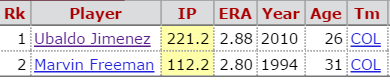
Here is a complete list of Rockies pitchers who have surpassed 200 IP in a season, sorted by their ERAs. Notice how by ERA+ many of those seemingly pedestrian seasons were actually well above league average when you factor in the Coors effect.


And this is a complete list of Rockies pitchers who have posted sub-3.00 ERAs and qualified for the ERA title.


The Colorado Rockies have only existed for 25 years, but it's safe to say that Ubaldo Jimenez owns the most (only?) dominant season in the team's history. That doesn't change the fact that the O's are paying him $13 million for what's shaping up to be a -2 WAR season, but it makes it a little easier to swallow knowing that Jimenez is kinda, sort of a legend.


29 June 2016

Jonathan Schoop Is Breaking OBP


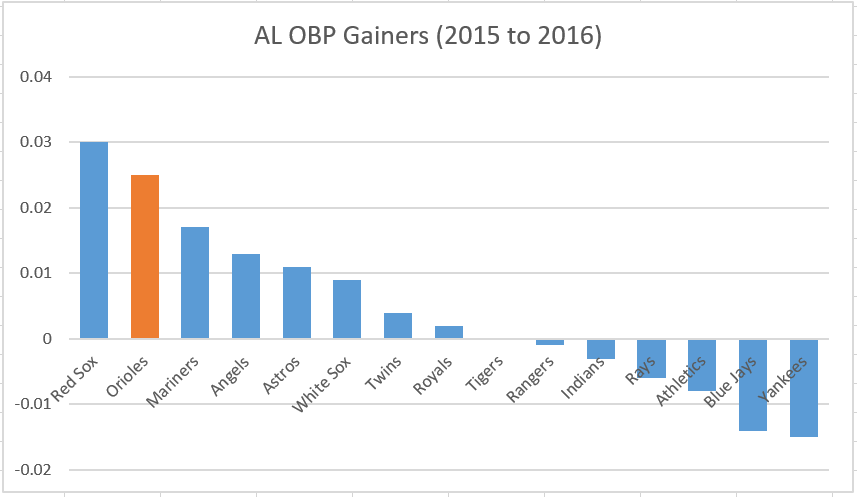
2015 is not 2016 in Baltimore. If the two seasons were made into one of those "spot the difference" games, the first thing you would notice is the homers. The O's lead all of baseball in bombs, and are close to breaking the major league record for home runs hit in a single month. But if you've been watching closely, the most glaring difference has been the men on base. The glorious men on base. The 2015 squad finished third in homers, but 24th in OBP (.307). Through almost three months, the 2016 Orioles have the second highest OBP in the AL with a .332 mark.


The Red Sox are the only AL team with a higher OBP, and the only AL team with a bigger gain in OBP from 2015 to 2016. There are many ways to get on base, and therefore many ways to raise your on-base percentage, but in general drawing more walks is the best way to go about it. And if we look at the teams that have improved in walk rate, we see a pretty strong correlation with the OBP gainers.


The Rays and the Jays are the only teams that have improved on their BB% and declined in OBP. The Royals (of course) are the only team that have posted a worse BB% but improved in OBP. So, unless you are following the Royals formula and making a ton of contact with speedy, high BABIP guys, then any increase in OBP is probably being fueled in large part thanks to a bump in your BB%. 

It's an intuitive concept to grasp, and it seems like everyone on the O's got the memo except for Jonathan Schoop. He actually has raised his BB% by a full percentage point this year. The only issue is that he raised it from 2.8% to 3.8%. For context, league average thus far is at around 8.4%. Walks have trended down over the last decade as strikeouts have risen, but any way you slice it, 3.8% is not good. 


And yet, somehow Schoop's OBP is currently sitting at .322. That isn't particularly good, but it's average, and that's all the O's need from him. To put it into perspective, Schoop's OBP beats out teammate Pedro Alvarez (.315) despite him having a BB% almost 7% lower than Alvarez. 

Schoop's inability to walk has always been troubling, but if he's found a way to get on base at a league-average rate despite his low walk rate, that eliminates arguably his biggest weakness and turns him all of a sudden into a complete player that could put up 3.0 WAR seasons at second base for years to come. 

Still, that's a big 'what if'. Without good speed, a .320 OBP is not easy to sustain with a 3.8 BB%. Looking at the underlying stats, the increase in OBP has been fed by a higher average that in turn has been supported by a .335 BABIP. While Schoop hits the ball hard enough to generate an above average BABIP, his career mark of .317 indicates a batting average regression is coming. So unless he starts getting hit by pitches regularly, the OBP should come down to around .300 by the end of the season. 

I did find two interesting adjustments that pitchers are making this season in response to Schoop's pitiful 2015 walk rate. First, Schoop is seeing 6.4% fewer fastballs according to PITCHf/x, which is a product of his .779 OPS vs. hard stuff / .635 OPS vs. soft stuff for his career. Second, Schoop has seen 6% more pitches in the strikezone (Zone%) this season compared to last, according to Baseball Info Solutions. In fact, his 48.8 Zone% is among the highest in baseball this season, which means that pitchers aren't afraid to give him a pitch to hit because they know he swings and misses a ton (his 17.5 SwStr would have led baseball last season if he had enough PA to qualify) and has poor discipline. 

But while he has continued to swing and miss a ton, he is taking the lemons and making lemonade. He's increased his contact percentage on pitches in the zone (Z-Contact%) by almost 5%, which has been a big reason behind his overall bump in Contact%. Baseball is a game of adjustments, and you can bet that pitchers will collectively dial back that Zone% as they realize that Schoop has the ability to do damage given enough pitches in the zone.   

Lastly, I thought it would be interesting to look at other players this season who have been valuable despite low walk rates. I set the WAR floor at 1.0 and the BB% ceiling at 5% and filtered to find these names.


Salvador Perez and J.T. Realmuto aren't the best comps because they get a big positional adjustment boost for being catchers. Starling Marte and Eduardo Nunez rely on their exceptional speed to get on base. Kevin Pillar fills up the WAR bucket almost entirely with his stellar center field defense. That leaves us with Adam Duvall and Rougned Odor. Both are intriguing comparisons. Odor obviously has speed but the fact that they're both second baseman who hit the ball hard brings them closer. Duvall is a more disciplined hitter but has very similar Soft/Med/Hard hit rates to Schoop. 

Regardless of which is the better comp, expect Schoop's OBP to come down to around Odor and Duvall's level (in the .290 to .300 range) as pitchers adjust and his BABIP regresses.