Before Andrew Casher signed with the Orioles, he already reminded some people of Yovani Gallardo. It probably had something to do with this:
Gallardo in 2015: 184.1 IP, 3.42 ERA, 4.00 FIP, 5.91 K/9, 3.32 BB/9
Cashner in 2017: 166.2 IP, 3.40 ERA, 4.61 FIP, 4.64 K/9, 3.46 BB/9
That was Gallardo's season with the Rangers before signing with the O's and Cashner's pitching line from last season. Cashner's numbers aren't as good (just looking at ERA only can be misleading), but they're a little closer if you instead look at each pitcher's last three seasons before joining the O's:
Cashner previous 3 years: 483.1 IP, 4.26 ERA, 4.38 FIP, 6.8 K/9, 3.5 BB/9
Gallardo previous 3 years: 557.1 IP, 3.70 ERA, 3.95 FIP, 6.6 K/9, 3.0 BB/9
Simply scouting the stat line performance alone, Gallardo is still the winner. He threw more innings and has slightly better peripheral stats. You can see why the O's wanted Gallardo. And considering the state of the team's starting rotation, you can see why the O's want Cashner.
That doesn't mean the signing is a sure-fire win. It's not because there are, of course, red flags. Bringing in a pitcher with a K/9 under 5 is not reassuring. Cashner has never thrown more than 185 innings in any season. And in his only season in the American League, he posted a 3.40 ERA that was rather fluky and that he's unlikely to replicate. As Jon discussed on Thursday, Cashner as a No. 5 starter sounds a whole lot better than a No. 3.
Still, while it's not hard to paint a picture of Cashner going off the rails in Baltimore like Gallardo did, the O's at least did not pay Gallardo prices. Comparing the career workloads for both when they signed with the O's, Gallardo had thrown about 580 more innings than Cashner. Gallardo deserves credit for being a workhouse, but that larger workload was a concern.
Gallardo's original deal with the O's for three years and $35 million dropped down to two years and $22 million (with a $13 million club option) after the O's oft-criticized (usually unfairly) physical process revealed a shoulder issue of some kind. (Gallardo hasn't been the same pitcher since.) The bargain improved the deal somewhat, but there were still injury worries. On top of that, the O's had to sacrifice the No. 14 overall pick in the 2016 MLB Draft because Gallardo had been offered the qualifying offer by the Rangers. The O's also tried to add Dexter Fowler in order to sign two QO free agents, like they had done with Ubaldo Jimenez and Nelson Cruz in 2014 to double-up and decrease the loss of the draft picks, but that plan fell through.
Gallardo had the better track record when he signed with the Orioles, but he signed a larger contract and had an apparent shoulder concern to worry about. Cashner, meanwhile, hasn't performed as well, but he hasn't thrown as many innings (both a good and bad thing) and signed for less money two years later. While some of that can be credited to the painfully slow offseason and perhaps some kind of referendum on the pursuit of free agents, waiting around and hoping for smaller deals is far from new to the Orioles under Dan Duquette.
It would not be surprising at all to see Cashner post an ERA over 5 in 2018. In his first year in Baltimore, Gallardo put up a 5.42 ERA in just 118 innings. Considering that performance and the options around him not named Bundy and Gausman, Cashner doesn't have to pitch that well to be useful. Still, hopefully the O's have another signing to make, preferably bringing in a pitcher who's better than Cashner.
Showing posts with label Yovani Gallardo. Show all posts
Showing posts with label Yovani Gallardo. Show all posts
16 February 2018
12 May 2017
Seth Smith Acquisition Is Paying Dividends
In a move that was roundly praised during the offseason, the Orioles added Seth Smith from the Mariners in exchange for Yovani Gallardo and cash (about $2 million). Because of the difference in salaries, the trade netted the O's some minimal cost savings as well. In terms of roster construction, the deal was at least a little curious. At the time, the O's seemed to be in the market for speed and better outfield defense. The O's also struggled when facing left-handed pitching in 2016, yet still made the move for Smith, a hitter who wears out right-handed pitching but doesn’t bring much else to the table.
Even though the O’s were and still are somewhat thin in the starting rotation (though they do have a seemingly endless supply of long relievers riding the Norfolk shuttle), it made sense to dump Gallardo, who was terrible and not 100 percent healthy in his first and only season in Baltimore. And the O’s were not only able to shed Gallardo, but able to land a competent player in Smith at the same time. (To Gallardo's credit, he's throwing harder this year, seems healthy, and has been decent.) It's hard to find an ideal fit when you're trying to dump a player that you don't want, but it's hard to argue that the O's could have done much better (except, you know, how the whole signing Gallardo part went in the first place).
The Orioles have not just received a good hitter in Smith, but one who has, so far, flourished in his leadoff hitter role. While playing almost exclusively against right-handed pitching -- 73 of his 75 plate appearances have come against right-handers -- Smith has been on a tear since the start of the season. His 160 wRC+ leads the club (he's two points ahead of Trey Mancini), and he’s consistently been on base. His .400 on-base percentage leads the team, comfortably ahead of Jonathan Schoop (.355).
A few things stand out when digging into Smith's batted ball and plate discipline data a bit (keep in mind, though, that it's only mid-May). He's pulling the ball half the time (career 43.1%), hitting the ball harder (38.5% hard-hit balls compared to 32.3% for his career), and avoiding weak contact (7.7% soft-hit balls compared to a 15.6% career mark). Among players with at least 50 plate appearances, that soft contact percentage is tied for sixth lowest in the majors.
Just take a look at Smith's zone breakdown in terms of exit velocity, courtesy of Baseball Savant. The first chart is 2016, and the next one is so far in 2017:


That's a lot more red, and a lot less blue.
As you'd expect, Smith is seeing the ball well and making lots of contact. He's not chasing as many pitches, swinging a bit less overall, and making a ton of contact when he does swing outside the zone (74.4% vs. 62.4% for his career).
Here’s the part you probably expected: Smith is unlikely to keep hitting this well, so who knows how long this will continue. He’s riding a BABIP of .347 (career .301), and he’s never posted a wRC+ above 131. While the O’s have to love Smith performing 60 percent better than the league average hitter, they’d certainly take 30 percent as well.
Bringing Smith on board was a smart move, but maybe it seemed like more of a luxury addition considering the rest of the Orioles' collection of outfielders. Smith has clearly been a useful left-handed bat, though, in a lineup that is frequently finding itself without the team’s other left-handed hitting outfielder, Hyun Soo Kim. Smith is providing the on-base skills that Kim demonstrated last season, but with more power.
Kim could be on the move at some point during this season, but Smith isn't going anywhere. And if he keeps this up, he'll be the Orioles' latest success story in getting the most out of an undervalued player.
Even though the O’s were and still are somewhat thin in the starting rotation (though they do have a seemingly endless supply of long relievers riding the Norfolk shuttle), it made sense to dump Gallardo, who was terrible and not 100 percent healthy in his first and only season in Baltimore. And the O’s were not only able to shed Gallardo, but able to land a competent player in Smith at the same time. (To Gallardo's credit, he's throwing harder this year, seems healthy, and has been decent.) It's hard to find an ideal fit when you're trying to dump a player that you don't want, but it's hard to argue that the O's could have done much better (except, you know, how the whole signing Gallardo part went in the first place).
The Orioles have not just received a good hitter in Smith, but one who has, so far, flourished in his leadoff hitter role. While playing almost exclusively against right-handed pitching -- 73 of his 75 plate appearances have come against right-handers -- Smith has been on a tear since the start of the season. His 160 wRC+ leads the club (he's two points ahead of Trey Mancini), and he’s consistently been on base. His .400 on-base percentage leads the team, comfortably ahead of Jonathan Schoop (.355).
A few things stand out when digging into Smith's batted ball and plate discipline data a bit (keep in mind, though, that it's only mid-May). He's pulling the ball half the time (career 43.1%), hitting the ball harder (38.5% hard-hit balls compared to 32.3% for his career), and avoiding weak contact (7.7% soft-hit balls compared to a 15.6% career mark). Among players with at least 50 plate appearances, that soft contact percentage is tied for sixth lowest in the majors.
Just take a look at Smith's zone breakdown in terms of exit velocity, courtesy of Baseball Savant. The first chart is 2016, and the next one is so far in 2017:
That's a lot more red, and a lot less blue.
As you'd expect, Smith is seeing the ball well and making lots of contact. He's not chasing as many pitches, swinging a bit less overall, and making a ton of contact when he does swing outside the zone (74.4% vs. 62.4% for his career).
Here’s the part you probably expected: Smith is unlikely to keep hitting this well, so who knows how long this will continue. He’s riding a BABIP of .347 (career .301), and he’s never posted a wRC+ above 131. While the O’s have to love Smith performing 60 percent better than the league average hitter, they’d certainly take 30 percent as well.
Bringing Smith on board was a smart move, but maybe it seemed like more of a luxury addition considering the rest of the Orioles' collection of outfielders. Smith has clearly been a useful left-handed bat, though, in a lineup that is frequently finding itself without the team’s other left-handed hitting outfielder, Hyun Soo Kim. Smith is providing the on-base skills that Kim demonstrated last season, but with more power.
Kim could be on the move at some point during this season, but Smith isn't going anywhere. And if he keeps this up, he'll be the Orioles' latest success story in getting the most out of an undervalued player.
07 January 2017
What To Know About Seth Smith
Click here for Ryan Romano's archives.
Our long, citywide nightmare — also known as The Yovani Gallardo Experience — is over. The owner of the fourth-highest cFIP in the majors will weigh down Seattle's rotation in 2017, as the Orioles dealt Gallardo to the Mariners yesterday in exchange for Seth Smith. The 34-year-old outfielder will make $7 million in 2017, thereby saving the Birds at least $6 million (Gallardo is due $11 million this year and has a $2 million buyout for next year).
Aside from salary, Smith appears to differ from Gallardo in three key regards:
He has a good eye, and possibly a great one.
The Orioles, as you may have heard, don't walk very much as a team — they've placed in the bottom half of the majors in free pass rate in the last four seasons. Strikeouts have become a problem as well in recent years: After putting up the 11th-highest K rate in the majors in 2014, Baltimore's been in the top 10 in 2015 and 2016. Plate discipline, in other words, is something for which the Orioles are wanting.
At the beginning of his career, Smith had some plate discipline. From 2007 to 2013, he swung at 27.8 percent of pitches outside the strike zone (the 214th-highest mark out of 429 qualified hitters), along with 61.6 percent of pitches inside the strike zone (233rd-highest); simultaneously, he made contact on 78.2 percent of his swings (134th-lowest). All that resulted in a 10.0 percent walk rate and 19.3 percent strikeout rate across those years — respectable figures, albeit nothing impressive.
But Smith became quite impressive in 2014, when he arrived in San Diego. That campaign, he reduced his O-Swing rate to the 18th-lowest among 146 qualified hitters, at 23.2 percent, while his Z-Swing rate dipped to the 34th-lowest at 59.2 percent. And he accomplished that as he made far more contact, posting the 69th-lowest figure in the majors at 81.1 percent. A more patient approach and better judgment on his swings gave Smith a superb 13.2 percent walk rate and 16.7 percent strikeout rate. His 0.79 BB/K ratio was on par with David Ortiz, and better than Edwin Encarnacion and Andrew McCutchen, among many others.
Did Smith undergo a legitimate breakout? That was the conclusion drawn by MLB.com's Corey Brock, FanGraphs' Matt Klaassen, The San Diego Union-Tribune's Dennis Lin, and others. These writers attributed Smith's improved plate discipline — which boosted his wRC+ to a career-best 131 — to the Lasik surgery he'd undergone the previous summer. It certainly seems that being able to see would help a hitter out. Maybe with sterling vision, Smith was finally reaching his potential.
Sadly, that narrative has deflated after two campaigns in humid Seattle. During 2015 and 2016, with his eyes presumably still intact from the surgery, Smith walked in 10.7 percent of his plate appearances, while striking out in 21.1 percent. His O-Swing rate (24.6 percent), Z-Swing rate (58.2 percent), and contact rate (76.4 percent) all began to regress toward his prior career levels. The breakout faded, and Smith returned to normal.
For 2017, what does this mean? The rational expectation is that Smith will maintain his 2015-16 level of play; that's what Steamer foresees, calling for a 10.7 percent walk rate and 21.2 percent strikeout rate. Still, the potential for a resurgence remains in place — plate discipline doesn't necessarily fade with age. If Smith remembers how to judge pitches again, he could again reach the Ortiz level of plate discipline.
He doesn't fare too well against fellow lefties.
Last offseason, after the Pirates non-tendered him, the Orioles reeled in Pedro Alvarez on a one-year deal. Though Alvarez threw right-handed, as virtually all nominal third basemen do, he hit from the left side of the plate. This meant he'd perform poorly when facing left-handed pitching — to such an extent that he'd be virtually unplayable against southpaws. Understanding this, Baltimore deployed Alvarez accordingly: He received only 42 plate appearances versus a left-hander last year, compared to 334 versus right-handers.
Smith, too, hits left-handed (although he also throws left-handed, which thankfully prevents him from manning third base and doing this). And like Alvarez, he's always come up short against same-handed opponents:
Smith's wRC+ against righties puts him 28th among 101 hitters with at least 3,000 plate appearances; he's tied with Evan Longoria and slightly ahead of Nelson Cruz. Meanwhile, his wRC+ against lefties ranks 322nd, in a sample of...327 hitters. So he does pretty well for himself when the pitcher throws with his right hand, and pretty terribly otherwise.
The BABIP and ISO troubles don't stem from an altered batted-ball distribution — Smith has an identical ground ball rate against righties and lefties. But he's made hard contact much more often off the former (33.5 percent) than the latter (24.4 percent). As with many platoon-hindered hitters, that's probably due to the location patterns he encounters:

Righties give Smith more pitches to hit, which he obviously capitalizes on. Lefties stay far, far away from him, thus preventing him from doing damage.
As with Alvarez, Smith's platoon split is most likely set in stone at this point — having turned 34 in September, Smith is what he is. With their new outfielder in the fold, the Orioles will likely have no need for Alvarez's services going forward; Smith will presumably team up with Joey Rickard in a corner outfield spot. If both players can maintain their solid production against opposite-handed pitching (Rickard had a 131 wRC+ off southpaws as a rookie), Baltimore will have a reliable platoon supporting its lineup.
He excelled in the first half of 2016, then struggled in the second half.
Like another former Oriole and current free agent, Smith started 2016 off on the right foot. He sailed to a .298/.423/.544 batting line and 166 wRC+ in April, and although he couldn't match that in the subsequent months, he still entered the All-Star Break with a .277/.366/.450 triple-slash and 127 wRC+ to his name. When he came back, though, things took a turn for the worse: Smith limped his way to a .202/.306/.361 line in the second half, good for a measly 85 wRC+.
Smith's decline in the later months of 2016 wasn't really because of plate discipline — while his strikeout rate rose from 19.4 percent to 21.8 percent, his walk rate also went up from 10.8 to 11.2 percent. He appeared to fall off thanks to his ISO, which sunk from .173 to .156, and his BABIP, which plummeted from .310 to .236. Without his power and average, no amount of plate discipline could save Smith.
Did Smith stand any chance of sustaining his first-half numbers, or was the decline destined to happen? His ground ball rate didn't change much from before the All-Star Break (48.1 percent) to afterward (47.7 percent), nor did he lose a great deal of hard contact (34.6 percent first half, 32.4 percent second half). But he did undergo a massive change in one regard: His popup rate doubled, from 2.8 percent to 5.4 percent after the Midsummer Classic. Infield fly balls almost always turn into outs, so that obviously put a damper on Smith's season.
Smith's second-half struggles were in large part unlucky. It's plausible he puts them behind him and returns to his first-half level of play, thus breaking out in 2017 (although we saw how well that thinking worked out in 2014). On the flipside, the popup problem could remain in place, which would continue to depress Smith's BABIP and ISO. The hard contact and ground ball consistency should help his cause, but if he can't hit his air balls out of the infield, he'll be stuck as a mediocre hitter.
His defense fell off a cliff in 2016.
From 2012 — his first year outside Colorado, which some evidence suggests may skew defensive metrics — to 2015, Smith compiled 2,794.1 innings in the outfield. In that time, he earned 6 Defensive Runs Saved and 6.2 Ultimate Zone Rating runs, which averaged out to 2.8 DRS/1300 and 2.9 UZR/1300 (about a full year's worth of innings). In other words, he was a modestly above-average corner outfielder, which coupled with his talent at the plate to make him a decent player.
That success didn't carry over into 2016, though. Last season, despite spending only 730.0 innings in the outfield, he cost the Mariners 7 DRS and 7.9 UZR, translating to 12.5 DRS/1300 and 14.1 UZR/1300. On a rate basis, Smith dropped off by more than a win and a half, which despite the small-sample caveats that come with defensive metrics is cause for concern.
How does FanGraphs' Inside Edge data appraise his decline? (As a primer: Inside Edge scouts put each play into one of six buckets, based on how often an average fielder would make it, then evaluate how often the defender in question succeeds on such plays. It's simpler than it sounds, trust me.) Let's look at his results from 2012 through 2015, and from 2016:
The plays in the 90-100 percent bucket — referred to as "routine" — make up the majority of all plays a fielder will encounter, so even the smallest change there can portend a larger shift in overall output. This might not be the case for Smith, though, as he failed to make just one of the 150 "routine" plays he faced last year.
Rather, the more difficult plays seem to have caused Smith's problems in 2016. He couldn't field anything in the 1-10 percent bucket ("remote") or the 10-40 percent bucket ("unlikely"), and his clip of 40-60 percent successes ("even") was cut in half. This trend points to an unsettling culprit: Father Time. Smith still knows how to position himself to handle the easy plays, but as he enters his mid-30s he may be losing the speed and instincts necessary for the tougher ones.
This may not be the sole cause. While Smith's generally kept himself healthy, he dealt with a groin injury earlier in the season, which might have hampered his performance in the outfield. Convalescing from that, with a full offseason to rest and rehab, might allow him to return to the field an above-average defender again. And, of course, this did all happen in a mere 730.0 innings; perhaps the Inside Edge scouts misjudged a few plays and screwed up Smith's numbers. From what we know about defensive aging curves, though, we shouldn't be too optimistic about Smith's glove going forward.
***
Let's wrap up with some glass-half-full analysis. Smith is a satisfactory outfielder: He can take a walk (and won't strike out too often), he hits righties well, and he might have some upside if he can rediscover his early-2016 magic, which will hopefully compensate for a possible defensive decline. With the $4 million they'll save this year, maybe the O's can bring in a fifth starter to shore up their rotation, or a right-handed outfielder to pair with Hyun Soo Kim. With just one trade, Dan Duquette partially filled a gaping hole on his roster and got rid of an albatross — I guess it was worth the wait.
Our long, citywide nightmare — also known as The Yovani Gallardo Experience — is over. The owner of the fourth-highest cFIP in the majors will weigh down Seattle's rotation in 2017, as the Orioles dealt Gallardo to the Mariners yesterday in exchange for Seth Smith. The 34-year-old outfielder will make $7 million in 2017, thereby saving the Birds at least $6 million (Gallardo is due $11 million this year and has a $2 million buyout for next year).
Aside from salary, Smith appears to differ from Gallardo in three key regards:
- He's a hitter;
- he's a lefty; and
- he's a competent major league baseball player.
He has a good eye, and possibly a great one.
The Orioles, as you may have heard, don't walk very much as a team — they've placed in the bottom half of the majors in free pass rate in the last four seasons. Strikeouts have become a problem as well in recent years: After putting up the 11th-highest K rate in the majors in 2014, Baltimore's been in the top 10 in 2015 and 2016. Plate discipline, in other words, is something for which the Orioles are wanting.
At the beginning of his career, Smith had some plate discipline. From 2007 to 2013, he swung at 27.8 percent of pitches outside the strike zone (the 214th-highest mark out of 429 qualified hitters), along with 61.6 percent of pitches inside the strike zone (233rd-highest); simultaneously, he made contact on 78.2 percent of his swings (134th-lowest). All that resulted in a 10.0 percent walk rate and 19.3 percent strikeout rate across those years — respectable figures, albeit nothing impressive.
But Smith became quite impressive in 2014, when he arrived in San Diego. That campaign, he reduced his O-Swing rate to the 18th-lowest among 146 qualified hitters, at 23.2 percent, while his Z-Swing rate dipped to the 34th-lowest at 59.2 percent. And he accomplished that as he made far more contact, posting the 69th-lowest figure in the majors at 81.1 percent. A more patient approach and better judgment on his swings gave Smith a superb 13.2 percent walk rate and 16.7 percent strikeout rate. His 0.79 BB/K ratio was on par with David Ortiz, and better than Edwin Encarnacion and Andrew McCutchen, among many others.
Did Smith undergo a legitimate breakout? That was the conclusion drawn by MLB.com's Corey Brock, FanGraphs' Matt Klaassen, The San Diego Union-Tribune's Dennis Lin, and others. These writers attributed Smith's improved plate discipline — which boosted his wRC+ to a career-best 131 — to the Lasik surgery he'd undergone the previous summer. It certainly seems that being able to see would help a hitter out. Maybe with sterling vision, Smith was finally reaching his potential.
Sadly, that narrative has deflated after two campaigns in humid Seattle. During 2015 and 2016, with his eyes presumably still intact from the surgery, Smith walked in 10.7 percent of his plate appearances, while striking out in 21.1 percent. His O-Swing rate (24.6 percent), Z-Swing rate (58.2 percent), and contact rate (76.4 percent) all began to regress toward his prior career levels. The breakout faded, and Smith returned to normal.
For 2017, what does this mean? The rational expectation is that Smith will maintain his 2015-16 level of play; that's what Steamer foresees, calling for a 10.7 percent walk rate and 21.2 percent strikeout rate. Still, the potential for a resurgence remains in place — plate discipline doesn't necessarily fade with age. If Smith remembers how to judge pitches again, he could again reach the Ortiz level of plate discipline.
He doesn't fare too well against fellow lefties.
Last offseason, after the Pirates non-tendered him, the Orioles reeled in Pedro Alvarez on a one-year deal. Though Alvarez threw right-handed, as virtually all nominal third basemen do, he hit from the left side of the plate. This meant he'd perform poorly when facing left-handed pitching — to such an extent that he'd be virtually unplayable against southpaws. Understanding this, Baltimore deployed Alvarez accordingly: He received only 42 plate appearances versus a left-hander last year, compared to 334 versus right-handers.
Smith, too, hits left-handed (although he also throws left-handed, which thankfully prevents him from manning third base and doing this). And like Alvarez, he's always come up short against same-handed opponents:
| Handedness | PA | BB% | K% | ISO | BABIP | AVG | OBP | SLG | wRC+ |
|---|---|---|---|---|---|---|---|---|---|
| L | 558 | 9.3% | 22.9% | .109 | .251 | .202 | .282 | .312 | 60 |
| R | 3153 | 10.9% | 18.7% | .200 | .309 | .272 | .355 | .472 | 121 |
Smith's wRC+ against righties puts him 28th among 101 hitters with at least 3,000 plate appearances; he's tied with Evan Longoria and slightly ahead of Nelson Cruz. Meanwhile, his wRC+ against lefties ranks 322nd, in a sample of...327 hitters. So he does pretty well for himself when the pitcher throws with his right hand, and pretty terribly otherwise.
The BABIP and ISO troubles don't stem from an altered batted-ball distribution — Smith has an identical ground ball rate against righties and lefties. But he's made hard contact much more often off the former (33.5 percent) than the latter (24.4 percent). As with many platoon-hindered hitters, that's probably due to the location patterns he encounters:

Righties give Smith more pitches to hit, which he obviously capitalizes on. Lefties stay far, far away from him, thus preventing him from doing damage.
As with Alvarez, Smith's platoon split is most likely set in stone at this point — having turned 34 in September, Smith is what he is. With their new outfielder in the fold, the Orioles will likely have no need for Alvarez's services going forward; Smith will presumably team up with Joey Rickard in a corner outfield spot. If both players can maintain their solid production against opposite-handed pitching (Rickard had a 131 wRC+ off southpaws as a rookie), Baltimore will have a reliable platoon supporting its lineup.
He excelled in the first half of 2016, then struggled in the second half.
Like another former Oriole and current free agent, Smith started 2016 off on the right foot. He sailed to a .298/.423/.544 batting line and 166 wRC+ in April, and although he couldn't match that in the subsequent months, he still entered the All-Star Break with a .277/.366/.450 triple-slash and 127 wRC+ to his name. When he came back, though, things took a turn for the worse: Smith limped his way to a .202/.306/.361 line in the second half, good for a measly 85 wRC+.
Smith's decline in the later months of 2016 wasn't really because of plate discipline — while his strikeout rate rose from 19.4 percent to 21.8 percent, his walk rate also went up from 10.8 to 11.2 percent. He appeared to fall off thanks to his ISO, which sunk from .173 to .156, and his BABIP, which plummeted from .310 to .236. Without his power and average, no amount of plate discipline could save Smith.
Did Smith stand any chance of sustaining his first-half numbers, or was the decline destined to happen? His ground ball rate didn't change much from before the All-Star Break (48.1 percent) to afterward (47.7 percent), nor did he lose a great deal of hard contact (34.6 percent first half, 32.4 percent second half). But he did undergo a massive change in one regard: His popup rate doubled, from 2.8 percent to 5.4 percent after the Midsummer Classic. Infield fly balls almost always turn into outs, so that obviously put a damper on Smith's season.
Smith's second-half struggles were in large part unlucky. It's plausible he puts them behind him and returns to his first-half level of play, thus breaking out in 2017 (although we saw how well that thinking worked out in 2014). On the flipside, the popup problem could remain in place, which would continue to depress Smith's BABIP and ISO. The hard contact and ground ball consistency should help his cause, but if he can't hit his air balls out of the infield, he'll be stuck as a mediocre hitter.
His defense fell off a cliff in 2016.
From 2012 — his first year outside Colorado, which some evidence suggests may skew defensive metrics — to 2015, Smith compiled 2,794.1 innings in the outfield. In that time, he earned 6 Defensive Runs Saved and 6.2 Ultimate Zone Rating runs, which averaged out to 2.8 DRS/1300 and 2.9 UZR/1300 (about a full year's worth of innings). In other words, he was a modestly above-average corner outfielder, which coupled with his talent at the plate to make him a decent player.
That success didn't carry over into 2016, though. Last season, despite spending only 730.0 innings in the outfield, he cost the Mariners 7 DRS and 7.9 UZR, translating to 12.5 DRS/1300 and 14.1 UZR/1300. On a rate basis, Smith dropped off by more than a win and a half, which despite the small-sample caveats that come with defensive metrics is cause for concern.
How does FanGraphs' Inside Edge data appraise his decline? (As a primer: Inside Edge scouts put each play into one of six buckets, based on how often an average fielder would make it, then evaluate how often the defender in question succeeds on such plays. It's simpler than it sounds, trust me.) Let's look at his results from 2012 through 2015, and from 2016:
| Year(s) | 0% | 1-10% | 10-40% | 40-60% | 60-90% | 90-100% |
|---|---|---|---|---|---|---|
| 2012-15 | 0.0% | 5.0% | 16.7% | 25.0% | 92.0% | 99.8% |
| 2016 | 0.0% | 0.0% | 0.0% | 12.5% | 100.0% | 99.3% |
The plays in the 90-100 percent bucket — referred to as "routine" — make up the majority of all plays a fielder will encounter, so even the smallest change there can portend a larger shift in overall output. This might not be the case for Smith, though, as he failed to make just one of the 150 "routine" plays he faced last year.
Rather, the more difficult plays seem to have caused Smith's problems in 2016. He couldn't field anything in the 1-10 percent bucket ("remote") or the 10-40 percent bucket ("unlikely"), and his clip of 40-60 percent successes ("even") was cut in half. This trend points to an unsettling culprit: Father Time. Smith still knows how to position himself to handle the easy plays, but as he enters his mid-30s he may be losing the speed and instincts necessary for the tougher ones.
This may not be the sole cause. While Smith's generally kept himself healthy, he dealt with a groin injury earlier in the season, which might have hampered his performance in the outfield. Convalescing from that, with a full offseason to rest and rehab, might allow him to return to the field an above-average defender again. And, of course, this did all happen in a mere 730.0 innings; perhaps the Inside Edge scouts misjudged a few plays and screwed up Smith's numbers. From what we know about defensive aging curves, though, we shouldn't be too optimistic about Smith's glove going forward.
***
Let's wrap up with some glass-half-full analysis. Smith is a satisfactory outfielder: He can take a walk (and won't strike out too often), he hits righties well, and he might have some upside if he can rediscover his early-2016 magic, which will hopefully compensate for a possible defensive decline. With the $4 million they'll save this year, maybe the O's can bring in a fifth starter to shore up their rotation, or a right-handed outfielder to pair with Hyun Soo Kim. With just one trade, Dan Duquette partially filled a gaping hole on his roster and got rid of an albatross — I guess it was worth the wait.
15 April 2016
Yovani Gallardo Has Two Sliders
During his first start for the Orioles on April 11, Gallardo threw 96 pitches - 67 of which PITCHf/x determined to be sliders. A look at the movement of his 96 pitches (with gravity - this is what the batter saw) shows two very distinct clusters of sliders. One looks the way you might expect a slider to look: dropping lower in the zone, traveling from left to right across the plate. The other cluster stayed up, dropping about 10 inches with the help of Mother Nature, and never actually slid. Instead, the second bunch of sliders stayed straight. They look the way you would expect a fastball to look.

PITCHf/x classifications are determined today by algorithm, although it has been done by hand in the past. It's certainly possible that these are simple misclassifications as a result of that estimation model. Gallardo's fastball was only thrown about 4 miles per hour faster on average than his slider - a major difference, but one that can easily be spanned by arm fatigue. Gallardo's fastest slider on April 11 was thrown at 87.5 miles per hour. It's entirely conceivable that an algorithm could label an 87.5 mile per hour slider that doesn't slide as an 88 mile per hour fastball.
At the same time, Gallardo has a short bit of a history with these two types of sliders. The vast majority of Gallardo's straight sliders is from 2015 onward, indicating that he could have added a slider with a different spin and a different movement path to his arsenal. According to PITCHf/x, Gallardo is also increasing the number of sliders he throws every year. If there were a sudden spike in slider usage, I might be more apt to consider it a fluke pointing to an issue in the algorithm's ability to classify Gallardo's pitches.

This leaves three possibilities (or some combination thereof, I suppose) to explain why PITCHf/x thinks Gallardo is throwing so many sliders, and in two distinct types. The first is that PITCHf/x is simply misclassifying Gallardo's fastballs as sliders for some reason and with some regularity. The second is that Gallardo actually did throw an obscene amount of sliders on April 11 and that they have always been more common for him than fastballs, he just isn't getting the break on them the way we would want to see. The final possibility is that Gallardo actually has two sliders that he throws in two different ways, on purpose, for different effect.
John Walsh at the Hardball Times put together a helpful pitch identification primer in 2009, in which he describes sliders as generally falling between fastballs and curveballs in terms of both speed and movement. He also identifies sliders that don't have any horizontal spin or break at all, pitches with essentially no movement. Here's how he describes the specific subset of sliders that we are possibly seeing from Gallardo:
While it's pretty cool to throw the same pitch two ways for two different effects (which, uh, might make them two pitches?) - if that is the case - it hasn't necessarily helped Gallardo. His batting average allowed on decisive sliders - ones that ended the plate appearance - from 2012 through September 2015 is 0.239, while his slugging percentage on decisive sliders is 0.370. When it's broken into the two categories of sliders, it's clear that one is more helpful than the other.
Notice that Gallardo hasn't thrown what I called a straight slider very often over his career. However, 49 of those came in 2015 alone, and he looks to have thrown about 20 in his first 2016 start as well. While the straight slider hasn't burned Gallardo for extra bases yet, it's worth keeping an eye on. If he means to get movement across the plate, it's a major issue that Gallardo is suddenly less and less capable of doing so. If he is using a straight slider as a pseudo-fastball for some reason, batters seem able to hit it pretty well. Gallardo's next few starts for the O's may shed more light on whether he's actually throwing this many sliders and whether he's throwing straight ones on purpose. If the latter is true, we're probably in the process of watching Gallardo reinvent his pitch arsenal, and arguably to one that gives up more hits.

PITCHf/x classifications are determined today by algorithm, although it has been done by hand in the past. It's certainly possible that these are simple misclassifications as a result of that estimation model. Gallardo's fastball was only thrown about 4 miles per hour faster on average than his slider - a major difference, but one that can easily be spanned by arm fatigue. Gallardo's fastest slider on April 11 was thrown at 87.5 miles per hour. It's entirely conceivable that an algorithm could label an 87.5 mile per hour slider that doesn't slide as an 88 mile per hour fastball.
At the same time, Gallardo has a short bit of a history with these two types of sliders. The vast majority of Gallardo's straight sliders is from 2015 onward, indicating that he could have added a slider with a different spin and a different movement path to his arsenal. According to PITCHf/x, Gallardo is also increasing the number of sliders he throws every year. If there were a sudden spike in slider usage, I might be more apt to consider it a fluke pointing to an issue in the algorithm's ability to classify Gallardo's pitches.

This leaves three possibilities (or some combination thereof, I suppose) to explain why PITCHf/x thinks Gallardo is throwing so many sliders, and in two distinct types. The first is that PITCHf/x is simply misclassifying Gallardo's fastballs as sliders for some reason and with some regularity. The second is that Gallardo actually did throw an obscene amount of sliders on April 11 and that they have always been more common for him than fastballs, he just isn't getting the break on them the way we would want to see. The final possibility is that Gallardo actually has two sliders that he throws in two different ways, on purpose, for different effect.
John Walsh at the Hardball Times put together a helpful pitch identification primer in 2009, in which he describes sliders as generally falling between fastballs and curveballs in terms of both speed and movement. He also identifies sliders that don't have any horizontal spin or break at all, pitches with essentially no movement. Here's how he describes the specific subset of sliders that we are possibly seeing from Gallardo:
[I]f the axis of spin is aligned with the direction of the pitch (like a football toss, or a … gyroball), there will be no break. I believe this is what we are seeing when we see a pitch with no movement. I wouldn’t call these gyroballs, by the way. Or maybe I should—in any case, a number of different pitchers throw sliders that fit the description, and I don’t believe it’s anything new.
While it's pretty cool to throw the same pitch two ways for two different effects (which, uh, might make them two pitches?) - if that is the case - it hasn't necessarily helped Gallardo. His batting average allowed on decisive sliders - ones that ended the plate appearance - from 2012 through September 2015 is 0.239, while his slugging percentage on decisive sliders is 0.370. When it's broken into the two categories of sliders, it's clear that one is more helpful than the other.
Pitch Type
|
Times
Thrown
|
Batting
Average
|
Slugging
Percentage
|
|---|---|---|---|
Traditional Slider
|
3,987
|
0.233
|
0.359
|
Straight Slider
|
61
|
0.328
|
0.361
|
 |
| Pitches in red are what I'm calling Straight Sliders. |
29 March 2016
Best And Worst Cases For The Orioles' Rotation
In case you haven't been paying close attention, or are in a constant state of denial, the Orioles have some serious starting rotation question marks. FanGraphs has been posting its 2016 positional power rankings series, and the O's starting rotation options ranked 28th in the majors.
That low ranking should not come as a surprise. With Chris Tillman, Ubaldo Jimenez, Yovani Gallardo, and Miguel Gonzalez, the O's have some decent starting pitchers, but none who should be considered superb or an ace. Then there's Kevin Gausman, who has the highest upside of anyone in the group and the potential to be a front-line arm. But he's also dealing with shoulder tendinitis, and he'll begin the year on the disabled list.
To round out the current starting options, Tyler Wilson and Mike Wright are seemingly in a constant -- but friendly! -- battle to take over for whomever in the group falters or gets injured (depending on Gausman's status in a few weeks). Then, in some order, there's Vance Worley, T.J. McFarland, Odrisamer Despaigne, Parker Bridwell, and Chris Lee. And in the impatient/pipe-dream category, there's Dylan Bundy. The Orioles could always acquire another starter, so things could change quickly.
Besides the rotation, the O's have the makings of a solid team. The offense, which doesn't have a bunch of high on-base types but does have lots of power bats, should feature plenty of homers and still score lots of runs. Defensively, the O's project to be pretty good in the infield. Mark Trumbo's defense is a serious concern in right field, but Adam Jones should at least be adequate in center. Left field is currently a question mark. Joey Rickard, the talk of O's camp, is a lock to make the opening day roster and at least comes with the reputation of a strong defensive outfielder. And despite being heavily relied on yet again, the bullpen should again be one of the best in the American League.
Things don't always go according to plan, but it sure seems like the starting rotation is the main issue holding the Orioles back from competing for the AL East crown. If you read any season preview of the Orioles, it won't take long to get to the team's starting rotation woes.
Anyway, you know what the projections say, and it isn't good. So let's take a hypothetical look at the best and worst cases for the O's projected rotation.
Chris Tillman
Tillman gets the nod on opening day for the Orioles. Because, you know, someone has to do it. The BABIP gods struck back against Tillman a bit last year (.293) after posting below average numbers the two years prior (.269 and .267, respectively). That could have something to do with him slowly becoming more of a groundball pitcher and incorporating a sinker. In his three full-time seasons, he's gone from 39% to 41% to 44%, which is an interesting shift. Still, Tillman doesn't miss enough bats and isn't efficient enough in limiting walks or generating ground balls to be considered anything better than a back-end arm.
You could see things breaking right for him and Tillman posting a similar season to 2014, when he had a 3.34 ERA despite peripheral numbers that suggested he wasn't that good. That year, he had an fWAR of 2.4. That's probably the best case. Worst case? Probably something like last year's 4.99 ERA and 1.9 fWAR, with the frightening potential to somehow underperform even those numbers.
Ubaldo Jimenez
You never know precisely what you're getting with Jimenez. And that should be well documented by now. He's consistently inconsistent (another way of saying he's somewhere between average and above average), and from start to start can look like a completely different pitcher. O's fans have already seen the worst-case version of Jimenez: the 2014 edition, with a 4.81 ERA that essentially matched his performance, a ridiculous amount of walks (5.53 BB/9), and many fewer generated ground balls. That year, he posted an fWAR of 0.4, and it's hard to imagine him being worse.
Jimenez's best-case scenario is something close to 3 fWAR -- so a bit better than last year, when he cut his walks by more than two per nine innings and posted his highest groundball percentage since 2009.
Yovani Gallardo
Gallardo is a good pitcher with a proven track record, and he makes the Orioles slightly better. But looking beyond ERA, his declining strikeout rates are noteworthy, his decreasing velocity is concerning, and a concern with his shoulder that was revealed during the O's physical process led to a restructured two-year deal (with an option).
Gallardo hasn't posted a 3+ fWAR season since 2011, but the Orioles would be thrilled to get anything within the 2.5-3 fWAR range in 2016. But there's always the chance that this is the year when he's unable to limit the amount of damage and his low strikeout totals start to haunt him. In that case, something closer to an fWAR of 1 seems possible, and would be problematic.
Kevin Gausman
Gausman is the youngest of the group, and he also has the biggest chance to be a difference maker. Unfortunately, it's getting dangerously close to that time of worrying if he'll ever live up to his draft position and hype. He'll start the year on the disabled list, but there's optimism that he will be able to pitch pain-free soon. The Orioles are more or less counting on him to take a huge step forward, even if everything they've done with him the past few seasons wasn't exactly in his best interest. It's not like the Orioles deserve the benefit of the doubt when it comes to grooming pitching prospects.
A full season building off what he did last year, while being better at keeping the ball in the ballpark, would surely be welcomed. Gausman's has top-of-the-rotation upside, so an fWAR above 3 is certainly within reason if he's able to come back healthy and avoid any injury concerns. Then again, injury issues could plague him the entire year, or perhaps he starts the year and is ineffective enough to warrant another ride on the Norfolk shuttle. If Gausman's not able to put everything together this year, it may be time to wonder if the O's eventually deal him away.
Miguel Gonzalez
Gonzalez has been awful this spring, and he was some combination of bad and injured last season. Depending on what you believe (and because he can be optioned), he's in a close battle with Tyler Wilson and Mike Wright for fifth starter duties. It's been a marvel to watch Gonzalez outperform his peripherals every year -- until last year, at least. If you want to give him the benefit of the doubt for pitching through pain, that's fine. It's not like his peripherals were all that different from years past, though his inability to limit the damage with runners on base cost him dearly.
Because he never rates well in fielding independent metrics, Gonzalez has never posted an fWAR over 1.6. So that would likely be his best-case scenario: something close to 175 innings and an ERA in the 3.5-3.75 range. The worst case is that he's ineffective early on, quickly loses his rotation spot, and is unable to rekindle what worked for him from 2012-2014. Even if that ends up being the case, he'll be regarded as one of the best finds and surprises of the Buck Showalter/Dan Duquette era.
-----
It's not a good sign when a large portion of a team's starting rotation needs to rebound considerably. And it's tough to overlook the starting rotation woes. But it is possible to still be positive about this team, and that's because starting rotation questions are nothing new for the Orioles under Buck Showalter.
Go back and look at other rotation options during Showalter's tenure. Rotation mainstay Wei-Yin Chen is gone, but there really is not much of substance there. There are names like Jason Hammel, Tillman, Gonzalez, Tommy Hunter, Joe Saunders, McFarland, Jake Arrieta (before he became Jake Arrieta), Scott Feldman, Bud Norris, Freddy Garcia, Jimenez, Gausman, and several others (none of them amazing).
Frustratingly, things have not changed much. It's an uphill battle to overcome a lack of quality starting pitching. But it's hardly impossible, even if it's occasionally hard to watch. And I can guarantee you that it will be very tough to watch at times this season.
That low ranking should not come as a surprise. With Chris Tillman, Ubaldo Jimenez, Yovani Gallardo, and Miguel Gonzalez, the O's have some decent starting pitchers, but none who should be considered superb or an ace. Then there's Kevin Gausman, who has the highest upside of anyone in the group and the potential to be a front-line arm. But he's also dealing with shoulder tendinitis, and he'll begin the year on the disabled list.
To round out the current starting options, Tyler Wilson and Mike Wright are seemingly in a constant -- but friendly! -- battle to take over for whomever in the group falters or gets injured (depending on Gausman's status in a few weeks). Then, in some order, there's Vance Worley, T.J. McFarland, Odrisamer Despaigne, Parker Bridwell, and Chris Lee. And in the impatient/pipe-dream category, there's Dylan Bundy. The Orioles could always acquire another starter, so things could change quickly.
Besides the rotation, the O's have the makings of a solid team. The offense, which doesn't have a bunch of high on-base types but does have lots of power bats, should feature plenty of homers and still score lots of runs. Defensively, the O's project to be pretty good in the infield. Mark Trumbo's defense is a serious concern in right field, but Adam Jones should at least be adequate in center. Left field is currently a question mark. Joey Rickard, the talk of O's camp, is a lock to make the opening day roster and at least comes with the reputation of a strong defensive outfielder. And despite being heavily relied on yet again, the bullpen should again be one of the best in the American League.
Things don't always go according to plan, but it sure seems like the starting rotation is the main issue holding the Orioles back from competing for the AL East crown. If you read any season preview of the Orioles, it won't take long to get to the team's starting rotation woes.
Anyway, you know what the projections say, and it isn't good. So let's take a hypothetical look at the best and worst cases for the O's projected rotation.
Chris Tillman
Tillman gets the nod on opening day for the Orioles. Because, you know, someone has to do it. The BABIP gods struck back against Tillman a bit last year (.293) after posting below average numbers the two years prior (.269 and .267, respectively). That could have something to do with him slowly becoming more of a groundball pitcher and incorporating a sinker. In his three full-time seasons, he's gone from 39% to 41% to 44%, which is an interesting shift. Still, Tillman doesn't miss enough bats and isn't efficient enough in limiting walks or generating ground balls to be considered anything better than a back-end arm.
You could see things breaking right for him and Tillman posting a similar season to 2014, when he had a 3.34 ERA despite peripheral numbers that suggested he wasn't that good. That year, he had an fWAR of 2.4. That's probably the best case. Worst case? Probably something like last year's 4.99 ERA and 1.9 fWAR, with the frightening potential to somehow underperform even those numbers.
Ubaldo Jimenez
You never know precisely what you're getting with Jimenez. And that should be well documented by now. He's consistently inconsistent (another way of saying he's somewhere between average and above average), and from start to start can look like a completely different pitcher. O's fans have already seen the worst-case version of Jimenez: the 2014 edition, with a 4.81 ERA that essentially matched his performance, a ridiculous amount of walks (5.53 BB/9), and many fewer generated ground balls. That year, he posted an fWAR of 0.4, and it's hard to imagine him being worse.
Jimenez's best-case scenario is something close to 3 fWAR -- so a bit better than last year, when he cut his walks by more than two per nine innings and posted his highest groundball percentage since 2009.
Yovani Gallardo
Gallardo is a good pitcher with a proven track record, and he makes the Orioles slightly better. But looking beyond ERA, his declining strikeout rates are noteworthy, his decreasing velocity is concerning, and a concern with his shoulder that was revealed during the O's physical process led to a restructured two-year deal (with an option).
Gallardo hasn't posted a 3+ fWAR season since 2011, but the Orioles would be thrilled to get anything within the 2.5-3 fWAR range in 2016. But there's always the chance that this is the year when he's unable to limit the amount of damage and his low strikeout totals start to haunt him. In that case, something closer to an fWAR of 1 seems possible, and would be problematic.
Kevin Gausman
Gausman is the youngest of the group, and he also has the biggest chance to be a difference maker. Unfortunately, it's getting dangerously close to that time of worrying if he'll ever live up to his draft position and hype. He'll start the year on the disabled list, but there's optimism that he will be able to pitch pain-free soon. The Orioles are more or less counting on him to take a huge step forward, even if everything they've done with him the past few seasons wasn't exactly in his best interest. It's not like the Orioles deserve the benefit of the doubt when it comes to grooming pitching prospects.
A full season building off what he did last year, while being better at keeping the ball in the ballpark, would surely be welcomed. Gausman's has top-of-the-rotation upside, so an fWAR above 3 is certainly within reason if he's able to come back healthy and avoid any injury concerns. Then again, injury issues could plague him the entire year, or perhaps he starts the year and is ineffective enough to warrant another ride on the Norfolk shuttle. If Gausman's not able to put everything together this year, it may be time to wonder if the O's eventually deal him away.
Miguel Gonzalez
Gonzalez has been awful this spring, and he was some combination of bad and injured last season. Depending on what you believe (and because he can be optioned), he's in a close battle with Tyler Wilson and Mike Wright for fifth starter duties. It's been a marvel to watch Gonzalez outperform his peripherals every year -- until last year, at least. If you want to give him the benefit of the doubt for pitching through pain, that's fine. It's not like his peripherals were all that different from years past, though his inability to limit the damage with runners on base cost him dearly.
Because he never rates well in fielding independent metrics, Gonzalez has never posted an fWAR over 1.6. So that would likely be his best-case scenario: something close to 175 innings and an ERA in the 3.5-3.75 range. The worst case is that he's ineffective early on, quickly loses his rotation spot, and is unable to rekindle what worked for him from 2012-2014. Even if that ends up being the case, he'll be regarded as one of the best finds and surprises of the Buck Showalter/Dan Duquette era.
-----
It's not a good sign when a large portion of a team's starting rotation needs to rebound considerably. And it's tough to overlook the starting rotation woes. But it is possible to still be positive about this team, and that's because starting rotation questions are nothing new for the Orioles under Buck Showalter.
Go back and look at other rotation options during Showalter's tenure. Rotation mainstay Wei-Yin Chen is gone, but there really is not much of substance there. There are names like Jason Hammel, Tillman, Gonzalez, Tommy Hunter, Joe Saunders, McFarland, Jake Arrieta (before he became Jake Arrieta), Scott Feldman, Bud Norris, Freddy Garcia, Jimenez, Gausman, and several others (none of them amazing).
Frustratingly, things have not changed much. It's an uphill battle to overcome a lack of quality starting pitching. But it's hardly impossible, even if it's occasionally hard to watch. And I can guarantee you that it will be very tough to watch at times this season.
25 February 2016
Orioles Should Have Assembled A Comparable Roster And Kept Their Draft Picks
Now that they've signed Dexter Fowler and reached a modified agreement with Yovani Gallardo, the Orioles seem like they're done spending. They are clearly better than they were a few weeks ago. And if that's all you want to focus on, that's all right.
So here are the notable moves from this offseason:
- Claimed Vance Worley off waivers from the Pirates (avoided arbitration, $2.6 million).
- Extended the qualifying offer to Matt Wieters ($15.8 million), who accepted.
- Signed Hyun Soo Kim to two-year, $7 million contract.
- Re-signed Darren O'Day (four years, $31 million; $1 million deferred annually).
- Traded Steve Clevenger to the Mariners for Mark Trumbo (and C.J. Riefenhauser). Trumbo avoided arbitration and will make $9.2 million.
- Re-signed Chris Davis for seven years and $161 million ($42 million deferred, with MLB calculating the deal's present-day value at around $147 million).
- Traded Jean Cosme to the Padres for Odrisamer Despaigne.
- Signed Dexter Fowler (three years, $33 million).
- Signed Yovani Gallardo (two years, $20 million, with $13 million club option and $2 million buyout, per Roch Kubatko).
That's a lot of spending! I've already come to terms with the Davis deal, the largest of the bunch by far. In all likelihood, a contract of anywhere near $100 million (or above) was going to be for Davis and no one else.
So the bulk of the rest of the free agent money went to, in order: Fowler, O'Day, Gallardo, Wieters, Trumbo, Kim, and Worley. Just working with rough numbers, that's about $120 million. (And that's also not factoring in the loss of the two draft picks (Nos. 14 and 29; a value of anywhere from $25-$30 million) for signing Gallardo and Fowler.)
So what could the O's have done differently with that money? Here at the Depot, we occasionally get some flak for being too negative. I've had my moments this offseason, especially when the Davis deal was first announced. But I have liked some of the O's moves: adding Kim, trading for Trumbo, and offering the QO to Wieters. Kim is a cheap upside play; Trumbo is a one-year flier and shores things up at designated hitter; and the Wieters gamble made sense. So let's keep all of them (about $32 million).
I would have entertained non-tendering or trading Miguel Gonzalez and Brian Matusz, or even -- gasp, trading Zach Britton -- but keeping all three is at least reasonable enough. With Britton on board and a handful of solid relievers, the Orioles could have let O'Day walk and used that money elsewhere. I was surprised the O's kept O'Day, but was a little more mixed on that deal than the ones above. I also would have avoided Fowler and Gallardo since they are attached to draft pick compensation. The Worley addition doesn't move the needle much, so let's undo that deal as well. Without O'Day, Gallardo, Fowler, and Worley, that leaves about $87 million, give or take, to play with.
The first move would have been to sign Scott Kazmir. The Dodgers signed Kazmir for three years and $48 million, with an opt-out after the first year. And yes, obviously the Orioles are not huge fans of handing out opt-out clauses. But would you rather offer an opt-out and lose a player after one year, or sacrifice a draft pick? Clearly the O's prefer to go the qualifying offer route, which gives them leverage, but Kazmir would have been a better fit for the 2016 squad, even if he departed after one year. The O's likely would have had to offer a bit more upfront money and more money overall; maybe something in the $51-$54 million range ($12 or $13 million in the first year) gets the deal done.
With that extra $33+ million, I would have gone after Denard Span. Maybe that wouldn't have been enough to pry him from the Giants, and maybe he would not have passed the O's demanding physical process (that could also have been a concern for Kazmir). Span also wanted the chance to play center field, and that opportunity would not have been available in Baltimore. A little more money could have been persuasive enough.
Span is a couple years older and more injury-prone than Fowler. But they are similar hitters (106 career wRC+ for Span; 107 wRC+ for Fowler). Span is also the superior defender, and he has experience in both left and right field (and played both well).
(For what it's worth, a pairing of Ben Zobrist and J.A. Happ or Doug Fister or Mat Latos would also have been a decent option, although Zobrist's apparent preference to play second base would have torpedoed that strategy. Jon also noted a possible Happ signing with a platoon of Nori Aoki and Chris Young. The O's likely could have kept O'Day in that situation as well. Still, the Davis contract limits a lot of potential, intriguing options.)
I'll admit that hindsight is 20/20, so going back after the fact isn't entirely fair. And maybe the money doesn't completely line up. But it's close (and that's without going back and doing things differently with an entire offseason blueprint). I suspect lots of fans would take O'Day, Gallardo, Fowler, and Worley over Kazmir and Span. It's possible that group performs better this year and beyond. But signing Kazmir and Span would have enabled the O's to keep their two highest picks in the upcoming draft.
Each draft selection is a lottery ticket and a chance to grab a talented player. Drafting players is difficult, and every additional pick helps. The O's have been bad at both drafting and player development, but punting on two top 30 draft picks does not help.
The Orioles could have opted for the best of both worlds -- putting together a solid and improved team while not harming their chances of improving the farm system. Instead, they chose the 2014 route of targeting QO players. By itself, that is not a bad strategy at all. But the O's could have assembled a similar or better team without the need to sacrifice draft picks. All it would have required is some flexibility.
-----
It may seem like complaining to have any issue with an offseason in which the O's handed out so much money. Overall, they have improved their chances, though maybe not to the extent many fans would like to believe. Even with Gallardo and Fowler on board, the O's aren't projected to be that much better. Thankfully, sometimes things don't go according to plan. The scary thing is what happens if they do.
So here are the notable moves from this offseason:
- Claimed Vance Worley off waivers from the Pirates (avoided arbitration, $2.6 million).
- Extended the qualifying offer to Matt Wieters ($15.8 million), who accepted.
- Signed Hyun Soo Kim to two-year, $7 million contract.
- Re-signed Darren O'Day (four years, $31 million; $1 million deferred annually).
- Traded Steve Clevenger to the Mariners for Mark Trumbo (and C.J. Riefenhauser). Trumbo avoided arbitration and will make $9.2 million.
- Re-signed Chris Davis for seven years and $161 million ($42 million deferred, with MLB calculating the deal's present-day value at around $147 million).
- Traded Jean Cosme to the Padres for Odrisamer Despaigne.
- Signed Dexter Fowler (three years, $33 million).
- Signed Yovani Gallardo (two years, $20 million, with $13 million club option and $2 million buyout, per Roch Kubatko).
That's a lot of spending! I've already come to terms with the Davis deal, the largest of the bunch by far. In all likelihood, a contract of anywhere near $100 million (or above) was going to be for Davis and no one else.
So the bulk of the rest of the free agent money went to, in order: Fowler, O'Day, Gallardo, Wieters, Trumbo, Kim, and Worley. Just working with rough numbers, that's about $120 million. (And that's also not factoring in the loss of the two draft picks (Nos. 14 and 29; a value of anywhere from $25-$30 million) for signing Gallardo and Fowler.)
So what could the O's have done differently with that money? Here at the Depot, we occasionally get some flak for being too negative. I've had my moments this offseason, especially when the Davis deal was first announced. But I have liked some of the O's moves: adding Kim, trading for Trumbo, and offering the QO to Wieters. Kim is a cheap upside play; Trumbo is a one-year flier and shores things up at designated hitter; and the Wieters gamble made sense. So let's keep all of them (about $32 million).
I would have entertained non-tendering or trading Miguel Gonzalez and Brian Matusz, or even -- gasp, trading Zach Britton -- but keeping all three is at least reasonable enough. With Britton on board and a handful of solid relievers, the Orioles could have let O'Day walk and used that money elsewhere. I was surprised the O's kept O'Day, but was a little more mixed on that deal than the ones above. I also would have avoided Fowler and Gallardo since they are attached to draft pick compensation. The Worley addition doesn't move the needle much, so let's undo that deal as well. Without O'Day, Gallardo, Fowler, and Worley, that leaves about $87 million, give or take, to play with.
The first move would have been to sign Scott Kazmir. The Dodgers signed Kazmir for three years and $48 million, with an opt-out after the first year. And yes, obviously the Orioles are not huge fans of handing out opt-out clauses. But would you rather offer an opt-out and lose a player after one year, or sacrifice a draft pick? Clearly the O's prefer to go the qualifying offer route, which gives them leverage, but Kazmir would have been a better fit for the 2016 squad, even if he departed after one year. The O's likely would have had to offer a bit more upfront money and more money overall; maybe something in the $51-$54 million range ($12 or $13 million in the first year) gets the deal done.
With that extra $33+ million, I would have gone after Denard Span. Maybe that wouldn't have been enough to pry him from the Giants, and maybe he would not have passed the O's demanding physical process (that could also have been a concern for Kazmir). Span also wanted the chance to play center field, and that opportunity would not have been available in Baltimore. A little more money could have been persuasive enough.
Span is a couple years older and more injury-prone than Fowler. But they are similar hitters (106 career wRC+ for Span; 107 wRC+ for Fowler). Span is also the superior defender, and he has experience in both left and right field (and played both well).
(For what it's worth, a pairing of Ben Zobrist and J.A. Happ or Doug Fister or Mat Latos would also have been a decent option, although Zobrist's apparent preference to play second base would have torpedoed that strategy. Jon also noted a possible Happ signing with a platoon of Nori Aoki and Chris Young. The O's likely could have kept O'Day in that situation as well. Still, the Davis contract limits a lot of potential, intriguing options.)
I'll admit that hindsight is 20/20, so going back after the fact isn't entirely fair. And maybe the money doesn't completely line up. But it's close (and that's without going back and doing things differently with an entire offseason blueprint). I suspect lots of fans would take O'Day, Gallardo, Fowler, and Worley over Kazmir and Span. It's possible that group performs better this year and beyond. But signing Kazmir and Span would have enabled the O's to keep their two highest picks in the upcoming draft.
Each draft selection is a lottery ticket and a chance to grab a talented player. Drafting players is difficult, and every additional pick helps. The O's have been bad at both drafting and player development, but punting on two top 30 draft picks does not help.
The Orioles could have opted for the best of both worlds -- putting together a solid and improved team while not harming their chances of improving the farm system. Instead, they chose the 2014 route of targeting QO players. By itself, that is not a bad strategy at all. But the O's could have assembled a similar or better team without the need to sacrifice draft picks. All it would have required is some flexibility.
-----
It may seem like complaining to have any issue with an offseason in which the O's handed out so much money. Overall, they have improved their chances, though maybe not to the extent many fans would like to believe. Even with Gallardo and Fowler on board, the O's aren't projected to be that much better. Thankfully, sometimes things don't go according to plan. The scary thing is what happens if they do.
21 February 2016
The Last Item In The Pitching Display Case: Yovani Gallardo
Yesterday, we learned that the Orioles were done hemming and hawing over retaining their 14th overall selection in the 2016 draft. They would willingly discard it in order to acquire Yovani Gallardo, a pitcher whose performance does not match what front offices seem to think of him. In other words, a pitcher who is considered a middle of the rotation arm is one that clubs are typically willing to sacrifice a draft pick in addition to offering a sizeable bundle of cash (see Ian Kennedy, Jeff Samardzija). Instead, the pitcher who often struggles is one who has accomplished quite a bit, but whose repertoire has become highly questioned (see Ubaldo Jimenez, Ervin Santana).
Back in the fall, I used the BORAS model to project future contracts. BORAS is a relatively simple model. It looks at several years of data as well as age. It does not consider Qualifying Offer status. BORAS pegged Gallardo for a four year deal at 58.4 MM. Last I heard, Gallardo was trying to secure himself a three year deal for 45 MM, which is in the ballpark. That would be a 15 MM annual salary as opposed to a 14.6 MM annual salary.
At this point, it might be good to compare different pitchers projected by the BORAS model:
Of the pitchers who are considered similar by BORAS, Gallardo is rather reasonably priced. Not shown here, is that besides earning a rather reasonable salary, Gallardo is also only on the hook for three years while pitchers like Leake, Samardzija, or Kennedy are locked in for five years. However, JA Happ certainly makes more sense as he would have provided the club with a left handed starter and not resulted in a lost draft pick. But just to reiterate, Gallardo's salary is quite reasonable (though the lost draft pick certainly adds a wrinkle and I will get to that later).
A while back I also put together a comparison model for Gallardo, which differs from the BORAS model in that it looks forward beyond the off season market. I never published it because I figured it would be silly for the Orioles to give up a mid-range first round pick on a relatively forgettable arm. I read the market wrong on that it seems. Anyway, the comps at his age for a variety of key characteristics (e.g., walk rate, strikeout rate, peripheral runs allowed indices, handedness) were: Brad Radke, Carl Pavano, Todd Ritchie, James Baldwin, Pedro Astacio, Jon Garland, Jeff Suppan, Ramon Ortiz, Matt Morris, Jason Johnson, Jake Westbrook, and Kyle Lohse. Pedro Astacio was his closest match.
That group led to this five year mean projection, one year beyond the contract's option year:
Next, here are the low, mean, and high expectations by WAR:
Part of the decrease is due to the injury rate of pitchers. As is pretty common, injury rate is quite low in the first year of a contract. For this comp population, 8% of the pitchers were unable to provide 100+ IP. Years two through four increases the attrition rate to 40% and year five has a 60% loss. If healthy, the contract could actually be a modest boon, The chance that Gallardo stays healthy and productive for the next three seasons is 33% and 13% through the option year. Purely on a coincidence, 33% is the historical average during the 2000s for a drafted player in the teens to turn into a regular which is what the Orioles gave up to sign Gallardo.
That draft pick, of course, is the cost associated with Gallardo that is the most difficult to pin down. Based on data science, a mid teens draft pick is worth about 20 MM. That number comes from the odds of a player panning out, cost controlled surplus value, and decreased value based on that value coming years down the line. In practice, teams appear to value these picks about half of what the data science suggests they are worth, so about 10 MM in market terms.
With the Gallardo deal, the Orioles saved ~10 MM on what BORAS thought Gallardo's salary should be. The Orioles saved additionally by only having to offer a three year deal, while BORAS suggested four. That probably saved the club another 7-9 MM. In other words, the Orioles appear to have gotten true data science value in signing Gallardo. However, if we look at it from a comp model perspective, he should have earned 3/33 and the only value saved is on not having to ensure a fourth year. So, that would be a savings of 7-9 MM which is closer to what market value of picks suggests. This paragraph is somewhat confusing. The take home is basically, this is relatively fair.
However, I do not think Gallardo is considerably better than what the Orioles already have shuttling between Baltimore and Norfolk. Additionally, the minor league system is nearly bereft of talent and an additional pick would be helpful to make the future look a little brighter. Some have suggested that due to the Orioles history of poor development that the club should value their draft picks less, which is a weird perspective to have. Personnel turnover has occurred regularly over the past couple decades and poor performance is not hereditary. The logo on the polo shirt does not provide automatic deficiencies.
From 2001-2010, the Orioles were below average in developing first round talent, but not by much. This range had a wide range of competency, from the wreck of the Syd Thrift era to better organizational efforts of Jim Beattie, Mike Flanagan, and Andy MacPhail. Over the course of these years and considering the probability of developing regular starters by draft pick, the Orioles would have been expected to produce 4.3 starters. Instead, they developed three: Nick Markakis, Matt Wieters, and Manny Machado. There is nothing exceptionally bad or good about that. I think that there is a "feeling" of poor development of first round picks that simply is not shown well in that actual production of their draft selections. Keep in mind, the decision to focus greatly on pitchers also plays a bit of a role on the below average success rate as pitchers are less likely to develop into starters than position players are.
Anyway, even if the Orioles have difficulty developing their own drafted talent, it helps picking higher up in the order where evaluation and development is often easier to accomplish. I think that argument holds no water. However, again, the play here is for the next couple years before the core gets old and Manny leaves for a 400-500 MM deal somewhere else. The draft pick would have no bearing on this window beyond a chance it could be used as trade bait. I know if my contract was coming up after 2018, I would not value these picks so greatly and would be looking to see how I could swing some success into another position.
Back in the fall, I used the BORAS model to project future contracts. BORAS is a relatively simple model. It looks at several years of data as well as age. It does not consider Qualifying Offer status. BORAS pegged Gallardo for a four year deal at 58.4 MM. Last I heard, Gallardo was trying to secure himself a three year deal for 45 MM, which is in the ballpark. That would be a 15 MM annual salary as opposed to a 14.6 MM annual salary.
At this point, it might be good to compare different pitchers projected by the BORAS model:
| Annual Salary | ||
| BORAS (MM) | Actual | |
| Jeff Samardzija | 15.8 | 18 |
| Scott Kazmir | 15.6 | 16 |
| Yovanni Gallardo | 14.6 | 12 |
| JA Happ | 14.4 | 12 |
| Hisashi Iwakuma | 13.5 | 12 |
| Mike Leake | 13.4 | 16 |
| Ian Kennedy | 9.6 | 14 |
A while back I also put together a comparison model for Gallardo, which differs from the BORAS model in that it looks forward beyond the off season market. I never published it because I figured it would be silly for the Orioles to give up a mid-range first round pick on a relatively forgettable arm. I read the market wrong on that it seems. Anyway, the comps at his age for a variety of key characteristics (e.g., walk rate, strikeout rate, peripheral runs allowed indices, handedness) were: Brad Radke, Carl Pavano, Todd Ritchie, James Baldwin, Pedro Astacio, Jon Garland, Jeff Suppan, Ramon Ortiz, Matt Morris, Jason Johnson, Jake Westbrook, and Kyle Lohse. Pedro Astacio was his closest match.
That group led to this five year mean projection, one year beyond the contract's option year:
IP
|
K
|
BB
|
FIP
|
WAR
| |
30
|
176.2
|
113
|
53
|
4.45
|
1.7
|
31
|
157.2
|
95
|
49
|
4.47
|
1.5
|
32
|
166.2
|
93
|
50
|
4.60
|
1.3
|
33
|
168.0
|
92
|
53
|
4.81
|
0.9
|
34
|
161.0
|
76
|
50
|
4.97
|
0.5
|
Next, here are the low, mean, and high expectations by WAR:
WAR
|
Low
|
Mean
|
High
|
28
|
1.3
|
1.7
|
2.5
|
29
|
0.7
|
1.5
|
2.3
|
30
|
0.0
|
1.3
|
2.7
|
31
|
-0.4
|
0.9
|
2.3
|
32
|
-0.9
|
0.5
|
1.9
|
Part of the decrease is due to the injury rate of pitchers. As is pretty common, injury rate is quite low in the first year of a contract. For this comp population, 8% of the pitchers were unable to provide 100+ IP. Years two through four increases the attrition rate to 40% and year five has a 60% loss. If healthy, the contract could actually be a modest boon, The chance that Gallardo stays healthy and productive for the next three seasons is 33% and 13% through the option year. Purely on a coincidence, 33% is the historical average during the 2000s for a drafted player in the teens to turn into a regular which is what the Orioles gave up to sign Gallardo.
That draft pick, of course, is the cost associated with Gallardo that is the most difficult to pin down. Based on data science, a mid teens draft pick is worth about 20 MM. That number comes from the odds of a player panning out, cost controlled surplus value, and decreased value based on that value coming years down the line. In practice, teams appear to value these picks about half of what the data science suggests they are worth, so about 10 MM in market terms.
With the Gallardo deal, the Orioles saved ~10 MM on what BORAS thought Gallardo's salary should be. The Orioles saved additionally by only having to offer a three year deal, while BORAS suggested four. That probably saved the club another 7-9 MM. In other words, the Orioles appear to have gotten true data science value in signing Gallardo. However, if we look at it from a comp model perspective, he should have earned 3/33 and the only value saved is on not having to ensure a fourth year. So, that would be a savings of 7-9 MM which is closer to what market value of picks suggests. This paragraph is somewhat confusing. The take home is basically, this is relatively fair.
However, I do not think Gallardo is considerably better than what the Orioles already have shuttling between Baltimore and Norfolk. Additionally, the minor league system is nearly bereft of talent and an additional pick would be helpful to make the future look a little brighter. Some have suggested that due to the Orioles history of poor development that the club should value their draft picks less, which is a weird perspective to have. Personnel turnover has occurred regularly over the past couple decades and poor performance is not hereditary. The logo on the polo shirt does not provide automatic deficiencies.
From 2001-2010, the Orioles were below average in developing first round talent, but not by much. This range had a wide range of competency, from the wreck of the Syd Thrift era to better organizational efforts of Jim Beattie, Mike Flanagan, and Andy MacPhail. Over the course of these years and considering the probability of developing regular starters by draft pick, the Orioles would have been expected to produce 4.3 starters. Instead, they developed three: Nick Markakis, Matt Wieters, and Manny Machado. There is nothing exceptionally bad or good about that. I think that there is a "feeling" of poor development of first round picks that simply is not shown well in that actual production of their draft selections. Keep in mind, the decision to focus greatly on pitchers also plays a bit of a role on the below average success rate as pitchers are less likely to develop into starters than position players are.
Anyway, even if the Orioles have difficulty developing their own drafted talent, it helps picking higher up in the order where evaluation and development is often easier to accomplish. I think that argument holds no water. However, again, the play here is for the next couple years before the core gets old and Manny leaves for a 400-500 MM deal somewhere else. The draft pick would have no bearing on this window beyond a chance it could be used as trade bait. I know if my contract was coming up after 2018, I would not value these picks so greatly and would be looking to see how I could swing some success into another position.
09 February 2016
What's Up With Yovani Gallardo's Slider/Cutter?
 On the surface, it seems the draft pick compensation issue is the main thing keeping the Orioles from inking Gallardo to a multiyear deal. They need another competent starter who throws a lot of innings, and Gallardo is a competent starter who will likely throw a lot of innings. And while his presence would help the rotation, it's up for debate exactly how much of an upgrade he'd be.
Gallardo, who turns 30 later this month, would rival Ubaldo Jimenez in the O's rotation in terms of career accomplishments. He's no longer the same type of pitcher he was just a few years ago, when he'd average at least nine strikeouts per nine innings and rely on a steady diet of four-seam fastballs, sliders, and curveballs. In 2012, Gallardo posted a strikeout rate of exactly nine; since then, his K/9 has dropped from 7.2, to 6.8, to 5.9 last season. Meanwhile, he's had to focus more on limiting the amount of hard contact against him and trying to keep the ball on the ground.
He still throws fastballs more than 50% of the time, but he now opts for fewer four-seamers and more two-seamers. And while he's seen a relative decline in his fastball velocity, Gallardo has also seen a gradual uptick in his slider velocity the last couple seasons:

Here's one explanation: Gallardo mixes in a cutter, and the difference is sometimes difficult to distinguish. Brooks Baseball labels Gallardo's offerings as sliders. Baseball Savant has him at 209 career cutters thrown (with only two in 2015). FanGraphs has him at 139 total cutters (going back to 2012). Still, the slider and/or the cutter are two of his better performing pitches, along with the curveball.
Gallardo is throwing his slider/cutter more than ever, and he also threw it higher in the strike zone than in any previous season by a decent margin:

Prior to 2015, Gallardo not only focused on keeping the pitch down and away, but also down in general. But last year, he wasn't afraid to keep the pitch in the zone, high or away:
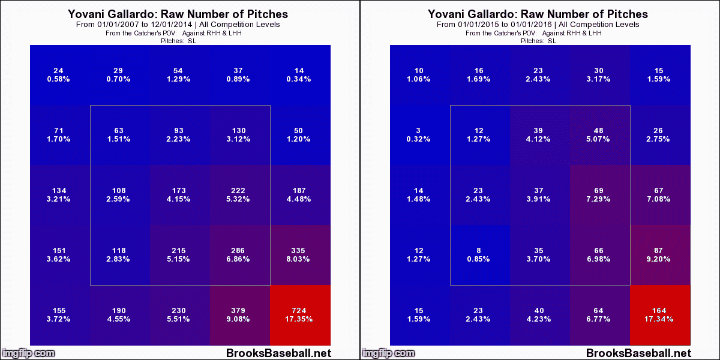
Opposing batters swung more than ever at Gallardo's slider/cutter, but those pitches also generated fewer whiffs. Opponents did have trouble hitting for power against those offerings. One large reason for that: an infield fly ball rate of 41%. It won't be easy to repeat that.
It's unclear whether Gallardo's slider/cutter results are a product of small sample size or suggest anything meaningful. Maybe it's a pitch he's growing more comfortable with and isn't shying away from throwing it in the zone. It seems like Gallardo is a tinkerer who's unafraid to try different things in search of success. Another example of that is his movement to both sides of the rubber the last couple seasons.
Still, it's tough to overlook Gallardo's lack of strikeouts. He can't exactly be considered a question mark, but he's more of a back-end starter in a good rotation (so at least a No. 2 or 3 for the Orioles). By itself, that would be fine. But that depends on the years and dollars he'd command, and it also doesn't factor in the loss of a first-round draft pick. Gallardo's price is clearly dropping, though, which is why the Orioles are hovering.
Perhaps the Orioles would be better off keeping their first-round draft pick and going with a revolving door of Vance Worley, Odrisamer Despaigne, Mike Wright, and Tyler Wilson as the fifth starter. That way, they could ride the hot hand and also maintain some flexibility (though Worley is out of options). But that's also something that occasionally sounds better in theory than in practice, and it doesn't account for an injury to any of the O's other starting pitchers. Gallardo would make the O's a little bit better, but it would come at a steep price.
The Orioles' major league team needs some help. Their farm system needs even more help. No one said this would be easy.
Photo via Keith Allison
03 February 2016
Orioles Again To Rely On Bounce-Backs, Hopes, And Wishes
Before the offseason even started, you could see it coming. Chris Davis was the team's top priority, and the Orioles (with Peter Angelos leading the charge) did everything to ensure his return. They should be commended for that, regardless of whether you think they spent too much money to bring him back. It was likely Davis or no other top free agent, and that does matter.
Still, the Orioles were not going to be able to take care of everything on their shopping list. And to be fair, that is usually the case. The Orioles don't spend enough as a mid-market team to go out and replenish their roster when players depart, and they combine that with having a disappointing farm system that is one of the worst in the majors. That makes it difficult to fill a well-rounded roster with cheap, cost-controlled players. (The Orioles have also had good teams recently, and while that's a positive, they've both dealt away some of their better prospects and dealt with injuries and haven't been able to restock their system.)
The O's have been active this offseason. They re-signed Davis and fought off the Nationals to keep Darren O'Day. They rightly extended the qualifying offer to Matt Wieters, who somewhat surprisingly accepted. They traded for Mark Trumbo and signed Hyun Soo Kim. And they've made a boatload of fringe roster moves in an effort to strike gold with one or two players. But that doesn't seem like enough. After those moves, the O's still may be the worst team in the American League East. And even if they aren't, they don't seem to be more than marginally better than any other team. Realistically, no flurry of moves would have done all that much to alter things. It's not like the Orioles were going to sign David Price, Zack Greinke, or Jason Heyward. They need to get better at developing players, in a hurry.
That brings us back to the apparent flaws of the current roster. The team's corner outfield options - Kim, Nolan Reimold, Dariel Alvarez, Joey Rickard, Henry Urrutia - leave a lot to be desired. Kim is a nice, low-risk signing, but he's unproven in the majors and can't be considered a sure thing. Trumbo needs to be included in that mix, but he's clearly a better option at designated hitter or to spell Davis at first base. Davis could also shift to right field some, but that's probably not what the Orioles have in mind after signing him for so much money. An actual corner outfielder, preferably one who is left-handed, would be a nice addition.
And then there's the starting rotation. Chris Tillman, Kevin Gausman, Ubaldo Jimenez, and Miguel Gonzalez are all locks to start the season in the rotation. That's hardly an inspiring group. Tillman was awful last season; Gausman has showed promise but the Orioles have refused to commit to keeping him in the major league rotation until now; Jimenez was improved last season but is hardly dependable; and Gonzalez finally buckled under the pressure of outpitching his FIP (and, you know, also dealt with elbow and shoulder injuries).
That's without mentioning the upcoming, riveting battle for fifth starter duties between Vance Worley, Mike Wright, and Tyler Wilson. Names such as Mat Latos, Kyle Lohse, Tim Lincecum, Aaron Harang, Alfredo Simon, and even Jeremy Guthrie and other AAAA starters are still out there. Maybe it's best to pursue that route and hope for the best. Or maybe the Orioles will make a trade.
There are still some talented players available on the free agent market, but some are tied to draft pick compensation (including Yovani Gallardo and Dexter Fowler). The Orioles seem set on holding on to their first-round draft pick. That probably has more to do with the money not being there for such signings; after all, the Orioles forfeited two draft picks to sign Ubaldo Jimenez and Nelson Cruz just a couple years ago. And it's not like the Orioles hoard their draft picks anyway.
Right now, it seems pretty foolish that the O's weren't willing to be more flexible to sign Scott Kazmir. Not only was he not tied to draft pick compensation, but he would have filled the left-handed starter void left by Wei-Yin Chen. It's unclear whether the O's were scared off more by Kazmir's injury history or his pursuit of a contract with an opt-out, but he would have been a nice signing -- and could have been considered the team's best starting pitcher.
Teams want more good players. The Orioles aren't any different. Without much to fall back on in the minors, the O's don't have much room for error. They again need a Nate McLouth or Steve Pearce type player to surface, or at least get Miguel Gonzalez to pitch like he did from 2012-2014 or get J.J. Hardy or Tillman to somewhat return to form. (Buck Showalter has acknowledged as much, particularly about his starting pitchers, in some of his comments.) Those types of performances shouldn't be taken for granted, especially when the O's need them as much as they do. Maybe it doesn't lead to exciting offseasons, but the O's again seem like a .500 team that with the right push could again be in the playoff hunt. That's the best-case scenario for this team. The worst case? Maybe you should take a look at that rotation again.
Still, the Orioles were not going to be able to take care of everything on their shopping list. And to be fair, that is usually the case. The Orioles don't spend enough as a mid-market team to go out and replenish their roster when players depart, and they combine that with having a disappointing farm system that is one of the worst in the majors. That makes it difficult to fill a well-rounded roster with cheap, cost-controlled players. (The Orioles have also had good teams recently, and while that's a positive, they've both dealt away some of their better prospects and dealt with injuries and haven't been able to restock their system.)
The O's have been active this offseason. They re-signed Davis and fought off the Nationals to keep Darren O'Day. They rightly extended the qualifying offer to Matt Wieters, who somewhat surprisingly accepted. They traded for Mark Trumbo and signed Hyun Soo Kim. And they've made a boatload of fringe roster moves in an effort to strike gold with one or two players. But that doesn't seem like enough. After those moves, the O's still may be the worst team in the American League East. And even if they aren't, they don't seem to be more than marginally better than any other team. Realistically, no flurry of moves would have done all that much to alter things. It's not like the Orioles were going to sign David Price, Zack Greinke, or Jason Heyward. They need to get better at developing players, in a hurry.
That brings us back to the apparent flaws of the current roster. The team's corner outfield options - Kim, Nolan Reimold, Dariel Alvarez, Joey Rickard, Henry Urrutia - leave a lot to be desired. Kim is a nice, low-risk signing, but he's unproven in the majors and can't be considered a sure thing. Trumbo needs to be included in that mix, but he's clearly a better option at designated hitter or to spell Davis at first base. Davis could also shift to right field some, but that's probably not what the Orioles have in mind after signing him for so much money. An actual corner outfielder, preferably one who is left-handed, would be a nice addition.
And then there's the starting rotation. Chris Tillman, Kevin Gausman, Ubaldo Jimenez, and Miguel Gonzalez are all locks to start the season in the rotation. That's hardly an inspiring group. Tillman was awful last season; Gausman has showed promise but the Orioles have refused to commit to keeping him in the major league rotation until now; Jimenez was improved last season but is hardly dependable; and Gonzalez finally buckled under the pressure of outpitching his FIP (and, you know, also dealt with elbow and shoulder injuries).
That's without mentioning the upcoming, riveting battle for fifth starter duties between Vance Worley, Mike Wright, and Tyler Wilson. Names such as Mat Latos, Kyle Lohse, Tim Lincecum, Aaron Harang, Alfredo Simon, and even Jeremy Guthrie and other AAAA starters are still out there. Maybe it's best to pursue that route and hope for the best. Or maybe the Orioles will make a trade.
There are still some talented players available on the free agent market, but some are tied to draft pick compensation (including Yovani Gallardo and Dexter Fowler). The Orioles seem set on holding on to their first-round draft pick. That probably has more to do with the money not being there for such signings; after all, the Orioles forfeited two draft picks to sign Ubaldo Jimenez and Nelson Cruz just a couple years ago. And it's not like the Orioles hoard their draft picks anyway.
Right now, it seems pretty foolish that the O's weren't willing to be more flexible to sign Scott Kazmir. Not only was he not tied to draft pick compensation, but he would have filled the left-handed starter void left by Wei-Yin Chen. It's unclear whether the O's were scared off more by Kazmir's injury history or his pursuit of a contract with an opt-out, but he would have been a nice signing -- and could have been considered the team's best starting pitcher.
Teams want more good players. The Orioles aren't any different. Without much to fall back on in the minors, the O's don't have much room for error. They again need a Nate McLouth or Steve Pearce type player to surface, or at least get Miguel Gonzalez to pitch like he did from 2012-2014 or get J.J. Hardy or Tillman to somewhat return to form. (Buck Showalter has acknowledged as much, particularly about his starting pitchers, in some of his comments.) Those types of performances shouldn't be taken for granted, especially when the O's need them as much as they do. Maybe it doesn't lead to exciting offseasons, but the O's again seem like a .500 team that with the right push could again be in the playoff hunt. That's the best-case scenario for this team. The worst case? Maybe you should take a look at that rotation again.
Subscribe to:
Posts (Atom)