02 November 2012

Why is in Left? The Orioles 2013 Edition

Previously, we discussed second base.

On this blog, and I assume elsewhere, left field has been an area of argument for what the Orioles should do in 2013.  In 2012, it was an up and down year.  Nolan Reimold came out strong, but quickly was injured.  Xavier Avery and Endy Chavez took the team nowhere.  Finally, Nate McLouth settled the position.  McLouth had spent two and half troubled seasons with the Braves maligned with injuries and poor performance.  The Braves declined his 2012 option and he wound up signing with the Pirates for 1.75MM.  He scuttled with Pittsburgh, was released, and then chose the Orioles over the Yankees as he felt the Orioles had a worse situation in left.  Then Orioles Magic happened.

That said, the Orioles' production was rather lousy over the full season as shown in the graph below.


For many, the ideal solution for the Orioles would be to solve the position internally.  This often means Nate McLouth being resigned or entrusting the position again to Nolan Reimold.

Internal
LHP RHP
LHP 40g RHP 110g

Age wRC+ wRC+ Defense WAR WAR WAR
Nate McLouth 31 70 102 0 -0.2 1.4 1.2
Xavier Avery 23 62 79 0 -0.4 0.0 -0.3
Endy Chavez 35 66 67 5 -0.1 -0.3 -0.5
Lew Ford 36 72 67 0 -0.1 -0.7 -0.8
Bill Hall 33 88 71 -5 0.1 -0.8 -0.8
LJ Hoes 23 81 77 0 0.0 -0.1 -0.1
Nolan Reimold 29 100 105 -5 0.3 1.2 1.5
Chris Davis 27 88 114 -10 -0.1 1.4 1.3
Steve Pearce 30 93 71 -5 0.2 -0.8 -0.7
Ryan Flaherty 26 64 80 0 -0.3 0.1 -0.2
Steve Tolleson 29 73 71 0 -0.1 -0.5 -0.6
The solutions within the organization are not exceptional.  The three best solutions are projected to be Nate McLouth, Nolan Reimold, and Chris Davis.  McLouth is a platoon hitter who struggles mightily against lefties and has had 55 adequate games offensively over the past three seasons.  Nolan Reimold has shown the potential to be a beast offensively, but has repeatedly had issues staying on the field throughout the minors and majors.  Chris Davis has a decent bat, but lacks the range and mechanics to be considered adequate.  Xavier Avery and LJ Hoes may be the future of the Orioles' left field, but that likely is not this year.

To improve upon the less than 1 WAR performance from last year, it may be useful to invest in a solution via free agency.

Free Agents
LHP RHP
LHP 40g RHP 110g

Age wRC+ wRC+ Defense WAR WAR WAR
Melky Cabrera 28 118 120 0 0.9 2.5 3.3
Jonny Gomes 32 127 91 -10 0.8 0.0 0.8
Josh Hamilton 32 123 142 5 1.1 4.1 5.2
Juan Pierre 35 81 80 -5 -0.1 -0.3 -0.4
Cody Ross 32 131 92 0 1.1 0.8 1.9
Shane Victorino 32 117 86 5 1.0 0.8 1.8
Angel Pagan 31 93 108 10 0.6 2.5 3.1
Grady Sizemore 30 71 101 0 -0.2 1.3 1.2
BJ Upton 28 118 100 10 1.1 2.0 3.1
Torii Hunter 37 121 112 5 1.0 2.3 3.4
Nick Swisher 32 132 116 0 1.2 2.2 3.4
Ichiro Suzuki 39 91 85 10 0.5 1.1 1.6

Left field appears to be a wonderful bounty, potentially.  Ideal targets in this group would include Melky Cabrera, Torii Hunter, and Nick Swisher.  Solutions here can be addressed as short term (e.g., Torii Hunter, Melky Cabrera) or long term (e.g., Nick Swisher, Angel Pagan).

Cheaper options may be available in the non-tender market.

Non-Tender
LHP RHP
LHP 40g RHP 110g

Age wRC+ wRC+ Defense WAR WAR WAR
Kyle Blanks 26 92 105 -10 0.0 0.8 0.9
Ben Francisco 31 86 86 -5 0.0 0.1 0.1
Sam Fuld 31 78 79 5 0.1 0.4 0.5
Nyjer Morgan 32 42 84 15 -0.4 1.4 1.0
At most, these players would be worth less than 1MM for a one year deal.  All four, in fact, may be able to be had as spring training invites.

Recommendation

My preference would be for the Orioles to secure a short term fix.  This would mean targeting a player like Torii Hunter or Melky Cabrera.  My personal preference would be to secure Cabrera up to 14MM.  I think it would cost a few million less than that for one year of service and I think the Orioles would present him with a solid opportunity to regain value as a free agent, enabling him to go back on the market and bring in a ton of money.  Torii Hunter would also be an interesting candidate as well.  Adam Jones often mentions Hunter as a mentor and Hunter could take on the role that Jim Thome had as the elder statesman.  Hunter though would be more useful as he still has a decent bat and glove.  Two things that sadly were lacking with Thome last year.

01 November 2012

What is on Second Base? The Orioles 2013 Offseason Edition

Several years ago, I came down against the Brian Roberts extension.  It was a difficult stance for me to take as the Depot is a fan of Roberts.  We have interviewed him and think quite highly of his charity to help children suffering from cancer.  However, the cruel reality of baseball decision making led us to conclude that letting Roberts walk or dealing him was preferable to signing him long term.  Our simple analysis was based on his decreasing defensive capabilities and the overwhelming historical weight of data that suggests that almost all second basemen stop being useful past the age of 32.  Further confusing us, was Andy MacPhail's offer of four years and 40 MM, which was arguably above market value.  At the time, Orlando Hudson was a free agent of roughly equal value to Brian Roberts.  He managed to secure a one year deal from the Dodgers for 3.4 MM.  The Orioles appeared to secure their second base position by vastly overpaying and overcommitting themselves to a player type that carried a high risk of completely collapsing in terms of value.

What happened?  In 2010, Roberts' first season of his extension and at the age of 32, his value disappeared.  It was more of the same in 2011 and 2012.  Issues have been related to his back and to concussions.  The historical evidence did not suggest that Roberts would go down with any specific injury, but that it was very very likely to occur.  From my perspective, second basemen get beaten up worse than almost any other position.  Every single game, second basemen (who are typically one of your smaller players on the team) has to take double play balls blindly, pivot, and hit the first baseman.  There is a good reason why second basemen are significantly more injured around the bag than shortstops.

Anyway, the point is that the Orioles have thrown away a ton of money on second and will likely continue to do so this year as well.  Below is another one of the WAR charts I have put together for first base and left field.  It uses Fangraphs numbers to convert positional value over 150 games.  I consider 150 games to be what one should consider a full season for a player.  Regardless of that assumption, it provides a decent visual to understand the spectrum.


What the above graph shows us is that second base was an incredibly weak position for the Orioles.  Robert Andino took the lion's share of the starts (96) and was helped out a little bit by Omar Quintanilla (27), Ryan Flaherty (20), Brian Roberts (17), and Steve Tolleson (2).  Whatever the Orioles tried, it did not work and not much was enticing in Norfolk (i.e., Ryan Adams, Blake Davis).  Andino rode out the year and the team succeeded despite his performance (-0.6).

Second base is actually a position of great possibility.  As we discussed earlier, the level of talent on the Orioles was closer to an 81 win team instead of a 93 win team.  Improvements are needed and, with approximately a -1.5 WAR coming from the position, second is a great place to target for improvement.

First, what options are available internally?


Internal
LHP RHP
LHP 40g RHP 110g

Age wRC+ wRC+ Defense WAR WAR WAR
Robert Andino 29 76 63 0 0.2 -0.1 0.1
Ryan Flaherty 26 64 80 -5 -0.2 0.5 0.3
Brian Roberts 35 49 61 -10 -0.6 -1.0 -1.6
Omar Quintanilla 31 41 74 0 -0.5 0.5 0.0
Steve Tolleson 29 73 71 0 0.2 0.3 0.5
LJ Hoes 23 81 77 -10 0.1 -0.1 0.0
Jonathan Schoop 22 68 54 0 0.1 -0.6 -0.6
Ryan Adams 26 84 75 -5 0.3 0.2 0.4
Blake Davis 30 41 62 5 -0.4 0.2 -0.2
At this moment, it is clear the organization is without much value at second base for the 2013 season.  Two players with the greatest potential here are LJ Hoes and Jonathan Schoop.  Hoes never really took to second base with the glove and now profiles more as a left fielder.  The bat might currently play at second as a marginal player, but that glove will be a severe impediment.  Schoop's defense is better than Hoes, but not special by any means.  His range is limited and might become even more limited as he fills out.  Right now though, his bat is still likely a year away for second base.

It appears that any decent solution for the Orioles at second will come from outside the organization. 
Free Agency
LHP RHP
LHP 40g RHP 110g

Age wRC+ wRC+ Defense WAR WAR WAR
Ronny Cedeno 30 65 70 5 0.1 0.6 0.8
Mike Fontenot 33 58 95 -5 -0.3 1.3 1.0
Kelly Johnson 31 89 93 -5 0.4 1.2 1.6
Jeff Keppinger 33 116 65 -10 1.0 -0.7 0.3
Freddy Sanchez 34 75 96 0 0.2 1.8 2.0
Marco Scutaro 37 86 95 -5 0.3 1.3 1.6
* - Originally, the model I used neglected that Sanchez missed the entirety of 2012 with a back injury.  I need to rerun those numbers as it would significantly drop his value.  Off the top of my head, I am thinking that he profiles more as a spring training invite sort of player.
** - The Keppinger splits were flipped.  That has now been corrected.  Sorry for all of the post-publishing edits.  I noticed that I had flipped some values and thought I had corrected them.

All six of these free agents are projected as providing better performance than any of the Orioles' internal options.  Fontenot would need to sit against southpaw starters and Keppinger would sit against right handers.  Both provide cringe inducing defense, but the offense is good enough to compensate if deployed properly.  Johnson and Scutaro project as more full timers in the field.  Some concerns about this group is the age of the players.  Free agent second basemen are often a risk because of age.  A general manager needs to think long and hard before going ahead and offering a multi-year deal.  From my perspective, I think none of them will require a multi-year deal except for Marco Scutaro whose uber-McLouth redemption with the Giants may have raised his profile for a few teams to consider as a free agent.  I would imagine something in the neighborhood of 3-8 MM for one year would be sufficient depending on how the money rolls out this off season.

Is there a cheaper model available in the non-tender candidates?
Non-tender
LHP RHP
LHP 40g RHP 110g

Age wRC+ wRC+ Defense WAR WAR WAR
E. Burriss 28 5 62 0 -1.3 -0.2 -1.4
Alexi Casilla 28 91 58 0 0.5 -0.4 0.1
Brent Lillibridge 29 41 34 -10 -0.8 -2.5 -3.3
Jayson Nix 30 86 72 5 0.6 0.8 1.3
Ian Stewart 28 70 81 -10 -0.2 0.2 0.0
Luis Valbuena 27 68 76 -5 -0.1 0.2 0.2
I would say the answer is a comfortable 'no.'  Jayson Nix might be the only player worth signing to a MLB deal.  I would entertain any of them as Spring Training invites.

Recommendation

If I was in control of the team, I would non-tender Robert Andino and focus on the free agent class.  I would talk with Kelly Johnson, Jeff Keppinger, Freddy Sanchez, and Marco Scutaro to determine what their asking prices would be.  I would hope to secure one of them for a one year deal at less than 5 million.  Keppinger should come at an even lower cost.  I would entertain the possibility of an option year with buyout.  As a backup, rolling the dice on is Valbuena or Alexi Casilla as a spring training invite to compete with Flaherty, Schoop, and Andino (if he accepts to come back at a lower cost).  I would also give LJ Hoes one last shot to be guided by Buck's staff in playing second base.  Additionally, I suggest the same offer as I mentioned last year, which would be to ask Brian Roberts to transition into a coaching/scouting role with the team or finding a business related position in the front office.  He is a Baltimore Oriole and has been a wonderful member of the organization.  It is unfortunate what he has had to suffer over the past few years, but he seems to be a solid individual and any organization could use someone like that.


30 October 2012

Mark Reynolds: Release, Arbitration, or Use the Option

I think I have it right here...the Orioles must decide whether or not to use Mark Reynolds' 11MM option for 2013 by close of business on Halloween.  If they choose not to bring him back for 11MM, then they can not select the option for 500k.  Here is a visualized set of possible events:

In trying to figure out how useful Mark Reynolds is as a first baseman and what that price might be.  Here is adjusted production over 150 games for all team in MLB (via Fangraphs).


Now, the graph above has its problems.  For example, the Orioles' performance is a weighted mix of Mark Reynolds and Chris Davis' total production, but I do think the above graph is a useful rough estimate of worth.  The green bars are what I would consider to be first division production.  The red bars are what I would think is lower tier production.  A key thing to understand is that if you are planning for a team to be a playoff contender than you want your players to be at least in that middle tier and you will need several on the team to be in that first division range.  This is not a hard fast rule.  The Rangers and Braves had third tier production from first.  The Tigers, Reds, Yankees, Nationals, Athletics, and Cardinals all had first division production.

Two concerns with Mark Reynolds is how well will he hit and how well will he field at first.  This gives us the following table (on left hand side wRC+ and defense across the top):


-10 -5 Average 5 10
120 1.5 2 2.5 3 3.5
110 0.7 1.2 1.7 2.2 2.7
100 0 0.5 1 1.5 2
90 -0.8 -0.3 0.2 0.7 1.2
80 -1.6 -1.1 -0.6 -0.1 0.4


For offensive production, wRC+ for a first basemen needs to be at least 110 for adequate production from first base.  That is not elite performance, but it a level of performance that you would at least feel comfortable having at first.  Last year Reynolds had a 108 wRC+ mark.  Over his career, he had put up 109, 97, 127, 96, 117, and 108.  Those years range from poor production (96 wRC+) to very good production (127 wRC+).

Where Reynolds' offense may not be incredibly dependable or, perhaps, even sufficient for first, his defense would need to pick up.  As we have discussed in our podcasts and in an article or two, Reynolds has developed this narrative where he has risen like a great phoenix from the ashes of third base to become a gold glove first baseman.  This call has come from television announcers as well as at level one former GM in Dan Evans.  BIS mentioned that Reynolds led the league in Good Fielding Plays, which are plays that are assumed to plays where the typical 1B would not be expected to make them.  Good or great glove play would be excellent for his value because it would enable him to produce near his worse season long production and still be considered a threshold quality first division first baseman.

However, I have some concerns with Reynolds' play at first.  Before I looked at his statistics at first, I was taking in the wondrous time of Orioles playoff baseball.  During that time, I would laugh whenever anyone said anything glowing about Reynolds' first base play.  It was not just me.  Actual scouts (I cannot say all scouts, I know awfully few) saw the same thing.  It seemed so readily apparent to me.  Great hands, nothing else.

Let us take a step back.  What made Reynolds fail at third base?  The most apparent thing he failed at was his arm.  His is plenty strong, but his accuracy was awful.  What hurt him often with his arm, and really any hit ball, is that he has horrible reaction time.  What he benefits from are excellent hands.  This would and has played well at first base.  He dives and falls and keeps his glove on the ball.  It looks Sportscenter good, but when you compare him to a truly elite defensive first baseman like Mark Teixeira...you truly see how slow Reynolds' first step is.  I see a first baseman who is below average.  Not awful, but clearly below average.

Looking at stats other than the aforementioned Good Fielding Plays, they seem to match that last sentence.  With the Defensive Runs Saved Model, it converts runs saved from Good Fieldng Plays to 4 runs saved.  Its Plus/Minus system (looks at both range and errors), has him at -6.  Add them together and you have a first baseman who cost you two runs over the course of his 957 innings at first.  Over a full season at first base, you are looking at maybe three runs.  It is a small sample size and it maybe not properly view any growth in competence at first, but this is what one would call a below average first baseman.  UZR pretty much agrees with a -3.8 runs for range, 0 runs for errors, and 0.6 runs saved for turning doubles plays.  UZR puts Reynolds at -3.2 runs for last year and -5.9 if you extrapolate that over a full season.

So this takes us back to the box above.  For Reynolds to be useful as a first baseman with below average defense, he needs to hit on par with his first season with the Orioles (his second best season ever).  Anything less than that would put him more in a stop gap roll until you, hopefully quickly, find someone else to play first base.

A basic estimate this year is that on the free agent market, a win will be worth about 5 MM.  It is a no brainer to opt out of Reynolds' contract and go to arbitration.  That saves 1.5 MM.  Is Reynolds worth 9 MM?  That would have him as a 1.8 WAR player.  I have him more as a 1.2 WAR or 6MM player.  I would expect him to earn roughly 8-10 MM on the free agent market because it seems that some really believe in his defensive abilities.

What would I do?  I would let him go and ride with the following platoon:

SP Player Games Offense Defense WAR
RHP Wilson Betemit 118 133 wRC+ Awful 1.8
LHP Chris Davis 44 112 wRC+ Poor 0.3

Total


2.1
This setup saves the team roughly 9 MM to be spent in other areas.  Against right handed starters, there will be issues later in games as Betemit could walk up to the plate armed with a soup ladle against a southpaw reliever and do just as well as he does with a bat.  This would need to be resolved with a bench bat that could play first and handle lefty relievers.  Nolan Reimold would fit that role incredibly well.

Using the Reynolds money and a few thousand more Benjamins, the team may be able to sign a legitimate left fielder in the mold of Nick Swisher, Melky Cabrera, or Angel Pagan.
29 October 2012

More McLouth: a Simple Post on Future Performance

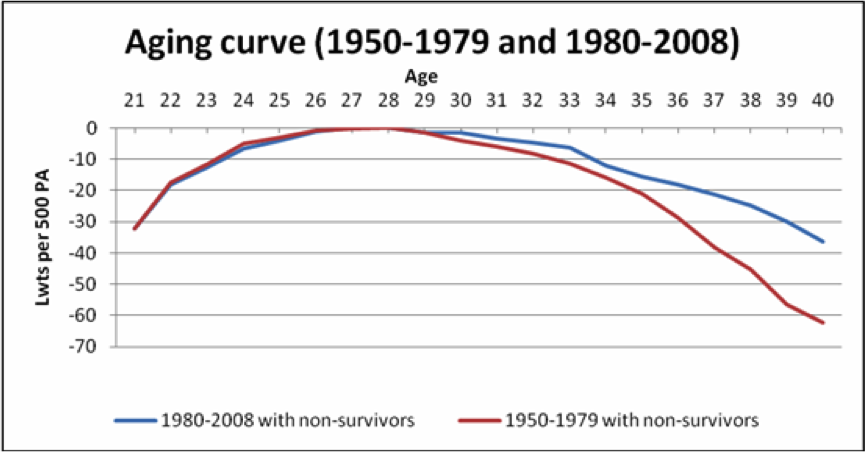
Aging curves are something we are all familiar with and agree with in principle.  I think that is a fair and safe assumption to make.  A young player will eventually reach his peak athletic performance and then decline until he is no longer valuable to any team.  That simply is how careers work.  Below is one of the standard curves:

From Baseball Prospectus

This is, of course, the age curve for a general population.  What that means is that individuals are likely to adhere to something similar to this curve, but that many players will indeed deviate from this curve.  Even with all of that uncertainty, it certainly helps predict player production and why age curves are included in any projection system you might use.

This brings us back to one of our favorite conversations in the past week: Nate McLouth.  There seems to be some confusion about how people are viewing him.  I decided to dive in the numbers (not very deep, though) to try to visualize the simple projection field for him.  On one perceived side, you have folks who think McLouth's years where he suffered major injuries (2010 and 2011) should directly inform future predictions of talent.  I don't think anyone has suggested something so extreme.

Likewise, there seems to be a misconception that Nate McClouth injury years as well as his go around with the Pirates in 2012, and maybe even his performance after the trade to the Braves in 2009 (because he was sad) should be ignored because he is now healthy and happy.  I think that is the misconception.  Otherwise, it is the point to which the argument is backed up against on the positive side.

Now, just looking at offense, what do these two perspectives show for McLouth?


The red series shows the optimistic view of McLouth.  Gone are his 2009-2011 time with the Braves and his 2012 time with the Pirates.  All that remains are his 2005-2009 Pirates years and his 55 games with the Orioles in 2012.  The blue series includes all of McLouth's time.  The green line is using his blue line data, but filling in any games missing up to 150 with an age regressed expectation based on his career year performance.

The three methods give the following three year projections:


wRC+

Hi Reg Lo
2013 106 92 70
2014 97 86 56
2015 83 75 38
To be honest, none of these projections would surprise me.  I can see McLouth maintaining his skills well enough where he essentially performs the same in 2013 as his Oriole 2012 tenure with decrease performance thereafter.  I can also see his batting fall part with a somewhat normal aging curve.  Yes, I can also see him completely falling apart.  The green series makes the most sense to me if we want to go strictly by numbers and how we understand player aging with McLouth going into his age 31-33 seasons.  Regardless, this is clearly not someone you would want to give a multi-year deal.

How does this fit into baseball in general in terms of left field offensive production?  The following graph was created using data from the Fangraphs team section, which has flaws.  When I look specifically for left fielders, it actually compiles everyone who spent a "significant" time in left field with that compilation including batting numbers when they were not actually at that position, so these numbers may be a bit loose.  However, I think it roughly gives us an idea of what a left fielder might be expected to do offensively.


What we see are a few things:
(1) The Orioles, over 2013, had bottom tier production from their left fielders.  Endy Chavez, Xavier Avery, Steve Tolleson, etc. were not getting it done out there.
(2) The Orioles 87 wRC+ was well behind the league median (97, respresent by the Mets in Red).
(3) The Orioles were also way behind the threshold for first division left field offensive production (111 wRC+, represented by the Rockies in Green).
Assuming these general patterns hold up, you can make the argument that Nate McLouth would be able to deliver average to above average offensive production with a possibility of providing near league worse production.  Of course, what informs whether or not that league worse production comes into play is whether or not you think McLouth's high intensity play leads to higher risk of injury, particularly with a post-30 year old ball player.  It may be noteworthy to mention that McLouth has only put up 400 plate appearances twice in his career.  This is due to him not being asked to play much or being injured and unable to do so.

This leads us back around to Nate McLouth and whether the Orioles should sign him.  I have the same opinion I had coming into this exercise.  I think McLouth can be a league average or above average left fielder.  He is not a first division left fielder.  I also doubt he can stay injury free and see him as a risk for a major drop off in production.  If he wants to come back for a position where he has to fight it out with other players for left field, then I would be happy to have him back.  If the Orioles could rope in a legitimate first division starter and McLouth wants back, then great.  McLouth is a solid option as a fourth outfielder who may sometimes get hot.  He is not much of a centerfielder with his collapsing range and his arm is not going to make right field work, but, with a decent defensive fifth outfielder, McLouth could work out just fine.