Showing posts with label Mark Reynolds. Show all posts

03 December 2014

The Orioles Can Replace Nelson Cruz With a Corner Infielder

With Nelson Cruz signing with the Mariners and the return of Nick Markakis reportedly becoming increasingly unlikely, the Orioles are rumored to be in the market for a corner outfielder such as Melky Cabrera or Matt Kemp, both of whom have been discussed here at Camden Depot. It makes perfect sense for the Orioles to target a corner outfielder, and any noteworthy move they make in terms of a position player is likely to involve one.

However, the Orioles aren't handcuffed to only addressing the loss of Cruz (and the potential loss of Markakis) by bringing in a corner outfielder. If the market for a corner outfielder doesn't make sense for the Orioles, they can sign a corner infielder and have Steve Pearce enter 2015 as part of the OF (Pearce is likely to get some OF playing time regardless, but more of his time will likely come at 1B/DH if the O's add to their OF). I've already written about why I think an outfield of Peace, Adam Jones, Alejandro De Aza, and David Lough would be serviceable.

So, here are three corner infielders the Orioles could pursue if the outfield market doesn't develop to their liking.
Photo by Keith Allison


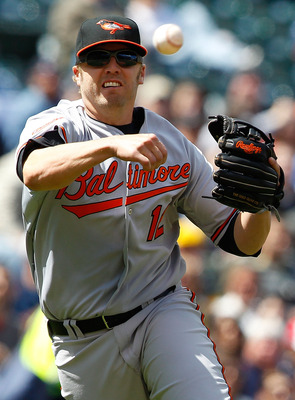
Mark Reynolds

Yeah, I'm serious. Reynolds spent last season in Milwaukee, where he posted an (career worst) 87 wRC+ and 1.6 fWAR in 433 plate appearances. Steamer projects Reynolds at a 103 wRC+ and 0.8 fWAR for 2015.

Dave Cameron at Fangraphs predicts Reynolds to sign a 1-year, $4 million deal, and actually predicts the Orioles as the team that will sign him. $4 million for Reynolds is the exact kind of low-risk, value deal the Orioles have targeted during the Duquette era.

Reynolds could split time between 1B and DH with Chris Davis (and likely a Delmon Young-type signing). While his defense at 3B is cringe-worthy, his experience at the hot corner gives Buck Showalter the roster flexibility he covets in case something were to happen to Manny Machado.

Reynolds is the exact opposite of the OBP-type player Orioles fans have been clamoring for. However, another reason he may be appealing to the club is that they may look to move Chris Davis if the opportunity presents itself, which would eliminate the Reynolds-Davis strikeout duo problem. I have no knowledge of Dan Duquette trying to move Davis, but rumors of them pursuing Adam Lind before he was traded makes me think they are considering it.

Chase Headley

This might be a bit of a pipe dream, and would require some creativity, but hear me out. Headley is coming off a 2014 campaign in which he had a wRC+ of 103 and a 4.4 fWAR. His Steamer projections for 2015 are 112 wRC+ and a 3.9 fWAR.

The Orioles could bring in Headley with the intention of using him at 1B/3B/DH. He could play a lot of 1B, where he played played 54 innings for the Yankees last year. Headley could also be a more than adequate option to spell Manny Machado every so often, which might not be a bad idea given Machado's injury history. Speaking of the injuries, Headley would serve as tremendous insurance in case Machado were to have any more unfortunate luck with injuries.

Dave Cameron projects Headley at 4 years for $60 million. He will be 31 in May, so a potential gradual shift to full-time 1B over the course of a 4-year deal isn't a terrible idea. I've heard nothing about the Orioles pursuing Headley and would be shocked if they did, but he's a great option if the team and the player are willing to think a bit outside the box.

Michael Morse

Okay, so Morse is technically more of a corner OF, but the Orioles would probably be better served pushing Pearce to the OF and using Morse as 1B/DH were they to bring him aboard.

Morse had a tremendous bounce back campaign in 2014, posting a 133 wRC+. Morse's fWAR was just 1.0, thanks to him being 18 runs below average defensively. In 2015, Morse is projected to have a wRC+ of 112 and a fWAR of 0.5. If the Orioles are to bring Morse aboard, it should probably be with the intention of playing him in the field far less then Nelson Cruz did in 2014. Morse has a career UZR/150 of -19.2 as an OF. I'd much prefer Morse to spend much of his time at DH, with some time at 1B, where he has a career UZR/150 of -2.0.

Cameron projects Morse to land a 2-year deal for $20 million.

Headley is definitely the least likely of the three to sign with the Orioles. Reynolds is the least desirable, but also the cheapest. Morse is probably the most realistic, and would be a perfectly adequate replacement for Cruz. However, all three of these players are affordable and all give the Orioles options as they seek to replace the loss of Nelson Cruz.

All stats from Fangraphs

09 August 2013

Can the Orioles Afford Mark Reynolds' Strikeouts?

Mark Reynolds in 2012 / photo: Keith Allison
Last year, Mark Reynolds was the Phoenix.  Whether he was rising from the ashes of his first half of a season or rising from one of his signature toe anchored flops at first base, he embodied the team last year.  He did not look good and probably really was not all that good, but he wound up successful over and over again.  In the fall, we took a hit from some of our Passengers at the Depot (not all, just a few) about our conclusion that Reynolds' option should not be picked up and that the team should let him go.  They did that and he wound up taking a pay cut with the Indians.

Here are his month by month slashes:
April - 301/368/651, .427 wOBA, 179 wRC+
May - 218/310/386, .310 wOBA, 98 wRC+
June - 187/288/253, .250 wOBA, 57 wRC+
July - 098/233/098, .178 wOBA, 7 RC+
Unsurprisingly, the playoff hoping Indians designated Mark Reynolds for assignment.

The presents the Orioles with a potential opportunity to provide some offense, which is something they failed to do when the regular trade deadline came and went in July.  In case you forgot, the Orioles have the third worst hitting DH performance in the American League:
Houston Astros - 185/266/313, 32.4 runs created
Oakland Athletics - 211/303/338, 40.8 runs created
Baltimore Orioles -  210/269/389, 41.1 runs created
New York Yankees - 208/293/350, 41.2 runs created
Chicago White Sox - 225/289/397, 43.8 runs created
It would be incredibly beneficial to the team to improve their weakness here.   True, this level of DH performance will not exclude them from making the playoffs as the Oakland Athletics are trying to illustrate, but it certainly makes things easier when your DH is not repeatedly relegated to the bottom of the lineup.

Recently, the Orioles have been employing the tandem of Henry Urrutia and Danny Valencia (now, Steve Pearce).  Mark Reynolds, over his career, tends to show a slight platoon with him hitting better off of southpaws.  This means that his addition would be to replace the mish mash of Valencia and Pearce.  However, he probably would be not incredibly worse than the Human Opposite Field Single hitter Henry Urrutia.  None of the current batch is a solid fielder, but having Reynolds in place of those two would enable the team to have a more capable defensive player on the roster.
After a monster April, Reynolds has been utterly horrific and that is being kind.  The Indians, fighting for a space in the playoffs, finally decided to let him go.

Now, it has been argued that Mark Reynolds is horrible.  Sure, he is.  He also has something like a one in twenty chance of being mind blowingly good.  The team is currently 1.5 games behind Texas or Oakland in the chase for the second Wild Card.  They also have Cleveland right behind them.  I think we can all agree that the Indians are playing over their head and that the race is essentially something like the A's, Rangers, and Orioles.  Of those three teams, two will make it.  How comfortable are you with the current offensive output from the DH slot?  Should the team be satisfied with the low grade chill that Uruttia and Pearce will provide?  Pearce can probably deliver a slightly below league average DH for the team, but it seems fairly obvious that Uruttia's bat needs a bit more seasoning at least.  With that in mind, maybe it makes sense to give Reynolds a chance to correct himself and go on a tear no matter how unlikely.  I mean, it is difficult to get much worse and, if Reynolds does nothing for a couple weeks, the September roster opens and you can bury him.

Another concern has been about having several high strikeout guys on the team.  Currently, the Orioles have one batter (Chris Davis) in the top ten for strike out percentage (29.2%).  Having Mark Reynolds on the team would increase that to two as he goes down on strikes 32% of the time this year so far.  This contention about having multiple big K guys on the team is somewhat of an issue that draws sides.  Some people think that too many people with high amounts of strikeouts would result in a lot of runners stranded without the opportunity of a batted ball to challenge the other team's defense.  Others think that with the high level of defense in the Majors that how you make an out is far less important than what you do when you are not making an out.

To try to test this, I decided to use a formula that Tom Tango came up with relating wOBA to runs scored per plate appearance.  The idea here is that if we find teams who had multiple high strikeout bats that if this actually poses a linear issue in run production then we should expect that those outs will not be properly accounted for in the wOBA formula.  In other words, the projected amount of team runs will be consistently greater than the actual runs a team scores.

2012
Baltimore Orioles
Chris Davis (30.1%) and Mark Reynolds (29.6%)
Tampa Bay Rays
Carlos Pena (30.3%) and B.J. Upton (26.7%)
2011
Cincinnati Reds
Drew Stubbs (30.1%) and Jay Bruce (23.8%)
Washington Nationals
Danny Espinosa (25.2%) and Jayson Werth (24.7%)
2010
Arizona Diamondbacks
Mark Reynolds (35.4%), Adam LaRoche (28.0%), and Justin Upton (26.6%)
Tampa Bay Rays
Carlos Pena (27.1%) and B.J. Upton (26.9%)
Los Angeles Dodgers
Matt Kemp (25.4%) and Casey Blake (24.2%)
2009
Arizona Diamondbacks
Mark Reynolds (33.7%) and Justin Upton (23.3%)
Tampa Bay Rays
Carlos Pena (28.6%) and B.J. Upton (24.3%)
Philadelphia Phillies
Ryan Howard (26.5%) and Jayson Werth (23.1%)

Out of those ten teams, we should expect that five would wind up scoring more runs than expected and five would score fewer if the number of high strikeout players on a team does not matter.  Just eyeballing it, if we wind up with 8 in either direction then I think it seems likely that there is an effect.


Year Team wOBA Runs Difference
2012 Orioles 0.317 712 13

Rays 0.311 697 30
2011 Reds 0.322 735 -6

Nationals 0.305 624 -15
2010 Dbacks 0.325 713 -24

Rays 0.326 802 50

Dodgers 0.309 667 5
2009 DBacks 0.324 720 -23

Rays 0.342 803 -14

Phillies 0.339 820 1

Five teams scored more than was expected and five teams scored worse.  Now, this is simply a pilot study, but this tends to suggest that there is not really an overwhelming impact on run production when a team has several high strikeout players in the lineup.  That concern is one that is likely overblown simply because strikeouts are a rather visual thing.

We often tend to take for granted how good MLB defenses actually are.  What is more important is not making outs and what happens to the ball when it is hit.  With that in mind, Mark Reynolds probably is a decent bet to take in hopes of leap frogging over the second wild card slot as well as making a break for the first wild card and maybe the division.  To do that, I think the team needs to be bold.  I do not think bold means Henry Urrutia or Steve Pearce.  I think bold means letting Mark Reynolds ride out August with his bat in the lineup and then reassess.

To put it another way, over the rest of August the tandem of Urrutia and Pearce look to be worth replacement level.  Urrutia so far has been worth -2 runs above replacement over 44 plate appearances with the bat (please, let's ignore his horrible baserunning for the moment) and Pearce's bat has been worth 2 runs above replacement over 99 plate appearances.  Zero seems like a fair number.  If Reynolds puts up a 40 wRC+ over the next 60 plate appearances to finish out the DH slot in August, the team stands to lose 4 runs of offense in comparison to Urrutia/Pearce.  I do not see how you could do anything other than taking a chance on Reynolds.

23 November 2012

The Camden Highball (Episode 5): Men who Stare at Men with Gloves

Oh, it is a Thanksgiving miracle!  The long awaited to be edited fifth episode of the Camden Highball is ready for public consumption.  Joining me on the show is Andrew Gibson of Baseball Info Solutions and Camden Chat fame.  We are discussing quite a bit about defensive metrics: what they mean and how they are calculated (in a very general idea-based way).  This means that we discussed the Orioles outfield and the worthiness of their gold gloves as well as one of our favorite subjects here at the Depot, Mark Reynolds.  Kevin sent me an email for me to comment on the Trayvon Robinson and Robert Andino deal that we wrote about earlier.  Let's get started...

Episode 5 of the Camden Highball

00:00:00 Music - Baltimore is the New Brooklyn by J.C. Brooks and the Uptown Sound (in full at end of podcast)
00:00:25 Greetings from Jon
00:02:00 Mailbag from Kevin in Newport News, VA.  Should we be excited about Trayvon Robinson?  What this means for Xavier Avery?
00:09:32 Interview with Andrew Gibson
00:10:25 What are DRS and UZR?
00:12:37 Balls hitting the outfield fence in DRS
00:15:08 Differences between home/road splits for Camden Yards
00:21:10 Good fielding plays explained using Mark Reynolds
00:25:49 Breaking down the arm component using Davis, Jones, and Markakis
00:40:12 Off season perspective on first base, More Mark Reynolds and others
00:45:55 Andrew likes Youk
00:48:04 Jon wonders about Travis Ishikawa and first base defense
00:52:02 Orioles needing to keep window open without selling off future
01:00:39 Baltimore is the New Brooklyn (in full)

We are available on iTunes (though we still seem to have some problems with updating there).  If you have any question you would like to pose to us, feel free to mail them via CamdenDepot@gmail.com or via the Camden Depot Facebook page.

Articles of note mentioned:
Depot's Home/Road UZR Split Post (it was nice to see this article had legs)
Dewan's indirect response on Jones and Markakis
Depot's pilot study on how arm components of defensive metrics change for elite arms

08 November 2012

Who is on First? Orioles 2013 Edition

First base is the final position I will be reviewing for the Orioles to improve themselves.  The other positions I have covered have been second base and left field.  This will not be the first time we have discussed the position.  It likely will not be the last.  The point of this post and the other two are to provide an understanding of what level of performance the Orioles generated from these positions last year and whether internal or eternal options are needed in order to improve the talent on the roster.

Below is a graph that first appeared in the Mark Reynolds piece.  It identifies that the Orioles were not weak at first base, but they did not have first division production from that position.  Improvement is possible here, but it may cost a bit.


There are a few options for 2013 that already exist within the organization.  I tried to be incredibly open minded when looking at this position, so I included some of the catchers and Nolan Reimold.

Internal
LHP RHP
LHP 40g RHP 110g

Age wRC+ wRC+ Defense WAR WAR WAR
Wilson Betemit 31 65 133 -15 -0.9 1.7 0.8
Chris Davis 27 112 121 -5 0.4 1.7 2.1
Joe Mahoney 26 84 82 -5 -0.2 -0.6 -0.8
Mark Reynolds 29 100 112 -5 0.2 1.2 1.4
Matt Wieters 27 143 105 -10 1.0 0.4 1.4
Taylor Teagarden 29 73 73 -10 -0.5 -1.5 -2.1
Steve Pearce 30 121 68 -5 0.6 -1.4 -0.8
Brandon Waring 27 107 62 -10 0.2 -2.2 -2.0
Nolan Reimold 29 100 105 -10 0.0 0.4 0.4
In an earlier post, I mentioned that a platoon of Betemit and Davis would work.  It should be noted that Davis all on his lonesome would also project to generate just as much offense as the platoon would generate.  I must say though that I find Davis' projection to be rather remarkable.  I do not believe in him as much as the model projects him.  Wieters would also be a good platoon partner at first, but it is quite doubtful that a sufficient catcher would be found to replace him at catcher.  Russell Martin would be a fit for that idea, but there is no way he would accept a role as a backup catcher, nor should he.

However, I think the take home message again from the above table is that Mark Reynolds' production can be replaced by what the Orioles already have.  Chris Davis, if he truly is the projected player, simply is better than Reynolds.  On the DH role, Betemit could face righties and, perhaps, Steve Pearce could face lefties.  Jeff Keppinger and Jonny Gomes would also be suitable DH platoon partners.  Whatever the solution is, it should be less than the 9MM Reynolds seems likely to earn in arbitration.

What is available for 1B as Free Agents?

Free Agents
LHP RHP
LHP 40g RHP 110g


Age wRC+ wRC+ Defense WAR WAR WAR
Lance Berkman 36 93 134 -5 0.0 2.5 2.5
Eric Hinske 35 57 84 0 -0.6 -0.1 -0.8
Travis Ishikawa 29 81 108 10 0.2 2.0 2.2
Jeff Keppinger 33 116 65 0 0.6 -1.3 -0.6
Adam LaRoche 33 99 123 5 0.4 2.6 3.0
Carlos Lee 37 91 88 -5 0.0 -0.2 -0.3
James Loney 29 69 101 5 -0.2 1.3 1.0
Mike Napoli 31 134 111 -5 0.9 1.1 2.0
Nick Swisher 32 132 116 0 1.0 1.8 2.8
Kevin Youkilis 34 118 107 0 0.7 1.2 1.9
As I mentioned before, I am a Keppinger fan and would be very interested in having his bat on the bench or starting against lefties.  Another player I find interesting, one that I think might be available on a split minor league deal, is Travis Ishikawa.  His value is based more on defense, but he is sufficiently able to start against righties.  I am not completely sold on his value, so I would be hesitant to make much of a commitment to him.

Of course, the elite bats here are Berkman, LaRoche, Napoli, Swisher, and Youkilis.  If you are concerned about the Orioles late first round selection in next year's draft, then you may hesitate in signing LaRoche or Swisher as both have qualifying offers on them from their 2012 teams.  Berkman is considering retirement, has a severe platoon bat, and is at an age where abilities can fall apart.  Youkilis is more of a natural fit for 1B, but looks like he is not long for MLB as his injuries are beginning to sap his offense.  Napoli is an interesting player as he is a platoon bat that is strong against left handers.  He may be able to give Wieters a rest at catcher against lefties and rest against some righties with tough plus breaking balls.  Such a move would push Davis to more of a full time DH with some 1B work and Betemit to the bench as a pinch hitter against righties as well as an occasional DH against right handed starters.  Napoli has been a bit of an up and down player, so there may be some concern over committing to him for too many year.

Non-Tender
LHP RHP
LHP 40g RHP 110g

Age wRC+ wRC+ Defense WAR WAR WAR
Daric Barton 27 94 91 10 0.4 1.0 1.5
Kyle Blanks 26 92 105 -5 0.0 0.8 0.8
Dan Johnson 33 94 93 0 0.2 0.4 0.6
Casey McGehee 30 67 100 -5 -0.5 0.5 -0.1
Gaby Sanchez 29 72 112 5 -0.2 1.9 1.7
I'd like to see both Daric Barton and Kyle Blanks in the system.  Gaby Sanchez looks likely to find himself a role with a MLB team and that simply is not an offer I would make to him.  Barton and Blanks would not earn a 40 man contract from me though.  There are more than enough people in the organization who can eke out play at first.

Recommendation
As I mentioned before, Mark Reynolds simply is not worth 9MM.  If one insists on spending 9MM and assuming Wieters can play some first base, then Mike Napoli would be someone I would target.  Equally acceptable for me would be to have Chris Davis or Davis and Wilson Betemit take on first.

30 October 2012

Mark Reynolds: Release, Arbitration, or Use the Option

I think I have it right here...the Orioles must decide whether or not to use Mark Reynolds' 11MM option for 2013 by close of business on Halloween.  If they choose not to bring him back for 11MM, then they can not select the option for 500k.  Here is a visualized set of possible events:

In trying to figure out how useful Mark Reynolds is as a first baseman and what that price might be.  Here is adjusted production over 150 games for all team in MLB (via Fangraphs).


Now, the graph above has its problems.  For example, the Orioles' performance is a weighted mix of Mark Reynolds and Chris Davis' total production, but I do think the above graph is a useful rough estimate of worth.  The green bars are what I would consider to be first division production.  The red bars are what I would think is lower tier production.  A key thing to understand is that if you are planning for a team to be a playoff contender than you want your players to be at least in that middle tier and you will need several on the team to be in that first division range.  This is not a hard fast rule.  The Rangers and Braves had third tier production from first.  The Tigers, Reds, Yankees, Nationals, Athletics, and Cardinals all had first division production.

Two concerns with Mark Reynolds is how well will he hit and how well will he field at first.  This gives us the following table (on left hand side wRC+ and defense across the top):


-10 -5 Average 5 10
120 1.5 2 2.5 3 3.5
110 0.7 1.2 1.7 2.2 2.7
100 0 0.5 1 1.5 2
90 -0.8 -0.3 0.2 0.7 1.2
80 -1.6 -1.1 -0.6 -0.1 0.4


For offensive production, wRC+ for a first basemen needs to be at least 110 for adequate production from first base.  That is not elite performance, but it a level of performance that you would at least feel comfortable having at first.  Last year Reynolds had a 108 wRC+ mark.  Over his career, he had put up 109, 97, 127, 96, 117, and 108.  Those years range from poor production (96 wRC+) to very good production (127 wRC+).

Where Reynolds' offense may not be incredibly dependable or, perhaps, even sufficient for first, his defense would need to pick up.  As we have discussed in our podcasts and in an article or two, Reynolds has developed this narrative where he has risen like a great phoenix from the ashes of third base to become a gold glove first baseman.  This call has come from television announcers as well as at level one former GM in Dan Evans.  BIS mentioned that Reynolds led the league in Good Fielding Plays, which are plays that are assumed to plays where the typical 1B would not be expected to make them.  Good or great glove play would be excellent for his value because it would enable him to produce near his worse season long production and still be considered a threshold quality first division first baseman.

However, I have some concerns with Reynolds' play at first.  Before I looked at his statistics at first, I was taking in the wondrous time of Orioles playoff baseball.  During that time, I would laugh whenever anyone said anything glowing about Reynolds' first base play.  It was not just me.  Actual scouts (I cannot say all scouts, I know awfully few) saw the same thing.  It seemed so readily apparent to me.  Great hands, nothing else.

Let us take a step back.  What made Reynolds fail at third base?  The most apparent thing he failed at was his arm.  His is plenty strong, but his accuracy was awful.  What hurt him often with his arm, and really any hit ball, is that he has horrible reaction time.  What he benefits from are excellent hands.  This would and has played well at first base.  He dives and falls and keeps his glove on the ball.  It looks Sportscenter good, but when you compare him to a truly elite defensive first baseman like Mark Teixeira...you truly see how slow Reynolds' first step is.  I see a first baseman who is below average.  Not awful, but clearly below average.

Looking at stats other than the aforementioned Good Fielding Plays, they seem to match that last sentence.  With the Defensive Runs Saved Model, it converts runs saved from Good Fieldng Plays to 4 runs saved.  Its Plus/Minus system (looks at both range and errors), has him at -6.  Add them together and you have a first baseman who cost you two runs over the course of his 957 innings at first.  Over a full season at first base, you are looking at maybe three runs.  It is a small sample size and it maybe not properly view any growth in competence at first, but this is what one would call a below average first baseman.  UZR pretty much agrees with a -3.8 runs for range, 0 runs for errors, and 0.6 runs saved for turning doubles plays.  UZR puts Reynolds at -3.2 runs for last year and -5.9 if you extrapolate that over a full season.

So this takes us back to the box above.  For Reynolds to be useful as a first baseman with below average defense, he needs to hit on par with his first season with the Orioles (his second best season ever).  Anything less than that would put him more in a stop gap roll until you, hopefully quickly, find someone else to play first base.

A basic estimate this year is that on the free agent market, a win will be worth about 5 MM.  It is a no brainer to opt out of Reynolds' contract and go to arbitration.  That saves 1.5 MM.  Is Reynolds worth 9 MM?  That would have him as a 1.8 WAR player.  I have him more as a 1.2 WAR or 6MM player.  I would expect him to earn roughly 8-10 MM on the free agent market because it seems that some really believe in his defensive abilities.

What would I do?  I would let him go and ride with the following platoon:

SP Player Games Offense Defense WAR
RHP Wilson Betemit 118 133 wRC+ Awful 1.8
LHP Chris Davis 44 112 wRC+ Poor 0.3

Total


2.1
This setup saves the team roughly 9 MM to be spent in other areas.  Against right handed starters, there will be issues later in games as Betemit could walk up to the plate armed with a soup ladle against a southpaw reliever and do just as well as he does with a bat.  This would need to be resolved with a bench bat that could play first and handle lefty relievers.  Nolan Reimold would fit that role incredibly well.

Using the Reynolds money and a few thousand more Benjamins, the team may be able to sign a legitimate left fielder in the mold of Nick Swisher, Melky Cabrera, or Angel Pagan.

27 October 2012

The Camden Highball (Episode 4): Searching for Nate McLouth

On the podcast today, I have finally gotten around to editing the track.  It was originally recorded on October 21st, but the discussion applies to today as well as it did on Sunday.  Replacing Nick Faleris on the podcast for this episode is co-writer of Camden Depot, Daniel Moroz.  We have a prequel discussion on what Nate McLouth means for the 2013 season on the Orioles.  We explore other possibilities for the outfield.  An aside about the misperception (in our opinion) of Mark Reynolds' defense at first base.  Some thoughts about internal and external left field options.  We also discuss the future of the Orioles behind the plate and what a Matt Wieters extension would mean.

Episode 4 of the Camden Highball

00:00:00 Music - Castle on the Cumberland by HooDoo Hounds (written by Matt Huddleston; in full at end of podcast - 01:19:00)
00:00:22 Greetings from Jon (with slight change in sound quality)
00:02:00 Mailbag from Phillip in Plano, TX.  Who earned their place on 2013 team?
00:04:00 Using Small Sample Sizes to Evaluate Players
00:10:19 Rolling into LF talk and Nate McLouth
00:16:48 Internal Options - Reimold, Avery, and Hoes
00:26:09 Perhaps a misguided idea about Mark Reynolds playing left field
00:27:40 Mark Reynolds is not a gold glove first baseman
00:34:32 Nick Markakis' defense is considered and his decline; other internal options
00:41:40 Free Agent Target: Josh Hamilton
00:47:25 Free Agent Target: Nick Swisher
00:54:14 Free Agent Target: Melky Cabrera
01:03:30 Daniel discusses centerfielders to shift to left (i.e., Angel Pagan, Cody Ross)
01:07:25 Orioles catchers and a Matt Wieters extension

We are available on iTunes (though we seem to have some problems with updating there).  It stands to be quite an exciting series of games between now and then.  If you have any question you would like to pose to us, feel free to mail them via CamdenDepot@gmail.com or via the Camden Depot Facebook page.

22 October 2012

2012 Orioles Retrospective: Mark Reynolds

Mark Reynolds did not have a particularly good 2011. Though he hit pretty well, his atrocious defense at third-base ate into his value enough that he ended up being only barely above replacement level. With a dearth of good options coming into this season though, Reynolds was sent right back out to the hot corner. 6 errors in 15 games quickly put that effort to an end; especially since he wasn't making up for his lead glove with his bat (just .143/.260/.206 in April, as he K'ed a ton and hit for no power).

Things started to turn around after that - Reynolds hit .308/.457/.654 in the first couple weeks of May - but a strained oblique landed him on the DL. He came back striking out less (and thus hitting for a somewhat higher average), but the power was still lacking. At the trade deadline, Mark Reynolds - who had hit 44, 32, and 37 homers the previous three years - had just 8 longballs in 79 games and was slugging .367.

From August 6th to September 8th though, Reynolds went on an absolute tear; .320/.431/.773. He homered 3 times in 3 games (twice in the opener) in Boston as the O's won a par. He went to New York and had a two home run game leading to a W, and then did it a again two days later. The Birds went up to Toronto, and we went deep twice more (the O's again took two of three on the road). Then the Yankees came to Baltimore on September 6th (Cal Ripken Jr. Statue Day), and Reynolds hit two home runs again. He added another round-tripper in the third game of that series. 29 games. 13 home runs.

Reynolds fell into a slump again to end the season, and continued it into the playoffs where he struck out 10 times in 25 plate appearances with just 3 hits (all singles) and a walk. Still, that one hot streak was enough to push his season batting line to an above average .221/.335/.429. He struck out less frequently than he ever had before, in (a still high) 29.6% of his times to the dish. He had the best season of his career when it came to working walks, drawing a free pass in over 13% of his plate appearances (excluding intentional walks).

It was pretty much just the power-outage that hurt him. Perhaps Reynolds had re-worked his swing or something, since his line-drive rate (according to FanGraphs) went way up - from just over 13% in the past two seasons (pretty low) to over 20% (a career high) - while his flyball rate was a career low. Fewer flyballs means that even a small drop in power would lead to a more substantial drop on home run production, and Reynolds HR/FB rate was his lowest since his rookie season (though 18% is still pretty good).

One would think that hitting more line-drives could drive up a player's batting average, and though he hit just .221 Reynolds did have his highest BABIP since 2009 at .282 (was ~.260 the last couple seasons). Trading some strike-outs for singles is good, but trading some strike-outs and some home runs for singles isn't especially helpful. Still, at least he made his home runs count; 6 came against the Yankees and 7 against the Red Sox, of his 23 total.

On the other side of the ball, things were perhaps a little more ambiguously interesting. Reynolds shifted across the diamond to first-base, and people began to talk about him being a Gold Glove caliber player over there. It strikes me now that perhaps this is no dissimilar to the story from Moneyball where - in an effort to bolster Scott Hatteberg's confidence as he transitioned to first - he was repeatedly told that he was a "pickin' machine".

Reynolds posted a -3 UZR at first-base this year - better than his -5 at third (in only 15 games!), but still below average. It seems like he often makes plays that look like they're hard, but they only appear hard because he had a tough time with them. The fall-down stretch at first can be a display of coordination and athleticism, or it could be the mark of a guy isn't the best at making a regular stretch (or both). The many sliding stops seem good, but they often just display a lack of range. The numbers didn't get better as the year went on, either, but that gets into some small (or, one should say, even smaller) sample sizes. Plus, when you account for the positional adjustment (allowing for first-base being easier to play than third), Reynolds had the second worst defensive season of his career.

Sure the metrics aren't exact, but all the ones I've looked at are in agreement that he's not a good first-baseman. "Fall-down" range at third-base isn't going to translate into excellent first-base play all that often. Maybe if he keeps working at it he can be adequate over there, but a Mark Reynolds who isn't hitting 30-35 home runs just isn't a useful player for a team looking to be at all competitive (and, perhaps at this point in his career, not even for a team that isn't). Given that, I'm not sure it's really worth bringing him back for 2013, despite his desire to return. Maybe a really cheap contract (definitely not his $11 M option), while not counting on him to start every day. Perhaps even in a platoon role to compliment Chris Davis and Wilson Betemit, as Reynolds has a career 123 wRC+ versus lefties (105 versus righties). That's a lot of all-hit no-field guys to keep on the roster though.

In any case, it was always enjoyable seeing Mark Reynolds hit those long home runs while in an Orioles uniform. The Sheriff of Swatingham indeed.

12 March 2012

Eyes on Spring Training: Can Mark Reynolds Find His Inner Toby Harrah?

A couple months back, I wrote a piece on the history of bad defensive third basemen.  Reynolds had a defensive value of -18 expected runs over the 114 games he played at third base.  I made an educated guess that Reynolds would likely not be as bad in 2012 at third with -15 expected runs over 150 games. 

The list I used in that column were third basemen who recorded at least -18 runs expected defensively.  Below the list is paired to how many games on average it took to have one negative run.  For instance, the worst number we see on the list is Ryan Braun who on average gave up a run for the Brewers every 3.2 games he played at third.  Amazingly, Mark Reynolds was twice as good as Braun.  Think about that for a second.


Games Per Run Given
Greg Norton 6.32
Jim Presley 6.65
Joel Youngblood 5.57
Toby Harrah 6.05
Fernando Tatis 6.68
Edwin Encarnacion 6.23
Mark Teahan 5.33
Joe Torre 6.44
Ty Wigginton 5.54
Gary Sheffield 4.29
Ryan Braun  3.2
Mark Reynolds 6.33
Bob Aspromonte   8
Todd Zeile 8.5
David Wright 7.89
Not including Reynolds, this is a list of 14 players.  Five of them (Greg Norton, Jim Presley, Joel Youngblood, Gary Sheffield, and Ryan Braun) were effectively moved off third base to less demanding positions.  The remaining nine all improved.  That list is presented below:


Year 1 Year 2
Toby Harrah 6.05 156
Fernando Tatis 6.68 11.38
Edwin Encarnacion 6.23 10.2
Mark Teahan 5.33 7.27
Joe Torre 6.44 19.5
Ty Wigginton 5.54 15.25
Bob Aspromonte   8 75
Todd Zeile 8.5 37.3
David Wright 7.89 22.14
The Toby Harrah number is actually fudged a little bit.  He played 156 games and had a 0 expected runs value, meaning that he was measured as perfectly average in that second year.  Mark Teahan improved the least with a 7.27 games per lost run value.

If you use this group as a range of possible improvement for Mark Reynolds' defensive metric, you have the following:
Mean value: -4 runs over 150 games at third
Median value: -8 runs over 150 games at third
If history is any indication of Reynolds' future performance, the outcomes range from below average to poor.  Couple that with the same offensive performance as last year's and you get someone who is a little above average.  I think we all can live with that.