27 October 2012

The Camden Highball (Episode 4): Searching for Nate McLouth

On the podcast today, I have finally gotten around to editing the track.  It was originally recorded on October 21st, but the discussion applies to today as well as it did on Sunday.  Replacing Nick Faleris on the podcast for this episode is co-writer of Camden Depot, Daniel Moroz.  We have a prequel discussion on what Nate McLouth means for the 2013 season on the Orioles.  We explore other possibilities for the outfield.  An aside about the misperception (in our opinion) of Mark Reynolds' defense at first base.  Some thoughts about internal and external left field options.  We also discuss the future of the Orioles behind the plate and what a Matt Wieters extension would mean.

Episode 4 of the Camden Highball

00:00:00 Music - Castle on the Cumberland by HooDoo Hounds (written by Matt Huddleston; in full at end of podcast - 01:19:00)
00:00:22 Greetings from Jon (with slight change in sound quality)
00:02:00 Mailbag from Phillip in Plano, TX.  Who earned their place on 2013 team?
00:04:00 Using Small Sample Sizes to Evaluate Players
00:10:19 Rolling into LF talk and Nate McLouth
00:16:48 Internal Options - Reimold, Avery, and Hoes
00:26:09 Perhaps a misguided idea about Mark Reynolds playing left field
00:27:40 Mark Reynolds is not a gold glove first baseman
00:34:32 Nick Markakis' defense is considered and his decline; other internal options
00:41:40 Free Agent Target: Josh Hamilton
00:47:25 Free Agent Target: Nick Swisher
00:54:14 Free Agent Target: Melky Cabrera
01:03:30 Daniel discusses centerfielders to shift to left (i.e., Angel Pagan, Cody Ross)
01:07:25 Orioles catchers and a Matt Wieters extension

We are available on iTunes (though we seem to have some problems with updating there).  It stands to be quite an exciting series of games between now and then.  If you have any question you would like to pose to us, feel free to mail them via CamdenDepot@gmail.com or via the Camden Depot Facebook page.

26 October 2012

2012 Orioles Retrospective: Nate McLouth

I've seen Pirates fans complain about Nate McLouth, and I've seen Braves fans complain about Nate McLouth, and I've seen some Orioles fans be confused when the team signed Nate McLouth this year. Many a joke was made by people (including me) about the O's - the contending O's, fighting for a playoff spot - counting on a guy who hadn't done anything in the Majors since 2009.

But it was McLouth and the O's that had the last laugh, as he hit .268/.342/.435 for the team and then .308/.321/.462 in the post-season. There is no doubt that he gave the team a shot in the arm down the stretch.

And yet, it seems very clear to me that - contra* Jeremy's post - counting on Nate McLouth to be the starting left-fielder for the O's in 2013 is not the best move.

* I assume Jeremy doesn't know Nate personally and doesn't have any actual knowledge about his state of mind and the effects thereof, so I'm not even going to address the arguments about how McLouth can be counted on to continuing playing so well in Baltimore because he's happy here. That stuff is malarkey the vast majority of the time, I think.

Projecting a player's production by looking at what he did in the last two months of a season and seasons three years prior, while ignoring everything in between, is generally wrong. Sure McLouth hit pretty well for the Orioles, but his overall 2012 batting line was just .241/.314/.380 and he accumulated 0.8 fWAR (decent in half a season of work, but not all that great).

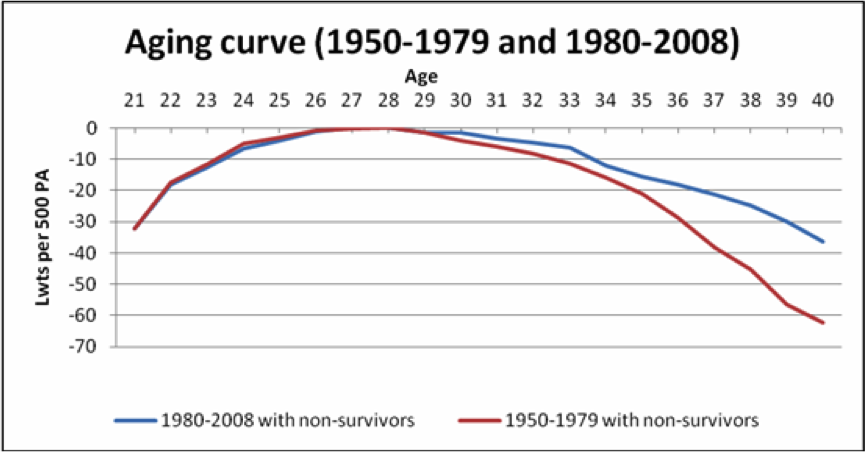
Just because McLouth was hurt in the intervening years doesn't mean that's wiped away completely - it negatively impacts not only how much we should expect McLouth to play, but it certainly means we shouldn't ignore the generic effects of aging.

Also, McLouth had about as many plate appearances in 2012 as he did in 2011 and 2010 (each). Over the entire span, he hit .221/.320/.340 - which is quite bad for a corner outfielder. He accumulated -0.4 fWAR. Just for comparison's sake, Nolan Reimold has hit .247/.317/.447 with 1.4 fWAR (in like 400 fewer PA). But sure, McLouth is the "proven guy"*.

* Reimold needs to stay healthy, but so does McLouth, right? Counting the minors, McLouth only has like 200 more PA than Reimold over the last three years (1276 to 1067). Why is one a huge injury risk while the other isn't at all?

To expect a player to continue hitting as well as he did in less than 250 PA at the end of a season - a substantially higher level than he has in years - is a mistake that overzealous fans sometimes make, but that GMs should not.

Even beyond that, one shouldn't expect McLouth's Orioles production to continue. His .306 BABIP would have been his best ever, and his career mark is just .277. So even just adjusting that down (and you better believe his career BABIP is what's more likely to show up in 2013 than 55 games if BABIP from this year), Nate's line falls to around .242/.318/.402 - that's a below average batting mark.

There are good parts of his game - he walks at a solid clip (9% for the O's, 10% career), doesn't strike out a ton (18% for the O's, 17% career), and has a bit of pop (.167 ISO for the O's, .173 career). But those are all merely solid, not great, as evidenced by his career 101 wRC+. A batter who's been almost exactly average in his career - with most of his playing time coming in his prime age 25-27 years - is very unlikely to be better than that (or even that good) when playing his age 31 season.

So we've got a slightly below average hitter at best, probably. Defensively, the numbers and the eye-test (to me, at least), indicate an average-ish left-fielder. His career UZR out there is -3 runs per 150 games, which is actually what you'd expect given his -13 runs per 150 games career in center-field (the positional adjustment between center and left is around 10 runs). The Gold Glove he has, like many of those that are handed out, was... not necessarily deserved.

Sure McLouth is a good baserunner - about +5 runs per full season in his career, 99 steals with an 86% success rate - but that isn't enough to turn a below average offensive, below average to average defensive corner outfielder on the wrong side of 30 who can't be counted on to play all year into a player who a team that wants to contend should give a starting spot to. And beyond the overall ability, McLouth probably shouldn't be starting anyway given his platoon splits (.342 career wOBA against righties, but only .292 against lefties).

Signing him to a one-year $2-3 M contract could be OK value (all of the above does add up to a 0.5 to 1 win player), but it doesn't actually make the O's a better team (they accumulated about a win from left-field in total in 2012). It's more promising him a job and then having to rely on him to do what no one should fairly expect from him that's the issue.

I will have many fond memories of Nate McLouth's contributions to the 2012 Orioles, and I wish him all the best in trying to land a starting gig on another (third-tier) team. If he finds those opportunities lacking, then bringing him back as a 4th outfielder isn't the worst (though his inability to play center in anything other than an emergency situation hurts). (This post was more negative on McLouth than I had originally intended, but it serves more as a counter-point to yesterday's decidedly pro-Nate post.)

25 October 2012

Nate McLouth: Should He Stay or Should He Go?

The 2012 Baltimore Orioles were composed of players from a wide variety of backgrounds and successes. One of the more interesting cases on the team was Nate McLouth. Nate seemed destined for success a few years back as a member of the Pittsburgh Pirates, a hard-nosed young player on a team struggling to build an identity, Nate was quickly anointed a fan-favorite after a break out season in 2008 which gave the fan base a real glimmer of hope.

After filling a 4th OF type role with the team in 2006 and 2007, McLouth was promoted to starting CF in 2008, mostly because the Pirates have constantly traded away players that developed some kind of trade value in hopes of bringing multiple players back in return to build a team for the future. Nate responded to this opportunity by hitting .276/.356/.497 while stealing 23 bases, playing gold glove defense, and drawing 65 walks. This was an amazing season which had McLouth labeled as a star in the making at 26 years old. Pittsburgh responded by signing him to a three year contract extension at a team friendly value of $15.75m, which is a steal for the kind of production he provided in 2008. The team then further rewarded him by continuing their "major league farm team" ways and traded him to the Atlanta Braves the following season for a package including Charlie Morton and Gorkys Hernandez, two of Atlanta's top 10 prospects.

The trade seemed to hurt McLouth personally as he really enjoyed the city and team in PIT and was blindsided after just agreeing to an extension with the team. That was followed by two injury plagued seasons in which he sustained a concussion in a collision with Jason Heyward in the OF, an oblique injury that led to a DL stint, and a sports hernia that robbed him of more than half a season of baseball. The Braves then declined his option making him a free agent, so he tried to go back home again and signed a 1-year deal with PIT. The reunion wasn't the same however as the team and environment was far different than when he left and he never seemed to get comfortable in his second go around with the team. After he was DFA'd by the Pirates, the Orioles signed him to a minor league deal and sent him to AAA, later recalling him in August, aligning the call up of Machado, these two moves drastically altered the team and gave them the push they needed to get to the playoffs.

Third base and left field were black holes for the Orioles for the first part of the 2012 season, with errors and lack of production haunting the team after Mark Reynolds/Wilson Betemit were ineffective at 3rd and Nolan Reimold went down for the season after a promising start in LF. As Machado solidified 3rd base and improved the defense in the infield, McLouth had the same effect on the OF. Seemingly comfortable playing in Baltimore, as showed by his slash line in Camden Yards of .314/.395/.505, Nate responded to the challenge, adding great defense and much needed speed to the lineup, filling two of the major holes this team just couldn't seem to overcome in 2012. After Nick Markakis ascended to the lead-off role and excelled, this team looked to have finally solved one of the missing pieces of the playoff puzzle, then down the stretch against the Yankees, he had a bone broken in his hand and was out for the season, placing doubt on the team's chances again. McLouth was inserted into the leadoff role and responded with a .797 OPS with 6 steals and 5 home runs in that period, helping to fill the gap Markakis left and helping the Orioles to secure the playoff bid down the stretch.

For his career, Nate has hit RHP to a tune of a .793 OPS and LHP to a .649 OPS which opens the door for a 4th OF to get some at-bats, and on a team that also features all the potential that lies in Reimold, who just can't stay healthy, finding a place to get him some at bats could be key. With Markakis back in 2013 in RF and leading off, Jones entrenched in CF, and McLouth showing not only that he can provide great defense in LF, but can play all 3 OF positions if someone needs a day off, he increases his appeal.

The naysayers will point to his stint in Atlanta and the small sample size of success he had in Baltimore, however, his entire stay in Atlanta was marred by nagging injuries that made it impossible to really get his feet wet there playing in only 250 games out of about 410 possible. That all-star player potential is still in there somewhere, and his time in BAL showed that. Nate said in an interview with Dan Connolly that he really liked Baltimore and felt comfortable here, his numbers sure seem to show that, and with a hole in left field, the team will be hard pressed to find speed, defense, offense, flexibility and a desire to play in Baltimore that is also cost effective as Nate should be. You may see a few other teams willing to take a gamble on Nate being back and try to jump in the bidding, but there is a mutual interest from both parties, and for the first time in a long time, we can say that Baltimore offers the chance to play for a contender.

 For a team that has all the potential in the world in Reimold, but can't rely on him to be healthy, Nate would be a great compliment considering the tools that he brings to the team. Having three former gold glove winners in your outfield is a great way to build a championship team, especially when you balance speed, defense and power like few teams can boast, and the team-friendly contract that comes with McLouth would allow us to keep the prospects we have in case we need them to make another deal, and keeps our payroll flexible in case the opportunity arises to add to secure extensions with our young core, or to add a marquis player to the team later.

24 October 2012

2012 Orioles Retrospective: Jim Johnson

I've spent years arguing that Jim Johnson could be an effective closer. Years. It used to be taken as an article of faith amongst fans (as well as some people with the team), that JJ just didn't have the "stuff" to close. Not his stuff - the hard sinker, curve, and change-up - but his "stuff". He just didn't have that "closer's mentality". Seriously.

Here's from September 2011:

"Johnson once blew a save (or two), which resulted in some people deciding that he didn't have the mentality of a closer, or something like that. His career numbers in saves are sparkling: an 0.79 ERA, a 2.8 strikeout to walk ratio and a .175/.221/.200 batting line against (batters are hitting .162/.205/.201 against Mariano Rivera in saves in his career). That's only 16 games, though. Let's expand out and look at all save situations versus non-save situations:

Save situations: 2.91 ERA, 114 1/3 innings pitched, 5.4 K/9, 2.4 BB/9, 0.55 HR/9, Fielding Independent Pitching of 3.59

Non-save situations: 3.28 ERA, 134 1/3 innings pitched, 6.4 K/9, 2.9 BB/9, 0.54 HR/9, Fielding Independent Pitching of 3.53

More strikeouts in non-save situations, but also more walks; he's pretty much the same guy overall (check out those FIPs). Batters are hitting .252/.304/.340 against him in save situations and .253/.318/.348 in non-save situations. Johnson can close if the team wants him to - he'd be fine at it."

There's some not dissimilar point here from April 2010.

It was entirely unnecessary to reproduce that passage, but it's a nice reminder of where we were once upon a time. Buck Showalter accepted this argument at the end of last season and into this season (though there was some discussion of moving JJ to the rotation), and so Jim Johnson was installed as the closer. Here are his stats for the last two years in a random order:

Year A: 2.67 ERA, 3.22 FIP, 3.42 xFIP, 5.7 K/9, 2.1 BB/9, 0.5 HR/9, 62% GB
Year B: 2.49 ERA, 3.25 FIP, 3.63 xFIP, 5.4 K/9, 2.0 BB/9, 0.4 HR/9, 62% GB

Ah, but what if I add:

Year A: 1.7 fWAR, 2.5 rWAR
Year B: 1.4 fWAR, 2.3 rWAR

Then it might be easier to guess. Year A - the season where Jim Johnson contributed more wins to the team - is 2011, of course. Year B is 2012. That's because as the closer, JJ was only rarely* asked to go more than one inning, so he finished with 68.2 IP (in 71 games). Last season, JJ had 91 IP in 69 games.

* He only pitched more than an inning twice, both times getting 2 IP against the Red Sox, in Boston, a month apart.

You don't often see a huge amount of consistency from year to year for relievers, but JJ was pretty much exactly the same guy this season that he was last season. You know, other than setting a club record by picking up 51 saves in 54 chances. He was consistent all year too, with two outings accounting for more than half of the total runs he allowed. In 32 of his 71 games, Johnson pitched an inning facing the minimum three batters*.

* No idea how that compares to the average closer, but it seems good. One data point; in 2009, Mariano Rivera pitched an inning facing the minimum 22 times in 66 games. Though he did go more than more inning more often, Mo faced the minimum in 39% of his outings that lasted an inning or less and Johnson did it in 46% of his.

It's a bit of a shame that JJ's sometimes devastating sinker isn't more of a swing and miss* offering. Though he can gets whiffs on his curve (and sometimes his change-up), pounding the zone with sinkers does keep things move along quickly and prevents walks and homer, but can leave Johnson vulnerable to the BABIP gods. Not that that's often been a problem - his BABIP against is just .279 for his career, and was .251 in 2012 - but, especially as a groundball pitcher in front of a sometimes poor infield defense, getting the K can often be better.

* His 5.4 K/9 is easily the lowest strike-out rate for a pitcher with 50 saves in a season. Next closest is 7.1 K/9, and that was back when strike-outs were less prevalent in general. 

The lack of strike-outs keeps Johnson from being one of the elite relievers in the Majors - even going by ERA, he was just 36th this year - but he's a good, usually* dependable guy to have at the back of the bullpen. The 51 saves might make his price-tag go up though (and he'll be a free agent soon), which means that it might actually be in the Orioles' best interests to shop him this off-season to a team in need of help in that area. Not that I'd mine terribly seeing him try to break his own record next year.

* Having the outcome of the ALDS essentially in his hands (though not really - an actual offense would have been nice), seeing Jim Johnson blow two games after the success he had this year was brutal. Luckily we seem to have avoided returning to the "he doesn't have a closer's mentality" stuff but, humorously may have tilted too far the other way in Game One ("he's a closer, don't bring him into a tie game").

22 October 2012

2012 Orioles Retrospective: Mark Reynolds

Mark Reynolds did not have a particularly good 2011. Though he hit pretty well, his atrocious defense at third-base ate into his value enough that he ended up being only barely above replacement level. With a dearth of good options coming into this season though, Reynolds was sent right back out to the hot corner. 6 errors in 15 games quickly put that effort to an end; especially since he wasn't making up for his lead glove with his bat (just .143/.260/.206 in April, as he K'ed a ton and hit for no power).

Things started to turn around after that - Reynolds hit .308/.457/.654 in the first couple weeks of May - but a strained oblique landed him on the DL. He came back striking out less (and thus hitting for a somewhat higher average), but the power was still lacking. At the trade deadline, Mark Reynolds - who had hit 44, 32, and 37 homers the previous three years - had just 8 longballs in 79 games and was slugging .367.

From August 6th to September 8th though, Reynolds went on an absolute tear; .320/.431/.773. He homered 3 times in 3 games (twice in the opener) in Boston as the O's won a par. He went to New York and had a two home run game leading to a W, and then did it a again two days later. The Birds went up to Toronto, and we went deep twice more (the O's again took two of three on the road). Then the Yankees came to Baltimore on September 6th (Cal Ripken Jr. Statue Day), and Reynolds hit two home runs again. He added another round-tripper in the third game of that series. 29 games. 13 home runs.

Reynolds fell into a slump again to end the season, and continued it into the playoffs where he struck out 10 times in 25 plate appearances with just 3 hits (all singles) and a walk. Still, that one hot streak was enough to push his season batting line to an above average .221/.335/.429. He struck out less frequently than he ever had before, in (a still high) 29.6% of his times to the dish. He had the best season of his career when it came to working walks, drawing a free pass in over 13% of his plate appearances (excluding intentional walks).

It was pretty much just the power-outage that hurt him. Perhaps Reynolds had re-worked his swing or something, since his line-drive rate (according to FanGraphs) went way up - from just over 13% in the past two seasons (pretty low) to over 20% (a career high) - while his flyball rate was a career low. Fewer flyballs means that even a small drop in power would lead to a more substantial drop on home run production, and Reynolds HR/FB rate was his lowest since his rookie season (though 18% is still pretty good).

One would think that hitting more line-drives could drive up a player's batting average, and though he hit just .221 Reynolds did have his highest BABIP since 2009 at .282 (was ~.260 the last couple seasons). Trading some strike-outs for singles is good, but trading some strike-outs and some home runs for singles isn't especially helpful. Still, at least he made his home runs count; 6 came against the Yankees and 7 against the Red Sox, of his 23 total.

On the other side of the ball, things were perhaps a little more ambiguously interesting. Reynolds shifted across the diamond to first-base, and people began to talk about him being a Gold Glove caliber player over there. It strikes me now that perhaps this is no dissimilar to the story from Moneyball where - in an effort to bolster Scott Hatteberg's confidence as he transitioned to first - he was repeatedly told that he was a "pickin' machine".

Reynolds posted a -3 UZR at first-base this year - better than his -5 at third (in only 15 games!), but still below average. It seems like he often makes plays that look like they're hard, but they only appear hard because he had a tough time with them. The fall-down stretch at first can be a display of coordination and athleticism, or it could be the mark of a guy isn't the best at making a regular stretch (or both). The many sliding stops seem good, but they often just display a lack of range. The numbers didn't get better as the year went on, either, but that gets into some small (or, one should say, even smaller) sample sizes. Plus, when you account for the positional adjustment (allowing for first-base being easier to play than third), Reynolds had the second worst defensive season of his career.

Sure the metrics aren't exact, but all the ones I've looked at are in agreement that he's not a good first-baseman. "Fall-down" range at third-base isn't going to translate into excellent first-base play all that often. Maybe if he keeps working at it he can be adequate over there, but a Mark Reynolds who isn't hitting 30-35 home runs just isn't a useful player for a team looking to be at all competitive (and, perhaps at this point in his career, not even for a team that isn't). Given that, I'm not sure it's really worth bringing him back for 2013, despite his desire to return. Maybe a really cheap contract (definitely not his $11 M option), while not counting on him to start every day. Perhaps even in a platoon role to compliment Chris Davis and Wilson Betemit, as Reynolds has a career 123 wRC+ versus lefties (105 versus righties). That's a lot of all-hit no-field guys to keep on the roster though.

In any case, it was always enjoyable seeing Mark Reynolds hit those long home runs while in an Orioles uniform. The Sheriff of Swatingham indeed.

21 October 2012

Sunday Comics: The Janitor

So you know how Jim Johnson's picked up the nickname 'The Janitor' for cleaning things up in the 9th so often and so well this past season?

...I did this.


Considering that just the other day I drew Buster Posey as Captain America, I guess I've got a nickname theme going here.