19 October 2012

2012 Orioles Retrospective: Jason Hammel

When Dan Duquette traded Jeremy Guthrie to the Rockies for Jason Hammel and Matt Lindstrom, a lot of Orioles fans were not particularly pleased. "Guthrie's the team's only real starter." "He's the O's #1 guy." And so on. Hammel didn't do much of anything in Tampa Bay, and then followed up two solid seasons in Colorado with a down year in 2011. I thought that Guthrie and Hammel could be expected to be about equally good in 2012, but that Hammel had a better chance of providing the O's with above average production. And I still ended up underestimating Jason Hammel. Boy what a difference one pitch can make.

Hammel added heavy use of a two-seam fastball to his repertoire in 2012, and it proved quite effective. Always a pitcher who could get a few groundballs, he became one of the best in the league at it (his 53.2% groundball rate was 9th in the AL amongst pitchers with at least 100 IP). That improvement allowed Hammel to post the lowest home run rate of his career (0.7 HR/9). When he had gotten groundballs in the past, it was usually with his off-speed stuff. This year though, it was with that sinker; almost 60% of the time that that pitch was put into play, it was on the ground.

Normally there might be some sort of trade-off keeping the ball on the ground and getting strike-outs, but not only did Hammel keep the ball in the yard but he also set a career high by striking out 8.6 batters per nine. After being around 7 K/9 in 2009-2010, that fell off to just under 5 K/9 in 2011 - so seeing a rebound (and then some) was hugely encouraging. Let's compare the whiff rate on his various pitches from this season to that 2009-2010 stretch, which was his previous best:

Year Fastball Slider Curve Change-up
'09-'10 10% 25% 37% 28%
2012 17% 38% 43% 19%

The "fastball" combines the two-seamer with the four-seamer. Breaking them out for 2012 it's 15% and 20%, respectively. As primarily a fastball-slider guy, it's easy to see why Hammel's strike-out rate jumped so much - he started missing way more bats. The sinker and the slider tend to work well together, and he started going to the slider more often this year as he added the sinker - from ~17% of his offerings to over 22%.

Hammel velocity also improved; the 93.5 mph that his fastballs (both similarly) averaged this year was a career high. The change-up, though he only used it sparingly, was up to over 88 mph. Power pitchers who also get groundballs are pretty rare. Here's the list of guys with at least a 50% GB rate, a 93+ mph fastball, and at least a 7 K/9 from this year: David Price, Edison Volquez, and Jason Hammel.

All that, and his control didn't fall off a cliff either. While a 3.2 BB/9 isn't great (and it's worse than the low-to-mid 2s he posted in '09-'10), it's perfectly serviceable for a guy who brings everything else to the table that Hammel did (and is actually better than the 3.6 BB/9 from 2011). Here's the list of guys with the GB/K/velo numbers from above who also walked fewer than 5 guys per nine: David Price, Jason Hammel. That's it.

It's truly a shame that a knee injury kept Jason Hammel out from almost all of the last month and a half of the season, because he was on pace to have the best season of his career (2.9 fWAR in 118 IP translated to about 4.2 fWAR in 170 IP - he had between 170 and 178 IP each of the three previous years). Hammel came back for the playoffs though, and largely picked up where he left off; 11.1 IP, 11 K, 4 UIBB, 3.18 ERA.

There are certainly some doubts about what Hammel will do next year (he's under team control for one more season - another nice bonus from the trade) given his history, but I think he's just not the same pitcher he used to be. While a 3.43 ERA, 3.29 FIP, and 3.46 xFIP might not happen again, there's good reason to think he can be an above average starter in 2013. And if he's able to stay a little healthier, that might even translate into a more valuable season. It's been a while since the O's have had an Opening Day where they could be pretty comfortable throwing their #1 out against whoever the opposing team has, but that might be the case next year.

16 October 2012

The Orioles Had a Topsy-Turvy Post-Season

The Orioles offense was not very good in the post-season - that can't be denied. Almost nobody hit, and they only scored 2.5 runs per game (that obviously didn't get it done). One sort of interesting aspect to the playoffs though, was how topsy-turvy everything went for the O's. Down was up, up was down. To wit:

* This team was largely carried by their historically successful bullpen. That pen had a 2.73 ERA in the playoffs, which is good but (a) not much better than their 3.00 during the regular season, (b) not that impressive given that they had their top guys going (ie, no Kevin Gregg), and (c) against a Yankees team that also stopped hitting. Mostly it was on Jim Johnson - he of the 2-1 record, 51 for 54 on saves, and 2.49 ERA - who went 0-1, with 2 saves in 3 chances and an 8.44 ERA.

* The starting pitching, which was shaky for much of the season, was superb. They had a 4.42 ERA in the regular season, and an ERA of 2.00 in the playoffs. They upped their strike-out rate from 6.9 K/9 to 7.8 K/9, while keeping their walk rate at 3 BB/9 and not giving up a single home run. And Joe Saunders started twice!

* Speaking of Saunders, he struck out 4 or more batters in less than half of his starts for the Orioles (3 of 7). So, of course, he recorded 4 and 5 K's in his two game.

* Offensively, the O's lived by the home run his year - they hit the second most longballs in the Majors, with 214 (about 1.3 per game). In the playoffs they hit just 3 (0.5 per game).

* Who did the hitting also took a decided flip. The worst position for the team this year was second-base, where the assorted players the O's trotted out (mostly Robert Andino and Ryan Flaherty) hit a combined .213/.273/.323 (.596 OPS). In the post-season, Andino hit .417/.417/.500 and Flaherty hit .273/.273/.545 (with a homer) for a combined .870 OPS that was the highest from any position for the team.

* The third worst OPS during the season came from left-field. Nate McLouth hit .308/.321/.462 (with one official homer) to put that position right behind second-base in the playoffs.

* Manny Machado drew just 9 walks during the season, for a 4.4% walk rate. In the post-season he walked twice (8.7% walk rate). He and Matt Wieters were the only Oriole batters to walk more than once.

* Adam Jones had the best offensive season of his career (.287/.334/.505), but did nothing in the playoffs (.077/.074/.077).

It was all pretty weird - and, in many cases, painful - to watch. For most of the season, people were saying "this just can't keep up". And them in the post-season, very few things actually did keep up. But, it should be noted, they were happening in the post-season.

15 October 2012

Can we assume Wieters will hit better next time in the playoffs?

Jon Shepherd contributed to this article.

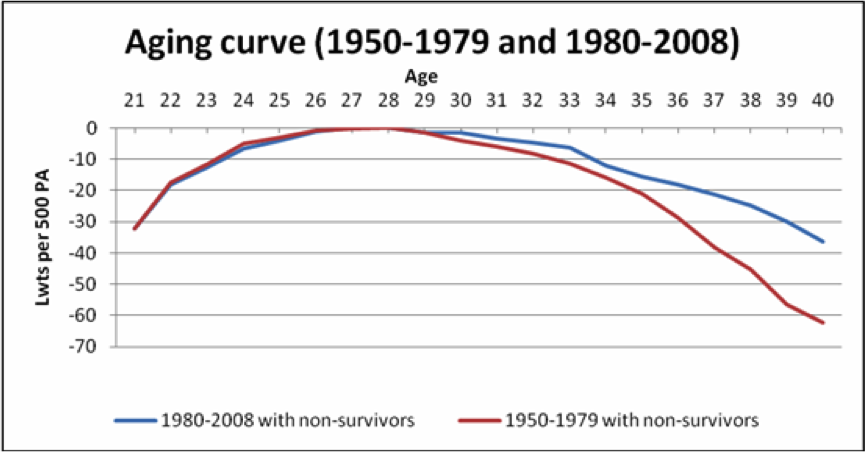
There has been some data that suggests that catchers peak later offensively in their careers than the average player. The narrative often attached to that late boost in offensive prowess is that a catcher has to deal with the mental hardships that come with taking care of a MLB staff and that exhausts a catcher from developing quickly from an offensive standpoint.  A second competing narrative is that a catcher's appearance in the majors is not a product of his offensive game, but of his defensive game.  As such, catchers with under developed offensive skills are more likely to be promoted and learn at the major league level than catchers with under developed defensive skills. 

The former idea of mental adaptation comes up a lot though in a variety of ways.  In a playoffs-related chat at Baseball Prospectus last week, Dan Evans suggested that the first time a catcher goes to the post-season his offensive production can suffer because he's focusing so much on his pitching staff. To put it another way, he is thinking so much about his pitchers that his mind is dulled for handling his own offense. This came up in reference to Matt Wieters, who ended up batting a dismal .125/.197/.167 in the playoffs. Jon was nice enough to provide me with a non-exhaustive list of catchers who had multiple post-season appearances over the last couple decades, so I could preliminary look at how they did their first time there versus their second (counting "first time" as the first year in which they had at least 10 plate appearances in the playoffs.)  The was not intended to be an exhaustive study on the subject, but a quick pilot study to see if there was any indication as to whether this truly is a topic to invest more time.


The list: Javy Lopez, Sandy Alomar Jr., Jason Varitek, Jorge Posada, Dan Wilson, Chris Hoiles, AJ Pierzynski, Yadier Molina, and Carlos Ruiz.

The first time this group of players were exposed to handling pitchers in the playoffs, they had an average OPS of .692. In the season preceding that post-season, they had an average OPS of .784. So, while acknowledged that the playoffs do only provide a small sample size, the catchers fared worse in the playoffs than they did in the regular season by an average of about 91 points or a reduction of 12%. This decrease would be in line with general conventional wisdom about offensive performance decreasing in the playoffs for all players in that pitchers in the playoffs tend to be better as a function of the best teams being in the playoffs. Worse teams with likely worse pitchers are not present for hitters to beat up on. 


The second time the catchers went to the playoffs, they had an average OPS of .674 - so that is a little bit worse than the first time. That isn't that bad though, when you account for their average OPS during the regular season on .742. So their OPS fell by only 69 points, on average, or a 9% decrease in performance.


This is only nine players, of course, likely with different levels of responsibility when it comes to handling their respective pitching staffs and the quality of pitching each of them faced while hitting may not be the typical quality of post-season pitchers. Again, this is a pilot study. A difference between a 12% decrease and a 9% decrease in relation to their regular season stats does not appear to be incredibly significant.  At least, it does not seem to be an interesting enough result to look more deeply into the numbers.  The idea is interesting and likely merits greater study, but nothing immediately emerges from this pilot study to indicate there is something really meaty here. A major problem for many statistical-minded folks is to be at arms with established lines of thought.  Where this has made sense in order for this approach to gain a strong foothold in every front office, it can sometimes overlook great ideas and concepts that statistical analysis has difficulty in assessing.  Perhaps there is truth to the mental hardship being placed on a playoff newbie catcher or maybe there is a general narrative that is being forced on catchers who happen to do poorly in a handful of plate appearances.


The work done here is largely inconclusive.  Maybe someone else can find much more merit to the idea than we did.  Our personal opinion is that Matt Wieters' line during the playoffs this year will not mean much to what he will do the next time he gets into the post season, fingers crossed, in 2013.

The full data (with an extra year for some catchers who were fortunate enough to see October over and over):

Javy Lopez:


1995 - .315/.344/.498, .842
 OPS

1995P - .300/.302/.525, .827 OPS, 43 PA

1996 - .282/.322/.466, .788
 OPS

1996P - .365/.426/.625, 1.061 OPS, 61 PA

1997 - .295/.361/.534, .895
 OPS

1997P - .125/.207/.250, .457 OPS, 29 PA

Sandy Alomar:


1995 - .300/.322/.478, .810
 OPS

1995P - .220/.233/.366, .598 OPS, 43 PA

1996 - .263/.299/.397, .696
 OPS

1996P - .125/.125/.125, .250 OPS, 16 PA

1997 - .324/.354/.545, .900
 OPS

1997P - .274/.303/.507, .809 OPS, 76 PA

Jason Varitek:


1999 - .269/.330/.482, .813
 OPS

1999P - .220/.227/.512, .739 OPS, 44 PA

2003 - .273/.351/.512, .863
 OPS

2003P - .294/.351/.706, 1.057 OPS, 37 PA

2004 - .296/.390/.482, .872
 OPS

2004P - .245/.295/.472, .767 OPS, 61 PA

Jorge Posada
:


1998 - .268/.350/.475, .824 OPS

1998P - .227/.414/.500, .914 OPS, 29 PA

1999 - .245/.341/.401, .752 OPS

1999P - .182/.217/.409, .626 OPS, 23 PA

2000 - .287/.417/.527, .943 OPS
 

2000P - .204/.353/.278, .631 OPS, 68 PA
 

Dan Wilson:

1995 - .285/.330/.3444, .774 OPS

1995P - .061/.114/.061, .175 OPS, 35 PA

1997 - .270/.326/.423, .749 OPS

1997P - .000/.000/.000, .000 OPS, 13 PA

Chris Hoiles
:


1996 - .258/.356/.474, .830 OPS

1996P - .158/.292/.316, .607 OPS, 24 PA

1997 - .259/.375/3419, .794 OPS
 

1997P - .143/.280/.286, .566 OPS, 25 PA

AJ Pierzynski:


2002 - .300/.334/.439, .773 OPS

2002P - .344/.371/.500, .871 OPS, 35 PA

2003 - .312/.360/.464, .824 OPS

2003P - .231/.333/.462, .795 OPS, 15 PA

2005 - .257/.308/.420, .728 OPS
 

2005P - .262/.313/.571, .884 OPS, 48 PA
 

Yadier Molina:

2005 - .252/.295/.358, .654 OPS

2005P - .286/.286/.371, .657 OPS, 35 PA

2006 - .216/.274/.321, .595 OPS

2006P - .358/.424/.547, .971 OPS, 59 PA

Carlos Ruiz
:


2007 - .259/.340/.396, .735 OPS

2007P - .333/.400/.444, .844 OPS, 10 PA

2008 - .219/.320/.300, .620 OPS

2008P - .261/.346/.391, .737 OPS, 52 PA

2009 - .255/.355/.425, .780 OPS

2009P - .341/.474/.591, .1.065 OPS, 57 PA

14 October 2012

Sunday Comics: Thank You, Orioles

This was not something I wanted to draw this early. I was hoping I wouldn't have to do this until November, to be honest, but here we are.


I didn't get to watch the last game of the season as I've been spending this weekend being a nerd at New York Comic Con doing stuff like this (and sadly not at a table selling this yet, but maybe someday). I'm crushed that it all ended against the Yankees, but at the same time I'm so beyond proud of this team for clearly overachieving what they were predicted to do on paper. They took us on one heck of a ride this year. And hey, they certainly gave the Yankees a good scare, didn't they? 

Thank you, Orioles, for making me fall in love with baseball all over again this year.