15 April 2011

Five Baysox to Watch in Bowie in 2011 and Hoes


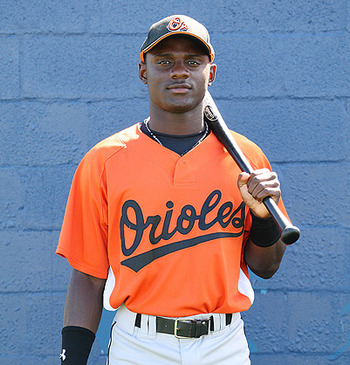
Orioles' OF Xavier Avery
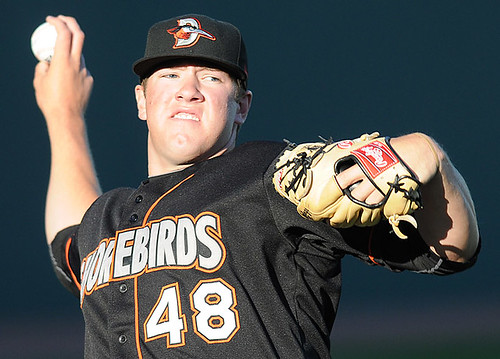
 When I wrote the Frederick Keys Five to Watch post I had assumed that LJ Hoes would be playing 2B in Bowie.  However, the Orioles wanted to give Greg Miclat the first go at second base.  As such, I think Hoes will perform well in Frederick and give Miclat a couple months to prove himself.  In this post, I will give a short summary of five to watch in Bowie as well as something about LJ Hoes.  The rest of Bowie showcases some of the second tier talent in the Orioles' system.  Unfortunately, the Orioles second tier talent would be other teams' third or fourth tier talent.  For example, Zach Britton and Manny Machado were in Baseball America's top 25.  Baseball America forms their top 100 prospects by having their five contributors devise their own individual top 150 lists.  No other Oriole found himself on any of the top 150s.  That is what we call a steep drop in talent.

However, one should not confuse such a steep drop as meaning the organization is without talent past Machado and Britton.  The organization has several C+ / fringe B- players who have a great chance of being solid bench players in the Majors and an off chance at being a regular.  I would say to not expect anything beyond that though.  Bowie is really the epitome of that.  They will have several players this year that might become something, but have significant flaws that they must address or find ways to compensate.

Xavier Avery, CF/LF
Avery has a package of raw skills that scouts can dream upon.  He has great athleticism and strength that was honed as a serious football first athlete in high school.  It has really only been in the past four years that Avery has taken baseball seriously.  That he will be a 21 year old in AA Bowie shows that his natural ability and a capable learning curve has done wonders for his game since he was selected in the second round in 2008.  Although strong, his lean frame does not and should not result in any significant power.  He has increased his power production from his age 18 season (ISO of .057) to last year's age 20 season (.115).  His goal should be to increase it to about .130 in order to keep pitchers honest.  Otherwise, he will be constantly challenged at the Major League level.  His contact rate is league average (not good) and his plate discipline is a shade below average (also not good).  He has also not proven to be completely adept at stealing bases, but not awful.  His lack of skill is overcome by his speed and has resulted in roughly break even marks for successfully stealing bases.  However, he is on a 16 straight stolen base streak without being caught.  His speed also helps him in the outfield making several plays in center.  His first step is not great, but he covers a great deal of territory and has natural control of his body (think of Felix Pie who has great speed and looks quite clumsy...Avery is similar without the clumsiness).  Avery is still developing as a player, so it will be interesting to see what he can do this year.

After the jump, four more Baysox and Hoes.

14 April 2011

Updated 2011 1st Rd Draft Rankings: Keith Law, Baseball America, Nick Faleris

Baseball America put out their mid-season revision of the 2011 amateur draft rankings (April 12th).  There has not, in general, been a lot of movement in the lists, which are composite rankings also using Keith Law's (March 22nd) and Nick Faleris' (March 27th).  Baseball America also only brought in two new players within the the top 50 universe of players collected so far from each of the three ranking source over the course of this season.  Those two were 49th and 50th in their most current update.  The BA update has resulted in only one individual being tossed out of the top 33 (Nimmo) and a new one finding his place (Stephenson).

Click on the image below to make the graph a bit larger and more legible.


The top four have stayed the same in order with Rendon, Cole, Gray, and Starling.  Behind them, players have moved up and down a few spots.  It is actually quite remarkable how similar these lists are becoming.  One of the reasons why I chose these three sources was because they are famous for being independent in their rankings.  Other sources tend to be massaged in concert with new lists hitting the net.

For the Orioles, the growing perspective is that the team is focused on Anthony Rendon and then a college pitcher.  It would be shocking to see Rendon fall to the Orioles at the four spot (1:4), so it will likely be a college pitcher.  Danny Hultzen of Virginia and Jed Bradley of Georgia Tech would be the two most obvious candidates.  I have been told by some fans that they hope Matthew Purke is the selection, but I figure his motion, injury history, and that he rejected a 6MM deal from the Yankees Rangers (edit: 4/17/11 JS I did not remember this correctly) his first time around might make things a bit uncomfortable in figuring out their draft budget and ensuring they select a high quality prospect.

At Camden Depot, I think the way we lean right now would be Sonny Gray (Jon Shepherd) and perhaps Bubba Starling (Nick Faleris).  I am assuming Nick's pick here.  However, there is a lot of talent bunched up in the 3-8 range.  I would be pleased with a good number of players including Hultzen and Bradley.  I would also be pleased with someone who I think is a sure Major Leaguer, but without a superstar potential (Jackie Bradley Jr).  Anyway, I imagine we will see at least another four future updates of this list.

13 April 2011

Is Wieters a poor behind the count hitter?

In the Oriole sphere of influence yesterday there was considerable talk about Matt Wieters and his ability to hit (or lack thereof) when behind in the count.  Much of it was initiated by a post on Orioles Hangout and it being highlighted by Tony Pente.  The post itself put an interesting premise in place about how Wieters hit no better than Cesar Izturis when behind in the count.  I'd argue though that it was an interesting notion, but we need to put the numbers within a bit more context.  Why?
  1. Small sample size.  Think about it, how many plate appearances do you need to feel comfortable about a player's performance?  It is probably somewhere in the 500-600 range where you begin to have a decent idea as to how good a hitter is.  Wieters has seen 916 first pitches in his career.  He has seen 424, 397, and 385 pitches in 0-1, 1-0, and 1-1 counts.  Every other situation is less than 257 pitches.  As one goes from 1 pitch to 500 pitches, the data becomes more meaningful.  However, you need to be quite open and aware that these are not hard, unwavering indications of ability.  As such, it is NOT safe to say Wieters is a poor Major League hitter in 0-1, 0-2, and 1-2 counts.  It MAY be safe to say that he has not performed well in those situations.  There is a subtle, but key point there.  Past events correlate ability, but past events are not ability.  The weaker the sample size, the weaker the correlation, typically.
  2. The poster presented Wieters numbers within the context of eight Orioles and two other players.  This is not ideal for a comparison population when Baseball Reference provides you with whole league data to devise an average level of performance.  To understand how Wieters' performance has been, it is necessary to determine how that performance compares to the league average hitter.  The point of doing this is to minimize peculiar collections of data.  Additionally, shouldn't we also consider how there is a scarcity of offense at his position?  It seems that comparing a catcher's offensive production to other positions with greater production might be a tad bit unfair.
  3. With the poster done with his findings, I think Tony Pente chose to present some statistics in a manner that could be confusing to his audience.  Tony is someone who I find to be quite good at scouting players.  I regularly check his views on Oriole minor leaguers.  I trust what he sees over many in the industry who look at the Orioles with a less focused eye (e.g., John Sickels).  However, I don't think Tony fully recognizes what statistics can and cannot do at times.  In one paragraph, he notes that the pitch distribution over 29 plate appearances "tells me the book on Wieters is not to try and throw fastballs by him, but to get him out with offspeed stuff."  Pitch distribution over 29 at bats is not a large enough sample size.  It can be too affected by pitchers faced, situations, and simple chance.  He next paragraph acknowledges the meager nature of the data set with "It's early and the numbers won't be as skewed by year's end, but one thing is certain is that Wieters has been a terrible hitter when down in the count throughout his career and that pitchers are throwing him more and more offspeed pitches..."  However, I am not sure what he means here.  He writes he is certain of one thing and mentions two.  I'd argue without true population context, we don't know if he has been terrible or poor or whatever.  Second, pitch distribution over 29 plate appearances should not make one certain that pitchers are throwing him "more and more off speed pitches."  Wieters has barely seen a cutter.  The same logic would dictate that reports have determined that Wieters crushes cutters and no one will throw them to him.  Markakis, Reynolds, and Vlad also have seen fewer fastballs as well.  Has the scouting report changed on all of these guys?  It would be nice if that data set is robust enough to use, but it is not.  Tony might be absolutely correct, but he is not citing anything that supports his notion.  This is a case of the existing statistics taken to fit a narrative.
In response, I plan to explore a few different ways we can measure quantitatively and qualitatively Wieters offensive performance.  This series may take three or four posts over the next couple weeks while being completely honest with ourselves about the robustness of the data we have and what we can say with it.  Remember, a batter going 0-4 had a poor performance, but may not be a poor hitter.  We need to make that distinction.  If we have 600 plate appearances we might be able to say something more conclusive.  With Wieters short experience, we will be mostly treading in statistics that have no much weight.

After the jump, I will re-explore the notion of Wieters' OPS once he reaches certain hit counts.

11 April 2011

Predicted Wins and Playoff Probability: Week 2

There were some problems in last year's projections and probability.  I have sorted out the errors in some of the equations.  The original probability was based on the unadjusted Depot win prediction, but that has been corrected to the adjusted wins.

Click to make larger.

10 April 2011

Two completely different Zach Brittons

Sunday morning Buster Olney tweeted this:
Zach Britton has a chance to become what Stephen Strasburg was last year: Must-see TV. He is a very rare lefty with veering 95 mph fastball.
As you probably know, I have always been a bit shy when it comes to predicting success for Zach Britton over the years.  He is a pitcher who does best by inducing poor contact (e.g. ground balls).  In the minors, you typically see a reduction in ground ball rates as you move up the ladder.  If I remember correctly, a league average pitcher will typically see a decrease in grounders about 10%.  In other words, if a pitcher was inducing 50% ground balls in low-A then the average result would be a 45% line in AAA.  These lost grounders are thought to be diverted into balls and line drives.  This is thought to mostly be a product of more polished hitters higher in the minors who lay off the low pitches or can square up the ball low in the zone or get around on high velocity pitches.

As such, I have tempered my expectations of Britton.  I put him in a category of pitchers who need to prove himself at each and every level because so much depend on inducing poor contacts.  The fear being that more polished hitters will lay off his sinking fastballs that fall out of the zone or guys would be able to square up on them at a higher rate.  Tony Pente was the first person I read who pushed all in on Britton as a future star.  He was doing that three or four years ago.  At times, he has mentioned Britton as being better than Brian Matusz.  Keith Law began beating the drum two years ago, but still considers Matusz the better pitcher.  I am still in a holding pattern waiting to see where Britton falls in the 2-4 range.

What has impressed me so far though through these two games (remember: small sample size) was how different the two outings were.  The first time Britton went out, he ditched his two-seamer and lived off his four-seamer with a mix of changeups and sliders.  On Saturday, he fully embraced the two seamer and casually threw his other pitches.  It was stunning.  Both pitchers looked quite effective with last night more so.  What this does for me is indicate that there is a broad set of skills in Zach Britton.  I find his two-seamer as his only exceptional pitch, but he can also effectively use his other offerings to get by.  That makes me optimistic that when the league starts adjusting to him, he will be able to keep up and change himself.

That being said . . . I saw Stephen Strasburg and this was no Stephen Strasburg.  However, it is still pretty amazing.  I hope Britton continues to surprise me.  Maybe next game he will break out a knuckle ball and an Eephus Pitch and no hit the Yankees.

Continue reading to see a comparison of the two Britton outings from Pitch f/x data.