Showing posts with label first base defense. Show all posts

07 December 2015

Is Mark Trumbo A Good Defender At First Base?

If you're going to acquire Mark Trumbo, then you're getting him for his bat. He has a career 108 wRC+, which means he's been 8 percentage points better than league average at the plate over the course of his career.

Specifically, though, you want his power in your lineup. In parts of six seasons in the majors, Trumbo has hit 131 home runs and has an isolated power of .208. I mentioned this the other day, but in the past three years, Trumbo is 24th among qualified players in isolated power. For reference, Chris Davis is first. Adam Jones ranks 23rd. Trumbo is strong, and he hits the ball far. That's valuable.

There's not much up for debate about Trumbo's offensive abilities. He's a high slugging, low on-base percentage hitter, and that's just fine. Most teams, especially American League ones, have room for Trumbo in their lineup.

But what about his defense? If we've learned anything about how to value players, it's that everything matters. And we know that Trumbo is a bad defensive outfielder, so hopefully he doesn't end up playing in left or right field often for the Orioles. His bat would make using him there tolerable, but it's not optimal strategy. Besides, Chris Davis very well may sign with another team, which would open up plenty of work for Trumbo at first base. So is he a good defensive option there? In Tuesday's trade write-up, I took a quick look at his defense both at first and in the outfield according to Ultimate Zone Rating (per 150 games) and Defensive Runs Saved. Let's break it down per season:

YearInningsUZR/150DRS
20103341.61
20111,2575.29
201215928.70
20131,03010.52
2014377-17.3-1
20151528.91
Total3,0096.312

Some takeaways: First, Trumbo has only played two seasons in which he's seen more than 377 innings at first base. And in those seasons (2011 and 2013), he graded well in both metrics. Also, his only negative defensive season came in 2014, after he took over for Paul Goldschmidt, who broke his hand in August and missed the rest of the season. Earlier in 2014, Trumbo missed about two months due to a stress fracture in his left foot. He also battled plantar fasciitis.

It's worth noting that after 2011, arguably Trumbo's best defensive season, the Angels explored moving him to third base. (He healed after dealing with a stress fracture in his right foot.) The Angels also signed some guy named Albert Pujols, which explains why Trumbo barely played at first in 2012. He started eight games at third base that season (and wasn't very good) while mostly playing in the outfield. Pujols then missed a chunk of the 2013 season, and that was the last time Trumbo had regular work at first base.

Looking at individual defensive seasons can be misleading and is hardly definitive. Still, Trumbo's overall defense at first base seems solid. That is, unless you place heavy weight on FanGraphs' Inside Edge fielding data. That data, which goes back to 2012 and breaks plays down into six categories of varying difficulty, does not paint Trumbo's first base defense in the best light.

From 2012-2015, among 40 first basemen who have seen more than 1,500 innings at first base, here's how Trumbo ranks in the various categories:

Almost Certain/Certain (90-100%): t-22nd (97.6%)
Likely (60-90%): 40th (60%)
About Even (40-60%): 31st (45.5%)
Unlikely (10-40%): t-37th (0%)
Remote (1-10%): t-25th (0%)
Impossible (0%): All at 0%

So that's not great! Trumbo makes the plays right at him decently enough, but he's not skilled at pulling off difficult ones. But that doesn't mean he still can't make good plays. Here's one, from 2013:
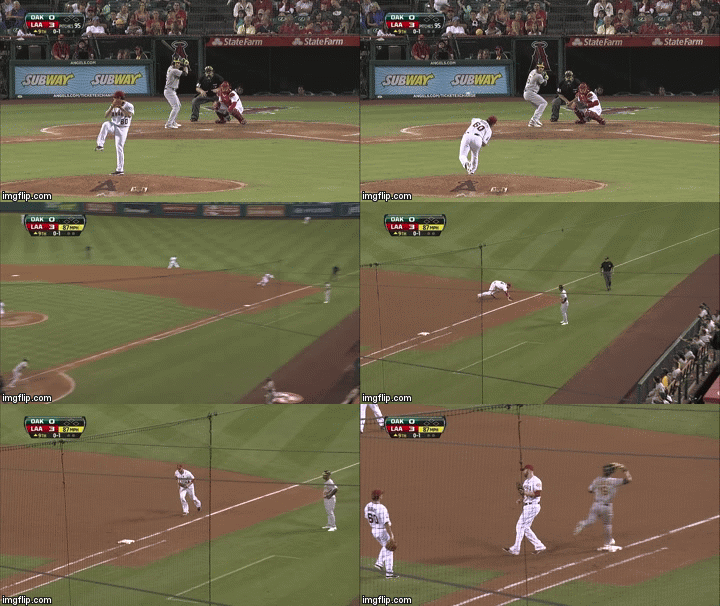


And here's another:
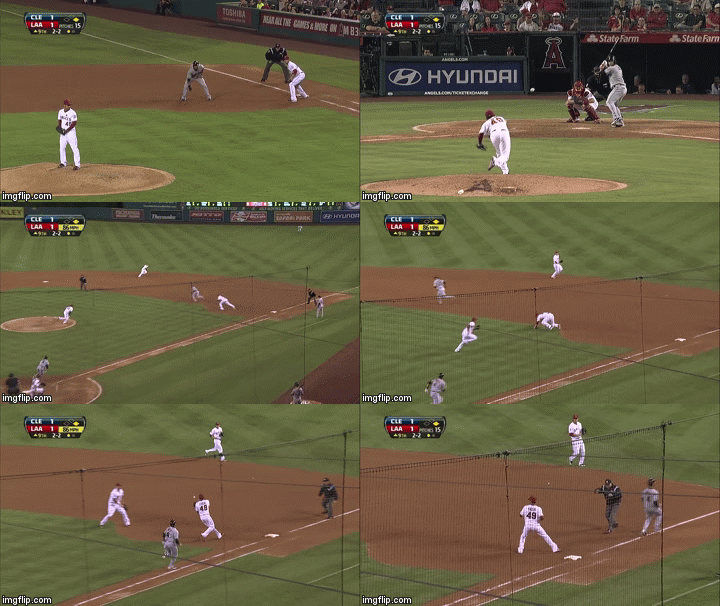


Trumbo is big and strong, and he sometimes makes pretty good plays. He won't often wow you. And you can say the same thing about Chris Davis, who occasionally looks solid at first base but does not impress in the two advanced defensive numbers many analysts trust the most. Trumbo has graded well in those metrics, though it's been a few seasons since he played first base regularly. It will be interesting to see what happens if he does in 2016.

What the Orioles care about most with Trumbo is how well he hits. But if he ends up being the main option at first base, it wouldn't hurt to have an above average defender there.

30 November 2013

First-Base Defense - A Look at Triple-A


Travis Ishikawa receiving a pickoff, a play I don't examine in this article. Photo courtesy of Norfolk Tides/Elaina Ellis.

During a rain delay, the Norfolk Tides' media relations intern, myself, and the Tides' official scorer, killed time by discussing the divide between the traditional evaluation methods and the new sabermetric methods. While all three appreciated the goals and efforts of the new analysts, I said that I was concerned that the advanced methods provide the illusion of knowledge without a strong foundation. Many of these statistics are proprietary - the data on which they are based are not available for examination. None of these statistics are verifiable - with offensive statistics, we can confirm that they "work" at a team level, but we can't check these statistics at a team level. And the statistics are inconsistent - it's common for a player to be rated an outstanding defender by one measure and a below-average defender by another.

In order for the newer methods to achieve true recognition, we should first focus on solid, easily understandable counts than on all-encompassing, single-number ratings. For example, before we can determine which of the various advanced defensive metrics is best ,we need to know some basic information that we don't really have - such as how many batted balls defensive players actually field and turn into outs.
During the discussion I referenced above, we all agreed that first-base defense is not measured well by traditional statistics. First basemen are credited with a putout on every play on which the batter-runner is retired at first base, although their contribution to the play is often simply catching a throw from another player. Those plays likely tell us relatively little about a first baseman's defense, because there is (presumably) relatively little difference among first basemen in their ability to catch such routine throws. I said that, before I can appreciate the value of the advanced evaluations, I want to know some fundamental information about first basemen - specifically, the number of batted balls first fielded by the first baseman and turned into outs. This article will look at the first basemen's defense in 2013 games played in Norfolk's Harbor Park.

There are four types of batted balls which first basemen turn into outs - ground balls (taken to the base himself, flipped to the pitcher covering, or thrown to another base to retire a runner); fair pop flies; foul pop flies, and line drives. The table below provides the totals of each type of batted balls that first basemen turned into outs in the Norfolk games for which I have data. First, the totals for both the Tides and their opponents:


Games
Innings
Ground Balls
Fair Fly Balls
Foul Fly Balls
Line Drives
Norfolk
71
634
78
6
14
6
Visitors
71
602 2/3
73
15
13
8

Or, converted to a per-nine-innings basis:


Ground Balls
Fair Fly Balls
Foul Fly Balls
Line Drives
Norfolk
1.107
0.099
0.198
0.085
Visitors
1.090
0.224
0.194
0.119


Before I looked closely at the play-by-play results I didn't know this. The first thing that struck me is there probably isn't much of a difference between the Norfolk first basemen and the visiting first basemen in their defense at Harbor Park. The one possibly noteworthy distinction is that the visitors recorded substantially more outs on fair fly balls than the Tides, but given the closeness everywhere else that's probably a random variation, not reflecting a real ability. The second thing that struck me is how few outs are recorded by first basemen by catching batted balls in the air. The Tides first basemen caught a fly or line drive about once every 2.6 games; the visitors, about once every 1.86 games. In contrast, first basemen fielded a ground ball that was turned into an out about once every game.

However, it does seem likely that the typical first baseman in Harbor Park fields about 1.1 ground balls a game (or about 160 in a 144-game AAA season) and catches about 0.2 foul fly balls a game (about 30 in a AAA season.) So we're not talking about a lot of plays.

The data above aggregates bad defensive first basemen and good defensive first basemen. It's certainly possible that good defensive first basemen are significantly better, and bad defensive first basemen significantly worse, than the total. Next we'll look at the individual Tides first basemen, to see if there's a significant difference among them.

Four Tides players played what I consider to be a significant number of first-base innings at Harbor Park The first table shows the total number of plays by each player, the second shows the plays per nine defensive innings:


Innings
Ground Balls
Fair Fly Balls
Foul Fly Balls
Line Drives
198
27
1
3
0
164
17
2
1
2
98
10
1
4
0
77
10
1
3
1


Innings
Ground Balls
Fair Fly Balls
Foul Fly Balls
Line Drives
Russ Canzler
198
1.227
0.045
0.136
0.000
Travis Ishikawa
164
0.933
0.109
0.055
0.109
Alex Liddi
98
0.918
0.092
0.367
0.000
Buck Britton
77
1.167
0.116
0.350
0.117

The other first basemen included Chris RobinsonBrandon WoodSteve Clevenger, and Dan Johnson, none of whom played more than five games at first base.

So, in a full 144-game season, Alex Liddi would have fielded about 132 ground balls and Russ Canzler about 177. Britton and Ishikawa would have fit between these totals.

It's interesting that Travis Ishikawa, who has had a good-glove reputation at first base, ranked below the average in the number of ground balls he fielded and turned into outs. The fly-ball data is too small to really allow us to draw meaningful conclusions. One point that may be worth further exploration is that Travis Ishikawa, who had been trained as a first baseman since his amateur days, caught fewer foul fly balls than did Russ Canzler, Alex Liddi, and Buck Britton, all of whom moved to first base from other infield positions.

This is a first step toward providing a better understanding of first-base defense. The biggest conclusion is that more research is needed. To me, the most interesting results are (1) how few fly balls and line drives are caught by the first baseman; and (2) that first basemen, on average, field one ground ball each game.

Of course, there are plenty of complicating factors - the ground-ball and strikeout tendencies of the pitching staff, the number of left-handed and right-handed batters in the opposing lineups, the size of foul territory, etc. The advanced fielding metrics attempt to account for all these factors. However, I don't think we can evaluate the metrics until we see how they compare with the more elementary components of first-base defense. This is a first attempt to quantify these elementary components.