Showing posts with label Toronto Blue Jays. Show all posts

20 May 2016

A Farewell To Jimmy Paredes

On Monday, Roch Kubatko of MASNsports.com broke the news that 27-year-old infielder/DH Jimmy Paredes had been claimed off waivers by the Blue Jays. Kubatko included this quote from O's GM Dan Duquette in a later column.
"The O's tried but we just didn't find a fit for Jimmy Paredes on this year's team when it was time for him to be reinstated. Jimmy worked hard with us and we appreciate his contributions over the past two seasons." 
The big switch-hitter showed flashes of promise at the plate over 277 first-half plate appearances in 2015, slashing .299/.332/.475 with 10 homers before falling off a cliff after the All-Star break. Interestingly, his BABIP remained around .370 in the second half, but the power disappeared and his K% shot up from 24.9 to 39.3%.

Sidelined with a wrist injury to start the season, Paredes went 9-for-27 with a homer in a short rehab stint with Norfolk before coming off the DL and forcing a roster crunch that led to Duquette placing him on waivers. As a side note, his last three rehab games were against Buffalo (the Jays' AAA affiliate), so perhaps Toronto's scouts, who are notorious for picking up powerful 1B/DH types off waivers (see Edwin Encarnacion), got a good look and liked what they saw. Maybe he would have cleared waivers had Norfolk not played Buffalo. Who knows.

It's safe to say that the reason Paredes was placed on waivers in the first place was defense. The O's definitely saw the potential in his bat, even during his horrid second half swoon, or else he wouldn't have given him so many at-bats post All-Star break. But with Ryan Flaherty able to provide above average infield glovework off the bench and Hyun Soo Kim forcing his way into more playing time wherever Buck can fit him in, the O's simply didn't have a pressing need for Jimmy Paredes on the team anymore.

This whole thing reminds me a lot of when the Jays put Danny Valencia on waivers last August due to a roster crunch. The A's immediately snapped him up and he has mashed for them since then, going off for a three-homer game just a few days ago. I'm not saying Paredes will suddenly blossom into a 30-homer threat, but there are a few reasons to keep an eye on him as he begins his tenure with Toronto.

The player that Paredes gets compared to the most is Robinson Cano, and looking at his swing you can see why.


The Blue Jays broadcast didn't hesitate to make the comparison in his Toronto debut, and they linked the two by dropping the name of legendary Dominican hitting guru Luis Mercedes, whose claim to fame is shaping Sammy Sosa, and who also currently works with Edwin Encarnacion and...you guessed it, Robinson Cano. According to Jays broadcaster Buck Martinez, Paredes has been working with Mercedes since 2012.

One of Paredes' perennial weaknesses has been his coverage of the outer half. He's always been able to pull inside pitches, but a big key to his mini-breakout in the first half of 2015 was how he was able to handle outside pitches.
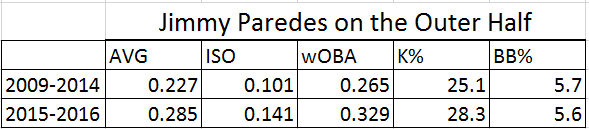

Here's a heat map showing his power zones (going by SLG) in the first half of 2015. Paredes took most of his at-bats as a lefty last year, and hit 24 of his 29 extra-base hits as a lefty. Take a look at that big red area outside from the LHB perspective.


He was able to achieve that elite outer-half SLG by taking the ball the opposite way with authority when he needed and generating more flyballs on outside pitches instead of slapping them into the dirt. The stats support this: from 2014 to 2015 his FB% rose by 6%, his Hard% rose by 4%, and his Oppo% rose by 5%.

Here's a GIF of the home run he hit on his very first swing as a Blue Jay.


That looks awfully close to the kind of swings he was taking early in 2015, so either he's a hot starter, or he's beginning to get his outer half power stroke back.

His main woes down the stretch last year stemmed from contact issues. Despite swinging at a higher rate than ever before in 2015, Paredes saw his Contact% drop from 74.8 to 65.6. He was missing pitches inside and outside the zone, and that resulted in a swinging strike rate of almost 20%, which would've led all of baseball by almost three per cent if Parades had enough PA to qualify.

There's no doubt Paredes is a very flawed player, and this post isn't meant to be an attack on the Duquette's decision to let him go. He'll probably continue to be plagued by contact problems, and his power is seriously limited as a righty. But if he can build on the approach he was taking early on in 2015, he could develop into a nice power bat in the homer-friendly Rogers Centre.

19 January 2015

Possible Compensation if Toronto Hires Dan Duquette

As we discussed in our most recent previous article, the Toronto Blue Jays have been and are interested in hiring Orioles GM Dan Duquette to be their president/CEO. Duquette is under contract with the Orioles through the 2018 season, so the Blue Jays would likely have to compensate the Orioles for letting Duquette out of his contract. Orioles fans - at least some of those who commented on our earlier article - are hoping that the compensation will be one of the Blue Jays' top prospects. In this article, I will look at the other times a team compensated another team for a non-player, and then speculate on whom the Orioles might reasonably expect to get as compensation.

There haven't been many instances of a team hiring a general manager under contract to another team without the original team's consent. The most notorious instance occurred in 2011, when Theo Epstein left the Boston Red Sox to join the Chicago Cubs. The Red Sox asked for either the Cubs' best starting pitcher, Matt Garza, their best player, Starlin Castro, or their most advanced prospect, Brett Jackson, as compensation. The Cubs refused; while we don't know what their counteroffer was we know that it wasn't what the Red Sox hoped. The teams were at an impasse; Commissioner Bud Selig was forced to resolve the issue.

The Red Sox didn't get what they hoped for. The compensation was Chris Carpenter and Aaron Kurcz; the Red Sox gave the Cubs Jair Bogaerts, a non-prospect whom the Cubs released in June without him having played in a game. At the time of his transfer, Carpenter was the Cubs #13 prospect according to Baseball America, a 26-year-old pitcher who was transitioning to the bullpen. Baseball America stated that he "could eventually develop into a set-up man". Kurcz was a 21-year-old pitcher who had once been the Cubs #25 prospect according to Baseball America, but wasn't then among their top thirty prospects. Kurcz had struck out a lot of batters as a 20-year-old in the Florida State League, but had problems with control. Neither Carpenter nor Kurcz was a top prospect.

The Red Sox may have overreached in their compensation request because they believed there was no precedent for compensating a team when its general manager was hired from another team. If they did so believe, they forgot that after the 1994 season the Cubs, who seem to like hiring star general managers from other teams, hired Twins General Manager Andy MacPhail as their new GM. And the Cubs compensated the Twins with Hector Trinidad. Trinidad was the Cubs #10 prospect after the 1994 season (in a weak farm system); a starting pitcher with great control but not much of a strikeout pitch.

And those are the only instances of a team compensating another team for a front-office signing. When the Cubs signed Theo Epstein, they also signed Jed Hoyer from the Padres and it was thought that the Cubs would compensate the Padres, but the matter kept being put off and eventually the Padres agreed not to press the Cubs for compensation. There have also been five instances in which a team signed a manager who was under contract to another team and compensated the original team with players.

After the 1967 season, the Mets hired Gil Hodges from the Senators. The Mets gave the Senators Bill Denehy and $100,000. Denehy was a 21-year-old pitcher who had been rushed to the big leagues (at least by today's standards) and had pitched poorly (73 ERA+) in 54 innings. Washington's ownership was always short of cash, and the $100,000 was probably more valued than the player.

After the 1976 season, the Pirates hired Chuck Tanner from the A's. The Pirates gave the A's Manny Sanguillen and $100,000. Sanguillen had been considered the second- or third-best catcher in the National League during the early 1970's, but by 1976 was in his early 30's and on the decline. Because the Pirates had some young catchers they were excited about, they were willing to surrender Sanguillen, And A's owner Charles Finley was short of cash, and welcomed the $100,000.

After the 2001 season, the Rays hired Lou Piniella from the Mariners. The Rays gave the Mariners Randy Winn; the Mariners gave the Rays Antonio Perez in addition to Piniella. Winn was named to the 2001 All-Star Game team and was coming off a 120 OPS+ season - but Perez was the Mariners' #3 prospect after both 2000 and 2001.

After the 2011 season, the Marlins hired Ozzie Guillen from the White Sox. The Marlins gave the White Sox Ozzie Martinez and Jhan Marinez; the White Sox gave the Marlins Ricardo Ambres in addition to Guillen. Ambres was released before playing a game in the Marlins' organization. Martinez and Marinez were both top ten prospects for the Marlins before 2011, but both had lost some luster after the season.

And, after the 2013 season, the Red Sox hired John Farrell from the Blue Jays. The Red Sox gave the Blue Jays Mike Aviles; the Blue Jays gave the Red Sox David Carpenter in addition to Farrell. Aviles was a 32-year-old up-and-down utility infielder; Carpenter was a 25-year-old right-handed relief specialist whom the Red Sox waived within a month.

In general, then, we see that the compensation for non-players is typically a marginal player or borderline prospect; better compensation packages such as Randy Winn from Tampa to Seattle will require more compensation than just the non-player. Although the Blue Jays AAA team in Buffalo plays in the International League with Norfolk, I don't claim to be an expert in the Blue Jays system. Nevertheless, there are two players in the Blue Jays' system who seem to me to be similar in value to the compensation examples shown above.

One is Kevin Pillar. Pillar is an outfielder who just turned 26. He is a career .322 hitter in the minor leagues, but doesn't have much power and doesn't draw walks. He spent part of 2013 and 2014 with the Jays; he hit .206/.250/.333 in 110 2013 plate appearances (OPS+ 53) and .267/.295/.397 in 122 2014 plate appearances (OPS+ 97). He's played mostly left field and center field in the minor leagues, and so projects to be a utility outfielder.

The other is John Stilson. Stilson is a right-handed relief pitcher who turned 24 last July. As a collegian, Stilson was an ace starting pitcher and a projected first-round draft pick, but a shoulder injury dropped him to the third round and relegated him to the bullpen. Stilson has continued to be injury-prone and was limited to 34 AAA innings in 2014. He projects to be a set-up man if he can stay healthy.

Duquette's perceived value, that he is under contract for four more seasons, and that the Blue Jays are in the same division as the Orioles may distinguish this situation from those discussed above. Still, based on the precedents above, it doesn't seem likely to me that the Orioles will get a potential impact player as compensation for Duquette. Whether those precedents adequately reflect Duquette's value to the Orioles is another question altogether.