The Brooks Robinson Story (1967) Jack Zanger
Putting It All Together (1971) by Brooks Robinson
Sports Hero: Brooks Robinson (1972) by Marshall Burchard
Third Base is My Home (1974) by Brooks Robinson
Brooks Robinson (1991) by Rick Wolff and Jim Murray
and now
Brooks: the Biography of Brooks Robinson (2014) by Doug Wilson
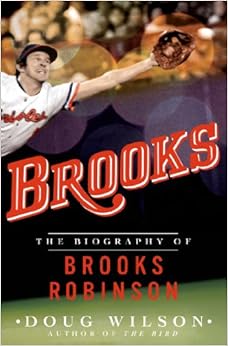 As I read through Wilson's book I came to realize why so little has been written about Brooks. He is pretty vanilla. I imagine a large number of books have been started to be written about him, but simply there is nothing that resembles any modern day hook. There are no great tragedies. No philandering, drug use, mid-career crises. Brooks came from a strong home with two dedicated parents. He was a solid member of the community in Little Rock and had a strong social network. He was a friend to many and often hung out with kids from the local schools of the deaf and blind. I think a major obstacle in writing the story of Brooks' life is that he does not have any axes to grind nor does anyone else have an ax to grind with him. He is one of those guys who you adore and aspire to be, but are never really excited to hear a story about him because if he has had any struggles, they are kept behind a veneer.
Now, that may come off as a strong reason not to read this book, but I would suggest you not to take it that way. Although it is a struggle to write a book like this, I think Wilson does a great job taking what he can from second parties (e.g., new interviews, past works) to develop the life and character of Brooks Robinson. In a way, it reads as an accompaniment to a Buttercream Gang movie. The character is so good and pure that it is somewhat laughable because it seems so unreal and peculiar to what we currently expect from our players a half a century later, but as far as I can tell from my own connections to people around Brooks...it is a rather genuine portrayal.
Brooks comes from that generation that matured right before the social challenging of the 1960s. It was a demographic strongly influenced by the troubles their parents had during the depression and a youth heavily shaped by the Second World War. An era that was largely marked with personal dedication to and faith in church, family, and country. Any transgressions, ever so slight, were things to be acknowledged, if asked, but never ruminated or reasonably explained. This is not to say that all people growing up in this time were calm, stoic, and of great social responsibility. It is to say that this demographic did exist and, for all appearances, Brooks is a shining example of that.
For instance, the failures of Brooks' commercial investment in a sporting company smells ripe of trouble and a juicy story. However, much is done to downplay the situation. Brooks and his wife note that trouble arose because his playing made him an absent co-owner of the venture and that he trusted his friend's management of the business. The friend said that there were reasons he did not wish to get into and that he was viewed unfairly by the press and public. Both men declare that the past is the past and they have amicably moved on. Nothing descriptive, just acknowledge without elaboration.
Perhaps the most contrarian episode to the legacy of Brooks Robinson is mentioned towards the end of the book, describing the oncoming of free agency. Brooks had the misfortune of his playing ability eroding significantly just as free agency came into being. Baltimore was obviously going to go in a different direction than have Brooks start and the team gave him their blessing to search for a starting position elsewhere. He was almost dealt to the Milwaukee Brewers, but the deal fell apart on his alleged insistence for a two year deal. Being born post-Brooks, I had no idea this happened and it really surprised me. I do not think it diminishes his legacy, but does put a human touch to the end of his career.
After finishing the biography, I found myself with greater respect for Robinson and a better idea of who he was and is. It is true that I like a good downfall and resurrection story, but I was still interested in the shoulder to the grindstone story laid out here. It is a sweet, pleasant story and a good item to carry in tow as an example to young readers on good character as well as to us older folks who sometimes forget that there were and are players out there who do not seek the limelight, who play the game fair, and simply do their job.
Brooks: the Biography of Brooks Robinson (2014) by Doug Wilson is available for pre-order at Amazon and will be released March 4, 2014.