When the Orioles signed Danny Valencia to a minor league deal on March 3, it was a random move. Not unlike the O's, of course, just random. No one should get upset about a minor league signing, but it was a little tough to see the fit. The Orioles already have first base/DH types like Chris Davis, Mark Trumbo, and Trey Mancini on the roster, and just a week before, the O's brought back Pedro Alvarez, another 1B/DH.
Still, while all of the O's players above have played different positions in their careers, all of them except for Mancini are primarily first basemen and/or designated hitters now. Trumbo could certainly play in the outfield some for the O's in 2018, but he shouldn't. And if first base were open for Mancini, he'd be playing there instead of left field.
All of this is to say: Valencia is a bit different than a typical depth addition at first base (like Alvarez). He's more like another Swiss Army knife the O's employed during the golden years of the Buck Showalter/Dan Duquette era. Of course, I'm talking about the great Steve Pearce.
In almost 1,000 plate appearances with the O's from 2012-2016, Pearce posted a wRC+ of 123. His masterpiece, far and away, is the 2014 season when he somehow put up a 161 wRC+ which fueled a bWAR of 5.9 and an fWAR of 4.9 in fewer than 400 plate appearances. Like many things during the Showalter/Duquette era, it was stunning and amazing.
Valencia is similar to Pearce: they're about the same age (Valencia is 33; Pearce is 34), he can hit left-handed pitching, and he can play multiple positions well enough.
Valencia: 136 wRC+ vs. LHP (career)
Pearce: 126 wRC+ vs. LHP (career)
Valencia isn't as good of a defensive first baseman as Pearce, and Valencia has rated poorly defensively at third base, but he's an OK enough corner outfielder and can fill in at second base. He also doesn't fare as well against same-handed throwers as Pearce (85 wRC+ vs. RHP vs. a 100 wRC+ for Pearce).
But having Valencia around can be useful. It's beneficial to have a player capable of handling multiple positions, and it's even better when that player mashes left-handed pitching. From 2015 to 2017, Valencia is tied for 19th best (with Edwin Encarnacion) in the majors with a 133 wRC+ against lefties (min. 400 plate appearances).
When the roster is clogged with all of Davis, Trumbo, and Mancini, it may be tough to find playing time for Valencia. But with Trumbo scheduled to start the year on the disabled list, there's room for someone with Valencia's skill-set. Now, instead of hoping for platoon at-bats in right field and some utility player work, he could receive at-bats at DH as well.
If the O's stay disciplined in using Valencia as a platoon bat and avoid giving him too much work at third base, he could be a nice depth addition. It wouldn't even be that surprising if he ended up with better overall offensive numbers than Trumbo, and it could be a bonus to have him around if Trumbo's injury lingers or Davis's elbow issues don't go away. The bar is low for a minor league signing, but Valencia's presence already seems helpful.
Showing posts with label Danny Valencia. Show all posts
Showing posts with label Danny Valencia. Show all posts
20 March 2018
06 March 2018
Orioles Could Use Neil Walker
When the Orioles picked up Danny Valencia and Pedro Alvarez, the common refrain amongst observers of the Orioles was just where exactly would Valencia fit. The idea for some would be that if Mark Trumbo would magically disappear that Valencia and Alvarez could form a formidable one-two designated hitter punch. For instance, Valencia can punish southpaws fairly well (136 wRC+ for career) while Alvarez hits right handers at a 117 wRC+ career clip. As a fringe, righty hitting designated hitter, it is not incredibly surprising how little interest Pedro Alvarez generates from other MLB clubs as well as how little he played last year. What is surprising is that Valencia, a poor fielder who only really hits left handers, has seen extensive playing time the past two seasons.
While Valencia is a poor fielder, he can fill in first, second, third, and corner outfield positions in a pinch. That is a terrible solution long term, but if your starter needs a breather or you need time to find a serviceable alternative when a starter goes down, then Valencia helps provide a barely adequate solution. Alvarez, on the other hand, can hold a bat. He used to play third base, but saw his athleticism vanish in Pittsburgh. He has attempted to play first base, but he lacked the footwork and touch. Last year was an experiment in the outfield and was something we just don't want to discuss. Whereas Valencia can be a solution in a pinch, Alvarez simply does not offer that.
So, the question is whether or not the club can improve upon what it has in Alvarez. This rather unseemly off-season has provided the Orioles with a potential option. That option would be in the vein of Valencia. A player who can perform in the field to a varying degree and provide value as a left handed option in the lineup or off the bench. His name is Neil Walker.
This might be a surprise. Last year, Neil Walker played under a qualifying offer, making 17.2 MM. This year, it is the beginning of March and he remains a free agent. Walker's market appears to be dwindling as fewer teams have any true need for a second baseman or even a third baseman. This might make Walker more open to spending the 2018 season in a bit of flux, position-wise.
Now, Neil Walker is not a good utility defender. He has performed slightly below average at second base and slightly below average at third base. In fact, he has spent more time as a catcher (168 games) in his professional career than he has in the outfield (0 games). He is a switch hitter, but is really only proficient as a left handed hitter with a 122 wRC+ line. In other words, his offensive value is similar to Alvarez', but he can actually be used in the field.
Last year, the Orioles' player with the highest on base percentage who met qualified status was Jonathan Schoop along with Trey Mancini with a .338 mark. Walker's .362 was much higher. Over the past five years, his worst performance was a .328 offering that would have settled in behind those two, but be ahead of Adam Jones' .322 mark. Needless to say, Walker does something repeatedly in the most recent past that no one else on the club seems to be doing regularly, getting on base.
Walker could be used as a leadoff man in a similar fashion as Seth Smith. In fact, he basically is Seth Smith. Both run about the same (~26.5 ft/s). Both get on base around the same rate. Both have similar power production. Neither are considered special defenders. Walker though can play at more restrictive positions. Walker is also three years younger. It is why BORAS projected Smith as a non-roster invite while Walker was put at a 2/22 value. Walker will not see that money, it seems, as this offseason appears to have marked a point where the value of players is now somehow different.
What this might mean is provide the Orioles with an opportunity. Walker gives the club a strong platoon option at designated hitter. He also can be used as depth for third base or second base. As such, he checks more boxes than Alvarez does. In addition to that, a multi-year deal could also provide the Orioles with a respectable cover for 2019 if Manny Machado leaves. Walker can fill in at second or third with Tim Beckham and Schoop shifting around.
In other words, perhaps 2018 would see Neil Walker as the Orioles poor man's version of prime Ben Zobrist. And, perhaps, in 2019 he offers a baseline solution to what certainly appears will be a need.
While Valencia is a poor fielder, he can fill in first, second, third, and corner outfield positions in a pinch. That is a terrible solution long term, but if your starter needs a breather or you need time to find a serviceable alternative when a starter goes down, then Valencia helps provide a barely adequate solution. Alvarez, on the other hand, can hold a bat. He used to play third base, but saw his athleticism vanish in Pittsburgh. He has attempted to play first base, but he lacked the footwork and touch. Last year was an experiment in the outfield and was something we just don't want to discuss. Whereas Valencia can be a solution in a pinch, Alvarez simply does not offer that.
So, the question is whether or not the club can improve upon what it has in Alvarez. This rather unseemly off-season has provided the Orioles with a potential option. That option would be in the vein of Valencia. A player who can perform in the field to a varying degree and provide value as a left handed option in the lineup or off the bench. His name is Neil Walker.
This might be a surprise. Last year, Neil Walker played under a qualifying offer, making 17.2 MM. This year, it is the beginning of March and he remains a free agent. Walker's market appears to be dwindling as fewer teams have any true need for a second baseman or even a third baseman. This might make Walker more open to spending the 2018 season in a bit of flux, position-wise.
Now, Neil Walker is not a good utility defender. He has performed slightly below average at second base and slightly below average at third base. In fact, he has spent more time as a catcher (168 games) in his professional career than he has in the outfield (0 games). He is a switch hitter, but is really only proficient as a left handed hitter with a 122 wRC+ line. In other words, his offensive value is similar to Alvarez', but he can actually be used in the field.
| Year | BA | OBP | SLG | OPS+ |
|---|---|---|---|---|
| 2013 | .251 | .339 | .418 | 114 |
| 2014 | .271 | .342 | .467 | 126 |
| 2015 | .269 | .328 | .427 | 106 |
| 2016 | .282 | .347 | .476 | 121 |
| 2017 | .265 | .362 | .439 | 111 |
Last year, the Orioles' player with the highest on base percentage who met qualified status was Jonathan Schoop along with Trey Mancini with a .338 mark. Walker's .362 was much higher. Over the past five years, his worst performance was a .328 offering that would have settled in behind those two, but be ahead of Adam Jones' .322 mark. Needless to say, Walker does something repeatedly in the most recent past that no one else on the club seems to be doing regularly, getting on base.
Walker could be used as a leadoff man in a similar fashion as Seth Smith. In fact, he basically is Seth Smith. Both run about the same (~26.5 ft/s). Both get on base around the same rate. Both have similar power production. Neither are considered special defenders. Walker though can play at more restrictive positions. Walker is also three years younger. It is why BORAS projected Smith as a non-roster invite while Walker was put at a 2/22 value. Walker will not see that money, it seems, as this offseason appears to have marked a point where the value of players is now somehow different.
What this might mean is provide the Orioles with an opportunity. Walker gives the club a strong platoon option at designated hitter. He also can be used as depth for third base or second base. As such, he checks more boxes than Alvarez does. In addition to that, a multi-year deal could also provide the Orioles with a respectable cover for 2019 if Manny Machado leaves. Walker can fill in at second or third with Tim Beckham and Schoop shifting around.
In other words, perhaps 2018 would see Neil Walker as the Orioles poor man's version of prime Ben Zobrist. And, perhaps, in 2019 he offers a baseline solution to what certainly appears will be a need.
31 December 2013
The Pros and Cons of Signing Kendrys Morales
The Orioles have a DH problem. This topic was covered in our offseason series, and I've written about the potential acquisition of Billy Butler and the potential signing of Mike Napoli. So far, the O's have only opted to deal one potential DH option away, when they shipped Danny Valencia to the Royals for outfielder David Lough. Valencia was the team's lone bright spot at DH, as Orioles' designated hitters batted a combined .236/.290/.418 last season.
Right now, the O's DH situation looks similar to how it was at the beginning of last season. Steve Pearce and Nolan Reimold, who were both tendered contracts this offseason, each started out last season getting an opportunity to DH. But Pearce (44 games) ended up battling wrist injuries for much of the season, and Reimold (40 games) needed neck surgery for a second time. Pearce and Reimold were supposed to handle the right-handed side of that DH platoon; Wilson Betemit was supposed to provide the left-handed pop. But he sustained a right knee injury in March that required surgery, and although he was able to return in late August, he failed to get a hit in 10 at-bats and was soon designated for assignment.
One potential answer to the team's DH issues is to scrap the DH platoon and just sign Kendrys Morales. Here's Roch Kubatko, expressing an opinion that seems to be popular with plenty of fans:
Morales turns 31 in June. In 156 games for the Mariners last year, he hit .277/.336/.449; he also has a career batting line of .280/.333/.480. Morales had a career year at the plate in 2009, finishing with a .387 wOBA while playing all of his 152 games at first base (where he was already a below average defender). In 2010, he was putting up pretty good numbers -- and then this happened:
Morales broke his lower left leg celebrating that grand slam, and he missed the rest of the 2010 season. He needed surgery to repair the injury, and about a year later, he opted for a second surgery after he had yet to fully recover. He missed the entire 2011 season as well. But he battled back, and Morales played in 134 games in 2012 and 156 games in 2013, while mainly DHing and playing occasionally at first base. His offensive numbers did not approach that career-best 2009 season, though: He had a wOBA of .339 in 2012 and .342 in 2013.
-----
There are obvious reasons why Morales was listed fourth on Dave Cameron's "Land Mines of the 2014 Free Agent Class" post from November. Besides the injury concerns (fair or unfair) listed above, Morales is not a great defender at first base and can no longer handle a full workload at the position; is a liability on the basepaths (career 34.6 baserunning runs below average); is a good but not great hitter who may be in decline; will likely command a two- or three-year deal; and will cost the team that signs him a draft pick because the Mariners extended him a qualifying offer, which he rejected.
Morales, a switch-hitter, is also not particularly adept at hitting left-handed pitching (.318 wOBA). He is much better against right-handed pitching (.359 wOBA). So, because Morales doesn't bring much to the table besides his bat, the O's could instead choose to find a good bat against right-handed pitching elsewhere. They lost a very good option against lefties when they traded Valencia (.380 wOBA vs. LHP) away, but Pearce (.349 wOBA vs. LHP) is effective against them. Unfortunately, he cannot hit right-handed pitching (.276 wOBA). Reimold has hit about the same against both -- .338 wOBA vs. RHP and .327 wOBA vs. LHP. But he is a wild card and should not be counted on to stay healthy.
Do you view Urrutia as a DH option? I don't, but it's possible. What about bringing back Betemit for cheap? As long as he's healthy, Betemit wears out right-handed pitching (.352 wOBA). The O's could then use that saved money to sign a starter and maybe another reliever. I am a bit surprised the Orioles haven't done more yet in free agency, but that will be something to revisit down the road if they don't spend more to fill some holes on the roster.
So what would you prefer? Morales's .359 wOBA vs. RHP and .318 wOBA vs. LHP, no first-round draft pick, and handing him a decent-sized contract? Or Betemit's .352 wOBA vs. RHP and Pearce's .349 wOBA vs. LHP? Betemit is not an option at third base (and maybe not even first base) and can't hit lefties, so he would limit roster flexibility. But he would only receive a one-year deal, and he wouldn't cost a draft pick. Morales is still probably the better option.
Relying on Pearce, Reimold, Betemit, or any other platoonable bat at DH is risky. They are all injury risks, and it's not like there are many other good options at this stage of free agency to bring aboard as competent bench bats. But Morales is far from a sure thing, and while he'd make the O's somewhat better right now, he's also an injury risk, isn't quite as good as fans think, would cost the team a draft pick, and is a more expensive option. I wouldn't be surprised at all if the O's eventually signed him, but I'm not sure they should.
Right now, the O's DH situation looks similar to how it was at the beginning of last season. Steve Pearce and Nolan Reimold, who were both tendered contracts this offseason, each started out last season getting an opportunity to DH. But Pearce (44 games) ended up battling wrist injuries for much of the season, and Reimold (40 games) needed neck surgery for a second time. Pearce and Reimold were supposed to handle the right-handed side of that DH platoon; Wilson Betemit was supposed to provide the left-handed pop. But he sustained a right knee injury in March that required surgery, and although he was able to return in late August, he failed to get a hit in 10 at-bats and was soon designated for assignment.
One potential answer to the team's DH issues is to scrap the DH platoon and just sign Kendrys Morales. Here's Roch Kubatko, expressing an opinion that seems to be popular with plenty of fans:
I want a full-time designated hitter - I'm still beating the Kendrys Morales drum - which allows Reimold to serve as an extra outfielder (and occasional DH) and Henry Urrutia to play every day in left field at Triple-A Norfolk. He's raw and needs the reps.I agree on Urrutia. I'm not sure he's ready to handle even a part-time role in the majors just yet, and it would not be bad for him to play every day at Norfolk. But let's explore the Morales possibility a bit further.
 |
| Kendrys Morales (photo via Keith Allison) |
Morales broke his lower left leg celebrating that grand slam, and he missed the rest of the 2010 season. He needed surgery to repair the injury, and about a year later, he opted for a second surgery after he had yet to fully recover. He missed the entire 2011 season as well. But he battled back, and Morales played in 134 games in 2012 and 156 games in 2013, while mainly DHing and playing occasionally at first base. His offensive numbers did not approach that career-best 2009 season, though: He had a wOBA of .339 in 2012 and .342 in 2013.
-----
There are obvious reasons why Morales was listed fourth on Dave Cameron's "Land Mines of the 2014 Free Agent Class" post from November. Besides the injury concerns (fair or unfair) listed above, Morales is not a great defender at first base and can no longer handle a full workload at the position; is a liability on the basepaths (career 34.6 baserunning runs below average); is a good but not great hitter who may be in decline; will likely command a two- or three-year deal; and will cost the team that signs him a draft pick because the Mariners extended him a qualifying offer, which he rejected.
Morales, a switch-hitter, is also not particularly adept at hitting left-handed pitching (.318 wOBA). He is much better against right-handed pitching (.359 wOBA). So, because Morales doesn't bring much to the table besides his bat, the O's could instead choose to find a good bat against right-handed pitching elsewhere. They lost a very good option against lefties when they traded Valencia (.380 wOBA vs. LHP) away, but Pearce (.349 wOBA vs. LHP) is effective against them. Unfortunately, he cannot hit right-handed pitching (.276 wOBA). Reimold has hit about the same against both -- .338 wOBA vs. RHP and .327 wOBA vs. LHP. But he is a wild card and should not be counted on to stay healthy.
Do you view Urrutia as a DH option? I don't, but it's possible. What about bringing back Betemit for cheap? As long as he's healthy, Betemit wears out right-handed pitching (.352 wOBA). The O's could then use that saved money to sign a starter and maybe another reliever. I am a bit surprised the Orioles haven't done more yet in free agency, but that will be something to revisit down the road if they don't spend more to fill some holes on the roster.
So what would you prefer? Morales's .359 wOBA vs. RHP and .318 wOBA vs. LHP, no first-round draft pick, and handing him a decent-sized contract? Or Betemit's .352 wOBA vs. RHP and Pearce's .349 wOBA vs. LHP? Betemit is not an option at third base (and maybe not even first base) and can't hit lefties, so he would limit roster flexibility. But he would only receive a one-year deal, and he wouldn't cost a draft pick. Morales is still probably the better option.
Relying on Pearce, Reimold, Betemit, or any other platoonable bat at DH is risky. They are all injury risks, and it's not like there are many other good options at this stage of free agency to bring aboard as competent bench bats. But Morales is far from a sure thing, and while he'd make the O's somewhat better right now, he's also an injury risk, isn't quite as good as fans think, would cost the team a draft pick, and is a more expensive option. I wouldn't be surprised at all if the O's eventually signed him, but I'm not sure they should.
19 December 2013
Trades and Signings: Lough et al. Replacing McLouth et al.
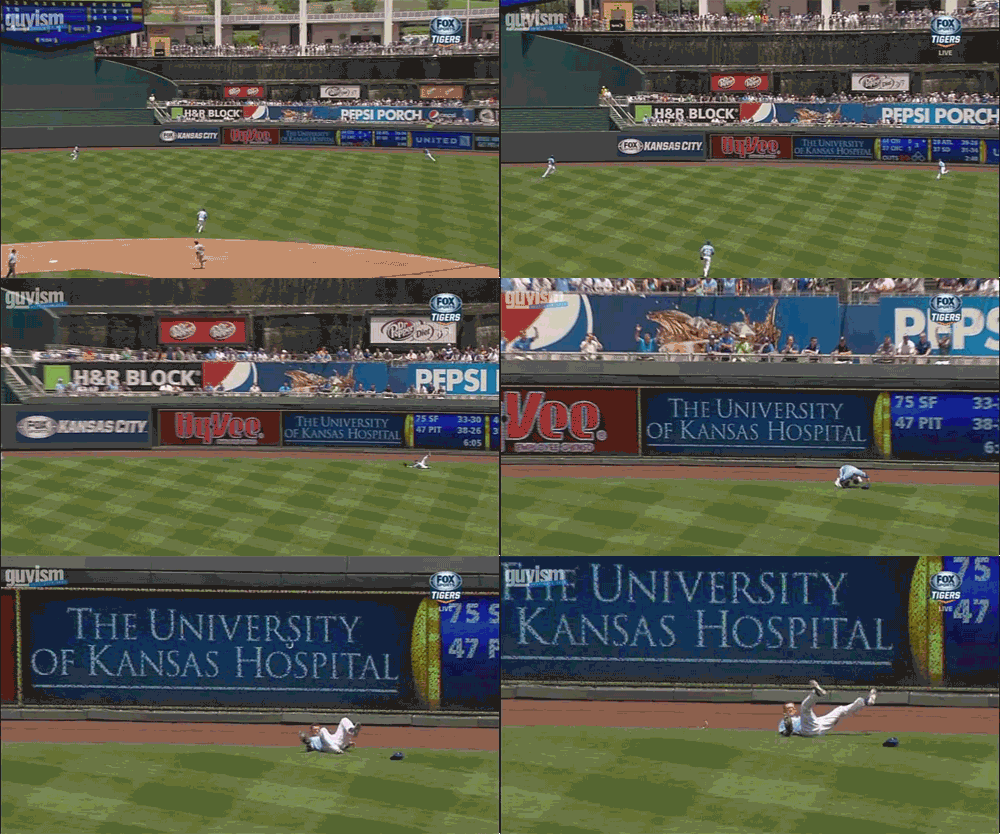 |
| Lough with a Plus Play |
There is a bit of dichotomy in Lough that has confused some. The last two seasons, Lough barely made it into the Royals top 30 prospects according to Baseball America. That would be indicative of a player who has little to no worth. However, his performance last year was not like the player who has been scouted. Lough slashed 286/311/413 over 335 MLB plate appearances. Defensive metrics loved him (remember that 95 games is about 200 games short of a meaningful sample size for defensive metrics). Both rWAR and fWAR value Lough above 2 WAR over that time period, indicating a star level quality player. If the offensive and defensive performance was legit, then that kind of player would be a 3-4 WAR player for less than a million over a full season. That is someone you hold onto or cash in big on.
Test those two ideas against what it cost to get Lough: Danny Valencia. Valencia plays a very poor third base. He has played no other position at the MLB level. He is on the less useful side of the platoon and is nearly helpless on the same side. That makes him particularly vulnerable to late inning relievers. Steamer projects him as below replacement level and Oliver has him, at 600 PA, as a 1 win player. That is a bench player who has very limited value. That perspective would point toward a player value more similar to Baseball America as opposed to his actual performance last year.
This does not mean that Lough is without value. He has value, but it is limited in that he must remain on the 25 man roster and has never given any previous indication that he has the bat to serve well in either a full time or platoon role. The bet is simply that his range was properly measured using fielding metrics as opposed to years of scouting.
This may cause some dismay for some of you out in Birdland, but I would contend that the team produced pretty well with a collection of misfit toys out there in 2013. Here is a rundown of last year's squad in left field:
| Age | wOBA | GS | Inn | Rtot | Rtot/yr | |
|---|---|---|---|---|---|---|
| Nate McLouth | 31 | .323 | 124 | 1138.2 | -9 | -9 |
| Steve Pearce | 30 | .345 | 15 | 107.1 | -4 | -44 |
| Nolan Reimold | 29 | .253 | 11 | 90.0 | -3 | -40 |
| Chris Dickerson | 31 | .291 | 2 | 46.0 | 0 | 9 |
| Mike Morse | 31 | .112 | 7 | 42.0 | 1 | 31 |
| Jason Pridie | 29 | .178 | 2 | 17.0 | -2 | -161 |
| L.J. Hoes | 23 | .000 | 1 | 9.0 | 0 | 15 |
| Henry Urrutia | 26 | .257 | 0 | 3.0 | -0 | -112 |
| Team Total | 162 | 1453.0 | -17 | -14 |
McLouth took the lion's share of innings out in left. He did so well that he turned it into a potentially prolific bench role with the Washington Nationals. For a 32 year old with a decent left field glove and a league average bat with platoon splits, that is just the kind of position you would expect McLouth to land.
In 2014, the Orioles have gathered together Lough (.305 wOBA, Oliver), Nolan Reimold (.318 wOBA), Steve Pearce (.334 wOBA), Henry Urrutia (.324 wOBA), and Francisco Peguero (.287 wOBA). Of that group, only Urrutia can be shuttled back and forth between Baltimore and Norfolk as the rest have no options. This was one of the benefits of having L.J. Hoes and Xavier Avery sitting in Norfolk. The team always knew they had tolerable depth in case they needed it. With them gone in the Bud Norris and the somewhat inexplicable Mike Morse deals, respectively, the Orioles are going a slightly different way this year.
Spring Training will likely be used as a battleground amongst the amassed outfielders with one lefty and, at most, two righties going with the team. The others likely have minimal trade value, so they very well could be exposed to waivers. Exposing the players to waivers risks them no longer being in the system. In that case, Duquette has been gathering outfielders in Norfolk. They include Ronald Bermudez (.267 wOBA) and Julio Borbon (.293), who both can fill in center field, as well as Kyeong Kang (.309 wOBA) and Chih-Hsien Chiang (.277), who have logged significant innings on the corners. You really would not want any of these players starting for you, but that goes the same for Hoes and Avery.
We are humming along on a tangent at this point, but it might be good to impress what the Bud Norris and Mike Morse trades really meant. They meant sacrificing assured flexibility in a roster as well as pieces having option years remaining to rise to higher levels of ability while under team control. In Hoes's case, Norris is an acceptable deal as he provides the team with a below market priced starter or an on market priced reliever. The Morse deal still looks poor in retrospect. He was a redundant piece, appeared injured before the deal, and then proceeded to hide an injury from the team. It cost a team with a strapped payroll money that could have been pushed forward to the following season as well as a player with good upside, but an incredibly low probability of showing that potential in the next year or ever.
So, not having Avery is not a big deal. It simply is a wasted opportunity. Sometimes those guys pan out. They pan out pretty much never, but it usually is a poor idea simply to send someone off who you still have time to let develop. Anyway, Avery is not in Norfolk. If an injury happens, Julio Borbon will likely be called if needed in center field in Baltimore. Based on past history and situations other teams will be facing mid-season, he stands a good chance at being claimed. If so, Bermudez would be next. He is not as capable and likely would freely pass through waivers.
Moving Forward
The team has finally resolved the issues they have faced in the Majors and upper minors with respect to the outfield. The new additions have not been remarkable, but left field should perform as well as it did last season. If injuries happen, AAA depth may only have one stint with the team before being claimed by another organization as a result of none of the outfielders having options other than Urrutia.
Free agency is unlikely to be over. Based on my calculations, the team has somewhere between 10-25 MM left to spend on payroll. Whatever remains is likely to be spent on a pitcher.
19 October 2013
Making the Orioles a Champion in 2014: Designated Hitter
This post is part of the Making the Orioles a Champion in 2014 Series. Below you will find links to the other articles. We will do our best to make sure the links go live with each new update.
.236/.290/.418.
That's the Batting Average / On-Base Percentage / Slugging Percentage of the Orioles' 2013 Designated Hitters. The OPS is .708.
.256/.320/.404.
That's the Batting Average / On-Base Percentage / Slugging Percentage of the American League. The OPS is .724.
That's right. The Orioles got worse performance out of their designated hitters - a position with zero defensive requirements, a position at which the only responsibility is offense - than the entire American League. They did get a little bit more power than the League, but were substantially lower in on-base percentage.
But wait. It gets worse, from a generic baseball fan perspective, or better, from the Orioles fan perspective. The Orioles .708 OPS from their designated hitters ranked eighth in the American League.
The production of American League teams' designated hitters can be put into five groups. Far and away the best was the Boston Red Sox (mostly David Ortiz), at .957. Here's the breakdown, with teams in the groupings ranked from highest to lowest:
.957 - 1 team (Boston)
.754 - .797 - 6 teams (Kansas City, Toronto, Detroit, Seattle, Cleveland, Los Angeles)
.660 - .708 - 5 teams (Baltimore, Texas, Oakland, Tampa Bay, Chicago)
.615 - .632 - 2 teams (Minnesota, Houston)
.567 - 1 team (New York)
I need to get this on the record. The 2013 New York Yankees at .184/.270/.297, got worse production from their designated hitters, relative to the league, than the 1971 San Diego Padres got from Enzo Hernandez when he notoriously drove in 12 runs in 618 plate appearances.
However, to get back to the Orioles. It's difficult to get a handle on all the statistical measurements out there, but it seems that David Ortiz and the Red Sox designated hitters was worth about four wins. It's even harder to estimate the contribution of the Orioles' designated hitters to their success, but I don't think you can claim that it was worth more than one win. So, given that the 2013 Orioles needed to improve by seven games to make the postseason, perhaps half that could have been made up if the Orioles actually had a good hitter be their designated hitter as opposed to the below-average troupe they used.
Before we look at how the Orioles could improve their 2014 designated hitters, we need to look at the individuals who served in 2013. The Orioles had 576 plate appearances from their designated hitters (which is lowest in the American League by 30. That, at least, reveals that the Orioles knew they had bad designated hitters; they batted their DHs lower in the order than every other team.) 143 came from players who normally played a defensive position but were designated hitting on a partial day off - Chris Davis, Brian Roberts, Adam Jones, Nate McLouth, Nick Markakis and Matt Wieters. If we subtract those players' contributions, we get a different view:
Day-off: .254/.329/.492
Quasi-Regular DH's: .231/.277/.395
Most of the DH productivity came from Chris Davis' 21 plate appearances; he hit .471/.571/1.235. Just removing Davis' 21 appearances leaves the rest of the DHs - both the starters having a day off and the "regular" DHs - at .228/.286/.390.
Historically, some teams have not used a regular DH, instead using the DH position to give regulars partial days off. There are two reasons why that was not a good option for the 2013 Orioles. First, most of the regulars didn't hit well as a DH. Second, if you do give the regular a break from defensive responsibilities, then you're playing a bench player. And, as we'll see when we look at the bench, the Orioles didn't have a good bench. It's doubtful that the benefits of giving players more defense-free days outweigh the losses from their lack of production as a DH and from playing a bench player.

So, I believe that if the Orioles are to improve their DH production, they'll need to find a good hitter or hitters to be their DH. Fortunately, one of the 2013 Orioles did hit very well as a DH. Danny Valencia had 145 plate appearances as a DH, and produced at a .307/.342/.912 clip. It seems likely that Valencia did most of his damage against left-handed pitchers; overall (both as a DH and as a non-DH) Valencia hit .371/.392/.639 against lefthanders but .203/.250/.422 against right-handed pitchers. During his major-league career, Valencia has hit .329/.367/.513 for an .880 OPS in 431 plate appearances versus left-handed pitchers, which includes his disappointing 2012. Valencia's career production versus left-handed pitchers would be better the production from all but one team's DHs.
So that's the right-handed half of a DH platoon. And the Orioles potentially have the left-handed half already in their organization in Henry Urrutia. Urrutia, of course, is a Cuban defector who played his first season in the U.S. in 2013. He played at AA, AAA, and in the Majors in 2013, and hit right-handers at least fairly well at all three levels - .374/.446/.585 at AA, .338/.376/.500 at AAA, and .294/.294/.333 in the Majors. While it's premature to project Urrutia to be as good against right-handers as Valencia is against left-handers, he has demonstrated the potential to hit .300 against right-handers with line-drive power. He's earned a full chance in the major leagues. A platoon of Urrutia and Valencia has the chance to be one of the most productive DHs in the League.
One of the problems in using a DH platoon is that it takes up two roster spots to fill one position. If a team carries twelve pitchers, and there are eight players in the starting lineup, that leaves five spots for reserve non-pitchers. There must be a backup catcher, a backup infielder, and a backup outfielder. So if you plan to use a DH platoon, you have no more available roster spots.
If the Orioles intend to compete with the financial resources of the Red Sox and Yankees and the seemingly endless parade of prospects of the Rays, they're going to need to think outside the box. And it's my belief that there is absolutely no need to carry twelve pitchers; that the Orioles will gain more from a DH platoon than from a twelfth pitcher.
It's always hard to determine who the twelfth pitcher on a staff is, much less a team like the Orioles which shuttles pitchers up, down, and around frequently. At any given time, though, there are five pitchers in the starting rotation, whoever they may be. The first six members of the bullpen were Jim Johnson, Darren O'Day, Tommy Hunter, Brian Matusz, Troy Patton, and T.J. McFarland. Pitchers occupying the seventh spot in the bullpen were Pedro Strop, Francisco Rodriguez, Jairo Ascensio, Kevin Gausman, etc. etc. None of these guys were notably effective; some were completely ineffective.
And, as best as I can determine, the pitchers in the seventh bullpen spot combined to pitch 72 2/3 innings before August 31, after which rosters expand and roster spots are plentiful. A baseball season lasts almost exactly six months, or 26 weeks; there are 22 weeks when the roster is limited to 25 men. So, the seventh spot in the bullpen pitched about 3 1/3 innings per week. Surely those six other relief pitchers can absorb an extra inning per week.every two weeks.
So, one of the easiest and cheapest moves the Orioles can make toward becoming a champion in 2014 is to drop the twelfth pitcher and platoon Henry Urrutia and Danny Valencia at DH.
.236/.290/.418.
That's the Batting Average / On-Base Percentage / Slugging Percentage of the Orioles' 2013 Designated Hitters. The OPS is .708.
.256/.320/.404.
That's the Batting Average / On-Base Percentage / Slugging Percentage of the American League. The OPS is .724.
That's right. The Orioles got worse performance out of their designated hitters - a position with zero defensive requirements, a position at which the only responsibility is offense - than the entire American League. They did get a little bit more power than the League, but were substantially lower in on-base percentage.
But wait. It gets worse, from a generic baseball fan perspective, or better, from the Orioles fan perspective. The Orioles .708 OPS from their designated hitters ranked eighth in the American League.
The production of American League teams' designated hitters can be put into five groups. Far and away the best was the Boston Red Sox (mostly David Ortiz), at .957. Here's the breakdown, with teams in the groupings ranked from highest to lowest:
.957 - 1 team (Boston)
.754 - .797 - 6 teams (Kansas City, Toronto, Detroit, Seattle, Cleveland, Los Angeles)
.660 - .708 - 5 teams (Baltimore, Texas, Oakland, Tampa Bay, Chicago)
.615 - .632 - 2 teams (Minnesota, Houston)
.567 - 1 team (New York)
I need to get this on the record. The 2013 New York Yankees at .184/.270/.297, got worse production from their designated hitters, relative to the league, than the 1971 San Diego Padres got from Enzo Hernandez when he notoriously drove in 12 runs in 618 plate appearances.
However, to get back to the Orioles. It's difficult to get a handle on all the statistical measurements out there, but it seems that David Ortiz and the Red Sox designated hitters was worth about four wins. It's even harder to estimate the contribution of the Orioles' designated hitters to their success, but I don't think you can claim that it was worth more than one win. So, given that the 2013 Orioles needed to improve by seven games to make the postseason, perhaps half that could have been made up if the Orioles actually had a good hitter be their designated hitter as opposed to the below-average troupe they used.
Before we look at how the Orioles could improve their 2014 designated hitters, we need to look at the individuals who served in 2013. The Orioles had 576 plate appearances from their designated hitters (which is lowest in the American League by 30. That, at least, reveals that the Orioles knew they had bad designated hitters; they batted their DHs lower in the order than every other team.) 143 came from players who normally played a defensive position but were designated hitting on a partial day off - Chris Davis, Brian Roberts, Adam Jones, Nate McLouth, Nick Markakis and Matt Wieters. If we subtract those players' contributions, we get a different view:
Day-off: .254/.329/.492
Quasi-Regular DH's: .231/.277/.395
Most of the DH productivity came from Chris Davis' 21 plate appearances; he hit .471/.571/1.235. Just removing Davis' 21 appearances leaves the rest of the DHs - both the starters having a day off and the "regular" DHs - at .228/.286/.390.
Historically, some teams have not used a regular DH, instead using the DH position to give regulars partial days off. There are two reasons why that was not a good option for the 2013 Orioles. First, most of the regulars didn't hit well as a DH. Second, if you do give the regular a break from defensive responsibilities, then you're playing a bench player. And, as we'll see when we look at the bench, the Orioles didn't have a good bench. It's doubtful that the benefits of giving players more defense-free days outweigh the losses from their lack of production as a DH and from playing a bench player.

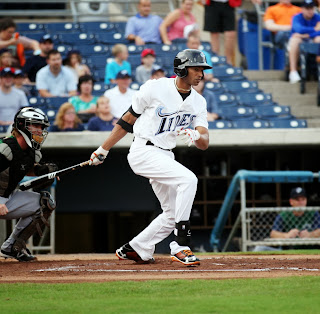
Danny Valencia leaving the batter's box in Norfolk's Harbor Park. (Elaina Ellis / Norfolk Tides)
So, I believe that if the Orioles are to improve their DH production, they'll need to find a good hitter or hitters to be their DH. Fortunately, one of the 2013 Orioles did hit very well as a DH. Danny Valencia had 145 plate appearances as a DH, and produced at a .307/.342/.912 clip. It seems likely that Valencia did most of his damage against left-handed pitchers; overall (both as a DH and as a non-DH) Valencia hit .371/.392/.639 against lefthanders but .203/.250/.422 against right-handed pitchers. During his major-league career, Valencia has hit .329/.367/.513 for an .880 OPS in 431 plate appearances versus left-handed pitchers, which includes his disappointing 2012. Valencia's career production versus left-handed pitchers would be better the production from all but one team's DHs.
So that's the right-handed half of a DH platoon. And the Orioles potentially have the left-handed half already in their organization in Henry Urrutia. Urrutia, of course, is a Cuban defector who played his first season in the U.S. in 2013. He played at AA, AAA, and in the Majors in 2013, and hit right-handers at least fairly well at all three levels - .374/.446/.585 at AA, .338/.376/.500 at AAA, and .294/.294/.333 in the Majors. While it's premature to project Urrutia to be as good against right-handers as Valencia is against left-handers, he has demonstrated the potential to hit .300 against right-handers with line-drive power. He's earned a full chance in the major leagues. A platoon of Urrutia and Valencia has the chance to be one of the most productive DHs in the League.

Henry Urrutia hitting from the left side. (Elaina Ellis/Norfolk Tides)
One of the problems in using a DH platoon is that it takes up two roster spots to fill one position. If a team carries twelve pitchers, and there are eight players in the starting lineup, that leaves five spots for reserve non-pitchers. There must be a backup catcher, a backup infielder, and a backup outfielder. So if you plan to use a DH platoon, you have no more available roster spots.
If the Orioles intend to compete with the financial resources of the Red Sox and Yankees and the seemingly endless parade of prospects of the Rays, they're going to need to think outside the box. And it's my belief that there is absolutely no need to carry twelve pitchers; that the Orioles will gain more from a DH platoon than from a twelfth pitcher.
It's always hard to determine who the twelfth pitcher on a staff is, much less a team like the Orioles which shuttles pitchers up, down, and around frequently. At any given time, though, there are five pitchers in the starting rotation, whoever they may be. The first six members of the bullpen were Jim Johnson, Darren O'Day, Tommy Hunter, Brian Matusz, Troy Patton, and T.J. McFarland. Pitchers occupying the seventh spot in the bullpen were Pedro Strop, Francisco Rodriguez, Jairo Ascensio, Kevin Gausman, etc. etc. None of these guys were notably effective; some were completely ineffective.
And, as best as I can determine, the pitchers in the seventh bullpen spot combined to pitch 72 2/3 innings before August 31, after which rosters expand and roster spots are plentiful. A baseball season lasts almost exactly six months, or 26 weeks; there are 22 weeks when the roster is limited to 25 men. So, the seventh spot in the bullpen pitched about 3 1/3 innings per week. Surely those six other relief pitchers can absorb an extra inning per week.every two weeks.
So, one of the easiest and cheapest moves the Orioles can make toward becoming a champion in 2014 is to drop the twelfth pitcher and platoon Henry Urrutia and Danny Valencia at DH.
15 October 2013
Making the Orioles a 2014 Champion: Third Base and Manny Machado
This post is part of the Making the Orioles a Champion in 2014 Series.
Below you will find links to the other articles. We will do our best
to make sure the links go live with each new update.
C | 1B | 2B (1, 2) | 3B | SS | LF | CF | RF | DH | Bench | SP (1, 2) | RHRP | LHRP | Conclusion
The 2013 season for Manny Machado was one that ended in almost catastrophic fashion, with a knee injury completing the third baseman's season a little prematurely. However, the drastic fashion in which Machado bid farewell to 2013 fell short of dampening not only the spirits of future fortunes for the team at the hot corner, but also Machado's ever tightening grip on team and league records for productivity at the position.
Looking Back
Like any forecast, we must first look to the past to get a better indication of the season Machado had for the Orioles in order to properly contextualize all that he has done in such short order in his professional career. First, let's take a look at where Machado's productivity -- measured by FanGraphs version of Wins Above Replacement (fWAR) -- places him against past third baseman for the Orioles. I took the liberty of only including the years played in Baltimore where the lion's share of games were played at third base for a given season for this table:
While his tenure is brief compared to his Bird brethren at the hot corner, Machado has already displayed a panache for above average play, already in Brooks Robinson territory as far as average WAR is concerned. Looking at it from a season's perspective, Machado's 2013 ranks sixth all-time in Baltimore Orioles history for third baseman:
With the brief historical reflection out of the way, let's jump into how Machado's 2013 compared to his contemporaries with the table below; on top of some offensive stats, I have also included two defensive metrics, Defensive Runs Saved (DRS) and Ultimate Zone Rating (UZR/150):
We see that Machado was no slouch with the bat in 2013 compared to such position luminaries and possible MVP candidates as Miguel Cabrera and Josh Donaldson; however, any discussion of Machado's productivity must include his glove work, another place where he can be compared favorably to Brooks Robinson. While DRS and UZR/150 don't allow us to directly compare Robinson to Machado, they do still provide a glimpse at how important and spectacular Machado's defense was at third base last season and in comparison to fellow third baseman of the past decade. With a DRS of 35, Machado led all MLB third baseman, while also leading all Orioles in the stat, regardless of position, besting Nick Markakis' 22 DRS in 2008 by a significant margin. This was also the fourth highest DRS ever posted by a player since the stat was collected, with the top three scores coming in 2013 as well. Alternatively, Machado's UZR/150 was second in 2013 only to Juan Uribe's 35.3 for third baseman, ranking as the seventh-best score since the stat was collected, regardless of position, and again dwarfing the previous Orioles record, held by Corey Patterson, with a 19.1 UZR/150 in 2006. As the previous table described, Machado's offense, while respectable, does show room for improvement -- middle of the pack power numbers for his position to go with similarly middle of the pack line drive (20.6%, tied for 14th for 3B) and home run per fly ball rates (7.9%, 17th for 3B) speak to where the deficiencies lie in Machado's game. While his stroke did propel Machado to accumulating an AL best 51 doubles in 2013, it did show some holes, in particular, against breaking pitches:

As shown in this Brooks Baseball zone profile, Machado struggled with breaking pitches down and away, whiffing at close to 30% of these offerings. However, with youth comes youthful indiscretions, particularly when it comes to pitch recognition; as Machado matures, so will the swing, both as a result of his physical development and the development of his baseball acumen.
Moving Forward
Discussion of the 2014 prospects of third base for Baltimore and Machado in general all hinge upon his return from knee injury, which we have discussed here at Camden Depot previously here and here. While somewhat gruesome visually, the injury to his medial patellofemoral ligament is one that should not affect him long term, even more so now that Machado has elected to have surgery performed to repair the ligament in lieu of rest and rehabilitation. While the more conservative approach does have its merits, having the elective surgery now versus later in the future alleviates much of the uncertainty revolving around possibly re-injury of the knee and ligament. In light of the news that Machado's recovery time will be closer to six months than four months, with the possibility of missing the first couple of weeks of the regular season strong, the third base position still remains well cemented for 2014, barring any major setbacks in rehabilitation and recovery. With this assumption of the procedure and rehab is as straightforward and uneventful as has been prognosticated, look for Machado to pick up where he left off in 2013, providing elite defense and a steady bat, with the potential for a 20+ home run season a small, but distinct possibility as he develops and continues to define his strike zone.
Other Options
Regardless of the ramifications of the offseason surgery, Baltimore is still well set internally with regards to their other third base options, should Machado stumble out of the blocks early in the season or simply needs a day off on occasion due to concerns with the knee. Ryan Flaherty, while primarily seen as a second baseman, can and has played third base for the team, having action at the position in seven games in 2013. Another option at the hot corner lies in Danny Valencia; given Valencia's allergy to leather, his future with the team should remain as a designated hitter. While his time at third has been limited and is more distant in the past compared to Flaherty's, rookie Jonathan Schoop does have some experience at third; an occasional start in place of Machado might be an interesting way of getting Schoop's bat into the lineup should his prospects at second be limited. Looking beyond the organization, the free agency pool is a tad shallow, with only older, injury prone or bench-destined players available at the position. Given Machado's injury not being as devastating as originally thought, the combination of his certain return in time for spring training along with his talent level and contract status, as well as the in-house options to spell Machado when the need arises, the pursuit of a free agent with third base repetitions in mind is probably unnecessary.
What to Do in 2014
In spite of the most recent memories of Machado being ones involving stretchers and unnatural stretching of his body, the Orioles should stand pat with the current makeup of the roster with respect to third base. Machado is a rare talent that has the potential to be the cornerstone of the franchise in 2014 and beyond. As previously discussed, his stardom and trajectory lie in the same constellation as Brooks Robinson and in spite of the knee woes, he should continue to build upon the foundation of superb defense and timely hitting with occasional pop for the foreseeable future.
C | 1B | 2B (1, 2) | 3B | SS | LF | CF | RF | DH | Bench | SP (1, 2) | RHRP | LHRP | Conclusion
The 2013 season for Manny Machado was one that ended in almost catastrophic fashion, with a knee injury completing the third baseman's season a little prematurely. However, the drastic fashion in which Machado bid farewell to 2013 fell short of dampening not only the spirits of future fortunes for the team at the hot corner, but also Machado's ever tightening grip on team and league records for productivity at the position.
Looking Back
Like any forecast, we must first look to the past to get a better indication of the season Machado had for the Orioles in order to properly contextualize all that he has done in such short order in his professional career. First, let's take a look at where Machado's productivity -- measured by FanGraphs version of Wins Above Replacement (fWAR) -- places him against past third baseman for the Orioles. I took the liberty of only including the years played in Baltimore where the lion's share of games were played at third base for a given season for this table:
| Player | Seasons at 3B | Cum. fWAR | Avg. fWAR |
|---|---|---|---|
| Brooks Robinson | 23 | 80.2 | 3.5 |
| Doug DeCinces | 8 | 22.4 | 2.5 |
| Cal Ripken, Jr. | 6 | 6.9 | 1.4 |
| Melvin Mora | 6 | 16.9 | 2.8 |
| Manny Machado | 2 | 7.5 | 3.8 |
While his tenure is brief compared to his Bird brethren at the hot corner, Machado has already displayed a panache for above average play, already in Brooks Robinson territory as far as average WAR is concerned. Looking at it from a season's perspective, Machado's 2013 ranks sixth all-time in Baltimore Orioles history for third baseman:
| Year | Name | OPS | wOBA | wRC+ | WAR |
|---|---|---|---|---|---|
| 1964 | Brooks Robinson | 0.889 | 0.384 | 145 | 8.1 |
| 1967 | Brooks Robinson | 0.762 | 0.338 | 123 | 7.6 |
| 1968 | Brooks Robinson | 0.72 | 0.322 | 116 | 7.1 |
| 1978 | Doug DeCinces | 0.872 | 0.388 | 149 | 6.6 |
| 1962 | Brooks Robinson | 0.828 | 0.361 | 122 | 6.3 |
| 2013 | Manny Machado | 0.746 | 0.325 | 101 | 6.2 |
| 2004 | Melvin Mora | 0.981 | 0.421 | 159 | 6 |
| 1971 | Brooks Robinson | 0.754 | 0.340 | 113 | 5.8 |
| 1965 | Brooks Robinson | 0.796 | 0.350 | 126 | 5.2 |
| 1974 | Brooks Robinson | 0.727 | 0.330 | 112 | 5 |
With the brief historical reflection out of the way, let's jump into how Machado's 2013 compared to his contemporaries with the table below; on top of some offensive stats, I have also included two defensive metrics, Defensive Runs Saved (DRS) and Ultimate Zone Rating (UZR/150):
| Name | Team | OPS | wOBA | wRC+ | WAR | DRS | UZR/150 |
|---|---|---|---|---|---|---|---|
| Josh Donaldson | Athletics | 0.883 | 0.384 | 148 | 7.7 | 11 | 11.1 |
| Miguel Cabrera | Tigers | 1.078 | 0.455 | 192 | 7.6 | -18 | -19.9 |
| Evan Longoria | Rays | 0.841 | 0.360 | 133 | 6.8 | 12 | 16.2 |
| Manny Machado | Orioles | 0.746 | 0.325 | 101 | 6.2 | 35 | 31.8 |
| Adrian Beltre | Rangers | 0.880 | 0.379 | 135 | 5.2 | -5 | -1.4 |
| Chase Headley | Padres | 0.747 | 0.330 | 113 | 3.6 | 5 | 8.2 |
| Kyle Seager | Mariners | 0.764 | 0.337 | 113 | 3.4 | -8 | -3.2 |
| Todd Frazier | Reds | 0.721 | 0.319 | 100 | 3.3 | 5 | 13.3 |
| Pedro Alvarez | Pirates | 0.769 | 0.330 | 111 | 3.1 | 3 | -0.4 |
| Ryan Zimmerman | Nationals | 0.809 | 0.353 | 125 | 3.0 | -1 | -14.9 |
We see that Machado was no slouch with the bat in 2013 compared to such position luminaries and possible MVP candidates as Miguel Cabrera and Josh Donaldson; however, any discussion of Machado's productivity must include his glove work, another place where he can be compared favorably to Brooks Robinson. While DRS and UZR/150 don't allow us to directly compare Robinson to Machado, they do still provide a glimpse at how important and spectacular Machado's defense was at third base last season and in comparison to fellow third baseman of the past decade. With a DRS of 35, Machado led all MLB third baseman, while also leading all Orioles in the stat, regardless of position, besting Nick Markakis' 22 DRS in 2008 by a significant margin. This was also the fourth highest DRS ever posted by a player since the stat was collected, with the top three scores coming in 2013 as well. Alternatively, Machado's UZR/150 was second in 2013 only to Juan Uribe's 35.3 for third baseman, ranking as the seventh-best score since the stat was collected, regardless of position, and again dwarfing the previous Orioles record, held by Corey Patterson, with a 19.1 UZR/150 in 2006. As the previous table described, Machado's offense, while respectable, does show room for improvement -- middle of the pack power numbers for his position to go with similarly middle of the pack line drive (20.6%, tied for 14th for 3B) and home run per fly ball rates (7.9%, 17th for 3B) speak to where the deficiencies lie in Machado's game. While his stroke did propel Machado to accumulating an AL best 51 doubles in 2013, it did show some holes, in particular, against breaking pitches:
As shown in this Brooks Baseball zone profile, Machado struggled with breaking pitches down and away, whiffing at close to 30% of these offerings. However, with youth comes youthful indiscretions, particularly when it comes to pitch recognition; as Machado matures, so will the swing, both as a result of his physical development and the development of his baseball acumen.
Moving Forward
Discussion of the 2014 prospects of third base for Baltimore and Machado in general all hinge upon his return from knee injury, which we have discussed here at Camden Depot previously here and here. While somewhat gruesome visually, the injury to his medial patellofemoral ligament is one that should not affect him long term, even more so now that Machado has elected to have surgery performed to repair the ligament in lieu of rest and rehabilitation. While the more conservative approach does have its merits, having the elective surgery now versus later in the future alleviates much of the uncertainty revolving around possibly re-injury of the knee and ligament. In light of the news that Machado's recovery time will be closer to six months than four months, with the possibility of missing the first couple of weeks of the regular season strong, the third base position still remains well cemented for 2014, barring any major setbacks in rehabilitation and recovery. With this assumption of the procedure and rehab is as straightforward and uneventful as has been prognosticated, look for Machado to pick up where he left off in 2013, providing elite defense and a steady bat, with the potential for a 20+ home run season a small, but distinct possibility as he develops and continues to define his strike zone.
Other Options
Regardless of the ramifications of the offseason surgery, Baltimore is still well set internally with regards to their other third base options, should Machado stumble out of the blocks early in the season or simply needs a day off on occasion due to concerns with the knee. Ryan Flaherty, while primarily seen as a second baseman, can and has played third base for the team, having action at the position in seven games in 2013. Another option at the hot corner lies in Danny Valencia; given Valencia's allergy to leather, his future with the team should remain as a designated hitter. While his time at third has been limited and is more distant in the past compared to Flaherty's, rookie Jonathan Schoop does have some experience at third; an occasional start in place of Machado might be an interesting way of getting Schoop's bat into the lineup should his prospects at second be limited. Looking beyond the organization, the free agency pool is a tad shallow, with only older, injury prone or bench-destined players available at the position. Given Machado's injury not being as devastating as originally thought, the combination of his certain return in time for spring training along with his talent level and contract status, as well as the in-house options to spell Machado when the need arises, the pursuit of a free agent with third base repetitions in mind is probably unnecessary.
What to Do in 2014
In spite of the most recent memories of Machado being ones involving stretchers and unnatural stretching of his body, the Orioles should stand pat with the current makeup of the roster with respect to third base. Machado is a rare talent that has the potential to be the cornerstone of the franchise in 2014 and beyond. As previously discussed, his stardom and trajectory lie in the same constellation as Brooks Robinson and in spite of the knee woes, he should continue to build upon the foundation of superb defense and timely hitting with occasional pop for the foreseeable future.
 |
| Courtesy of @OriolesGIFs |
***
17 September 2013
Danny Valencia Is Doing His Best to Fix O's DH Problem
 |
| Photo: Keith Allison |
None of the above players should really be relied upon to consistently hit major league pitching, but then again you could say the same thing about Danny Valencia, who currently has a batting line of .317/.344/.618 in 128 plate appearances. Valencia, who started the year at Norfolk and has been shipped between Triple-A and the majors a couple times this season, now seems to be locked in as the team's primary DH -- and for good reason. He's been on fire since August, collecting 25 hits (and a walk) in 54 plate appearances. He has absolutely destroyed left-handed pitching this year, hitting a ridiculous .378/.400/.683 in 85 plate appearances. Even Chris Davis has to respect those numbers. In about half as many trips to the plate against righties, Valencia hasn't been efficient at reaching base (.233 OBP), but he has hit for power (.488 SLG). Without Betemit's injury and subsequent ineffectiveness, the two likely would have formed a decent right/lefty DH combination.
Mostly thanks to Valencia's tear, O's DHs are hitting a slightly less embarrassing .230/.287/.413. The on-base percentage is still too low, but the power is there. Maybe the O's can rectify that issue next season.
It probably goes without saying, though, but Valencia is not this good. His .348 BABIP is 53 points above his major league average of .295, and his HR/FB rate is nearly 20% (career rate around 9%). So he's due for some regression, certainly, but there's no reason why he can't continue to hit at an absurd level for just 13 more games, which is what the Orioles really need right now considering they are just two games back in the Wild Card race.
But beyond this season, Valencia still has some value as a lefty masher. And if he continues to not chase pitches out of the zone, which he's currently doing and is more in line with his impressive rookie campaign, he could at least be a competent DH/bench bat.
(Quick tangent: The Orioles are going to have some offseason lineup issues to address. Manny Machado certainly has plenty of upside, but you can't really say that about many other O's hitters. Davis is having an amazing season, but there's no guarantee he posts similar numbers going forward. Adam Jones is steady, and J.J. Hardy is having a nice rebound season. But Nate McLouth is a free agent after this season and likely will not be able to be retained for the previous low price of $2 million. Brian Roberts's deal finally comes off the books, but is Jonathan Schoop ready? And what about the offensive struggles of Matt Wieters and especially Nick Markakis? With those main parts, the O's still have the makings of a decent lineup, but relying on Davis, Machado, and Jones to do most of the heavy lifting may not be wise. Duquette and Buck Showalter may need to consider bringing in a new corner outfielder, second baseman, or another DH option -- or maybe all three.)
Subscribe to:
Posts (Atom)