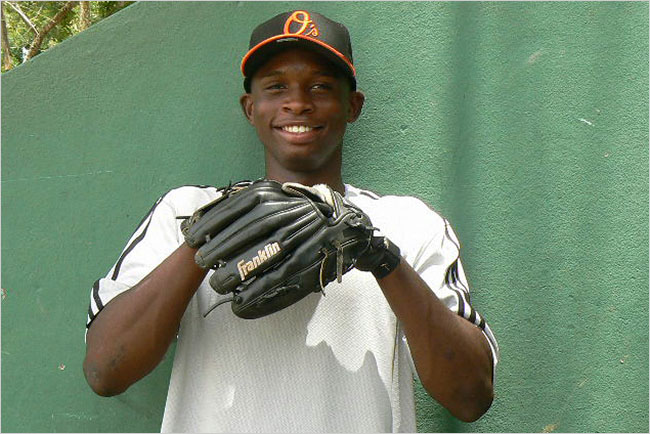
ESPN Jorge Arangure Jr. posted an update on the Dominican Prospect League in his blog, today (link for ESPN Insiders). To catch everyone up, the Dominican Prospect League was put together by three agents to help showcase some young and talented ballplayers from the Dominican Republic. The idea was to provide a central location and game situations wherein players could perform for scouts against good competition. Essentially, make the scout's life easier by putting good talent on display in game situations and make the player's life easier by giving him a chance to be seen by a bunch of Major League Organizations.
Troubling Baltimore news as the story continues after the jump...
The league has some questions surrounding it, including whether the cream of the crop will consistently show and how much the buscons might affect the league by trying to force playing time for certain players. But generally, the league seems to be very well received (quote from Arangure's linked piece):
"The league has allowed me to see the supposed top players for this year's signing period in game action," wrote Reds Latin American scouting director Tony Arias in an email. "Time will tell if all the top kids participated in the DPL. I think most Latin Scouting Directors have made it a point to see the DPL games when they are in the Dominican on Wednesdays. It has been beneficial to both the kids and teams in the scouting process in allowing all teams access to scout the kids playing in games amongst their peers. I hope they continue to have harmony and success with this venture as I think it benefits all the people involved with baseball in the Dominican."
Some teams have found some "overlooked" value, as Arangure reports further that seven players not signed this past summer have now been inked to mid-five to low-six figure deals. The main takeaway seems to be that the League may not cover all the bases on the Dominican scouting field, but it's a great place to get a look at good talent, particularly for organizations that aren't well-established in the Dominican Republic as of yet.
Unfortunately, according to Arangure's latest report, Baltimore has not been an active participant:
"Also, though most teams' scouts have shown up regularly for games, Mejia notes that some teams -- like the Chicago White Sox and the Baltimore Orioles -- still have not had a regular presence at games."
We all know it takes time to make inroads in Latin America. You need to develop relationships with the buscons and earn some trust and a level of comfort with the communities. But how can an organization so dreadfully lacking on the international scene not take advantage of an opportunity like this? Provided there isn't much more to this story, this looks like another missed opportunity for the Orioles, and another inexcusable failure on the international front.
06 January 2010
AL East Best Under-26 Team: Part 1 - Catcher
To be alerted to all new postings, follow Camden Depot at Twitter (www.twitter.com/camdendepot)
Series Links
Intro / C / 1B / 2B / 3B / SS / OF / RHP / LHP / CL
On Monday we penned our introduction to the series. Today, MJ kicks off our series with a look at the Top 3 Under-26 Catchers in the AL East. Not surprisingly, baseball's most highly-touted prospect of 2009 tops the list. The full list with brief write-ups after the jump...
1. Matt Wieters / Baltimore Orioles (MLB)
Height/Weight - 6-5/230 / Born - 5/21/1986 / Bats/Throws - B/R
Stats - Fangraphs / Baseball-Reference / MinorLeagueSplits
 Considered not only the top catching prospect in the division but also the best prospect overall according to Baseball America’s top-100 ranking for the 2009 season, Wieters is the rare combination of offensive and defensive prowess at a position known for players possessing one trait or the other but rarely both.
After a relatively slow transition to the big leagues following his promotion from AAA-Norfolk, Wieters came into his own once the calendar flipped to September, posting a .333/.395/.486 line to finish the year, as compared to his .267/.314/.379 slash stats from May-August. In 738.1 defensive innings, Wieters committed five errors, including three passed balls and only threw out 21 of 86 attempted base-stealers (24%) but gradually grew into his role as the team’s everyday catcher. As scouts have raved about his makeup, advanced knowledge of the strike zone and smooth catching skills (despite his atypical size for a catcher), Wieters profiles as a future All-Star behind the dish for years to come.
2. Jesus Montero / New York Yankees (AAA/Scranton)
Height/Weight - 6-4/225 / Born - 11/28/1989 / Bats/Throws - R/R
Stats - Fangraphs / Baseball-Reference / MinorLeagueSplits
As with Wieters, Montero is considered a very advanced offensive prospect, garnering comparisons to some of the game’s best sluggers and drawing raves for his natural power and ability to square up on the baseball. Some scouts have even graded him as an 80 on the 20-80 scale for hitting and power. After destroying advanced A-level ball to the tune of .356/.406/.583, Montero was well on his way to similarly dominating AA pitching (.317/.370/.539) before breaking his middle finger and being shelved for the remainder of the season.
Unlike Wieters, however, Montero’s future as a catcher is in doubt. Whereas some scouts project him as a poor defensive catcher with a ceiling of Mike Piazza’s skills behind the plate, others believe that the Yankees are prolonging the inevitable and that Montero will indeed either man first base or be a full-time DH upon reaching the big leagues. Scouts cite a lack of natural athleticism and poor footwork behind the plate, and, despite a strong throwing arm, nearly all those who have watched Montero behind the plate feel that he is no better than a below average defensive prospect.
3. Austin Romine / New York Yankees (AA/Trenton)
Height/Weight - 6-2/210 / Born: 11/22/1988 / Bats/Throws - R/R
Stats - Fangraphs / Baseball-Reference / MinorLeagueSplits
With Montero’s promotion to AAA after only 167 at-bats at AA, his former platoon-mate Austin Romine will be granted the full-time catching duties at AA-Trenton in 2010. Romine is considered an all-around catching prospect with above-average raw power and solidly above-average skills behind home plate, including a strong and accurate arm. Additionally, Romine is viewed as a good athlete with fair speed for a catcher, evidenced by his 11 steals (out of 16 chances). The 2009 Florida State Player of the Year,Romine – and not Montero – appears to be the heir apparent to Jorge Posada as the everyday catcher of the future for the New York Yankees.
HM. Dioner Navarro / Tampa Bay Rays (MLB)
Height/Weight - 5-10/190 / Born - 2/9/1984 / Bats/Throws - R/R
Stats - Fangraphs / Baseball-Reference / MinorLeagueSplits
Navarro makes this list as much by virtue of his birth date as for the fact that he has crafted a five year career as a catcher at the major league level. Although his skills and stats translate to a roughly average performer at the position, it is nonetheless reason enough to recognize Navarro as one of the division’s best catchers aged 26 and younger.
Travis d’Arnaud (Toronto Blue Jays) was also considered for this spot but Navarro was given preference based on his established major league track record, especially in contrast with d’Arnaud’s 2010 season likely opening at A-Adv. Dunedin.
Series Links
Intro / C / 1B / 2B / 3B / SS / OF / RHP / LHP / CL
On Monday we penned our introduction to the series. Today, MJ kicks off our series with a look at the Top 3 Under-26 Catchers in the AL East. Not surprisingly, baseball's most highly-touted prospect of 2009 tops the list. The full list with brief write-ups after the jump...
1. Matt Wieters / Baltimore Orioles (MLB)
Height/Weight - 6-5/230 / Born - 5/21/1986 / Bats/Throws - B/R
Stats - Fangraphs / Baseball-Reference / MinorLeagueSplits
 Considered not only the top catching prospect in the division but also the best prospect overall according to Baseball America’s top-100 ranking for the 2009 season, Wieters is the rare combination of offensive and defensive prowess at a position known for players possessing one trait or the other but rarely both.
After a relatively slow transition to the big leagues following his promotion from AAA-Norfolk, Wieters came into his own once the calendar flipped to September, posting a .333/.395/.486 line to finish the year, as compared to his .267/.314/.379 slash stats from May-August. In 738.1 defensive innings, Wieters committed five errors, including three passed balls and only threw out 21 of 86 attempted base-stealers (24%) but gradually grew into his role as the team’s everyday catcher. As scouts have raved about his makeup, advanced knowledge of the strike zone and smooth catching skills (despite his atypical size for a catcher), Wieters profiles as a future All-Star behind the dish for years to come.
2. Jesus Montero / New York Yankees (AAA/Scranton)
Height/Weight - 6-4/225 / Born - 11/28/1989 / Bats/Throws - R/R
Stats - Fangraphs / Baseball-Reference / MinorLeagueSplits
As with Wieters, Montero is considered a very advanced offensive prospect, garnering comparisons to some of the game’s best sluggers and drawing raves for his natural power and ability to square up on the baseball. Some scouts have even graded him as an 80 on the 20-80 scale for hitting and power. After destroying advanced A-level ball to the tune of .356/.406/.583, Montero was well on his way to similarly dominating AA pitching (.317/.370/.539) before breaking his middle finger and being shelved for the remainder of the season.
Unlike Wieters, however, Montero’s future as a catcher is in doubt. Whereas some scouts project him as a poor defensive catcher with a ceiling of Mike Piazza’s skills behind the plate, others believe that the Yankees are prolonging the inevitable and that Montero will indeed either man first base or be a full-time DH upon reaching the big leagues. Scouts cite a lack of natural athleticism and poor footwork behind the plate, and, despite a strong throwing arm, nearly all those who have watched Montero behind the plate feel that he is no better than a below average defensive prospect.
3. Austin Romine / New York Yankees (AA/Trenton)
Height/Weight - 6-2/210 / Born: 11/22/1988 / Bats/Throws - R/R
Stats - Fangraphs / Baseball-Reference / MinorLeagueSplits
With Montero’s promotion to AAA after only 167 at-bats at AA, his former platoon-mate Austin Romine will be granted the full-time catching duties at AA-Trenton in 2010. Romine is considered an all-around catching prospect with above-average raw power and solidly above-average skills behind home plate, including a strong and accurate arm. Additionally, Romine is viewed as a good athlete with fair speed for a catcher, evidenced by his 11 steals (out of 16 chances). The 2009 Florida State Player of the Year,Romine – and not Montero – appears to be the heir apparent to Jorge Posada as the everyday catcher of the future for the New York Yankees.
HM. Dioner Navarro / Tampa Bay Rays (MLB)
Height/Weight - 5-10/190 / Born - 2/9/1984 / Bats/Throws - R/R
Stats - Fangraphs / Baseball-Reference / MinorLeagueSplits
Navarro makes this list as much by virtue of his birth date as for the fact that he has crafted a five year career as a catcher at the major league level. Although his skills and stats translate to a roughly average performer at the position, it is nonetheless reason enough to recognize Navarro as one of the division’s best catchers aged 26 and younger.
Travis d’Arnaud (Toronto Blue Jays) was also considered for this spot but Navarro was given preference based on his established major league track record, especially in contrast with d’Arnaud’s 2010 season likely opening at A-Adv. Dunedin.
05 January 2010
Interesting Matt Hobgood Interview at Baseball Beginnings
Matt Hobgood discusses, at reasonable length, about the difficulties he faced after being drafted by the Orioles. He has been quite focused at API and has lost 8 pounds and reduced his percent body fat by 3% in a month. He hopes to come into spring training at 240lbs to quiet anyone about his conditioning.
Here is a short response about his troubles at Bluefield:
You can find the full interview here:
Part I
Part II
Here is a short response about his troubles at Bluefield:
It took me a little over a month just to get back to feeling where I could actually throw good, and even then, I think I topped the whole year at Bluefield at like 91. I was trying to throw hard, but I wasn’t trying to look like I was throwing hard, if you know what I mean. I talked to (Orioles scouting director) Joe Jordan a little bit. He came down and he said somebody asked him why high school pitchers loose velocity as rookies. Joe said it’s just different. We’re not used to throwing every day.
You can find the full interview here:
Part I
Part II
Collection of John Sickels' 2010 NL Prospect Grades

In this posting I will link to all of John Sickels' 2010 Prospect Grades for every NL team. Click here for the AL links.
NL East
Atlanta Braves
Florida Marlins
New York Mets
Philadelphia Phillies
Washington Nationals
NL Central
Chicago Cubs
Cincinnati Reds
Houston Astros
Milwaukee Brewers
Pittsburgh Pirates
St. Louis Cardinals
NL West
Arizona Diamondbacks
Colorado Rockies
Los Angeles Dodgers
San Diego Padres
San Francisco Giants
04 January 2010
AL East Best Under-26 Team: Introduction
With the Yankees and Red Sox running out front in the AL East for much of the aughts, the 2008 Tampa Bay Rays gave baseball a glimpse into the type of team that will ultimately need to be assembled in order to run with the deeper pockets in the division. Acquiring and developing young, inexpensive talent carries two primary benefits for the non-Yanks/Sox of the division:
1. Defends against the "big contract" injury/busts that can potentially tie-up payroll for a year or more. By adding as much talent as possible while keeping the payroll as low as possible, Tampa, Baltimore and Toronto will give themselves the flexibility to address an injury or bust via trade/free agency, rather than being forced to rush a prospect or, worse, do nothing.
2. Keeps payroll available for selectively aggressive moves in the free agent/trade markets/extension of homegrown talent. By assembling as talented a team as possible while leaving as much capital available as possible, the option hopefully exists to make a run at a more expensive free agent when the potential wins added by that free agent/expensive trade target, or locking-up one of the homegrown talents for a period of years, are relevant to making a playoff run (preferably for an extended period of time).
It remains to be seen how effective Baltimore, Tampa and Toronto will be in executing, but this is likely the best approach to competing with Boston and New York in the standings and, in selected situations, in the free agent and trade market.
So where do each of the AL East teams rank in current under-26 year old talent (a quick and dirty cut-off for gauging "young and cheap" talent)? After the jump we'll step through the criteria we've used for our position-by-position nine-part series. In this pivotal cross-section of talent acquisition and development, which AL East team is best situating themselves....
Subject: The goal of the series is two-fold:
1. To find the best young players at each position in the AL East talent structure, and
2. To get an idea of where the AL East teams stack-up, overall, with regards to young talent in the pipeline.
Parameters: In order to qualify, a player must satisfy the following requirements:
1. The player must be 26 or younger during the 2010 season (born October 1, 1983 to present), and
2. The player must currently be under the control of an AL East organization (the player can be at any level in the organization).
Discussion: The bulk of the pieces will be prepared by myself (Stotle) and by MJ. MJ comes to us by way of the New York Yankees fan base and has contributed as a writer for the popular Yankees site www.waswatching.com. As is the case with Crawdaddy and myself, he follows the AL East closely and should provide good balance to the pieces. The two of us, along with Craw, will be selecting the top players for each position. The author of the piece will be responsible for the ultimate ranking of the players. We hope you'll add your thoughts in the comment section of each piece, as well.
We'll keep a running count of the Top Under-26 Team at the conclusion of each piece, and Craw, MJ and I will put together a "wrap-up" piece briefly discussing our findings.
This is quite an exciting endeavor for the three of us. We hope that even if you disagree with our rankings, our series will trigger some discussion amongst the various fan bases. Part 1: Catchers, is being finalized by MJ now and will post on Wednesday. Craw will be putting-up something fun and interesting in the interim.
Happy New Year's; see you soon.
-Stotle
1. Defends against the "big contract" injury/busts that can potentially tie-up payroll for a year or more. By adding as much talent as possible while keeping the payroll as low as possible, Tampa, Baltimore and Toronto will give themselves the flexibility to address an injury or bust via trade/free agency, rather than being forced to rush a prospect or, worse, do nothing.
2. Keeps payroll available for selectively aggressive moves in the free agent/trade markets/extension of homegrown talent. By assembling as talented a team as possible while leaving as much capital available as possible, the option hopefully exists to make a run at a more expensive free agent when the potential wins added by that free agent/expensive trade target, or locking-up one of the homegrown talents for a period of years, are relevant to making a playoff run (preferably for an extended period of time).
It remains to be seen how effective Baltimore, Tampa and Toronto will be in executing, but this is likely the best approach to competing with Boston and New York in the standings and, in selected situations, in the free agent and trade market.
So where do each of the AL East teams rank in current under-26 year old talent (a quick and dirty cut-off for gauging "young and cheap" talent)? After the jump we'll step through the criteria we've used for our position-by-position nine-part series. In this pivotal cross-section of talent acquisition and development, which AL East team is best situating themselves....
Subject: The goal of the series is two-fold:
1. To find the best young players at each position in the AL East talent structure, and
2. To get an idea of where the AL East teams stack-up, overall, with regards to young talent in the pipeline.
Parameters: In order to qualify, a player must satisfy the following requirements:
1. The player must be 26 or younger during the 2010 season (born October 1, 1983 to present), and
2. The player must currently be under the control of an AL East organization (the player can be at any level in the organization).
Discussion: The bulk of the pieces will be prepared by myself (Stotle) and by MJ. MJ comes to us by way of the New York Yankees fan base and has contributed as a writer for the popular Yankees site www.waswatching.com. As is the case with Crawdaddy and myself, he follows the AL East closely and should provide good balance to the pieces. The two of us, along with Craw, will be selecting the top players for each position. The author of the piece will be responsible for the ultimate ranking of the players. We hope you'll add your thoughts in the comment section of each piece, as well.
We'll keep a running count of the Top Under-26 Team at the conclusion of each piece, and Craw, MJ and I will put together a "wrap-up" piece briefly discussing our findings.
This is quite an exciting endeavor for the three of us. We hope that even if you disagree with our rankings, our series will trigger some discussion amongst the various fan bases. Part 1: Catchers, is being finalized by MJ now and will post on Wednesday. Craw will be putting-up something fun and interesting in the interim.
Happy New Year's; see you soon.
-Stotle
03 January 2010
Joe Sheehan Chat and AL GM Rankings
Weekend editions are usually a good time to look back on the previous week. So, here are some Orioles focused quotes from the most recent Joe Sheehan chat:
[Mike Gonzalez' deal is] a very inexpensive contract, and the Orioles' bullpen has sucked for a while, so I don't hate the deal. It makes a hell of a lot more sense than signing Garret Atkins, who is 1) not very good and 2) redundant even at his potential skill set and role because of Ty Wigginton. Gonzalez can at least do something.
This echoes my sentiment. Gonzalez is a roughly average to below average deal. It is one that does not seem to make most of having the 3rd pick in the second round, but the value lost there is not great. The Garrett Atkins deal is a headscratcher and only makes sense in take the alternative is atrocious and he has some upside. Of course, sending Scott Moore out there and banking Miguel (Angel Sano) Jean with the difference would have been a better move in my opinion.
[Best GMs in the game are] Epstein, Cashman, Beane, [Zduriencik, and] . . . Daniels or Williams . . .
That puts Andy MacPhail at seventh or lower in the AL.
My ranking of GMs in the AL and some other Sheehan quotes after the jump.
Crawdaddy's list of best GMs in baseball:
1. Theo Epstein, Boston Red Sox - Best run program in the game. Domestic/International talent acquisition is stellar and free agents pickups are largely successful (outside of SS).
2. Bill Beane, Oakland Athletics - Slightly shaky lately and somewhat overrated . . . still the Gold Standard. Set with a misguided run last season, he was able to turn around and replenish his minors.
3. Jack Zduriencik, Seattle Mariners - Nearly every move he has made has been a steal. He wound up with Cliff Lee for less than the Yanks gave for Vazquez.
4. Andrew Freidman, Tampa Bay Rays - Competing in the AL East with a slim payroll and having arguably the best Minor League talent pool in the game.
5. Jon Daniels, Texas Rangers - Has turned things around greatly in the past couple years. He used to be rather awful. Great minors and solid MLB moves.
6. Dave Dombrowski, Detroit Tigers - Great turnover in the system, but he acquires top amateur talent and has made a few excellent trades (although somewhat blemished--Dontrelle Willis).
7. Brian Cashman, New York Yankees - He is difficult to evaluate, but Cashman's tenure has been much smoother since he was given more of a free reign to go after younger players. Money certainly helps though and they do not seem to embrace progressiveness like the BoSox.
8. Andy MacPhail, Baltimore Orioles - He has shown a lot of patience in getting generally solid returns in trades (Bedard and Sherrill deals) and an emerging proliferation of minor league talent. Free agent acquisitions do not seem incredibly shrewd and the team missed out on trading some of their players at the right time.
9. Mark Shapiro, Cleveland Indians - This might be too low for Shapiro. Solid assessment of high round minor league talent and young positional players. Poor drafting (to be kind) and a near complete lack of evaluating pitching. Kerry Wood acquisition was expensive for the team and did not address starting pitching.
10. Kenny Williams, Chicago White Sox - Williams is a gambler who seems to make moves using his gut much more than his head. When he had a set of supernaturally healthy and good starters . . . it worked. He has had trouble getting back to that. The Peavy and Rios deals could set this team well. The Teahan deal is perplexing. The outfield is often peculiarly addressed. Has the feeling of a rotisserie team.
11. Bill Smith, Minnesota Twins - This will probably be a rather controversial placement. Smith though has been underachieving for years. His Santana deal paled in comparison to what the Erik Bedard deal was. Solutions to add offense to the squad were met with continual bouts of failure. MLB level moves look quite poor. The team excels with its amateur scouting. I am unsure how much Smith is involved with that.
12. Tony Reagins, Los Angeles Angels of Anaheim - They have not done much to replace the massive amount of talent they had. This includes at an amateur levels and at a pro level. Also seems to have a tendency to hold onto prospects for too long. Not much was gained from Tex's departure.
13. Alex Anthopoulos, Toronto Blue Jays - Not much to grade him on, but the Jays did seem to get value closer to what the O's got for Bedard than what the Twins got for Santana. So he easily rates above the fourteenth selection whom I am at a loss to name a single good move.
14. Dayton Moore, Kansas City Royals - Two words: The Process.
[One of the three worst moves of the offseason is the signing of] Garret Atkins, because the Orioles already had a fat, slow, pseudo-corner-guy with a huge platoon split who hits into lots of DPs.
Yeah, Sheehan is not fond of this one. Nor am I.
That is all we have for today.
02 January 2010
Interesting Tidbits From Jim Callis' Chat
Here are just a few interesting comments in Jim Callis' last chat:
What I found most interesting was that he rated the Rays (2nd) and the BoSox (7th) above the Orioles (8th). That means the AL East has a very talented minor league system. Life will not be easy for the O's.
When I did my personal list, I rated the Orioles as the eighth-best farm system, which is quite impressive considering that Wieters, Tillman and Reimold graduated to the majors in 2009.
Tillman, easily [has the better career]. And I like Arrieta.
I ranked [the Nationals] 20th, in large part because of Strasburg. If you took him out of the mix, I would have rated their system 27th.
I'd give Pie another shot [at being a starter and have Reimold DH] but I don't have much faith that [Pie starting] will work out.
[Orioles drafted Matt Hobgood because he would sign for slot].
What I found most interesting was that he rated the Rays (2nd) and the BoSox (7th) above the Orioles (8th). That means the AL East has a very talented minor league system. Life will not be easy for the O's.
31 December 2009

Does Holliday Make Sense for the Orioles?

Tracy Ringolsgy wears a cowbot hat. Rongolsby also writes for Fox Sports. He wrote today that the Baltimore Orioles had extended an 8 year offer to Matt Holliday to the tune of 130MM. That is an annual average of 16.25MM. An eight year deal will also take Holliday through his age 37 season. Andy MacPhail has offered to get together with him and Peter Angelos in Austin where Holliday lives. Roch says MacPhail denied the offer was ever presented.
The alleged offer consists of a rather lengthy contract. Based on his age and position, he projects to roughly 26 wins above replacement over that eight year period. Assuming an increase of 10% increase in the cost per win and that this year's value is 4MM/win, Holliday is worth 137MM over those eight years. More pessimistic projections see his value as closer to 124MM over eight years with those last two seasons rating him as severely below average. In truth, it is difficult to find any projection that is optimistic over years 7 and 8.
Although I am not a great fan of this supposed proposed offer, I can understand why it would make sense. More after the jump.
Some points:
1. We have excess outfielders, why do we need to purchase a left fielder?
By signing Holliday, it leaves a glut of outfielders with Felix Pie, Nolan Reimold, and Luke Scott. Such as situation would enable the team to engage in a trade to move talent around. Players like Pie and Reimold (to a lesser extent Scott) present plus value for other teams with payroll restrictions due to their status under the CBA as renewal year players. Signing Holliday could mean a redistribution of talent from Reimold to Blanks at first.
2. Holliday is on the wrong side of 30, how does that fit?
Players with a high contact rate, decent walk rate, some speed, and power age better than others. What is more worrisome is the athlete who relies many on one or two skills. His bat should age rather well and his defense should remain passable in left field for several seasons. He figures to age much better than Jason Bay.
3. What about the Coors split?
Much concern over Holliday is his home/road splits attributed largely to the Coors effect. While this was a concern last off season, it may not be as much of one this off season. He exhibited another extreme home/road split this year with Oakland and St. Louis (OPS; 982 vs 830). This may just be his performance characterization. He hits well at home. With Camden Yards as one of the top three homerun hitting environments in the Majors, he stands to do well with his high contact rate and power. He should hit well as an Oriole.
4. So what do I have against this trade?
This sort of contract ensures a nearly worthless player on the team for two seasons down the road. That restricts a team's roster in sunk cost and potentially a sunk 25 man roster slot. Such a signing also means that about 15% of the team's possible budget will be tied to a left fielder who skills are decreasing each year instead of getting better while all the players around him are excelling. Such a signing means that we are ignoring the plus value available from the left field slot that we currently have and hoping to find that elsewhere in the lineup or needing to overpay more to fill positions. It also means we are paying a premium on a position that is of little consequence this season.
I can understand why a Holliday signing makes sense, but I would not suggest it. I think it would do more to limit roster and payroll flexibility down the line in a way that is not essential for the future success of the team.
30 December 2009
Collection of John Sickels' 2010 AL Prospect Grades

In this posting I will link to all of John Sickels' 2010 AL Prospect Grades for every AL team. NL links can be found here.
AL East
Baltimore Orioles
Boston Red Sox
New York Yankees
Tampa Bay Rays
Toronto Blue Jays
AL Central
Detroit Tigers
Chicago White Sox
Cleveland Indians
Kansas City Royals
Minnesota Twins
AL West
Los Angeles Angels of Anaheim
Oakland Athletics
Seattle Mariners
Texas Rangers
Subscribe to:
Posts (Atom)