06 September 2011

More Info on Replacing MacPhail

Tony Lacava
Yesterday, Ken Rosenthal reported on who Angelos might replace as Andy MacPhail's replacement.  I've noticed over the years that Rosenthal's stellar reporting on Baltimore's future has become more and more hit or miss.  I think many of his connections from his days in town are no longer tight with the team.  That said, I do think his reporting should be noted.  In his column, he cited the Marlins' Dan Jennings and the Jays' Tony LaCava.  Both would be fine choices.  I have written earlier on Jennings in this column.  Specifically, I wrote:
Jennings has been rumored for GM positions for about ten years now.  Last year he was a finalist in the Mets opening before losing out to Sandy Alderson.  Jennings is known as being skilled at scouting and would probably complement Buck Showalter quite well.  As a long time Florida employee, he is also well aware of Joe Jordan.  If the Orioles want more continuity along with revamping the organization to be more efficient, Jennings might be that guy and Jordan might be a great help to him.  The weakness here though is that this leaves no one in the front office in control who has experience running the day-to-day operations of the team.  Buck would need someone who is well skilled to be able to turn deals that Buck cannot do while sitting in the dugout.  I do think Jennings would be an interesting choice.
I do think Jordan and Jennings would make a good team, but seven years have passed between them and the word is that Jordan will not seek a continuation of his service with Baltimore.  I have had my disagreements with how Jordan chooses to spend his money, but am wholly sincere when I say that I find him to be an average to above average scouting director.  Jennings knows his scouting though and would find someone suitable to work with him in forging a solid front office built on a strong foundation of amateur assessment.  Of course, this group will need to figure out what the developmental hangups are in this organization.

The second person mentioned, Tony LaCava, was not mentioned before in this blog.  LaCava would be a great pick up.  He has been toiling with the Blue Jays for several seasons and had been retained by Alex Anthopoulos.  He has been a runner up for several positions including the Seattle Mariners, Washington Nationals, and Pittsburgh Pirates.  LaCava is someone who everyone seems to know in baseball.  This also may be a problem.  LaCava might be a MacPhail without track record of relative success.  Like MacPhail, everyone seems to know LaCava and everyone seems to think he has a great baseball mind.  LaCava, now in his 50s, has been on the threshold of being a GM, so it makes one wonder why he continually is passed over.  The Orioles may also provide a situation where the best of the interview worn bunch may not be a ticket for the World Series.  LaCava may have been unjustly overlooked several times in his career (perhaps due to some lack of involvement in player development), but this Orioles' franchise in this division may need someone who is willing to think unconventionally.  Maybe LaCava is that person.  Maybe he is the guy who has had a heavy hand in transforming the Jays.  He just might be.  If he is, I think it would arguably be the best acquisition since Pat Gillick was inked.  However, I have my doubts.

That said, both of these candidates would give the Orioles General Managers who will likely be average to above average in performing their duties.  Neither would be an out and out mistake.  I recognize my own personal bias in wanting to find an untested genius, but it may be that these somewhat well-traveled careers have been voyaged by individuals who have incredibly creative minds to take the current relatively stable and somewhat under performing Baltimore Orioles and act in a successful, unconventional way.  It has been too long that other teams have mimicked the Rays and Jays or wished they had the revenue to mimic the BoSox or Yanks.  Let others wish they had the brain power of the Orioles or at least fail extraordinarily trying.

05 September 2011

Review of Joe Jordan's Drafts (First Round Selections)

There has been uncertainty as to whether Joe Jordan would continue as the Orioles scouting director for the amateur draft.  His tenure began in 2004 under Flanagan's regime and he has overseen seven drafts for the Orioles.  During his time, the Orioles have not developed into a year in and year out top tier team with minor league talent.  His GMs often left him with lost picks and did not plan well to give him extra picks in the compensation rounds.  It is also difficult to separate responsibility between Jordan's scouting group and the organization's developmental staff.  It does appear as though the team has not done will with targeting or developing the right raw, toolsy position players and the team also appears to have a knack selecting or acquiring pitchers who quickly break down and/or lose velocity.  This all may be chance and the responsibility of development, but some aspect of it likely lies at Jordan's feet.  In this post, we will begin to assess how Jordan performed over the past seven years by focusing solely on the first round.

2005
Jordan walked into the organization from the Florida Marlins in November of 2004 under Mike Flanagan.  He was considered a well respected scout in the Marlins system who could not be promoted beyond his immediate boss Dan Jennings.  In his first draft, Jordan selected an offensive minded high school catcher named Brandon Snyder.  It was a somewhat controversial pick as Snyder was a slight reach, questionable as to whether could remain as a catcher, and he did not profile as an elite bat.  His bat has actually come along as well as can be respected.  He has a smooth solid swing and hits the ball hard.  He has a line drive swing with moderate power.  This would be considered a success if he was able to remain as a catcher, but shoulder injuries pushed him to first base where his offense does not profile him as a starter at the MLB level.  Only 24, he has spun his wheels in Norfolk the past two and a half seasons.  Snyder is unlikely to provide any significant value for the Orioles.

The following selection in that draft was Trevor Crowe by the Cleveland Indians.  Crowe has also experienced periods of success in the minors, a couple injuries, and an inability to transfer it to the Majors.  As a 27 year old, he appears unlikely to show anything new.  The White Sox then selected Lance Broadway whose progress slowed once he reached AAA.  He has now bounced to the Mets system and has shown no ability to succeed as a reliever in the Majors.  Jordan's old team, the Marlins, then took Chris Volstad.  Volstad, as a prospect, has been the most heralded and has seen the most success.  After a solid half season to begin his career, he has gone backwards with an ERA+ in the low 80s over 450 innings.  2005 was a difficult year for players taken at the Orioles selection and the three that followed.

2006
For those who have been frustrated by Jordan's tenure, Billy Rowell's name comes up often.  It should be remembered that Rowell was not a reach.  He was a decent athlete with an incredible arm and a bat capable of light tower displays of power.  The only fear was that as a New Jersey baseball player he had not had the reps or played against high level competition.  These two aspects can hurt a scout in evaluating a player and being sure what he sees is real.  Rowell showed good ability to hit and decent enough defense in rookie ball, but began to struggle as he began to see more advanced off speed pitches in Delmarva and Frederick.  He could still show off his light tower power in batting practice, but it could not transfer over to the game with pitchers actively trying to get him out.  At 22, he could not handle AA pitching at all in Bowie and finished his season with a few at bats in the Gulf Coast League where it had become apparent to all involved that he would not longer be with the Orioles' franchise in the future.

What makes this selection burn more than the Snyder pick is that the toolsy Rowell was selected just in front of Cy Young award winner Tim Lincecum, potential top tier pitcher Max Scherzer, and heralded Kasey Kiker.  Only Kiker has sputtered out after getting injured.  To provide context, Lincecum was avoided by many because of his thin frame and unconventional pitching mechanics.  Scherzer was avoided due to some concern with his mechanics, but a lot of concern over his price tag.  As it stands, Jordan was trumped here by two of the three teams.  His hands may have been tied due to financial considerations, but that is not readily apparent.  Again, it should be recognized that Rowell was not a reach.

2007
Jordan had Matt Wieters fall into his lap as the new defunct regime in Pittsburgh took Daniel Moskos the pick before.  There was some concern that Angelos would overrule the Orioles brain trust as he did in 2004 and not allow them to select a player with a large price tag.  However, they did.  More concern followed as Andy MacPhail was hired and indirectly shared sentiment that he would not have selected Wieters.  All that came to naught as a contract was inked and Wieters became one of the best catchers in baseball.  This selection was an unqualified success and Jordan should be congratulated for recognizing that money spent here was better than spreading it out in later rounds.

The following three picks have been a mixed bag.  Ross Detwiler (who many thought the Orioles would select) has been a high quality prospect, but has had his share of injury woes.  Matt LaPorta is a valuable commodity that has yet to effectively display his power potential.  Casey Weathers is an example as to why top draft picks should not be used for relief pitchers.  The upside was limited and he hurt his arm.  His career is now uncertain.  Three years in and Jordan's record has been a push--not bad or good.

2008
This draft was another strong draft for Jordan to select a quality prospect.  This was also the first year that MacPhail publicly announced that the team's philosophy would be to acquire pitching talent in the draft and sign hitters.  The reasoning behind it was that pitchers are less likely to come to Baltimore because wins would be scarce facing the stacked lineups of Boston and New York.  A perfect pitcher was available for the Orioles when Brian Matusz was available.  He was a polished lefty who had a wide range of offerings enabling him to pitch backwards.  Matusz quickly made his way through the minors, but has seen his career derail in 2011.  His velocity has decreased and, always prone to be hit hard, has been hit hard more often.  Only recently has this looked like a poor pick.  At the time, I thought it was the right one.  In fact, Matusz was also selected in our shadow draft.  Hopefully an off season will help correct whatever issue Matusz is dealing with whether it is proper conditioning or something else.

Buster Posey was taken next.  The Orioles shied away from him due to his excessive demands and that the team already had Matt Wieters in the fold.  In hindsight, drafting Posey and sticking him at third base probably would have been the smartest move, but it made since at the time given what we all knew not to select him.  Kyle Skipworth was selected by the Marlins and has had a great deal of trouble developing into something more.  Yonder Alonso went after him and is trying to wiggle into a Reds' lineup where he has no position and his hitting is essentially Ryan Howard light.  All in all, Jordan's work here has been a push.  I think it will be difficult to ever really fail him here.  Matusz undeniably has talent.

2009
This year was the year I began having doubts on the direction Joe Jordan was taking in the draft.  According to various reports, he was faced with a decision between Tyler Matzek, Zack Wheeler, and Matt Hobgood.  Hobgood was a pitcher with little projection, but great performance.  He was rushing up boards with a hard, heavy fastball and a hammer curve.  Jordan was also impressed with Hobgood's makeup.  Tyler Matzek was considered the consensus best player, but his demands and the manner in which he carried himself turned many teams off.  Zack Wheeler was in between it all in terms of potential and makeup.  In the end, Hobgood's character, allegedly, influenced the pick.  From that point onward, Matzek has been shaky, but appears to have lately resurrected his young career.  Zack Wheeler has been astounding and is now in the Mets organization arguably as their top pitching prospect.  Hobgood's character has not exactly transferred over to baseball.  He was not well developed in understanding how to take care of himself physically and then has suffered potentially serious shoulder issues.  Things do not look good for him.

Following his selection, the Giants took the aforementioned Zack Wheeler who has done nothing but succeed in the minors.  The next two picks were safe, polished selections in Mike Minor and Mike Leake.  Both have been useful to their MLB organizations, but more time is needed to get a better handle on how well they will pitch.  Regardless, all three of the following pitchers look vastly better than Hobgood has.  Also, all three were rated on average higher than Hobgood.  I think Jordan may have gotten carried away with a lackluster draft year and trying to look for something that stood out among the draftees.  Instead, he became overly enamored with an aspect of a player (e.g. makeup) that should almost never be the primary reason for selecting someone.  To be clear, much of this is conjecture rooted with a couple sources from the media and a few others with hearsay and a couple more from the horse's mouth.

2010
From my perspective, the 2010 draft was similar to the 2009 draft.  I thought there were two elite talents (Jameson Taillon, Bryce Harper) and a bunched group clearly below.  Most others disagreed and saw Manny Machado also in that group.  Jordan selected Machado and so far has shown that his choice was likely better than our own, Karsten Whitson (Whitson is doing quite well at Florida though).  There is only a season of data to lean on, but it is fair to say that Machado will be a top ten talent next year.  I still fear that he will be pushed to third, but many think he will maintain his ability to play shortstop.

The next three taken were Christian Colon, Drew Pomeranz, and Barrett Loux.  Loux was found to have some structural damage in his shoulder, but has looked good so far.  Drew Pomeranz was looking good and pulled back Ubaldo Jimenez for the Indians before getting hurt.  Christian Colon has looked like an an eventual Major Leaguer, but not exceptional.  As such, I think Joe Jordan did a solid job in last year's draft even with my doubts

2011
At this point, we do not know what this year has brought.  Dylan Bundy is certainly in the conversation for the most valuable player.  So were Bubba Starling and Anthony Rendon, the players taken after Bundy.  It is just too early.

Conclusion
In the seven years Joe Jordan has been leading the draft effort, he has taken a community defensible player every year except his first year in 2005 and in 2009.  Two out of seven years, Jordan went in a direction different from the mainstream.  Claims of signability and peculiar assessments just do not hold water for first round selections.  He appears as above average as a scouting director considering only these picks.

Next...rounds 2-5.

03 September 2011

Expanded Roster: Can Wieters Put it Together

During the month of September, Camden Depot will expand our rosters beyond Nick Faleris and Jon Shepherd.  This will enable our audience to speak directly outside of the comment box as well as shine a light on other Orioles writers.  The first up in this series is Ben Feldman who writes for OsWARhouse.blogspot.com


Can Wieters put it together?

.311/.395/.544

That slash line (BA/OBP/SLG) is what PECOTA, Baseball Prospectus’s Projection system declared Matt Wieters would bat as a rookie in 2009; the best catcher in baseball, Mark Texeira as a backstop. Of course, not all projections were so optimistic, ZIPS (available at FanGraphs) projected that Wieters would hit .274/.352/.439. That was the low end of the range of projection.  It was offered that by many that Matt Wieters would be the best offensive catcher in baseball the day he stepped onto the field in the Major Leagues. As Ryan Glass at Fangraphs wrote, “at worst, it seems like he will be a top 5 offensive catcher next year”.

Matt Wieters has not lived up to that lofty offensive expectation. The christened “Joe Mauer with power” has grown to be excellent behind the plate, but merely average beside it.

His rookie year, he hit .288/.340/.412; well below PECOTA’s lofty forecast, but a league average line from a rookie catcher in the AL East; facing the pitching staffs of Boston and New York was still quite impressive. His overall line was brought down quite a bit by his struggles from the right side of the plate. Wieters’s overall batting lines, as well his numbers from each side of the plate in his first three seasons (see the figure below). Note OPS+ is adjusted for park effects and league averages to show how a hitter’s line is relative to league average (100 = average; >100 is above average; <100 is below average). 
 
In 2009 and 2010, Wieters performed as a league average hitter, or slightly above from the left side of the plate, and he produced a line equivalent to former Oriole Brandon Fahey from the right side. This year, those splits have been reversed. Could the turn around from the right side of the plate be for real? Could the decline from the left be a mirage?

Let’s look at Wieters’s line drive, ground ball, and fly ball rates for the last three years. Line drives are the most likely to turn into hits (and specifically into extra base hits), fly balls are more likely to go for extra bases and ground balls tend to end up as hits more, but not for power. I’ve also included the percentage of fly balls that go for homeruns, and batting average on balls in play. A normal batting average on balls in play is .300, but can vary quite a bit for hitters (less so for pitchers).
 
A couple things seem clear from the above chart. In 2011, Wieters has been unusually lucky from the right side of the plate, and unusually unlucky from the left side. His rates in 2011 from the left compare favorably with those from 2010, yet his Batting Average on Balls in Play is 41 points lower.  His line drive rate from the right is the highest of his career, and while his HR/FB and Babip both seem unsustainable, some of the improvement could be genuine.

Hardball Times has a tool that calculates Expected Batting Average on Balls in Play (xBABIP). Using this tool, gives Wieters an expected .315 BABIP from the left, and a .321 BABIP from the right side.

If Wieters had hit in normal luck, his individual, and cumulative lines, would be as follows:

 
Wieters’s adjusted OBP of .361 would be 5th among MLB catchers with at leat 300 plate appearances (he is currently 9th) and his adjusted SLG would be 3rd (currently 7th). Still not quite to the level expected of him, but a much closer approximation. Adjusted for luck, Wieters quickly becomes the third most productive offensive catcher in baseball, after only Alex Avila and Brian McCann in 2011.

Of course, offense is only part of the story. The aspect of Wieters’s game that has not disappointed is his exceptional defense. Even with his middle offensive numbers, Wieters’s defense has contributed to him rankings as the third most valuable catcher in the game according to total WAR.  He has been worth 3.1 wins above replacement according to Fangraphs (behind 3.5 for Brian McCann and 4.9! for Alex Avila). Wieters has been the best defensive catcher in the game according to Fangraphs, worth 9 runs above an average catcher, and Beyond the Box Score (5.7 runs). It isn’t only advanced statistical analysis that rates Wieters’s defense so highly, a recent Baseball America of all 30 managers declared Matt the best defensive catcher in the sport.

Even if Wieters never becomes the offensive force many of us thought he would, his gold glove defense makes him one of the most valuable properties in the game. If Wieters’s gains are legitimate adjustments – rather than chance – 2011 could be something of a breakout year, just one clouded in poor luck. He may never be Joe Mauer with power, but he may yet become the best catcher in Major League Baseball.


Footnote - fun with WAR (or, the Orioles have been how bad for HOW long!?)

The best single seasons the Orioles have gotten from centerfielders in the last ten years belong to Corey Patterson and Luis Matos (3.6 and 3.5 WAR – although Adam Jones may eclipse them both this year with 3.3 through August 24th).  Every other team in baseball has gotten at least one 3.6+ year out of centerfield. Corey Patterson. It says quite a bit when the best performer at a position is also a symbol (one of many) for what is wrong with the team. 


01 September 2011

Scouting the O's: Pedro Strop (rhp)

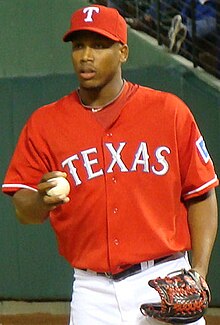
Yesterday the Orioles and the Rangers consummated a trade deadline deal that swapped-out strong-armed relievers, sending Mike Gonzalez (lhp) down to Arlington and Pedro Strop (rhp) up to Baltimore. Here's an introduction to Strop in scouting report form, based on six looks from this year (ML and AAA). Photo from Wikipedia.com creative commons files: http://es.wikipedia.org/wiki/Archivo:Pedro_Strop.jpg


Pedro Strop
Position: Relief Pitcher (rhp)
Born: June 13, 1985
Height: 6'0"
Weight: 175
B/T: R/R


Grading Out:

Current (Future)
Mechanics: 35/40 (45)
Fastball: 50/55 (60)
Splitter: 50 (55/60)
Slider: 40 (45)
Control: 35 (40)
Command: 30 (35/40)
Feel: 35 (40)
Overall: 45 (50)
OFP Range: 47-53 (potential 7th or 8th inning arm)


Physical Description:

Strop has a strong, athletic build, with a sturdy trunk from years as an infielder. He shows clean actions off the mound and moves around well on it.


Mechanics:

Strop began his pro career as a shortstop, converting to the mound in 2006 while in the Rockies organization. It is not surprising that the hard-throwing righty lacks a "classic" set of mechanics. It is interesting, however, that the former infielder utilizes such a long and whippy arm action out of a high three-quarters slot -- the opposite of what you would see coming from the six-spot. Strop's primary mechanical issues come from this arm action/slot combination, and are exacerbated by a high effort lower-half and periodic stiff landing. All of this leads to great inconsistency in his release, affecting the consistency of his slider and his control over the whole arsenal. When he lands stiff on his front leg (usually failing to get over top) he cuts off his motion and causes his arm to come across his body, which in turn causes him to push the ball up in the zone and also leads to first base fall-off. He can also overthrow -- especially when ahead in the count -- though this is tied more to his mental approach, as it isn't a mainstay in his motion. Finally, he flashes high and early, giving the batter a clear look at the ball for an extended period of time.


Throws:

Fastball - Strop uses both a four-seam and a two-seam fastball, capable of dialing-up to 97/98 mph with the four-seamer. He will get solid armside life on the two-seamer around 92-93 mph, and creates good downhill plane with both variations. He struggles to command his fastball, but when in the zone it is a legit plus pitch that will miss bats.

Splitter - Strop's splitter is a mid- to upper-80s vanisher when he hits his release. It's a bury pitch that loses effectiveness when he tries to drop it into the zone, so it is almost exclusively a chase weapon to be utilized ahead in the count. The velocity and break qualify it as a potential plus pitch, but the limited utility drops a half step for me.

Slider - The breaker is the biggest victim of Strop's failure to consistently hit his release point. When he does, he snaps off a nice solid average low- to mid-80s slider with excellent tilt and good deception. Unfortunately, his inability to repeatedly execute the pitch leaves too many spinners out over the plate, making it a questionable ML offering at this point.


Summary:

Strop has a special arm, and should be commended for reinventing himself as a power arm in the pen after struggling with the stick earlier in his professional career. Ideally, he can rein in his mechanics enough over short spurts to provide valuable innings in the 7th and 8th. The heavy downhill plane on his pitches, high slot and diving fastball and splitter will produce plenty of grounders if Strop can find a way to catch the strike zone more consistently. It is unlikely he will produce many sub-10 pitch innings, and baserunners are going to be mainstays. But the raw stuff is good enough to miss bats and help Strop carveout a solid career in a Major League pen. He just needs to push the control dial a little further from "where is it going" and a little closer to the strikezone with more frequency. With in-and-out mechanics, he'll also need to maintain a steady head on the mound and create a mental rhythm to assist him in hitting his mechanical checkpoints. It will be on the Orioles developmental staff to help him to create that internal routine.

29 August 2011

Adam Dunn Might Edge Mark Reynolds

A little known record Mark Reynolds hold is one that is exceptionally difficult to do.  He has the greatest number of strike outs over hits in the history of baseball.  He set it last year with 112 by striking out 211 times and getting a hit 99 times.  Before this year, the next closet would be the immortal Rob Deer at 175 Ks and 80 hits in 1991 as a Detroit Tiger.  Behind him was Melvin Nieves at 75 with 157 Ks and 82 hits.  The difference between first and third is 37.  That is a pretty incredibly difference.  You need to be quite an unusual player to accomplish this feat.  You need to be a three true outcome hitter.  That is what you call a player who can do three things: hit home runs, walk, and strikeout.  Those first two outcomes typically need to be good enough for clubs to stomach the last outcome.

Coming into 2011, it looked as though Reynolds record would be safe.  Only Carlos Pena and Chris Davis showed any proclivity to accomplish such things.  However, Adam Dunn's collapse has given Reynolds a true contender.  This year Dunn has 96 differential with 156 Ks and 60 hits.  He is on pace to finish with a differential of about 108, so he is going to have to pick it up a bit.  Dunn though is more of a two true outcome hitter, he strikes out and he earns a lot of money.  His salary is what gets him in the lineup.

We'll see.

28 August 2011

What is the Value of a Compensation Draft Pick?

This past season Tyler Beede decided not to take a signing bonus north of 2MM with the Blue Jays and instead committed himself to college.  He was the 21st selection in the first round.  As compensation, the Jays will receive an unprotected pick in next year's draft, which is the 22nd selection in the first round.  A question quite a few asked was: what, if anything, have the Blue Jays lost in terms of value?  There are several considerations.

A pick being delayed a year.

A team often relies on waves of highly talented, cost-controlled players graduating to the Majors each year.  If these players are not available, the team has to utilize the free agent market where costs are significantly higher.  For instance, if a team loses it's 21st round pick it will have to supplement it's lineup roughly the cost of what that pick would have provided.  The 21st round pick is worth about 10MM on average over the course of his career.  If that first year needs to be covered, then it will cost the team arguably 1.7 MM.  This value is not uniform for all selections, of course.  The higher up in the draft a player is selected, the greater the expected value of a player as players with greater value are typically chosen earlier.  If it was a first round pick being lost, the expected loss of one year of value would be around 13.3 MM.  The graph below shows the relationship between cost-controlled (first six years) WAR and draft pick selection.  The drafts used for this graph are from 1991-2000.

click to enlarge


It may be argued that in the grand scheme, a one year delay on receiving value is largely inconsequential.  This is likely to be a rather accurate assessment.  The difficulty in projecting players into the future and when they may be able to help the Major League team means that teams largely are not relying on these players to develop.  In a general sense, they need these draftees to develop and contribute, but few teams will set their watches to players producing except at the front end of the draft.  Only there do you find truly remarkable talents that teams will expect to advance quickly and be productive members of the organization at the highest level.

Draft Budget and the Unprotected Nature of Draft Pick Compensation

In practice, the greater concern in practice is how having multiple draft picks in the first round affects the quality of talent being selected.  Additionally, compensation picks are unprotected, which has tended to cause teams to select players more conservatively and reach a little bit.  In 2009, the Nationals selected Drew Storen for 200k less than slot.  Storen has been incredibly successful in the Majors as a reliever.  However, one wonders how important it was for the Nationals, a team in need of impact players, to select a pitcher who throws an inning every few days.  This, however, is not a uniform strategy as this year the Diamondbacks drafted and signed top ten pitchers Trevor Bauer and Archie Bradley.  Both required significant investment and the Diamondbacks accomplished that.

So, how much more useful is one approach than the other?  In the graph below, picks are grouped in fives over the course of the first thirty picks in the draft from 1991-2000.  Those players' control year WAR is compared to players selected the following year a selection behind them or a more conservative ten places later.

click to enlarge


The graph shows that there is a negligible difference between the value of the initial selection vs a selection a year later and a pick later.  However, there appears to be a sizable difference if a team with a compensation pick in the first 20 selections decides to be conservative and draft a signable player (defined in this study as a player taken 10 slots later).  A conservative approach for a top 5 pick would result in a loss of about 4 WAR (~20 MM) while picks 6-20 result in a loss of about 2 WAR (~10 MM).  It appears to be a rather large misfire if a team does not fully utilize their picks.  A simple investment of an extra 1-3 MM results in a several fold return.  Even if an unprotected draftee recognizes his signing team is in a position where they need to sign him, it is highly unlikely the pick would ever receive more money than what the average pick would give back to the team.

Differences in Talent Between Draft Classes

However, this brings us back to the Blue Jays.  Are they worse off for not signing Tyler Beede?  According to this quick study, no they are not worse off.  In an average year, players available at pick 21 are typically equally available the following year at pick 22.  The assumption is though that this year is an average year and next year will also be an average year.  The following graph shows differences in total six year WAR for the first 30 picks in each first round from 1991-2000.

Click to enlarge

This past year's draft was considered one that was quite full with talent.  The majority opinion would find that this year's draft is likely to be similar, in total value, to those in 1992, 1993, 1995, 1997, and 1998.  The early opinion for next year is that it will be an average class which would be similar to 1991, 1994, 1996, 1998, or 1999.  The difference between this and next year is about 30% if these opinions are accurate.  That assumed difference in draft classes between this year and next is illustrated on the following graph which takes the values in the second figure and adjusts them according to general draft worth.

click to enlarge


In general, if the talent level in the current draft appears to be significantly greater than the following draft then it makes sense to aggressively sign those players.  However, if the following draft appears to be more talented then it might make sense to be not so giving during negotiations and to feel free to utilize a compensatory pick the following draft. 

25 August 2011

Flanny, in their words....


This will be an open post where we will provide links to some of our favorite remembrances of Mr. Flanagan. Please feel free to add to the thoughts/links in the comment section.

------------------

Fox Sports' Ken Rosenthal speaks about Flanny (Video) -- a player of substance and a representation of The Oriole Way.

MLB.com's Jon Star and Jordan Schelling provide quotes and comments on Flanagan, including video of MASN's post-game coverage last night (video of Jim Palmer, Buck Showalter, Cal Ripken and Joe Jordan sharing heartfelt thoughts).

ESPN's Tim Kurkjian shares fond thoughts regarding a memorable man. If you're going to read one piece today, Kurkjian's is the one to read. Some quotes:


In 1980, as another Orioles pitcher, Steve Stone, was on his way to winning the Cy Young, Flanagan determined the different stages of Cy: He was the reigning Cy Young. "[Jim] Palmer is Cy Old," he said. "Stone is Cy Present and Storm [Davis] is Cy Future. When you get hurt, you become Cy-bex. When you're done, you become Cy-onara."


I covered a game in 1991 in which Orioles DH/first baseman Sam Horn struck out six times consecutively, the first non-pitcher in AL history to do that. After the game, I went to Flanagan. "Three strikeouts is a hat trick," he said, "four is a sombrero, five is a golden sombrero and from now on, six will be known as a Horn. Seven will be a Horn-A-Plenty."


Flanagan played in his high school alumni game one year, and scored 63 points. He played freshman basketball at UMass with Rick Pitino. Flanagan tried out for the varsity the next year. "I pulled up for a jumper on the break from the top of the key, and Julius Erving blocked it, then swoop-jammed on the other end,'' he said. "I knew then it was time to work on my slider."

Some quotes from MASN's Roch Kubatko on Flanny:


[Former pitcher and current MASN analyst Dave] Johnson watched from the dugout on Oct. 6, 1991 when Flanagan, as the last Oriole to throw a pitch at Memorial Stadium, struck out the only two batters he faced in the top of the ninth inning and walked off the mound to a rousing ovation.

"I remember thinking, 'I wish that was me,' " said Johnson, who started the previous day. "I meant that I wish I had that type of career where I was the guy out there to close that ballpark. It was neat and fitting that it was him doing it because he had that type of career and he deserved to be out there."

Chron.com's Richard Justice -- "If you were lucky enough to know Mike Flanagan, you were better off for it." Some fun stories in Justice's piece here:


Did you hear the one about the Orioles mascot falling from the roof into the dugout onto the concrete floor below? Yeah, unfortunately he landed at Flanagan’s feet.

His head was turned completely around, and from inside the costume, groaning could be heard.

“Listen,” Flanagan told the guy, “take two bird seed and call me in the morning.”


Peter Gammons with more Flanny stories at MLB.com. Select quotes:


If you've ever seen the famous video of the argument between Weaver and umpire Bill Haller in Oakland (in which Earl correctly predicted he would go to the Hall of Fame), it began because Haller called a balk on Flanagan. The obscenity-laded argument lasted a dozen minutes, and, finally, as Earl passed the mound en route to the third-base dugout and the clubhouse, Earl told Flanny, "You got [hosed]."

"Actually," Flanagan replied, "I balked."


There have been few greater baseball humorists in the last 50 years than
Flanagan, a New England iconoclast as well as a brilliant pitching mind. He
threw the last inning at Memorial Stadium because he was so revered in
Baltimore, where he won the American League Cy Young Award in 1979 and helped win the O's the World Series in 1983.

24 August 2011

Peter Angelos Releases Statement on the Passing of Mike Flanagan

It is with deep sadness that I learned of the death of my friend Mike Flanagan earlier this evening. In over a quarter century with the organization, Flanny became an integral part of the Orioles family, for his accomplishments both on and off the field. His loss will be felt deeply and profoundly by all of us with the ballclub and by Orioles fans everywhere who admired him. On behalf of the club I extend my condolences to his wife, Alex; and daughters Kerry, Kathryn and Kendall.

-Peter Angelos


I met Mike Flanagan a couple times as part of my duties here with Camden Depot this past season.  In those brief interactions I came to think of him as a smart, insightful, and interesting person.  It saddens me to learn of his passing and my thoughts go out to his family and friends.

23 August 2011

Camden Depot Wants You!: September Call Ups

In the spirit of September call ups, Camden Depot is offering to expand the writing staff for a cup of coffee.  As you know, the Depot is a member of ESPN's Sweetspot Network and we can provide a rather decent size platform for aspiring writers with a bent on the Baltimore Orioles.

Who is eligible?
Everyone is eligible.  If you already have a site, that is fine.  We can tastefully tag your article with that information.

What kind of article do you want?
We don't have any guidelines other than we want good writing.

What is the process?
1. Send your article to camdendepot@gmail.com
2. Nick or I review your article and decide whether: a) it is good as is, b) requires editing, or c) outright rejected.
3. The article is published on the Depot.

We promise nothing.  It could be what we receive is just not of our particular taste.  We truly hope you surprise us.

21 August 2011

The Science of Baseball: August 21, 2011

This week's Science of Baseball will consider two articles: one on using sling exercises in lieu of throwing to warm up pitchers and another on the effects of caffeinated gum on the performance of cyclists.

Sling exercise and traditional warm-up have similar effects the velocity and accuracy of throwing.
Huang et al. 2011 Journal of Strength and Conditioning Research 25:1673-1679

A growing number of athletes have begun using sling exercises to work out or warm up for competitive play.  There has been some discussion whether or not these exercises might be useful for pitchers.  The idea is two fold: (1) sling exercises involve whole body action which may help a pitcher and (2) it reduces the number of throws a pitcher makes in total.  This study used collegiate pitchers from DI schools.  I'm not sure which schools because the mean pitch was about 75 mph. 

I doubt this study has anything conclusive to say.  The study claims they found no difference between the two techniques and suggest either would be useful.  I don't agree with that.  It is an interesting concept though that one could use alternative ways to warm up muscles needed for pitching without overtaxing tendons and ligaments used for pitching.  It might be a good idea to redo this study a few times.  It is also probably a good time to recognize just how little we know about how pitching impacts the health of an arm short-term and seasonally.  It is a field of study where teams and players both have great reasons not to participate in any studies.  More information is not always something that benefits or, at least, it can be perceived that way.  In the autumn, I will be reviewing several articles on pitching.

Caffeinated chewing gum increases repeated sprint performance and augments increases in testosterone in competitive cyclists
Paton et al. 2010 European Journal of Applied Physiology 110:1243-1250

This article was published last year, but it deals with an issue in which I have a lot of interest (case in point).  Since sports began, players have tried to get advantages outside the spirit by which the rules are written.  The research described in this paper look at how chewing gum impregnated with affects fatigue and hormone responses during cycling sprints.  The study included nine male cyclists (age 24 +/- 7 years) who completed four high-intensity exercises that consisted of four sets of 30 second sprints (five sprints each set).  The cyclists were given the caffeinated gum after the second set.  They found the caffeine reduced fatigue and increased performance by 5.4% as measured by power output.  Testosterone (measured in saliva) increased with the addition of caffeine.  Cortisol levels also were decreased.

Baseball is a game of repeated sprints.  For those of us who have played, we are generally aware of many players who drink copious amounts of drinks like Fuel or other highly caffeinated drinks.  While cognitive function has been shown to not rebound greatly with caffeine, other functions are shown to be boosted by the chemical.  I can see how caffeinated gum could be quite useful to pitchers and, perhaps, fielders later in the game.  The question then becomes: what is cheating?  We tend to think of illegal drugs (e.g. steroids, hGH, amphetamines), but ignore the drugs that are effective but over the counter (e.g. caffeine, aspirin).  Where does that line stand?