Showing posts with label Knuckleball. Show all posts

24 August 2013

Eddie Gamboa - the Good and the Not-So-Good

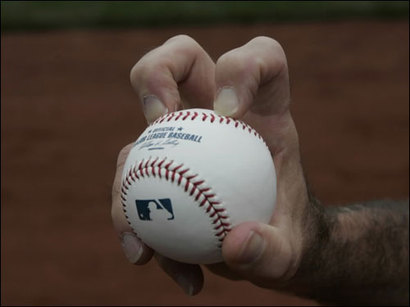
After five seasons in the Orioles' minor-league system, pitching primarily as a swingman, Eddie Gamboa took the chance in 2013 and determined to become a full-time knuckleball pitcher. The Orioles didn't have many options for upper-level starting pitchers, and so put Gamboa full-time into the AA Bowie rotation. On July 10, Gamboa was promoted to AAA Norfolk and has remained there even as the Tides have accumulated seven starting pitchers.

While he was with Bowie, Gamboa made the milb.com front page twice in late June - once for pitching 7 1/3 innings of one-hit ball and once for pitching a seven-inning no-hitter. While with Norfolk, Gamboa impressed observers with a two-hit, seven-inning performance. Unfortunately, I wasn't fortunate enough to see those games and have to rely on others' descriptions of Gamboa's games.

 On the other hand, I have seen Gamboa pitch three times - once for Bowie and twice for Norfolk. And those games were not so good, as you'll see. This article will compare Gamboa's three great games to the three not-so-great games I saw, and see the difference between Gamboa pitching well and Gamboa not pitching well.

Here are the basics of Gamboa's great games:
Date
Opponent
IP
H
R
ER
BB
K
Game Score
June 23
Altoona
7 1/3
1
0
0
3
7
80
June 30
Harrisburg
7
0
0
0
3
5
79
August 5
Gwinnett
7
2
1
0
1
6
76

And the basics of the games I saw Gamboa pitch:
Date
Opponent
IP
H
R
ER
BB
K
Game Score
June 5
Harrisburg
6
9
4
4
1
6
43
July 24
Pawtucket
5
9
4
4
2
3
34
August 11
Rochester
4 2/3
7
4
4
1
1
34


We'll start by looking at Gamboa's pitches in each game. I'll record the percentage of pitches with each result. First, the great games:
Date
Balls
Called Strikes
Swing Strikes
Fouls
In-Play
June 23
44.8%
15.9%
11.2%
14.0%
14.0%
June 30
43.3%
16.3%
12.5%
11.5%
15.4%
August 5
30.0%
23.8%
20.0%
11.2%
21.2%

And the other games:
Date
Balls
Called Strikes
Swing Strikes
Fouls
In-Play
June 5
35.1%
14.9%
14.95
13.8%
21.3%
July 24
35.2%
20.9%
4.3%
18.7%
20.9%
August 11
41.5%
18.1%
4.3%
17.0%
19.1%

I had hoped that there would be some large, obvious difference between the great games and the ordinary games, but nothing jumps out. The great game on August 5 is completely different than the others; for whatever reason, Gamboa controlled his knuckleball substantially better than in his other games. To the extent any conclusion can be drawn, in Gamboa's bad games batters made contact with his pitches (fouls + in-play) more often than in his good games.

From this limited data, it's dangerous to draw any conclusions. I expect that if we looked more closely at a bigger data set we'd find some pattern that would correlate with Gamboa's success. It's also possible that whether or not Gamboa has a good game depends upon the opponent or some other factor he has no influence on.

In an earlier post, I dismissed Gamboa (and Zach Clark) with two sentences. At the highest level, those comments remain valid - he's a previously-stalled pitching prospect trying to salvage his career with the knuckleball. However, his three outstanding starts make him slightly more interesting, and there's a better chance that he'll develop into a major-league pitcher.

18 December 2012

Are Domes a Knuckleballer's Paradise?

With R.A. Dickey moving to Toronto, discussion has arose again laying claim that a dome is good for a knuckleball pitcher.  That is that the knuckleball travels so slow that having it exposed to the wind outside results in a pitch that is very difficult to control.  Therefore, without any wind the pitch would be more effective as a result of the pitcher having better control.  Runs through the physics of it and a fastball of 90 mph can be pushed three inches with a sustained crosswind.  Dickey's 78 mph knuckler may be pushed about three and a half inches.  It should be noted that the lack of spin on the ball might result in greater drag that could increase how much the wind can draw the pitch off course.

Ideally, we would use real data to determine how well R.A. Dickey can pitch in a dome vs. outside of one.  However, he has thrown only once in the past three years inside such a structure.  Last year, he tossed nine innings against the Rays in Tropicana Field.  The result was a one hit shutout with twelve strikeouts.  That simply won't do in terms of sample size, so I decided to take a look at the last four great knuckleballers: Phil Neikro, Joe Niekro, Charlie Hough, and Tim Wakefield.


RA/9

Inside Outside
Phil Niekro 3.98 3.90
Joe Niekro 3.47 4.07
Charlie Hough 4.02 4.29
Tim Wakefield 4.95 5.01
The lowest number of innings in a dome for the above pitchers was 375 innings.  Only Joe Niekro exceeded that with over 1,300 IP...thanks to many a game in the Astrodome.  That said, Joe Niekro appeared to really benefit from pitching his home games in the Astrodome while Charlie Hough also performed well out of the elements.  Wakefield and Phil Niekro did not appear to show much of a difference.  It should be noted that the four above never threw a knuckler the way Dickey does.  Hough would occasionally try to let go of a hard knuckler, but all four of them typically stayed within the 50-70 mph range with their pitches.

So...what does this all mean?  There seems to faint evidence that "knuckleball" throwing pitchers pitch the same or better when pitching inside a dome.  It will be interesting to see next year how Dickey fairs inside the Rogers Centre.  Some have noted it as a launching pad, but that seems to potentially be hyperbole borne out of a couple of seasons where Blue Jay hitters performed awfully well there while being bookended by relatively average home run seasons.  Citi Field actually saw an increase in home runs hit with them moving in their fences last year.  Although the first season in Citi Field played about league average for home runs.  Below are park factors for HR:


Rogers Citi
2009 0.99 1.06
2010 1.36 0.72
2011 1.19 0.74
2012 1.03 1.07
If I was forced to guess, I would say that Dickey will be worth anywhere between 3-4 wins next year.  Some have called this deal a mistake on the Blue Jays part in giving up an offensive catcher who most scouts feel sure will be a major part of the Mets lineup to come along with a few interesting parts that may boost the Mets pitching or outfield.  There is truth in that.  The Jays gave up a lot, but when you look at the vulnerability in the AL East at the moment...it is hard not to try to go for it.  There certainly is a good deal of risk in the Jays roster with guys who have been somewhat uneven in performance and injured, but, with the money behind the Yankees and Red Sox, if you can strike then you strike.  That is what the Jays are doing and, to me, it makes complete sense.  As of this moment, they are my favorite for the division.