Showing posts with label But Didn't We Have Fun?. Show all posts

09 October 2011

CDOBC: But Didn't We Have Fun? Chp 9-11

For more about the book club and books on the agenda click here.

Time having spun away from me lately, we are going again in three chapters to finish this book and move on to Weaver on Strategy.  I hope I am not doing Peter Morris' book a disservice as this almost actually resembled a book club last time when a comment was fielded.  Let's get exponential!

But Didn't We Have Fun? An Informal History of Baseball's Pioneer Era 1843-1870
by Peter Morris

Chapter: 1 | 2 | 3 | 4 | 5 | 6, 7, 8 | 9, 10, 11 | 12 | 13
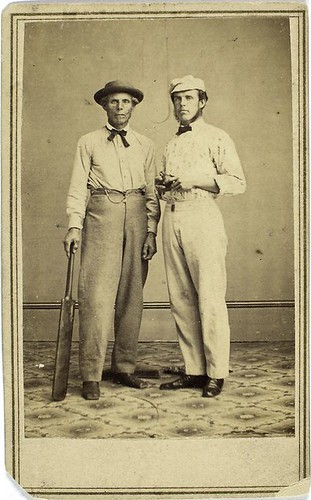
Yes, Harry Wright started out with Cricket
Chapter 9: The Civil War, The End of an Era, part I

It has often been said, incorrectly, that the Civil War was a boon for baseball.  That Abner Doubleday and others used Union camps to teach and play baseball.  That this caused a great dispersion of the game and sent it to all corners of the United States.  From this book, we learn that baseball was alive, well, and thriving throughout from just below the Mason Dixon line and northward (I am unsure why the South is so little mentioned in this book and find it strange that baseball was not being playing to a greater degree in some of the larger towns in the South).  We also learn that there is no evidence that Doubleday ever had an interest or was aware of the game.

What the Civil War did though was resulted in the mass enlistment of young men that depleted the ranks of baseball clubs, causing the majority of them to shut down or merge with the remnants of other teams.  Larger cities could cope and play games between the couple of clubs left, but small cities and towns stopped seeing highly organized games.  The war not only led to enlistment of young men, but the mass crippling and slaughter of those young men.  This made it difficult for towns to put teams together during and in the aftermath of the war.  It likely also caused many a good and dedicated player to move from those smaller towns to larger ones.  Combine that with the advent of the train and migration becomes far easier.  Baseball was ceasing as a community club and turning into a business in and of its own.

Chapter 10: Competitiveness and Professionalism, and What they Wrought, The End of an Era, part II

As cities grew, baseball playing fields became fewer and of poorer quality.  However, throngs of spectators would attend these games.  This made for a ripe environment for business ventures to emerge.  An entity would build enclosed baseball stadiums and sign agreements for teams to make the stadium their home field.  This arrangement often had no money being exchanged.  In turn, the owners of the ball park would then charge admission to spectators who chose to attend these games.  This inevitably led to the ball players becoming irritated at having money made off of them, so agreements were then made to pay the players.

This meant that for your team to be successful, you need to have revenue streams.  Players were now being regularly paid to play which hurt smaller towns who did not have the revenue streams to build stadiums and then pay their players.  The good ones migrated to areas where the could be paid to play.  Even cities as large as Philadelphia did not have a large enough market for these things to occur, which resulted in many ball players migrated to New York, Cincinnati, and Washington DC. 
Washington DC had revenue for a ball club, the Washington Nationals, because it grifted money from the federal government.  Players were given solid government jobs that were primarily located in the treasury department.  This enabled the team to spend large sums on their players and also fund train travel throughout the United States for barn storming ventures.

Chapter 11: The Cincinnati Base Ball Club and the Red Stockings

The Cincinnati Base Ball Club was basically the final nail in the coffin for the long term viability of baseball being a successful amateur game.  The city was successful and did not need much advertisement, so the club did not truly operate as ambassadors for the city.  Instead, they became the cities desired reflection.  The direction of the club was not outward, but inward.  The team was based on civic pride.  Civic pride is often competitive and so the team as a reflection of the city also needed to be competitive, so it made sense for the base ball club to become one of the first clubs to be completely made up of paid professional players with nearly all of them not from Cincinnati.

The team ran out the slate in 1869 undefeated.  They were the darling of Cincinnati and a beacon for the city.  However, with the coming of openly professional players in 1869, Cincinnati team was basically practicing Moneyball.  The inefficiency in the market in 1869 were ball players who got paid.  By 1870, Cincinnati's Moneyball scheme became simply baseball.  They lost several games and were eventually disbanded as the non-native club began to disgrace the city on and off the field.  No doubt, the losing on the field was the main issue, but players did things such as walk into saloons while wearing their uniform.  This was strictly frowned upon.

Thus, the Cincinnati Base Ball Club shut down their experiment with professionalism.  Harry Wright and the Red Stockings reconstituted their team in Boston wearing the same exact uniforms.  This eventually led to a slight change in the name to Red Sox.  Professionalism could not be done away with, but rather merely move around to where it was more acceptable and profitable.  In a period of about two decades, the game shifted from serving as a municipality's diplomatic arm to an inward focused expression of civic pride to a simple capitalistic venture in civic pride's clothing.

Next up . . . the evolution of the game to a strong undercurrent of 'Muffin Ball.'
01 October 2011

CDOBC: But Didn't We Have Fun Chps 6-8

For more about the book club and books on the agenda click here.

But Didn't We Have Fun? An Informal History of Baseball's Pioneer Era 1843-1870
by Peter Morris

Chapter: 1 | 2 | 3 | 4 | 5 | 6, 7, 8 | 9 | 10 | 11 | 12 | 13


For this post, I am collapsing a few of the chapter where I have not much to add.

Chapter 6: Customs and Rituals

This chapter is about how baseball was involved in courting and other social ceremonies.  Baseball clubs were, in some places, certainly treated as well respected clubs.

Chapter 7: Club Life

One of the major take home points in this chapter is that the history of baseball is limited to those who thought it worthwhile mentioning.  To many, this was a simple game for fun and exercise.  It was not considered more than that.

Chapter 8: Intercity Competition and Civic Pride

In the mid 1800s, many towns were fighting for a larger population to provide manual labor for whatever industries were important in the town.  Many saw baseball clubs as a way to promote their town and encourage others to immigrate.  This was truly a matter of life and death for many places.  The more people you had, the more your town could produce.  The more your town produced, the more money it had.  The more money it had, your needs your more likely represented in state and federal efforts.  If a baseball club could get a town a railroad or a major road coming through, they were going to use it.

It reminds me of an ancestor of mine who held some sway in Virginia.  He was actually able to get the small little road in front of our ancestral estate to be chosen for a section of US 15.  It would be unheard of these days for any home owner to want a major highway be built within a stone's throw of the front door of your mansion and 600 acre home.  Back then, it was a boon.  More business passed through town and more important people on their way to Richmond or Washington DC would have to make its way through.  The town today is no longer very important.  The mills burned down (as did most of the town) and the water diverted, but it still is retained as the county seat.

As peculiar as that seems now, it also seems peculiar for a city to acquire a team for the purpose of promoting the city.  Teams just are not ambassadors anymore.  I think they are solely acquired for the enjoyment of the local city and to try to draw more recreational funds from the greater city and into the inner city.

25 September 2011

CDOBC: But Didn't We Have Fun? Chapter 5

For more about the book club and books on the agenda click here.

But Didn't We Have Fun? An Informal History of Baseball's Pioneer Era 1843-1870
by Peter Morris

Chapter: 1 | 2 | 3 | 4 | 5 | 6 | 7 | 8 | 9 | 10 | 11 | 12 | 13

"Lemon Peel" baseball
Chapter 5: Balls, Bats, Bases, and the Playing Field

This is a great chapter.  If you ever find yourself in a library waiting for your significant other to find an audiobook she would like for her commute, you will likely have enough time to sit and make your way through these pages.  As cleanly summarized in the title, it is a brief description of the types of balls, bats, bases, and playing fields that were in use in baseball during this period in the mid-1800s.  As shown before, the simple rules that the Knickerbockers' devised and dispersed standardized many aspects of the game, but left many open for interpretation.  For a single team or field, this makes complete sense as selection of ball, bat, bases, and field are largely without choice or can be quickly determined and followed from there on out.  However, if two different populations of ball players never much interacted then you are likely to have two wildly different implements for your game.

Two major extremes are present in this chapter.  In one locale, I believe Michigan, the version of baseball played there was with a 10 inch diameter baseball whose core was a melted down rubber shoe with yarn tied around it and leather keeping it together.  They had one ball and it was highly treasured (in fact, it was common during this time that when a team won a game, the winners were awarded with a baseball).  On the other end was a group of rural folk who supposedly wrapped twine around a bullet to form a small little ball that injured many a player's hands.  As you can imagine, these two games would be played in vastly different ways and players accustomed to one would be at a significant disadvantage to play it a different way.

The use of a harder ball often resulted in a more destructive projectile.  Where the town ball game could be played in the commons, town square, or on a vacant sand lot, the new baseball game was wont to break windows and terrorize residents.  One part of the book that stuck close to one of my own experiences is from a first hand account of a ball player who was kicked out of his town square because an elderly gentleman was concerned about them hitting balls into the trees, knocking down branches, and potentially killing the trees.  The same thing happened to me in a park near Capitol South where my softball team captain this past summer had us practice in a small park with dogs, babies, and people playing boche ball running around.  An elderly man walked up to us and said the same thing.  I was actually quite glad that no one got hurt as there was no good reason why we were out there.  I felt at one with those 1850's ball players.

Anyway, the transition resulted in many more towns and cities to ban all ball playing within their limits.  Many compromises began coming into play as many clubs began using dead balls to keep them closer to the confines of the city.  The 10 inch diameter ball with a seven inch chunk of rubber in the middle was discarded for one with less rubber and more yarn.  "Bullet balls" and other small projectile were being replaced by larger balls that traveled less distance.  It is actually amazing to think how often during this time the types of balls changed whereas in MLB there appears to be only four or five changes to the ball in the past five years (with most of them being completely unintentional).  Very different.

CDOBC: But Didn't We Have Fun? Chapter 4

For more about the book club and books on the agenda click here.

But Didn't We Have Fun? An Informal History of Baseball's Pioneer Era 1843-1870
by Peter Morris

Chapter: 1 | 2 | 3 | 4 | 5 | 6 | 7 | 8 | 9 | 10 | 11 | 12 | 13

Chapter 4: How the Game was Played

As peculiar and momentous as it was to write down rules to a simple game, perhaps more interesting is how the rest of the game was played.  In today's environment, the rule book is dense.  What started as one sheet of paper has grown into a 130 page document.  This is also not entirely correct as the original rule book also included items that would eventually evolve into aspects of the collective bargaining agreement (CBA).  The CBA is 241 pages in length.  There are also a plethora of other documents that ownership uses to self-regulate, players use to self-regulate, umpires use to self-regulate, an MLB agreement with umpires, teams use to self-regulate, and so on and so on.  So, it could be seen that that single page has become a few thousands pages of rules and regulation.  What spurned that growth was what caused those initial rules to be put into place: arguments getting in the way of the game. 

Perhaps one of the more interesting parts of the early regulation of the game was the role of umpires.  Umpires were usually seated thirty feet from the plate under an umbrella with drink and food at his disposal.  They did not call balls or strikes (as there were no called pitches).  They never actively engaged themselves into the game.  Instead, they were largely ceremonious and were only involved in the game when there was a close play and the player yelled for a "judgement."  Typically, the umpire was a well known individual and a pillar of the community.  The umpire typically knew very little about the game.  His role was to make sure the spirit of fair play was maintained and that all participants were to remain gentlemanly in conduct.

A primary problem with this was that baseball was as much about winning as it was about having "fun."  Such a situation means that players began doing what they could to win without appearing to cross the line of being a gentleman.  One problem occurred as the conversion from rocks, stumps, and stakes to sand or sawdust bag bases occurred.  This combined with the emergence of better kept fields resulted in the strategy of sliding to decelerate quickly as well as to avoid a tag.  Crowds were often surprised by this technique and often assumed a player stumbled, rolled, and fortuitously avoided a tag.  Blowback against this technique and the way fields were maintained kept this to a minimum until professionalism occurred.

A second, and more prominent, issue was that pitchers were beginning to establish themselves as one of the more important defenders.  There were no called pitches, but pitchers would try to get batters to swing at bad pitches and not hit the ball so solidly.  In response to this, batters would merely wait until they found a pitch to their liking.  It was not unheard of for single innings to involve a hundred pitches.  Obviously, this would likely make the play less interesting as crowds would sit and wait for a dozen or so pitches before a batter would swing.  This largely took the umpire off his pampered life and into the fray behind the catcher for pitches to be called.

CDOBC: But Didn't We Have Fun? Chapter 3

For more about the book club and books on the agenda click here.

But Didn't We Have Fun? An Informal History of Baseball's Pioneer Era 1843-1870
by Peter Morris

Chapter: 1 | 2 | 3 | 4 | 5 | 6 | 7 | 8 | 9 | 10 | 11 | 12 | 13 | App 1

Chapter 3: The New York Game Becomes America's Game

One of the major reasons why the Knickerbocker's style of play grew beyond their influence on the Burroughs was the transition between centralized news and the telegraph.  On December 6, 1856, the newspaper Porter's Spirit of the Times printed the Knickerbocker rules.  Oral transmission of the rules of the game limited how far the game could travel and how accurate the transmission of these rules would be.  By using print, the rules could be effectively communicated by the letter.  News at this point was beginning to be decentralized from Washington and New York with the development of the telegraph system, allowing newspapers in Boston, Chicago, St. Louis, etc. to have first hand accounts with their own perspective as well as being able to join news associations who would offer stories for print.  This period of transition allowed for the exact Knickerbocker rules to spread across the country.  The aura of New York sophistication could be helpful to ball players who were maligned for spending time playing a children's game.  If you can point to New York and say this is played there, it gives you more credibility.

However, technological achievements and a country still somewhat looking to the East Coast for instruction were not alone in spreading the game.  These things help convince people to try a game that is played in New York City as their was certainly respect for a perceived sophistication back east, but it would not make people continue playing the game.  It had to be enjoyable as well.

I touched on it slightly in the last chapter review, but I think the spread primarily had to do with this: no soaking, foul balls, and what became the use of a harder ball.  With the elimination of soaking, there was no longer a need for a fairly soft ball.  No longer worried about injuring a person with a hard one, they could use balls that could travel a greater distance.  This is important because there was no longer foul territory.  The field would be too collapse with a short distance ball, a harder ball extended the field of play.  This meant that you no longer had to be a lean, athletic, and fast person to be able to play.  The importance of power and speed became far more balanced.

By balancing power and speed, it enabled a few things that make the game enjoyable.  First of all, it increased the population able to play the game.  People with body types that are not especially suited for chasing down runners and then soaking them were not well suited for the town ball games.  Baseball enabled them to hit the ball far to avoid being chased down as well as allowed them to use their arm to throw at the bases which required less skill than throwing at a moving target.  Second, I think it made baseball more enjoyable for spectators.  Town ball was a spectacle of players hitting the ball in front of and behind home plate, often intentionally glancing batted balls to go no further than 50 feet.  The idea was often just to get to first and successfully get to bases in run downs.  If one chose to hit the ball well, it would go about 120 to 150 feet.  Town ball was essentially a series of guys chasing each other and hitting them with balls.  The Knickerbocker rules lengthen the field and the fans largely enjoyed the long ball.  Everyone seems to love a good feat of strength.

What I find interesting is how a major current discussion in baseball is the relative worth of a game relying on good pitching versus good hitting.  That is where we are now.  Back then, it was about good fielding versus good hitting.  Pitchers were considered merely one of the nine fielders.  The spirit of the rules primarily limited a pitcher back then to merely serve up balls for batters to hit and fielders to field.  Over the next few chapters we are bound to see the development of pitchers changing their own role.

18 September 2011

CDOBC: But Didn't We Have Fun? Chapter 2

For more about the book club and books on the agenda click here.

But Didn't We Have Fun? An Informal History of Baseball's Pioneer Era 1843-1870
by Peter Morris

Chapter: 1 | 2 | 3 | 4 | 5 | 6 | 7 | 8 | 9 | 10 | 11 | 12 | 13 | App 1

Chapter 2: The Knickerbockers' Game Becomes the New York Game

As I wrote in the previous entry, baseball was a great collections of different games that pitted batters against fielders and nothing really more.  The game was one where the rules changed frequently even when played by the same players from one day to the next.  The available fields dictated the play.  The number of people attending dictated the play.  It was largely the American game if one can allow for game to mean one of seemingly infinite manifestations.  Also, it was more commonly referred to as town ball.  Baseball was a named that arrived later when bases became commonly used.

On September 23, 1845, the Knickerbockers devised these rules:
1. Members must strictly observe the time agreed upon for exercise, and be punctual in their attendance.
2. When assembled for exercise, the President, of in his absence, the Vice-President, shall appoint an Umpire, who shall keep the game in a book provided for that purpose, and note all violations of the By-Laws and Rules during the time of exercise.
3. The presiding officer shall designate two members as Captains, who shall retire and make the match to be played, observing at the same time that the player's opposite to each other should be as nearly equal as possible, the choice of sides to be then tossed for, and the first in hand to be decided in like manner.
4. The bases shall be from "home" to second base, forty-two paces; from first to third base, forty-two paces, equidistant.
5. No stump match shall be played on a regular day of exercise.
6. If there should not be a sufficient number of members of the Club present at the time agreed upon to commence exercise, gentlemen not members may be chosen in to make up the match, which shall not be broken up to take in members that may afterwards appear; but in all cases, members shall have the preference, when present, at the making of the match.
7. If members appear after the game is commenced, they may be chosen in if mutually agreed upon.
8. The game to consist of twenty-one counts, or aces; but at the conclusion an equal number of hands must be played.
9. The ball must be pitched, not thrown, for the bat.
10. A ball knocked out of the field, or outside the range of the first and third base, is foul.
11. Three balls being struck at and missed and the last one caught, is a hand-out; if not caught is considered fair, and the striker bound to run.
12. If a ball be struck, or tipped, and caught, either flying or on the first bound, it is a hand out.
13. A player running the bases shall be out, if the ball is in the hands of an adversary on the base, or the runner is touched with it before he makes his base; it being understood, however, that in no instance is a ball to be thrown at him.
14. A player running who shall prevent an adversary from catching or getting the ball before making his base, is a hand out.
15. Three hands out, all out.
16. Players must take their strike in regular turn.
17. All disputes and differences relative to the game, to be decided by the Umpire, from which there is no appeal.
18. No ace or base can be made on a foul strike.
19. A runner cannot be put out in making one base, when a balk is made on the pitcher.
20. But one base allowed when a ball bounds out of the field when struck.
Those are impressive rules and it is equally impressive that once these rules were made, the club basically was non-existent for about eight years.  It is an interesting aspect of history how unlikely it is that these rules became the core standardization for baseball.

The things I find interesting:

1. The rules are to prevent time consuming altercations.
From my view, these rules are not about defining a game, but rather restricting argument.  By entering into a contract (which is what this document is), everyone on the field agrees to these rules.  I find it fascinating that one of the elements of our current game arose because of adults bickering with each other.  Seven of the twenty rules are solely about how to administer the club.  Only the remaining thirteen have to do with the game.  It seems point of contention have been addressed.  The rules detail who is allowed to play, giving priority to those who came up with the game; the basic rules (e.g. how long the game is, what is fair, what is an out); and a way to diffuse arguments (e.g. presence of an umpire).  Major aspects of the game are not mentioned.  There is no indication of the proper way to pitch a ball or which way you are allowed to run or even how scoring occurs.  The negative space of these rules are just as interesting as what is explicit.

2. The elimination of soaking.
Most of the town ball games at the time used a somewhat softer ball (many report light tower shots as those going about 170 feet) that would be used to soak them (throw at them).  The game was one where a ball was hit and then you chased down runners to get close to them in order to improve your ability to hit them before they got to a safe area.  The game was built on speed and sure-handedness.  If you eliminate soaking, then you free yourself to use a harder baseball.  A harder baseball means that speed becomes less important as power can open up the field.

3. Establishing the concept of foul territory.
It is often interesting to hear about life in America in the early 1800s.  That the burroughs of New York City were in fact separate distinct towns.  Some things are just hard to envision.  I once was walking through the Maryland Historical Society in Mt. Vernon in Baltimore.  I was looking at a painting that was taken from an estate that was roughly where the Methodist church now stands in the square.  The painting depicted a craggy rock and a tree on an uncovered hill overlooking the quaint little town that was Baltimore.  Times have certainly changed as there are only a few places around there now where you can actually see the Harbor.

Those changing times also affected the game of baseball.  As the towns grew into cities, the commons and the undeveloped sand lots grew smaller and smaller.  Games like the Massachusetts game required a great deal of space as part of the strategy was to deflect a ball backwards away from the catcher in order to safely get to first.  As the free spaces closed, it meant that the playing field needed to be narrowed.  The creation of foul territory allowed baseball to be played in smaller open areas.  Players could place home plate flush up against a boundary and not worry about balls being in play where roads or buildings lie.  It permitted baseball to live on.  It permitted the game to be played within the town square for a while longer which enable men to play before work or immediately after as transportation was not easy nor fast.

Another unintended consequence was how this affected the catcher.  In the early days of the game, the two most athletic players where the pitcher and the catcher.  These two players had to cover ground immediately in front and behind of the batter.  With the creation of foul territory, the catcher no longer needed to quickly cover a great deal of range and be able to quickly get the ball near first or to prevent someone from going to second.  It was the beginning of making the catcher a largely stationary position.

Chapter 3 will be focusing on how the game according to the Knickerbocker rules began to spread and how that changed the game for much of America.

15 September 2011

CDOBC: But Didn't We Have Fun? Chapter 1

The first book I have chosen for this book club is one I am currently working my way through.  The way in which I plan to go through these chapters is one or two at a time with my general thoughts or ideas.  I am not necessarily doing a book report here, but providing a bit of a commentary.


But Didn't We Have Fun? An Informal History of Baseball's Pioneer Era 1843-1870
by Peter Morris

I chose this book as the new beginning for the book club because it gives light to a misconception of what baseball is or at least from where baseball emerged.  Originally, Earl Weaver's book was to be first, but I figured that might be a book more readers would want to be prepared to discuss.  Weaver is also a bit full of myth wrapped around a core truth.  Weaver and his success are in ways a lot like the beginnings of baseball.

Chapter 1: Before the Knickerbockers

This chapter is largely concerned with the games that preceded what we would have some inkling of recognition of baseball.  What struck me as interesting about these games in the 1830s or so is how populist they were.  Young and old adults would get together in the morning before work in the city square or find an open space on Sunday and play a game.  This game consisted of a ball, typically quite soft, a bat, and some number of stakes or bases.  There were no rule books, but the game took up a number of different iterations and braced against any standardization.  The game was the antithesis of a national game.  It was different everywhere.  Rounders was not popular.  Cricket was not popular.  Rather it was a highly localized ball and bat game that was influenced by the English fare and the necessities of local elements.  Sometimes the number of players available were few or incredibly numerous and therefore rules had to change depending on whatever needs had to be met that particular day.

It is incredibly difficult to write a history of something that was not considered with much seriousness.  People simply do not write these things down.  It has made researching the foundation of the game as quite a difficult endeavor.  The evidence at hand is often patchy and filled with colored memories.  It reminds me of the plethora of games I invented in my youth.  Even being squarely involved in a game I played with my friends that involved using a bat and a football to play a kind of golf, I would be hard pressed to remember the rules or the name we called it.  I am not even sure we had a name for it.  We certainly had fun and that was the point.

As the author presents it, the standardization of baseball appears to have had a lot to do with legitimizing adults playing a children's game.  The Olympics of Philadelphia played their games across the river in New Jersey due to ball games being illegal in Philly.  Apparently, the members of the club were given a great deal of flack for spending so much time on a frivolous activity.  The result was for the club to write a constitution in 1838 to try to make their endeavor more respectable.  I find it interesting that baseball may have become baseball in part due to simple shame.

However, what I take from this most is this: baseball in its infancy was an abstract thing.  The ball, the bat, points, and running were all important aspects of it, but it was molded.  It makes me think how untenable it is for people to be traditionalists in baseball preaching for it to remain authentic.  Has there ever been an authentic thing about baseball?  The history of the game suggests otherwise.  Rules change dramatically.  Players change dramatically.  Fields change dramatically.  Everything about the game changes.  It is why we have tried so hard to develop ways to measure baseball where players are compared within their era against their colleagues.  Face it, Babe Ruth would be Matt Stairs at best.  Jim Palmer would be quite normal.  The game changes and often it grows more difficult or, at least, it becomes more competitive.  Those wishing for the authentic game are merely pining for a specific type of baseball that may or may not have existed for a brief moment in time.