In case you hadn't heard, the Orioles didn't trade Zach Britton. Despite what seemed like strong interest from multiple teams, most notably the Astros, the non-waiver trade deadline passed and Britton stayed in Baltimore, gaining a save and win in the week since. Details surrounding the deal have begun to leak out, with multiple reports saying that the Astros may have been a bit stingy with their prospects, and as such the Orioles decided to keep their dominant closer.
But, for how long? While the Orioles have played well since the deadline and find themselves in the midst of the wild card hunt despite what remains a sub-.500 record, it seems Britton's future with the club is still very much in doubt. MASN's Roch Kubatko has repeatedly questioned the likelihood of the team agreeing to a substantial raise for Britton in arbitration, which brings up inevitable speculation that the team may yet end up dealing him before the 2018 season.
The issue seems to revolve around the fact that Britton, who is making $11.4 million in his second to last year of arbitration, may be in line to make as much as $12-13 million next season. This would track with raises for guys like Aroldis Chapman ($3 million raise in his last arbitration season), Wade Davis ($2 million), Greg Holland (nearly $4 million, but was non-tendered leading into his last arbitration year), and Kenley Jansen ($4 million). Given the number of holes the team is facing in the rotation as well as other arbitration raises to players like Manny Machado, Jonathan Schoop, and Brad Brach, there may be concern that spending top dollar for one year on Britton doesn't quite fit into the budget. Indeed, spending potentially 10% of the payroll on a closer may be unpalatable, especially if the team fails to make the postseason this year.
The choices, then, are: tender Britton a deal with an almost certain salary increase and keep him, tender him a contract and trade him, or non-tender him. Kubatko's reporting hasn't explicitly entertained the notion that Britton will be non-tendered, but if front office misgivings about a salary increase for Britton are public knowledge it could torpedo any leverage that the club would have to make a deal immediately after the season. Given the repeated insistence by the front office that the Orioles are attempting to compete in 2018, however, it also seems unlikely that the team will want to move Britton for less than they could have gotten at the deadline.
That said, it is almost certainly the case that Britton's injury plagued season had something to do with the less than stellar trade offers. Over his last four outings as of August 6, however, he's been his usual fantastic self, throwing 3 1/3 perfect innings. His velocity has returned and he looks like the Britton of old, just maybe a couple of weeks later than would have been ideal. If he really is back, there is going to be some serious regret on the part of contenders that could have had him if the offer had been better.
Continued outstanding performance will certainly keep his trade value up, even though relievers historically have been valued more highly at the deadline than in the off season, but anything less than a dominant August and September will raise very interesting questions. Certainly, the idea that the Orioles would simply non-tender Britton and get nothing in return seems totally insane, but the fact that there isn't an iron clad commitment to pay Britton an expected arbitration raise opens up the remote possibility that it could happen. If teams sense that Britton may be non-tendered, the likelihood that the Orioles would get anything approaching the return they were offered at the deadline seems implausible. What both Britton and the Orioles really need is for him to continue to pitch well, which would open up multiple options in the off season, maybe even including signing him long term.
Even if he doesn't pitch great down the stretch, however, it isn't impossible to imagine that teams will be interested in him on a one year deal worth something like $14 million. Zach Britton, even at that price, surely does not have negative value. The Orioles wouldn't have much trouble moving him regardless, but of course the return could be much, much lower than someone with Britton's talent level deserves. So, the solution is: Pitch great and things will be fine! Maybe I should just send the whole team a memo...
07 August 2017
02 August 2017
Orioles Take the Road to 2018
While so much focus on the trades laid on whether or not the club is built to be a contender or refreshed the prospect ranks, I think a bit more nuance might be best. The post will look at a few areas of the club and what exactly the future holds.
Shortstop and Third Base
In early October 2014, the Orioles solved the left side of the infield for three seasons. They inked J.J. Hardy to a three year deal (and an evergreen fourth year) to create a defensive stalwart combo between him and Manny Machado. Machado kept up his end, but Hardy quickly developed a problematic left labrum issue that sapped his power and, eventually, a bad back that sapped his defense. At the time, it looked like a decent solution, one that I was only mildly against. It has turned into one of the worst contracts in Orioles history.
In 2017, Hardy never seemed to get healthy and his body appears broken down. Two days ago, he was placed on the 60 day DL, which is where players go and are never heard from until November. The club has trotted out Jonathan Schoop, Ryan Flaherty, and Ruben Tejada. Schoop simply does not have the range and has trouble getting down onto balls. Flaherty has yet to have the bat that was rumored on his minor league scouting reports. What Tejada lacks in defense, he lacks more in offense. All in all, none are good solutions. Machado can play there, but it remains to be seen where exactly he envisions himself. Is he an otherworldly third baseman or is he one of the handful bashing shortstops?
A few weeks back, the Orioles inquired on Adeiny Hechevarria. He has two years left of team control and will be earning about 4.5 MM next season. The Orioles allegedly floated a low minors arm and Hyun Soo Kim. The deal supposedly ended with the salary offset the Orioles were looking for. Instead, Hechevarria went to the Tampa Rays. With Tampa, his defense has been great and he seems to hit the ball hard. Maybe the Rays are looking to revamp the swing because as good as the statcast metrics look, he has done nothing at the plate.
The Rays made their decision though and seem to be sticking with it because they jettisoned Tim Beckham to Baltimore. Jettison is the right word, the Rays grew weary over the years with Beckham's behavior. Several instances of lagging on the field and rumors beyond appear to evidence their alleged irritation and the eventual transaction of a young-ish, defensively able, decent bat for a shortstop player to an in-division rival. In return, the Rays got an interesting, but not too interesting pitching prospect in Tobias Myers.
What may make Beckham special is that while he plays an average-ish shortstop, he is also capable of playing second base and third base. This enables him, if he does start, to adapt to whatever the Orioles choose to do with Jonathan Schoop and Manny Machado. The offensive output is fairly playable as well. Not exceptional, but playable. In the end, this move gives the club three years of control (Beckham is entering his first arbitration) for player who could solve holes at several positions. He is not exceptional and their are some considerable red flags attached, but it could be a boon. It is a move that builds for this year and next and perhaps two more.
Starting Rotation
The sense is that the Orioles attempted to deal Zach Britton for at least one starting pitcher to plug into the 2018 rotation. For one reason or another, that did not happen at the trade deadline and now we can all assume whatever we wish to assume about anything. Moving on, the Orioles did one major move that potentially could improve the 2018 rotation: trading for Jeremy Hellickson. Hellickson was acquired for the aforementioned Hyun Soo Kim as well as some international money and Garrett Cleavenger. In other words, the Orioles sent away things they do not use for something they could use. Now, Hellickson is a free agent at the end of the year, but he could help next year's rotation by letting the fatigued Dylan Bundy have extended rest for the remainder of the season or even be shut down completely.
Anyway, that is the hope. The 2018 rotation looks to be Kevin Gausman, Dylan Bundy, and three people who have never been in my kitchen. Who are those three men? I do not know. Ideally, something happens over the next couple months with Jayson Aquino, Alec Asher, or someone out in the ether like Lucas Long making themselves known. Otherwise, a good portion of the 50 MM or so coming off the books will need to be devoted to rounding this group out.
Outfield
All signs appear to point to Austin Hays gracing the big league club at some point. His batting approach does not appear to include walking, so that is always a concern. However, he mashed HiA pitching and continues to mash AA pitching, so a jump to Baltimore would not be unheard of. He will likely struggle, but that seems to be a logical move. Cedric Mullins is also making a similar claim. Add those with Joey Rickard, Adam Jones, Mark Trumbo, and Trey Mancini, and, well, that is your likely outfield bucket.
Ideally, the club finds someone, anyone, to pick up Trumbo for nothing. He has some value, but it does not offset his contract and he really no longer has a place on this club with Mancini appearing to continue his breakout season. Mancini lacks the athleticism to be a long term solution for the corner outfield positions. His best spot is a Trumbo-less designated hitter position. That really leaves Rickard, Jones, Hays, and Mullins to figure things out. One outside of the box idea is that perhaps Jonathan Schoop's range has collapsed so much that a move to right field might be in order.
Catcher
Perhaps the only two conclusive misses for this past trade deadline are that Welington Castillo and Seth Smith are still around. We do not know what the markets were and I did not hear anything on Castillo at all, which makes sense because the only non-move that made me nervous is the presence of Castillo. As we have already established, a lot of money probably needs to rain down on the rotation and Castillo may hamper that slightly.
Last winter, Castillo was non-tendered by the Diamondbacks. They could find no takers willing to go through arbitration with Castillo. The Orioles made their way to him once he hit the open market and gave him a player option for 6 MM. Castillo is not a good catcher and his bat has been stuck in the doldrums, so it is becoming increasingly more likely that he accepts the option. This would not be ideal for the club because Caleb Joseph has shown he deserves to be around and Chance Sisco is polishing off his minor league career to be promoted next Spring.
Conclusion
Several media reports have put the Orioles down as losers at the deadline. They failed to get anything out of the commodities they possessed. Even the most blatantly unneeded and somewhat wanted commodity, Seth Smith, remained with the club. With the industry discussing the coming cliff after the 2018 season without a strong farm to deal with the likely mass exodus.
It is true that the commodities that the Orioles have the rights over could have buoyed the system somewhat. Rumors have it that Britton was effectively worth a cost controlled 2018 starting pitcher plus two interesting prospects (read: not top 100). The question then becomes to what extent does Britton really improve the farm by trading him? What really is the loss in value come this winter? If the loss is as much as a top tier minor league 2018 ready starting pitcher, then is that really worth all that much. A general study would state that value is about 25 MM, but the median value is about 4 MM.
In other words, a forest of prospects is very meaningful, but a solitary tree does not mean all that much. Britton's value would have been fully in the trade column if he could pull back a top 10 truly elite talent, but that did not appear to be the case. So while the Orioles should have moved Britton, perhaps, there simply was not a true location to send him for it to mean all that much.
In turn, the trade deadline for the club was much more about tinkering for 2018. It is doubtful that the club can finish out 35-21 in the remaining games to win it all. That is why you did not see the club make any win now moves. The moves were simply to shoulder this season and build for another run next year. That probably is the most you can ask for when the return value on the deals was firmly in a gray area.
Easy deals, top 10 prospect deals, would be something I would trust to a potentially outgoing senior executive. However, deals with nuance truly requires whoever will be leading the club over the next few years to make that decision. Many of us have said it, Duquette needs an extension or the club needs to find who that next chap with the splendid title is. From there, the future can be directed.
Shortstop and Third Base
In early October 2014, the Orioles solved the left side of the infield for three seasons. They inked J.J. Hardy to a three year deal (and an evergreen fourth year) to create a defensive stalwart combo between him and Manny Machado. Machado kept up his end, but Hardy quickly developed a problematic left labrum issue that sapped his power and, eventually, a bad back that sapped his defense. At the time, it looked like a decent solution, one that I was only mildly against. It has turned into one of the worst contracts in Orioles history.
In 2017, Hardy never seemed to get healthy and his body appears broken down. Two days ago, he was placed on the 60 day DL, which is where players go and are never heard from until November. The club has trotted out Jonathan Schoop, Ryan Flaherty, and Ruben Tejada. Schoop simply does not have the range and has trouble getting down onto balls. Flaherty has yet to have the bat that was rumored on his minor league scouting reports. What Tejada lacks in defense, he lacks more in offense. All in all, none are good solutions. Machado can play there, but it remains to be seen where exactly he envisions himself. Is he an otherworldly third baseman or is he one of the handful bashing shortstops?
A few weeks back, the Orioles inquired on Adeiny Hechevarria. He has two years left of team control and will be earning about 4.5 MM next season. The Orioles allegedly floated a low minors arm and Hyun Soo Kim. The deal supposedly ended with the salary offset the Orioles were looking for. Instead, Hechevarria went to the Tampa Rays. With Tampa, his defense has been great and he seems to hit the ball hard. Maybe the Rays are looking to revamp the swing because as good as the statcast metrics look, he has done nothing at the plate.
The Rays made their decision though and seem to be sticking with it because they jettisoned Tim Beckham to Baltimore. Jettison is the right word, the Rays grew weary over the years with Beckham's behavior. Several instances of lagging on the field and rumors beyond appear to evidence their alleged irritation and the eventual transaction of a young-ish, defensively able, decent bat for a shortstop player to an in-division rival. In return, the Rays got an interesting, but not too interesting pitching prospect in Tobias Myers.
| Age | PA | BA | OBP | SLG | OPS+ | UZR(SS) |
|---|---|---|---|---|---|---|
| 25 | 223 | .222 | .274 | .429 | 93 | -2.1 |
| 26 | 215 | .247 | .300 | .434 | 99 | 1.3 |
| 27 | 345 | .259 | .314 | .407 | 96 | -1.8 |
What may make Beckham special is that while he plays an average-ish shortstop, he is also capable of playing second base and third base. This enables him, if he does start, to adapt to whatever the Orioles choose to do with Jonathan Schoop and Manny Machado. The offensive output is fairly playable as well. Not exceptional, but playable. In the end, this move gives the club three years of control (Beckham is entering his first arbitration) for player who could solve holes at several positions. He is not exceptional and their are some considerable red flags attached, but it could be a boon. It is a move that builds for this year and next and perhaps two more.
Starting Rotation
The sense is that the Orioles attempted to deal Zach Britton for at least one starting pitcher to plug into the 2018 rotation. For one reason or another, that did not happen at the trade deadline and now we can all assume whatever we wish to assume about anything. Moving on, the Orioles did one major move that potentially could improve the 2018 rotation: trading for Jeremy Hellickson. Hellickson was acquired for the aforementioned Hyun Soo Kim as well as some international money and Garrett Cleavenger. In other words, the Orioles sent away things they do not use for something they could use. Now, Hellickson is a free agent at the end of the year, but he could help next year's rotation by letting the fatigued Dylan Bundy have extended rest for the remainder of the season or even be shut down completely.
Anyway, that is the hope. The 2018 rotation looks to be Kevin Gausman, Dylan Bundy, and three people who have never been in my kitchen. Who are those three men? I do not know. Ideally, something happens over the next couple months with Jayson Aquino, Alec Asher, or someone out in the ether like Lucas Long making themselves known. Otherwise, a good portion of the 50 MM or so coming off the books will need to be devoted to rounding this group out.
Outfield
All signs appear to point to Austin Hays gracing the big league club at some point. His batting approach does not appear to include walking, so that is always a concern. However, he mashed HiA pitching and continues to mash AA pitching, so a jump to Baltimore would not be unheard of. He will likely struggle, but that seems to be a logical move. Cedric Mullins is also making a similar claim. Add those with Joey Rickard, Adam Jones, Mark Trumbo, and Trey Mancini, and, well, that is your likely outfield bucket.
Ideally, the club finds someone, anyone, to pick up Trumbo for nothing. He has some value, but it does not offset his contract and he really no longer has a place on this club with Mancini appearing to continue his breakout season. Mancini lacks the athleticism to be a long term solution for the corner outfield positions. His best spot is a Trumbo-less designated hitter position. That really leaves Rickard, Jones, Hays, and Mullins to figure things out. One outside of the box idea is that perhaps Jonathan Schoop's range has collapsed so much that a move to right field might be in order.
Catcher
Perhaps the only two conclusive misses for this past trade deadline are that Welington Castillo and Seth Smith are still around. We do not know what the markets were and I did not hear anything on Castillo at all, which makes sense because the only non-move that made me nervous is the presence of Castillo. As we have already established, a lot of money probably needs to rain down on the rotation and Castillo may hamper that slightly.
Last winter, Castillo was non-tendered by the Diamondbacks. They could find no takers willing to go through arbitration with Castillo. The Orioles made their way to him once he hit the open market and gave him a player option for 6 MM. Castillo is not a good catcher and his bat has been stuck in the doldrums, so it is becoming increasingly more likely that he accepts the option. This would not be ideal for the club because Caleb Joseph has shown he deserves to be around and Chance Sisco is polishing off his minor league career to be promoted next Spring.
Conclusion
Several media reports have put the Orioles down as losers at the deadline. They failed to get anything out of the commodities they possessed. Even the most blatantly unneeded and somewhat wanted commodity, Seth Smith, remained with the club. With the industry discussing the coming cliff after the 2018 season without a strong farm to deal with the likely mass exodus.
It is true that the commodities that the Orioles have the rights over could have buoyed the system somewhat. Rumors have it that Britton was effectively worth a cost controlled 2018 starting pitcher plus two interesting prospects (read: not top 100). The question then becomes to what extent does Britton really improve the farm by trading him? What really is the loss in value come this winter? If the loss is as much as a top tier minor league 2018 ready starting pitcher, then is that really worth all that much. A general study would state that value is about 25 MM, but the median value is about 4 MM.
In other words, a forest of prospects is very meaningful, but a solitary tree does not mean all that much. Britton's value would have been fully in the trade column if he could pull back a top 10 truly elite talent, but that did not appear to be the case. So while the Orioles should have moved Britton, perhaps, there simply was not a true location to send him for it to mean all that much.
In turn, the trade deadline for the club was much more about tinkering for 2018. It is doubtful that the club can finish out 35-21 in the remaining games to win it all. That is why you did not see the club make any win now moves. The moves were simply to shoulder this season and build for another run next year. That probably is the most you can ask for when the return value on the deals was firmly in a gray area.
Easy deals, top 10 prospect deals, would be something I would trust to a potentially outgoing senior executive. However, deals with nuance truly requires whoever will be leading the club over the next few years to make that decision. Many of us have said it, Duquette needs an extension or the club needs to find who that next chap with the splendid title is. From there, the future can be directed.
01 August 2017
So you're telling me there's a chance!
There a lot of ways you can sum up the Orioles 2017
season. Most of them involve colorful,
four-letter words. In times of insanity,
sometimes we must comfort ourselves with humor, lest bleakness envelope us
completely. So, let’s sprinkle in a few
quotes from the timeless (and aptly-titled) Farrelly-brothers classic, Dumb and
Dumber.
Do you want to hear the most-annoying sound in the world?
For baseball fans, it has to be the sound from a front
office in denial. For weeks, the
Orioles’ brass has done a good job talking out of both sides of their mouths,
promising both fire-sale and contention in practically the same breath.
We live in the bright and glorious age of advanced metrics
and baby-faced, whip-smart general managers.
Despite this, it often feels like the Orioles’ baseball department
procures their analysis from the contents of a crumpled-up newspaper.
Here’s a neat fact: Fangraphs pegs the Orioles with a 3%
chance of grabbing a wild card slot (sterling when compared to their .4% chance
of winning the division). To add insult
to injury, even the last place Blue Jays have better odds.
Baseball fans aren’t stupid.
They can spot a dud when they see one.
Look no further than the Orioles’ middling attendance numbers, this
season (26,704, 19th in MLB).
And yet, there was Dan Duquette, on Monday, confidently informing
reporters that Baltimore
is going for it.
While the quote sounds like a man trying his best to get
fired, long-tenured Orioles fans can detect the strong whiff of ownership
behind the rhetoric.
I do believe the Orioles will play better down the stretch –
not so much because of their controversial-acquisitions, but because the law of
averages states the overall-talent of this club is too great to play .429 ball, as they did in May
and June.
Still, when your best-case scenario involves an appearance
in a one-game-playoff, it’s time to burn the ships and rebuild with the future
in mind. The Orioles have done neither,
failing to capitalize on expendable assets (Zach Britton, Brad Brach) and going
out and acquiring players who will have little to no re-sale value.
The perfect epitaph for the Orioles’ season is the quote
from this gem of a D&D scene.
Well, minus the whole redeeming part. Redeeming implies light at the end of a dark
tunnel. It would mean that all this
agony would someday be worth it. There
is little to no evidence that will be the case.
31 July 2017
The One Move the Orioles Should Really Make Today
The MLB non-waiver trade deadline is today, but you probably knew that already. Despite some rumblings that the Orioles were on the fence about being buyers or sellers, we here at the Depot have pretty much been on the “seller” side of things for some time. And as Jon explained last week, being 3.5 games back with 6 teams in front of you is not an easy task to overcome, and it’s a big reason why sites such as Fangraphs and Baseball Prospectus have the Orioles odds of making playoffs (in any form) so low.
Is a mid-level veteran rotation arm really going to move the needle on this team and propel them to a wild card spot? No, it won’t. It will help (in the case of the Jeremy Hellickson trade, it helps in providing innings), but the team would also need improvement from all of their core players, specifically the starting rotation. So the Orioles should be selling and the fact that we’ve made it this far without any moves has to be a little troubling (again, I’m not counting Hellickson). But fear not, as of the time of this posting (9 AM ET), there is still 7 hours for the team to come to its senses and deal some players for something in return.
The players who are set to become free agents after the season are the obvious places to start, especially considering that the team has plans on competing in 2018. While there are 7 players set to enter free agency in the offseason (including Welington Castillo, who has a $7 million player option), none are likely to bring back returns that will help Baltimore next year or in the future.
Minimal Return
Sure the Orioles could (i.e. should) also look to clear the salary owed to Mark Trumbo, Chris Davis, and/or Darren O’Day, but their combination of performance and remaining money owed doesn’t lead one to believe that anyone would be willing to take them, even for minimal return. So, if the Orioles are planning on being competitive in 2018 (which, in my opinion is debatable), the one player they absolutely need to trade today before the deadline is Zach Britton.
While it appears that the Orioles will not lose much from their free agents, they will have plenty of holes to fill. And as we’ve discussed before on this site, there isn’t anything in the high minors ready to contribute next year (if you’re a believer in Austin Hays and Ryan Mountcastle, I think the best case scenario is they can play their way to Baltimore after the 2018 All-Star break). The Orioles will need to fill (at least) 2 rotation spots, a SS (or 3B depending on where they decide to play Manny Machado), an upgrade in one (if not 2) outfield spots, and possibly even another catcher. Those holes can’t all be filled via free agency, and even if they could, it’s unlikely the team would spend enough for the team to be markedly improved.
Zach Britton is the one player that the Orioles can trade at the deadline whose return could fill one or two of those holes in 2018. Granted, it’s unlikely that he’ll bring back a superstar on the cusp of a major league call-up, but a package of 1 or 2 high minors prospects who could be solid contributors and 1 or 2 well-regarded prospects in the low minors is reasonable. If the Orioles aren’t going to trade Machado, then Britton is the one guy who can bring back some talent that can help the team sooner rather than later.
Barring any sort of injury, Britton’s value shouldn’t decline between now and the offseason, so it’s true that the Orioles could wait to get a package they like until then, but I do believe the time is now to trade Britton. He is the kind of elite bullpen arm that literally every contender could use, and the presence of Britton even on an already GREAT bullpen, makes that team much more dangerous in the postseason. And while there may be more teams looking for Britton’s services in the offseason, I think the Orioles can capitalize on some trade deadline desperation and sell Britton as someone who can impact 2 seasons.
Obviously, if Baltimore doesn’t get a deal that they like, they shouldn’t accept a deal just for the sake of accepting it. And in fact, with Britton’s injury earlier this season, some teams may be skeptical of whether or not Britton is healthy, which would be a cause of concern in acquiring him (another may be his salary). However, based on what Britton has shown since returning from injury, he appears to be pretty similar to what he was last year. The time to trade Zach Britton is today, and while losing him may hurt, the one thing the Orioles have been good at is finding cheap and effective relief arms. Britton makes every team in contention much better, and trading him is the best chance the Orioles have to give this group of players one last championship run in 2018.
Is a mid-level veteran rotation arm really going to move the needle on this team and propel them to a wild card spot? No, it won’t. It will help (in the case of the Jeremy Hellickson trade, it helps in providing innings), but the team would also need improvement from all of their core players, specifically the starting rotation. So the Orioles should be selling and the fact that we’ve made it this far without any moves has to be a little troubling (again, I’m not counting Hellickson). But fear not, as of the time of this posting (9 AM ET), there is still 7 hours for the team to come to its senses and deal some players for something in return.
The players who are set to become free agents after the season are the obvious places to start, especially considering that the team has plans on competing in 2018. While there are 7 players set to enter free agency in the offseason (including Welington Castillo, who has a $7 million player option), none are likely to bring back returns that will help Baltimore next year or in the future.
Minimal Return
- Seth Smith
- Welington Castillo
Hyun-Soo Kim
- Chris Tillman (someone needs to pitch innings)
- Ryan Flaherty
Sure the Orioles could (i.e. should) also look to clear the salary owed to Mark Trumbo, Chris Davis, and/or Darren O’Day, but their combination of performance and remaining money owed doesn’t lead one to believe that anyone would be willing to take them, even for minimal return. So, if the Orioles are planning on being competitive in 2018 (which, in my opinion is debatable), the one player they absolutely need to trade today before the deadline is Zach Britton.
While it appears that the Orioles will not lose much from their free agents, they will have plenty of holes to fill. And as we’ve discussed before on this site, there isn’t anything in the high minors ready to contribute next year (if you’re a believer in Austin Hays and Ryan Mountcastle, I think the best case scenario is they can play their way to Baltimore after the 2018 All-Star break). The Orioles will need to fill (at least) 2 rotation spots, a SS (or 3B depending on where they decide to play Manny Machado), an upgrade in one (if not 2) outfield spots, and possibly even another catcher. Those holes can’t all be filled via free agency, and even if they could, it’s unlikely the team would spend enough for the team to be markedly improved.
Zach Britton is the one player that the Orioles can trade at the deadline whose return could fill one or two of those holes in 2018. Granted, it’s unlikely that he’ll bring back a superstar on the cusp of a major league call-up, but a package of 1 or 2 high minors prospects who could be solid contributors and 1 or 2 well-regarded prospects in the low minors is reasonable. If the Orioles aren’t going to trade Machado, then Britton is the one guy who can bring back some talent that can help the team sooner rather than later.
Barring any sort of injury, Britton’s value shouldn’t decline between now and the offseason, so it’s true that the Orioles could wait to get a package they like until then, but I do believe the time is now to trade Britton. He is the kind of elite bullpen arm that literally every contender could use, and the presence of Britton even on an already GREAT bullpen, makes that team much more dangerous in the postseason. And while there may be more teams looking for Britton’s services in the offseason, I think the Orioles can capitalize on some trade deadline desperation and sell Britton as someone who can impact 2 seasons.
Obviously, if Baltimore doesn’t get a deal that they like, they shouldn’t accept a deal just for the sake of accepting it. And in fact, with Britton’s injury earlier this season, some teams may be skeptical of whether or not Britton is healthy, which would be a cause of concern in acquiring him (another may be his salary). However, based on what Britton has shown since returning from injury, he appears to be pretty similar to what he was last year. The time to trade Zach Britton is today, and while losing him may hurt, the one thing the Orioles have been good at is finding cheap and effective relief arms. Britton makes every team in contention much better, and trading him is the best chance the Orioles have to give this group of players one last championship run in 2018.
27 July 2017
Trade Retrospective: Wade Miley vs. Ariel Miranda
When Wade Miley was acquired at the non-waiver trade deadline in 2016 for Ariel Miranda, there was legitimate reason to believe the Orioles had not dramatically improved their pitching situation. Miley had not posted an ERA under 4.34 since 2013 and was mired in, frankly, a poor season in Seattle. Miranda, on the other hand, had progressed quickly through the Orioles' farm system after coming over from the Cuban leagues and had put up solid, if unspectacular, numbers at every level. As we know, Miley has been (to be charitable) a low grade tire fire as an Oriole while Miranda has quietly been pretty decent in Seattle, despite a certain blogger arguing that Miley had figured things out in April and May.
It seems to be yet another ill-fated deadline move made by General Manager Dan Duquette, whose history at the non-waiver deadline has been checkered during his time in Baltimore. He infamously traded Jake Arrieta and Pedro Strop for Scott Feldman, dealt away Zach Davies (who has become a relatively decent back-end starter himself) for two months of Gerardo Parra posting a .671 OPS, and got 20 lights-out innings from Andrew Miller in exchange for top pitching prospect Eduardo Rodriguez. This is... not amazing, to say the least. His overall best deal was probably getting Bud Norris for LJ Hoes and Josh Hader in 2013, though Hader is off to a decent start to his career in Milwaukee and Norris had an epic, $8 million meltdown in 2015 after a solid 2014.
But was this move as bad as it seems? If you go by straight results, the answer is an unequivocal "yes, good lord, yes." Miranda has put up a 4.16 ERA to go along with a 1.145 WHIP for the Mariners, while Miley has countered with a ghastly 5.79 ERA and 1.733 WHIP during his time in Baltimore. If you could do a straight-up swap of those numbers, it wouldn't be hard to imagine that the Orioles would feel significantly better about their 4th starter slot right about now.
Of course, a straight swap is unrealistic for any number of reasons, but most notably that Baltimore and Seattle are not exactly the same in terms of being run environments. Historically, Camden Yards has been a hitter's haven (say that five times fast) while Safeco Field has been more forgiving to pitchers. This may explain the differences in xFIP between the two: Miley has put up an acceptable 4.66 xFIP this year, with Miranda posting a 5.33.
xFIP grants pitchers a league average home run rate, arguing that year-to-year fluctuations are essentially noise, and in Miley's case this may be accurate. Before coming to Baltimore, Miley was pretty good at limiting home runs. This year, however, Miley has one of the worst HR/9 marks in baseball at 1.43. So, we've solved it! Miley went to Baltimore and gives up a ton of homers, while Miranda got to go to a better park and gives up fewer homers. Done and done.
While that's a convenient narrative, it turns out to perhaps not be so simple. Miranda has somehow been worse than Miley this season, with a shocking 1.73 HR/9 rate. So how is Miranda even above water this season? Well, for one thing, he does a good job of limiting hard contact and having pretty good command. He gives up homers, to be sure, but he doesn't put a ton of baserunners on which limits the overall damage. Miley, on the other hand, is more like Oprah: "you have a walk, and you have a walk!" Wade is walking an almost unfathomable 5.4 hitters per game, which is both far and away the highest in baseball this year and the worst mark of his career. So, Miley lets guys get on base all the time while also allowing lots of homers. That is not a recipe for success. On the other hand, Miley has a better than league average strikeout rate while Miranda prefers to pitch to contact.
So, did Duquette screw up? Yes, but not necessarily because Miranda is actually a much better pitcher than Miley. I think the numbers indicate that, while Miley has better peripheral stats without question, it may be the case that those stats do not tell the whole story. Miranda is, ironically, a guy that seems to have the ability to outperform his peripherals while Miley does not. Miranda would actually fit in perfectly with the O's overall philosophy of "we literally do not care about ERA estimators," while Miley's stat sheet on Fangraphs indicates that he is an okay pitcher getting unlucky. Watching him pitch this year, however, throws about 500 gallons of cold water on that theory. Additionally, Miley consistently underperforms his peripherals and, really, does nothing particularly well other than generating ground balls. So, it's not that Miranda is so much better, it's that Miley is bad, has been bad for a while, and has gotten worse since the Orioles traded for him.
In the case of Miley vs. Miranda, we find in favor of (drum roll)....getting better pitchers! But seriously, folks, those pining for the Miranda who got away probably wouldn't be much happier if he was still here and Miley was not, though he also doesn't cost $10 million. Miranda probably wouldn't be a sub-4.50 ERA guy in Baltimore, but there's also nothing that necessarily indicates he'd be a plus-5.50 guy, either. Miley, unfortunately, is. That's reason enough to say that this deal isn't something Duquette should lead with in his next job interview.
26 July 2017
Checking in with Trey Mancini
Left fielder Trey Mancini has been one of the lone bright spots in the Baltimore Orioles 2017 campaign. In each of the previous two seasons, Mancini made his way into the top 10 in Baseball America's list of organizational prospects, and so far has fulfilled his promise at the Major League level. While most rookies can be expected to struggle some at the plate, Mancini has put up a slash line for the Orioles similar to what he was doing for the organization's minor league affiliates. His OPS with the Major League club has eclipsed that for all but one year of his time spent in the minors.
Today, Mancini ranks as the 38th best rookie since 2017 in wRC+, a measure of pure hitting ability. His 127 wRC+ indicates that he's batting 27% better than the league as a whole, similar to the offensive performance put up by Francisco Lindor, Mookie Betts, and George Springer in their rookie seasons.
Earlier articles on this very website pointed to Mancini's very high HR/FB rate as a cause for his offensive performance, and a possible area of regression. When Mancini started the season, his 70% HR/FB rate was unsustainable, and it has fallen back to earth - kind of. His current 21.7% rate is still very high, 27th highest in the league among qualified hitters, but well within the range of an excellent power hitter.
However, Mancini hits ground balls too frequently to turn this HR/FB rate into the kind of attention that fellow rookie Aaron Judge is receiving. 50.7% of balls put into play by Mancini are ground balls, the 22nd highest rate in the league and mostly similar to league-average or below-average hitters.
 As shown in the above batted ball trajectory chart, Mancini hits as many balls at steep downward angles (ie, into the dirt) as he does flat balls that are likely easily fielded grounders and balls at the 15 to 20 degree angle that are the most likely to be hits.
When hitting line drives and fly balls, the most preferable batted ball types, Mancini's average exit velocity of 96.4 miles per hour ranks 19th in the league this season. Of course, Mancini's average exit velocity is weaker when considering all batted ball types because he hits ground balls so frequently.
Notably, Mancini's power extends to all fields. Observe his spray chart, color-coded by exit velocity:

Most of the pitches Mancini sees are low and away. Most likely related: Mancini generally hits ground balls on pitches low and away that he puts into play. Fortunately, Mancini appears to exhibit a decent eye, swinging primarily at pitches middle and in:
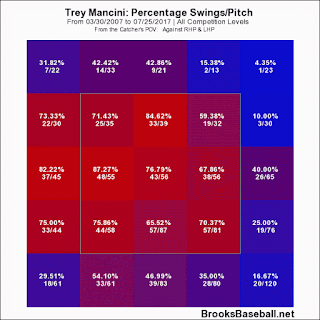 While he has strong ground ball tendencies against pitches in all locations, Mancini is more likely to hit these middle-in pitches for fly balls, and hits line drives most frequently on pitches in the middle and bottom thirds of the zone. That he does a relatively good job of avoiding pitches that he almost definitely hits on the ground is another good sign for a 25-year-old who will likely rely on his bat to be a successful Major League ballplayer. If Mancini can avoid hitting as many balls into the dirt, he could improve his offensive performance even further.
Mancini is the Orioles' second best hitter this season in wRC+, and showing potential for consistent hitting and clear opportunities for improvement. The latter might not sound as positive, but identifying areas of weakness is a necessary first step toward improvement. If Mancini can reduce his GB% to something resembling the league average, or average among other power hitters, the Orioles might have a very scary hitter on their hands.
If the Orioles knew what they had on their hands in Mancini, they might not have been as eager to sign Chris Davis or Trumbo to longer-term and higher-priced contracts. As it stands, the Orioles have a good, young, controlled power hitter on their hands to fill the role of 1B/DH/OF-only-if-you-have-to.
Today, Mancini ranks as the 38th best rookie since 2017 in wRC+, a measure of pure hitting ability. His 127 wRC+ indicates that he's batting 27% better than the league as a whole, similar to the offensive performance put up by Francisco Lindor, Mookie Betts, and George Springer in their rookie seasons.
Earlier articles on this very website pointed to Mancini's very high HR/FB rate as a cause for his offensive performance, and a possible area of regression. When Mancini started the season, his 70% HR/FB rate was unsustainable, and it has fallen back to earth - kind of. His current 21.7% rate is still very high, 27th highest in the league among qualified hitters, but well within the range of an excellent power hitter.
However, Mancini hits ground balls too frequently to turn this HR/FB rate into the kind of attention that fellow rookie Aaron Judge is receiving. 50.7% of balls put into play by Mancini are ground balls, the 22nd highest rate in the league and mostly similar to league-average or below-average hitters.

When hitting line drives and fly balls, the most preferable batted ball types, Mancini's average exit velocity of 96.4 miles per hour ranks 19th in the league this season. Of course, Mancini's average exit velocity is weaker when considering all batted ball types because he hits ground balls so frequently.
Notably, Mancini's power extends to all fields. Observe his spray chart, color-coded by exit velocity:

On balls in play that Mancini gets a solid bat on, he's generally hitting them to all fields. His weakly pulled grounders are not atypical for power hitters (and are the basis for shifting the infield against left-handed ones). That he hits line drives to all fields is notable, and promising for continued batting average success.
Most of the pitches Mancini sees are low and away. Most likely related: Mancini generally hits ground balls on pitches low and away that he puts into play. Fortunately, Mancini appears to exhibit a decent eye, swinging primarily at pitches middle and in:

Mancini is the Orioles' second best hitter this season in wRC+, and showing potential for consistent hitting and clear opportunities for improvement. The latter might not sound as positive, but identifying areas of weakness is a necessary first step toward improvement. If Mancini can reduce his GB% to something resembling the league average, or average among other power hitters, the Orioles might have a very scary hitter on their hands.
If the Orioles knew what they had on their hands in Mancini, they might not have been as eager to sign Chris Davis or Trumbo to longer-term and higher-priced contracts. As it stands, the Orioles have a good, young, controlled power hitter on their hands to fill the role of 1B/DH/OF-only-if-you-have-to.
25 July 2017
Cup of jO's: Zach Britton is Fine...Right Now
Over the past week, there has been a steady current of criticism toward Zach Britton's value. Among the Baltimore faithful, there was hope that a Britton trade would bring back a bevy of talent similar to the Aroldis Chapman or Andrew Miller deals: a top 25 player, maybe a backend top 100 talent, and some prospect depth behind that. However, there has been some dispute over that value. To that end, I concur with the concerns about Britton's health. The issue was never fully figured out and he needed lengthy time on the DL to sort things out.
The knock on his performance though has been interesting. It began with a New York Post column where a scout was quoted about Britton's inability to pound the bottom of the zone. It then led to a pretty sensationalistic article about Britton's performance on Beyond the Box Score and then a follow up one.
To test all of this, I decided to look at Britton's most recent outings where he has maintained a 96+ mph velocity similar to last year and consider metrics that are more useful in the short term. Remember, it is important to use data that can answer your question. Some of the failings in the articles above is that they use global 2017 data, which is not a good thing to do because you are suggesting that the entire 2017 season is representative to what Britton is now. Post DL trip data might also be squirrelly because Britton was rusty. You really want to see the peripherals light up and velocity can do that for you.
2016*: 96.3 mph
2017**: 96.5 mph
* July 5th to October 2nd, 2016
** July 16th to July 23rd, 2017
What we see here is that Britton is sustaining a velocity that is equal to what he did last year. If you are worried about range, his lowest average velocity for his fastball was 96.3 and his highest was 96.7 over these last four outings.
So, how well has he hit the bottom third of the strike zone and just beyond the strike zone.
This completely contradicts what the scout in the New York Post column said about Britton not being able to pound it low in the zone. He is actually doing it numerically better this year than last year.
Here are a few other metrics that were noted in the columns above:
Swinging Strikes
2016*: 15.6%
2017**: 16.7%
Groundball Percentage
2016*: 79.1%
2017**: 84.6%
Hard Hit Balls
2016*: 12.8%
2017**:15.4%
--------
So, yes, any taker should be concerned about the injuries. I would not deal elite talent for Britton if I was given such a responsibility because I worry about that and the dent on payroll. Performance-wise though, he looks to be firing on all cylinders.
The knock on his performance though has been interesting. It began with a New York Post column where a scout was quoted about Britton's inability to pound the bottom of the zone. It then led to a pretty sensationalistic article about Britton's performance on Beyond the Box Score and then a follow up one.
To test all of this, I decided to look at Britton's most recent outings where he has maintained a 96+ mph velocity similar to last year and consider metrics that are more useful in the short term. Remember, it is important to use data that can answer your question. Some of the failings in the articles above is that they use global 2017 data, which is not a good thing to do because you are suggesting that the entire 2017 season is representative to what Britton is now. Post DL trip data might also be squirrelly because Britton was rusty. You really want to see the peripherals light up and velocity can do that for you.
2016*: 96.3 mph
2017**: 96.5 mph
* July 5th to October 2nd, 2016
** July 16th to July 23rd, 2017
What we see here is that Britton is sustaining a velocity that is equal to what he did last year. If you are worried about range, his lowest average velocity for his fastball was 96.3 and his highest was 96.7 over these last four outings.
So, how well has he hit the bottom third of the strike zone and just beyond the strike zone.
| 2016* | 2017** | |
| B 3rd | 24% | 34% |
| Ex B 3rd | 19% | 21% |
| 43% | 55% |
This completely contradicts what the scout in the New York Post column said about Britton not being able to pound it low in the zone. He is actually doing it numerically better this year than last year.
Here are a few other metrics that were noted in the columns above:
Swinging Strikes
2016*: 15.6%
2017**: 16.7%
Groundball Percentage
2016*: 79.1%
2017**: 84.6%
Hard Hit Balls
2016*: 12.8%
2017**:15.4%
--------
So, yes, any taker should be concerned about the injuries. I would not deal elite talent for Britton if I was given such a responsibility because I worry about that and the dent on payroll. Performance-wise though, he looks to be firing on all cylinders.
Games Back: It's Kind of Complicated
Yesterday, I asked the site's followers for their opinion of when the probabilities are high enough to reach out and start buying at the trade deadline. Overwhelmingly, they choose 50% with the caveat that some had others ideas like 40%, but 50% was closest to their perspective. In turn, I wanted to compare those preferences to the Orioles' situation and how we think about playoff likelihood in a more traditional way.At what probability for playoffs should a team be buyers?— Camden Depot (@CamdenDepot) July 23, 2017
Over the past few weeks, feverish attention has been placed on how many Games Back the Orioles are of either the AL East crown or, more often, the second Wild Card slot. This attention often appears to coincide with a demand that the club is not out of the hunt and should not scatter players into the transaction wire wind. However, Games Back as simple as it sounds is actually a rather difficult metric to comprehend. If you think of each club as a particle moving through space, the distance between and the speed of both your particle and the particle you wish to overtake is needed, but also every other particle in the mix. Just focusing on you and the leader gives you an incomplete view.
But what exactly is that incomplete view? In this column, we will ignore probability metrics. Those are probably the best way to figure out whether or not the club you root for is alive. And, well, if you have resisted looking at them for perceived faults in their talent assumptions, then, well, I doubt this column will change your mind. Instead, I will show you a different metric, This one is called summed Games Back.
Summed Games Back is literally what it claims to be. You simply add the number of Games Back the club is to the number of Games Back every club ahead of them is. For instance, here are the standings from July 21, 2017:
| Tm | W | L | GB | GBsum |
|---|---|---|---|---|
| TBR | 51 | 45 | +1.0 | -- |
| NYY | 49 | 45 | -- | -- |
| MIN | 48 | 46 | 1.0 | 1.0 |
| KCR | 47 | 47 | 2.0 | 3.0 |
| SEA | 48 | 49 | 2.5 | 4.5 |
| LAA | 47 | 50 | 3.5 | 8.5 |
| BAL | 46 | 49 | 3.5 | 8.5 |
| TEX | 45 | 50 | 4.5 | 14.5 |
| TOR | 44 | 51 | 5.5 | 21.5 |
| DET | 43 | 51 | 6.0 | 25.5 |
| OAK | 43 | 52 | 6.5 | 30.0 |
| CHW | 38 | 54 | 10.0 | 65.0 |
| Avg | 47 | 47 |
You will notice that the Orioles are shown as 8.5 GBsum vs. 3.5 GB. That 8.5 summed GB number is the sum comes from adding the Orioles (3.5), Mariners (2.5), Royals (2.0), and Twins (1.0) Games Back values. It is certainly a number that can fluctuate wildly. For instance, if the Angels were a half game better, the Orioles would go from 8.5 to 11.5. That inability to account for equal records certainly is a drawback (one that playoff probability metrics account for), but it is also a weak point in traditional Games Back approach.
So, let us compare GB vs. GBsum. For this, I decided to look at all Wild Card races from 2012 until 2016 on July 25th. I only looked at clubs who were five games or fewer Games Back. I compared that placement with where they were at the end of the year. That way we can decide what the probability of a placement is in getting a playoff entry. I will do the same for those clubs, but use summed Games Back (regardless of that value for those teams that are 5 GB). If GBsum is a better metric, then we will find that it will more accurately identify competitive teams.
When we batch numbers for Games Back from the second wild card from 2012-2016, something sticks out:
| GB | % PO | GBsum | % PO | |
| 0 | 50 | 0 | 50 | |
| 1 and 2 | 21 | 1 to 3 | 21 | |
| 3 and 4 | 9 | 4 to 9 | 13 | |
| 5 | 11 | 10 to 14 | 0 |
Where are the Orioles now, as I write this, they are 3.5 Games Back (suggesting ~10% likelihood) while they are 12.5 summed Games Back (suggesting 0% likelihood). The larger take home would be this: 3.5 Games Back is a tough struggle to climb and a lot of data can be hidden in that number as you do not know how well other teams are doing. Summed Games Back gives a better indication of who else is at play. It suggests that the Orioles are in a situation where things are impossible. If the Orioles do come back from 12.5 GBsum, it will be something no club has been able to do in the 2012 to 2016 window.
When it comes to that Twitter poll question, it seems fairly clear that maybe only about 1 in 20 Orioles fans think it is prudent for the club to buy and go for that Wild Card slot. Most appear to think a club should only buy if it is sitting in the second wild card slot at the end of July. A few more consider it practical to buy as long as a club is no more than two games back. Then again, it may well be that most people and their perceived tolerance for probabilities are not in line with actual probabilities as they relate to Games Back.
Update: The Orioles won last night after I scheduled this for publication. They currently are still 3.5 games out, but are now 9 summed Games Back. This would put them squarely in the ~10% bracket.
24 July 2017
Minor League Defensive Shifts
Joe Reisel's Archives
It's been several years that defensive shifts - generally considered to be three infielders on one side of second base, as opposed to the standard two - have become more mainstream in the major leagues. Once reserved for use against the most extreme power hitters, it's now commonly used against any left-handed hitter who is not known as a slap hitter and against many right-handed power hitters. But it's only been the past three seasons or so that the practice has spread to the AAA minor-league level. Indeed, over the past three years Baseball Info Solutions has asked its scorers to record whether the batter has been shifted against.
Although different organizations employ defensive shifts at the AAA level with much more variety than at the major-league level, there is some consensus. Against the Norfolk Tides' Pedro Alvarez, almost every team plays three infielders between first and second, with one player positioned several yards out in the outfield. This should be completely unsurprising, as Alvarez has a long track record. The consensus is that he pulls almost all of the ground balls he hits, and he is not a fast runner. From a competitive standpoint, it makes no sense to station a defensive player where a ball won't be hit. Most of the AAA International League teams I've seen, including the Tides, will shift against Alvarez-like players.
On the other hand, the Charlotte Knights - the Chicago White Sox AAA affiliate - don't shift at all. Even against Pedro Alvarez, their shortstops stayed on the left side of second base. While that makes no sense from a competitive standpoint, it might make sense from a development standpoint. Yoan Moncada, the Knights' second baseman (until he was recently promoted), is a young potential star and the White Sox may not want to complicate his development by incorporating defensive shifts. Or, they may want their shortstops to demonstrate their range more effectively by stationing him further away from where balls are likely to be hit.
But Charlotte's lack of shifting against the Tides isn't interesting. More interesting is the team at the other end of the spectrum, the Durham Bulls. The Bulls are the AAA affiliate of the Tampa Bay Rays, a team historically at the forefront of the new wave of defensive shifting. The Bulls shift against Pedro Alvarez, as most teams do. They shift against David Washington, a similar although less extreme player; many teams employ a shift against him. But Durham also shifted against Johnny Giavotella, a right-handed hitting singles hitter, and Drew Dosch, a left-handed hitter making his AAA debut at age 25.
These shifts were generally successful; in the press box we commented and discussed how effective they were. It then struck me that this successful defensive positioning reveals something about the Tampa organization. Unlike the other organizations with teams in the International League, the Rays knew the offensive tendencies of Giavotella and Dosch. While the Rays may have assembled a dossier on Giavotella from his major-league time in the American League, they cared enough to pass that information down to Durham. And, because the Rays' A, Advanced A, and AA teams are in leagues different from the Orioles', they couldn't have personally seen Dosch play and so relied on their scouts or video for their information.
To me, at least, this illustrates that the Rays, as a organization, focus on gathering and disseminating information.. They care enough to collect data even on marginal prospects like Drew Dosch. Presumably, they care enough to tell the Durham field management to shift against unusual candidates like Dosch and Johnny Giavotella; at least, they encourage Durham to employ such shifts. The Rays organization is willing to explore non-standard methods to win more games.
And this information-gathering is cheap. The data-gathering and video review would be done by interns or entry-level employees. The information can be sent for free via email. It's unlikely to be substantially more expensive to hire minor-league managers and coaches open to new uses of information than those who are more resistant. There may be advantages to having players used to shifting at the minor-league level, rather than learning at the major-league level.
All of this is speculation and opinion; I don't know if any of what I've seen makes a difference or if my conclusions are valid. I do know that I'll be more interested in the Rays over the next few years than I would have been without having seen Durham shift so frequently.
It's been several years that defensive shifts - generally considered to be three infielders on one side of second base, as opposed to the standard two - have become more mainstream in the major leagues. Once reserved for use against the most extreme power hitters, it's now commonly used against any left-handed hitter who is not known as a slap hitter and against many right-handed power hitters. But it's only been the past three seasons or so that the practice has spread to the AAA minor-league level. Indeed, over the past three years Baseball Info Solutions has asked its scorers to record whether the batter has been shifted against.
Although different organizations employ defensive shifts at the AAA level with much more variety than at the major-league level, there is some consensus. Against the Norfolk Tides' Pedro Alvarez, almost every team plays three infielders between first and second, with one player positioned several yards out in the outfield. This should be completely unsurprising, as Alvarez has a long track record. The consensus is that he pulls almost all of the ground balls he hits, and he is not a fast runner. From a competitive standpoint, it makes no sense to station a defensive player where a ball won't be hit. Most of the AAA International League teams I've seen, including the Tides, will shift against Alvarez-like players.
On the other hand, the Charlotte Knights - the Chicago White Sox AAA affiliate - don't shift at all. Even against Pedro Alvarez, their shortstops stayed on the left side of second base. While that makes no sense from a competitive standpoint, it might make sense from a development standpoint. Yoan Moncada, the Knights' second baseman (until he was recently promoted), is a young potential star and the White Sox may not want to complicate his development by incorporating defensive shifts. Or, they may want their shortstops to demonstrate their range more effectively by stationing him further away from where balls are likely to be hit.
But Charlotte's lack of shifting against the Tides isn't interesting. More interesting is the team at the other end of the spectrum, the Durham Bulls. The Bulls are the AAA affiliate of the Tampa Bay Rays, a team historically at the forefront of the new wave of defensive shifting. The Bulls shift against Pedro Alvarez, as most teams do. They shift against David Washington, a similar although less extreme player; many teams employ a shift against him. But Durham also shifted against Johnny Giavotella, a right-handed hitting singles hitter, and Drew Dosch, a left-handed hitter making his AAA debut at age 25.
These shifts were generally successful; in the press box we commented and discussed how effective they were. It then struck me that this successful defensive positioning reveals something about the Tampa organization. Unlike the other organizations with teams in the International League, the Rays knew the offensive tendencies of Giavotella and Dosch. While the Rays may have assembled a dossier on Giavotella from his major-league time in the American League, they cared enough to pass that information down to Durham. And, because the Rays' A, Advanced A, and AA teams are in leagues different from the Orioles', they couldn't have personally seen Dosch play and so relied on their scouts or video for their information.
To me, at least, this illustrates that the Rays, as a organization, focus on gathering and disseminating information.. They care enough to collect data even on marginal prospects like Drew Dosch. Presumably, they care enough to tell the Durham field management to shift against unusual candidates like Dosch and Johnny Giavotella; at least, they encourage Durham to employ such shifts. The Rays organization is willing to explore non-standard methods to win more games.
And this information-gathering is cheap. The data-gathering and video review would be done by interns or entry-level employees. The information can be sent for free via email. It's unlikely to be substantially more expensive to hire minor-league managers and coaches open to new uses of information than those who are more resistant. There may be advantages to having players used to shifting at the minor-league level, rather than learning at the major-league level.
All of this is speculation and opinion; I don't know if any of what I've seen makes a difference or if my conclusions are valid. I do know that I'll be more interested in the Rays over the next few years than I would have been without having seen Durham shift so frequently.
21 July 2017
Caleb Joseph Has Recovered Nicely
At the plate, Caleb Joseph was about as bad as you could be last season. It was a painful year for him, and it's unknown exactly how much of an effect the injury had on his performance. So far this season, there are two noteworthy items for Joseph. First, he's healthy. And second, he's hitting extremely well for a backup catcher.
Joseph already has 21 more plate appearances than last year, so let's take a look at his 2016 vs. 2017:
2016: 141 PA, 6 wRC+, -0.9 fWAR
2017: 162 PA, 108 wRC+, 0.8 fWAR
Out of all catchers with at least 100 plate appearances, Joseph's 108 wRC+ is tied for 12th. Welington Castillo is 24th with a 91 wRC+. And, just for fun, Matt Wieters (71 wRC+) is tied for 40th out of 52.
Yes, as it's worth pointing out again, Joseph had a wRC+ of 6 last year. Six!!! And, notably, he didn't drive in a single run. It was an anomaly, it didn't make sense, and it was kind of funny (not to Joseph, of course).
So what's new for Joseph this year? Let's dig a little deeper. First, it's hard to ignore his BABIP increase of 164 points from last year to this year. Right now, Joseph has a BABIP of .385. You don't need me to tell you that isn't likely to stay so high. Still, if anyone was due some better fortune, it was probably Joseph. It also helps that he's hitting the ball harder (32.5 Hard% in 2017 vs. 21.7% in 2016).
And not only is Joseph hitting the ball harder, but he's pulling it more as well. Just take a look at his spray heatmaps in 2016 vs. 2017, courtesy of Baseball Savant:
That's less of an up-the-middle/opposite-field approach and a lot more pulled baseballs that are hit with increased authority.
Joseph has talked about having more confidence and putting in extra work, and things are going well for him right now. In all likelihood, with a BABIP regression, Joseph is closer to the range of 71-87 wRC+ he posted in 2014 and 2015. That may not be amazing, but when accounting for his pitch-framing skills, that makes a more-than-useful catcher, let alone one that's being used in a backup role. And, obviously, the dreadful 6 wRC+ season seems very much like a fluke.
Joseph is clearly the superior pitch-framer to Castillo, and he's currently performing better with the bat as well. Joseph's rebound has been one of the bright spots of a difficult O's season, and he's a major reason why the O's would be just fine if they're able to find a taker for Castillo and his 2018 player option (which may be no small feat).
Joseph already has 21 more plate appearances than last year, so let's take a look at his 2016 vs. 2017:
2016: 141 PA, 6 wRC+, -0.9 fWAR
2017: 162 PA, 108 wRC+, 0.8 fWAR
Out of all catchers with at least 100 plate appearances, Joseph's 108 wRC+ is tied for 12th. Welington Castillo is 24th with a 91 wRC+. And, just for fun, Matt Wieters (71 wRC+) is tied for 40th out of 52.
Yes, as it's worth pointing out again, Joseph had a wRC+ of 6 last year. Six!!! And, notably, he didn't drive in a single run. It was an anomaly, it didn't make sense, and it was kind of funny (not to Joseph, of course).
So what's new for Joseph this year? Let's dig a little deeper. First, it's hard to ignore his BABIP increase of 164 points from last year to this year. Right now, Joseph has a BABIP of .385. You don't need me to tell you that isn't likely to stay so high. Still, if anyone was due some better fortune, it was probably Joseph. It also helps that he's hitting the ball harder (32.5 Hard% in 2017 vs. 21.7% in 2016).
And not only is Joseph hitting the ball harder, but he's pulling it more as well. Just take a look at his spray heatmaps in 2016 vs. 2017, courtesy of Baseball Savant:
 |
| Spray Heatmap for 2016 |
 |
| Spray Heatmap for 2017 |
That's less of an up-the-middle/opposite-field approach and a lot more pulled baseballs that are hit with increased authority.
Joseph has talked about having more confidence and putting in extra work, and things are going well for him right now. In all likelihood, with a BABIP regression, Joseph is closer to the range of 71-87 wRC+ he posted in 2014 and 2015. That may not be amazing, but when accounting for his pitch-framing skills, that makes a more-than-useful catcher, let alone one that's being used in a backup role. And, obviously, the dreadful 6 wRC+ season seems very much like a fluke.
Joseph is clearly the superior pitch-framer to Castillo, and he's currently performing better with the bat as well. Joseph's rebound has been one of the bright spots of a difficult O's season, and he's a major reason why the O's would be just fine if they're able to find a taker for Castillo and his 2018 player option (which may be no small feat).
Subscribe to:
Posts (Atom)