Showing posts with label MiL Recap. Show all posts

13 November 2011

MiLB Year in Review: Bowie Baysox and Norfolk Tides

Hoes showing offensive maturity; Nary a nugget at Norfolk

It is not a strong class of Orioles prospects at AA and AAA. Currently, the group lacks a projected standout impact player and tops out with some potential fringe regulars. At the same time, there is value in finding utility players, relief arms, fourth outfielders and back-end starters on the cheap when you are looking to build a cost effective Major League team -- and particularly when you have some young impact talent at the Major League level that will soon be hitting arbitration and considered for extension.

Bowie By the Numbers:
Record: 75 - 66
Top Arm: Dan Klein (2010 Draft, 3rd Round)
Top Bat: LJ Hoes (2008 Draft, 3rd Round)

Player of the Year:
LJ Hoes (387 PA, 338 AB, .311/.385/.420, 17 2B, 1 3B, 6 HR, 43 BB, 55 SO)

Camden Depot made (minimal) waves in the blogosphere in 2008 when we listed LJ Hoes as the 9th best Orioles prospect after his first professional season. Since then, he has steadily climbed prospect lists across the board, topping out at #3 for the Depot last year and #4 for the world renowned Baseball America.

In 2011, Hoes made the jump to Bowie after a sluggish start in Frederick. Accompanying his promotion was a position switch from second base to left field. While the Orioles' brass insists this was out of team need, rather than a decision that Hoes could not handle second, there were grumblings from pro scouts that the former St. Johns HS standout was not making the expected progress at the four-spot a month into his third full pro season. Ideally, he would shift back to second base in Bowie to start 2012 and Baltimore could get one last look at his outlook there. Hoes has the athleticism to stick in the infield, but has been tripped-up some by some finer points in the field, including set-up in his lower half, footwork around the bag, and lines.

Offensively, Hoes remains one of the top hit tools in the organization. He is very compact to contact, with a simple and quiet load, balanced lower-half and quick-twitch core. A keen batting eye helps Hoes to maintain a solid OBP while utilizing the whole field in attacking the ball in all quadrants. He has started to manifest in-game pop, and could see a breakout in that department next summer. While there isn't tons of physical projection left, he will hang a little more muscle on the frame, and the stronger hands and wrists at contact will marry with his bat speed to send some more balls to the gaps and over the fence. While some prospect reports were down on his 2011, Hoes still profiles as a potential everyday player -- be it at second base, third base or left field.

Players to know:

Xavier Avery remains an upside prospect with promise, despite completing his third full season with strikeouts in over 20% of his plate appearances. The reason for optimism is simple -- he continues to be promoted by the O's and remains one of the youngest players in the league, year-in and year-out. He will start 2012 at age 22, and could get a bump to Norfolk following a solid AFL campaign and provided he shows well in the spring. A speed-first talent, Avery is among the fastest prospects in the system (along with Kyle Hudson and Glynn Davis -- all "80" runners on the 20/80 scouting scale). His heavy left/right split could spell a future as part of a platoon. If he can tighten-up his routes in center field, he should have easy value as a fourth outfielder. His ability to improve against lefties and to learn to more consistently ID off-speed will determine if he can become a regular at the highest level.

2011 Baltimore MiL Pitcher of the Year (Jim Palmer Award) winner Tim Bascom likely tops as a relief arm or swingman, despite the hardware earned off the solid 2011 stat line. Bascom projects to fringe-average across the board, with solid command and some idea as to how to sequence. His fastball is below-average and his breaking ball is generally short, soft or somewhere in between. His stuff leaves very little room for error, and he could be in for big statistical regression when he reaches Norfolk and has to go to work against a large number of hitters with Major League experience. His profile says "shrug", but you should still know a little about the Minor League Player of the Year for 2011.

Caleb Joseph followed a disappointing offensive 2010 with a similarly "meh" 2011. His command of the strikezone remains solid, but his bat control is lacking and the consistent hard contact simply is not there at Double-A. Around draft time he was projected to grow into average or slightly above-average power, but that growth has not come. He falls into a one-piece swing and too often makes contact out in front, sapping his power and leading to a fair amount of soft contact. Behind the plate, Joseph continues to improve. He blocks well, has quieted his receiving and has improved his catch-and-throw to the tune of an increase in his caught stealing from 26% in 2010 to 38% in 2011. Jospeh profiles as a back-up catcher with a bottom-third bat. Not an uncommon offensive profile for a back-up, but a bit shy of the potential shown in his first couple of seasons.

Dan Klein was a shutdown closer at UCLA with a history of shoulder issues. Baltimore saw the advanced four-pitch mix and sturdy 6-foot-3, 190-pound build and decided to develop him as a starter. The result was 32.1 dominant innings of baseball between Advanced-A Frederick and Double-A Bowie, including 10.3 SO/9 and just 1.7 BB/9, and a season-ending shoulder surgery. That means it has been four years now since Klein has surpassed 52 innings of in-game work -- the last time being his performance between his high school team and summer ball. It may be time to shift Klein to the pen full-time, where he could top out as a solid set-up man or second-division closer. When healthy, his low-90s fastball is a solid average pitch that serves to set-up and above-average 12/6 curve and mid-80s change. He has shown growth in his off-speed since his junior year as a Bruin, where he periodically left the pitch flat and up, where it was drivable. Klein will also flash a fringe-average slider with minimal depth and bite, but enough differential from his fastball to force soft contact if set-up properly.

Joe Mahoney is a bat-first corner defender likely to end-up at first base or designated hitter, full time. He has some length to his swing, a not-insignificant leak entering his weight transfer and a moderate to heavy backside collapse, depending on the at bat. Prognosis? It's unlikely contact will be Mahoney's strong suit, and he could be quickly exposed at the Major League level, if not Triple-A. He projects as a bench bat or Four-A player.

In this, Greg Miclat's first full season at Double-A Bowie, the former Cavalier showed why he was signed by East Coast Area Scout Dean Albany for an overslot $225,000, in spite of significant shoulder and elbow issues through his sophomore and junior years at UVA. Miclat baffled opposing pitchers and catchers to the tune of a 54-of-57 stolen base record and top-of-the-order-worthy .371 OBP. While Miclat easily has the glove, arm and footwork to be an everyday second baseman, he likely tops out as a second-division regular or a first-division utility bat, due to the absence of any power. He'll be challenged early and often by ML arms, which will bite into his walks and likely limit him to a bottom-third bat profile.

Ronnie Welty has long been a Camden Depot favorite, after being inked in the 20th Round of the 2008 Draft by Area Scout John Gillette. Welty's promise has always been in his power potential, and over the last two seasons he has shown that pop -- launching 31 homeruns between Frederick and Bowie. Unfortunately, Welty's big leverage comes with an aggressive approach. That has equated to a strikeout about every three at bats, in 25-30% of his plate appearances. He is still drawing walks (with a BA/OBP delta of almost .100), but more advanced arms will be better equipped to play to Welty's weaknesses without having to pitch around the power. He should play an adequate right field at the highest level, and possesses more than enough arm to keep baserunners honest. He will attempt to hit the reset button on his offensive production in 2012, likely back at Bowie.

Rick Zagone may have reached his breaking point as a starter, struggling to miss bats while seeing his BB/9, H/9 and HR/9 rates increase with his promotion to Bowie. The side-arming lefty still has some potential as a lefty specialist, with righties making more hard contact against him than did lefties. Zagone also suffered through a tough July, showing signs of tiring out -- not surprising considering the increase in physical and mental demand inherent in a pitcher of his profile attacking Double-A line-ups twice through every five days. He should shift to the pen in 2012 and could begin his season either in Bowie or Norfolk.


Norfolk By the Numbers:
Record: 56 - 87
Top Arm: Troy Patton (2004 Draft, 9th Round (Houston))
Top Bat: Ryan Adams (2006 Draft, 2nd Round)

Player of the Year:
Ryan Adams (415 PA, 377 AB, .284/.341/.454, 28 2B, 3 3B, 10 HR, 30 BB, 103 SO)

In 2008 Camden Depot rated Ryan Adams as the 25th best prospect in the system with a Four-A floor, a ceiling as an above-average offensive second baseman and a projected outcome as a below-average everyday second baseman. Three years later that evaluation remains spot on, as the former New Orleans High Schooler has slowly worked his way through the system, making his Major League debut this summer. While his 2011 at Norfolk was more "solid" than "eye popping", he essentially maintained his production from Bowie while cleaning-up his infield defense.

Offensively, Adams will swing and miss a fair amount due to average bat speed, and top velocity will likely always give him trouble. But he keeps his swing simple and tight, and finds ways to get the barrel to the ball. His raw power is above-average, with potential average in-game applicability. He could carveout a spot as a 6 or 7 hitter in a first division line-up if he finds enough gaps and is able to produce 15 or so homeruns per year.

Defensively, Adams still struggles with his footwork, though he has made strides in cleaning-up the set-up on his throws (which in turn has improved his play-to-play accuracy). He is the type of player that will always need to work to maintain an adequate defensive disposition, but could be making enough progress to be passable at either third base or second base. Adams could be adequate as an inexpensive bridge to Miclat, Hoes or Schoop, but probably profiles best as a bench bat and occasional starter at either second or third.

Players to know:

Matt Angle has arrived at Baltimore with largely the profile expected of him since he entered the system in 2007. Largely devoid of power, the former Buckeye center fielder fits best as a 4th outfielder capable of plus defense and solid value as a pinch runner. Like Adams, he could slot in as a placeholder in a starting lineup, but it is unlikely he will be able to handle Major League velocity on the inner-half to the point that he maintains even a passable on-base percentage. He should have the inside track on the 4th outfield spot, depending on what transpires this off-season, and could see significant innings as a late-inning defensive replacement, pinch runner and Sunday starter.

Kyle Hudson, like Angle, made his Major League debut this summer -- starting eight September games and appearing in six more as a defensive replacement, pinch runner or pinch hitter. The hope is that Hudson will eventually provide 4th outfield value along the lines of Matt Angle (though he is unlikely to have the defensive profile of Angle, who's feel for the game drives his plus glove). Hudson is a burner with 20 power on the 20/80 scale and will likely struggle to barrel much of any Major League pitching as a result of his uneven pitch-ID. Hudson should begin 2012 back in Norfolk as the starting center fielder, and is worth keeping an eye on to see if he can grow into even gap power.

After shifting to the pen and keeping Triple-A hitters off-balance for around 40 IP, Troy Patton made the most of his first extended look with the Big Club. While he will never be a strikeout specialist, he does have an ability to miss some bats thanks to a solid four-pitch arsenal. His fastball is generally an upper-80s offering, and is best at 87-89 with some armside life, though he'll push 90-92 with his four-seam. His most effective secondary is an upper-70s to low-80s slider that has good armslot deception and does a solid job missing barrels. His change-up gives him a weapon against lefties, thanks to solid fade, and he'll drop a curve as well to keep hitters honest. While he isn't the sexiest of prospects, Patton could be a valuable 7th or 8th inning arm, and should be a cheap bullpen option for the O's for the next couple of seasons.
18 October 2011

MiLB Year in Review: Frederick Keys

Interesting mix fuels Frederick playoff run

The Frederick Keys ended the season with a tie for the best record in the League (losing the tie-breaker to Potomac for regular season title), a playoff series win in the Northern Division Championship against Potomac, and a Mills Cup title over Kinston. The players constituting the 2011 Keys were a blend of young and old, including two of the youngest and most talented players in the high Class A Carolina League -- Manny Machado and Jonathan Schoop.

There are a number of solid performers and potential Major League contributors, but as is the case throughout the Baltimore system, the impact talent is limited. At the plate, Machado and Schoop are the only two potential above-average Major Leaguers, though Trent Mummey, Tyler Townsend and Kyle Hudson have a chance to carveout roles off the bench at the highest level. LJ Hoes still has everyday potential, but spent more significant time in Class Double-A Bowie, and will accordingly be discussed in more detail in our review of the Baysox.

On the hill, Bobby Bundy took a nice step forward, rewarding Camden Depot's steadfast support of him as one of the top arms in the system. Clayton Schrader completed the second half of his dominating first pro year with a strong showing at Frederick, and both Oliver Drake and Sean Gleason showed potential as future bullpen arms.

Frederick By the Numbers:
Record: 39 - 31 (Northern Division Champions; Mills Cup Champion)
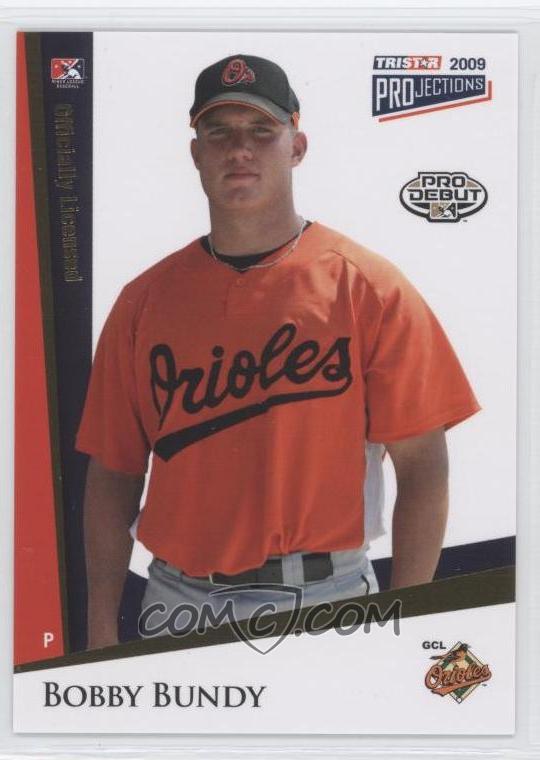
Top Arm: Bobby Bundy (2008 Draft, 8th Round)
Top Bat: Jonathan Schoop (2008, international FA)

Player of the Year:
Bobby Bundy (121 IP, 102 H, 43 R, 37 ER, 31 BB, 100 SO)

Camden Depot readers will recognize Bundy as a staple in the top half of our Prospect Rankigns for the past three seasons. After a breakout summer, Bundy will see his name climbing the rankings of blogs and national outlets, as well, and deservingly so. A workout nut, Bundy is a strong and durable body, listed at 6-foot-2, 215-pounds. He logged a total of 136 IP this year between Frederick and Bowie, and projects as a #3 or #4 starter capable of eating innings at the Major League level.

Mechanically, Bundy has seen some lengthening in his arm action over the past three seasons, but has utilized his athleticism and solid body control to repeat his mechanics and release without too much inconsistency. The result is solid control/command and, more importantly, increasing consistency in the execution of his offerings. He throws out of a true three-quarters slot and creates solid downhill plane on his fastball and a decent angle on his curve. His sturdy base provides good drive and a muscular core serves as a capable the generator while maintaining an easy arm action.

His fastball is a low-90s heater that can come with some bore. He spots it well to both sides and can elevate it when needed, touching 94/95 mph up in the zone. His best breaking ball is an upper-70s curve with downer action, though he still rolls it from time-to-time, causing it to lose bite and rendering it hittable. He throws a firm change-up that will improve as he continues to gain feel. He has flashed a slider, but remains generally a three pitch arm with mid-rotation upside and high marks for durability.

Players to know:

Oliver Drake has a compact, under-control delivery and maintains a good line to home. His 89-92 mph fastball has some life and can induce soft contact down in the zone. His slider is a solid average to above-average offering, and he has also flashed average throughout his pro career with both a change-up and a curve. Drake has the body and endurance to chew through innings, but his stuff may be better suited for the pen, where his fastball/slider combo could be solid in middle-inning work. Baltimore will give him a second run at Bowie next year. If he stumbles, he could shift to the pen prior to promotion to Norfolk.

Since transitioning to the pen in 2010, Sean Gleason has emerged as a potential future contributor with the big club, and a candidate for late-inning work if he can spot better in the zone. He is primarily a fastball/slider reliever, sitting 91-94 mph and touching 96 mph when he reaches back for it. One scout shared that, in his first appearance in this year's Arizona Fall League, Gleason topped out at 97 mph up in the zone. His slider is an average offering that can flash plus, but he can tip the pitch at times with arm slot, and needs to find a balance between throwing it as a case pitch and catching too much of the plate. He'll also mix in a change-up and a curve as a change of pace, though both are generally below average. He'll turn 27 next year, and Baltimore will need to decide whether to protect him on the 40-man or expose him to the Rule 5 Draft in December (where an opportunistic organization could roll the dice on Gleason's arm strength).

Nicholas Haughian started 21 games for the Keys, but projects at best as a situational lefty at the Major League level. He commands his upper-80s fastball fairly well, and could sit 88-92 mph when permitted to go all out iun a relief role. His slider is a solid breaker and he'll also mix in a fringy change-up, though he slows his arm too often when dealing the mid-70s offspeed. Baltimore may continue to run him out as part of a rotation until he stumbles, but his stuff, as well as his limited ability to miss bats, indicate a shift to the pen may be unavoidable.

LJ Hoes struggled offensively in a 41-game stay in Frederick before righting the ship in Bowie. Owner of a compact frame with increasing strength, Hoes should see some power starting to develop in his game over the next twelve months. This will be an important development to monitor, as without that added dimension to his game, Hoes could be cast as a 'tweener, with a solid stick for second base but not the glove, and a solid defensive profile in left with not quite enough offensive pop.

Speedster Kyle Hudson toured through four levels in 2011 (Frederick, Bowie, Norfolk and Balitmore), and will be discussed in more detail in our review of the Triple-A Norfolk. Hudon's game is dependent on speed, and he'll have to show a consistent ability to find ways to first base against Major League pitching in order to provide any value at the Major League level. The complete absence of any power in his offensive game will open him up to aggressive arms at the highest level, and will drastically cut into his ability to maintain a lofty on-base percentage as his ability to draw a walk is taken away from him.

Manny Machado was once again the highest-ceilinged player on his squad, though the on-field results were mixed during his second half stay in Frederick. Machado continued to show a solid understanding of the strikezone, but struggled some with pitch identification, leading to too much soft contact on "pitchers" pitches. At his best, he still showed an ability to punish fastballs and mistakes, and there is little doubt he will make the necessary adjustments to continue to grow, offensively. Whether he starts 2012 back in high Class A Frederick or at Class Double-A Bowie will likely be determined in the spring.

Nathan Moreau has a phone booth delivery with a "just below" three-quarters arm slot. He struggles to finish and will occasionally cut himself off, each of which can have a negative impact on his ability to throw strikes. His fastball is generally 88-91 mph and he pairs it with a sweeping breaking ball that shows depth but inconsistent bite. His change-up is a workable third pitch but projects merely as potentially average. Seen as an upside selection when selected out of the University of Georgia in 2008, Moreau has stagnated, failing to improve upon his command or his stuff over the past two seasons. He still has a chance to provide value as a lefty specialist if he can find more consistency in his breaking ball and command.

As noted in our low Class A Delmarva review, Trent Mummey has limited ceiling, but plays a good center field, runs well, and has a short swing capable of spraying the gaps. He's undersized, but strong, and likely fits best as a future 4th outfielder. He gets tied up on the inner half when faced with good velocity, and his ability to adjust to more advanced secondary stuff at Class Double-A Bowie will say a lot about his future potential.

Jonathan Schoop saw a dip in his in-game power once he was promoted to Frederick, but continued to show a solid approach and ability to barrel balls. Like many young players, Schoop needs to tighten-up his pitch-ID, and should see a nice jump in power production once he is more comfortable working for and identifying pitches he can drive. Already thickening in his core, Schoop's future power tool is his best asset. He could end-up at third base, second base or an outfield corner, depending on Baltimore's needs, and has the athleticism and arm to fit into any of those roles.

Clayton Schrader followed up 22 dominant innings at low Class A Delmarva (where he was Camden Depot's selection for top arm) with 24 dominant innings at high Class A Frederick, boasting 13.1 SO/9 and 3.0 H/9 as a Keys reliever. Unfortunately, he also walked 19 batters in those 24 innings, though those baserunners were largely negated by his ability to miss bats. Schrader's performance at Bowie will help to ground his projection, which could be as high as a true shut-down late-inning arm and as low as a Four-A arm. Camden Depot entered 2011 bullish on Schrader and remains so, projecting him as a solid late-inning contributor with a future plus fastball and plus slider. He could be ready for Baltimore by next summer.

Tyler Townsend produced a triple-slash line of .317/.358/.583, but once again failed to stay healthy, logging just 72 games this summer (67 of them with Frederick). When healthy, Townsend shows some raw power and a solid enough glove at first base. He has a deep hand load and a fair amount of length to his swing, which causes him to start his swing early and hampers his ability to properly identify more advanced breakign stuff. His hand-eye coordination is such that he has been able to square pitches, even when fooled, at the lower levels. But he will need to overhaul his aggressive approach, including tightening his swing mechanics, in order to succeed against the advanced arms he'll see in Bowie, Norfolk and Baltimore. Townsend doesn't yet project as a future Major League regular, but could greatly improve his stock by staying healthy through 2012 with a solid showing at Bowie.

14 October 2011

MiLB Year in Review: Delmarva Shorebirds

Machado, Schoop shine for Shorebirds

The 55-85 record of the Delmarva Shorebirds (Class A, South Atlantic League) speaks for itself. While the 'birds boasted a handful of our favorite prospects for portions of the summer, the overall collection of talent was thin, with limited upside. With that said, Delmarva housed the top two prospects in the system for a combined 408 plate appearances and 89 games -- Manny Machado and Jonathan Schoop.

Clayton Schrader and David Baker topped a short list of arms with successful campaigns in 2011.

Delmarva By the Numbers:
Record: 55 - 85
Top Arm: Clayton Schrader, rhp (2010 Draft, 10th Round)
Top Bat: Jonathan Schoop, inf (2008, international FA)

Player of the Year:
Manny Machado, ss (170 PA, 145 AB, .276/.376/.483, 8 2B, 2 3B, 6 HR, 23 BB, 25 SO)

The third overall selection in the 2010 Draft, Manny Machado put together strong first year of pro ball, split between Delmarva and Frederick. The stat line does not do justice to Machado's successes as the youngest player in each of the Sally and the Carolina League. While not as flashy as the triple-slash of equally unbaked Bryce Harper (.318/.423/.554), Machado's season included about a month's worth of missed time due to a patella subluxation of his left knee.

Machado is a four-tool player, with speed fringe-average and likely to decrease further as his thin lower-half fills out his broad frame over the next few years. He generates good bat speed through his core, and possesses the hands to consistently center the ball on the barrel. Already showing solid power, it could be a true "plus" weapon once he adds some strength and does a better job identifying pitches to drive.

His hands and arm are more than adequate for a shortstop, and his footwork is clean and effortless. The big question that remains is whether the inevitable loss of lateral quickness will hit Machado earlier or later in his pro career. If the former, he could switch to third where his bat will play closer to average, but still above. If the latter, he could enjoy some productive years as an offensive-minded ML shortstop with above-average defense to boot before shifting to the hot corner.

Players to know:

David Baker is currently a fastball-first arm, but it's a good fastball, straddling the line between average and plus. He tends to roll his curve, and his arm slot may ultimately be better suited for a slider. Long and lean, Baker still struggles to repeat his motion and will lose his release and command periodically. He tackled full season ball at age 20, showing good maturity on the mound over seven starts in which he averaged 8.0 SO/9, 3.1 BB/9 and 6.6 H/9. He could start 2012 back in Delmarva or as part of the Frederick rotation, depending on his instructs and spring.

Matt Bywater throws out of a true side-armed slot, sitting upper-80s with a three-way fastball and flashing a solid average breaking ball and change-up. He profiles as a lefty/groundball specialist but will need to find a lot more consistency in his arm action and release, as his command/control has taken a step back since his time at Pepperdine, now grading out as below-average.

Jake Cowan (discussed in more detail in our short-season/rookie review) has a solid four pitch mix, with his secondaries often utilized as his primary weapons. He tired as the season wound down, stumbling to the finish line in Delmarva after a solid showing in Aberdeen and a couple good starts for the 'birds. He'll likely start 2012 back in the Sally but needs to get start 1) logging innings, and 2) moving up the ladder in order to find a spot in Baltimore's future.

After blowing out his elbow as a prep, Randy Henry has been brought along slowly (throwing just 11 innings at his community college and just 23 and 52 innings, all in relief, in his first two years of pro ball). Henry profiles as a middle or late inning reliever with a plus fastball and average to above-average breaking ball. He has the frame and mechanics to start, but considering he'll be 22 next year, has an elbow surgery under his belt and has never thrown more than 55 innings in a year, a conversion to the rotation may be a long shot. If Baltimore goes that route, they could start him in the pen in Frederick and shift him to the Aberdeen rotation once short season starts up (totaling around 80 IP for the summer). He has no issue throwing strikes, but too often lives in the middle of the plate where more advanced hitters will benefit from his limited repertoire.

Trent Mummey missed time after crashing into an outfield wall in May, then again due to hamstring issues later in the summer. While he only logged 29 games and 134 plate appearances this summer (14 and 69 in Delmarva, respectively), he needs to be on the radar of Orioles fans. Mummey has limited ceiling, but plays a good center field, runs well, and has a short swing capable of spraying the gaps. He's undersized, but strong, and likely fits best as a future 4th outfielder. He gets tied up on the inner half when faced with good velocity, and his ability to adjust to more advanced secondary stuff at Class AA Bowie will say a lot about his future potential.

Johnny Ruettiger was a 9th Round selection in this year's Draft, and put together a lackluster debut in full season ball after slapping around some teens in a three game stay in the Gulf Coast League. Ruettiger is a plus runner with good instincts in the outfield, but little experience in center field. He has a history of success with wood, including a Cape Cod batting title in 2010, but can get overly aggressive at the plate and needs to shift to a top-of-the-order approach in order to carve out a role as a professional. Ideally, he'd develop his on-base skills to the point he is serviceable at the top of an Major League lineup. More likely, he profiles as a 4th outfielder capable of holding down all three outfield positions as needed while providing a bottom-third offensive skillset.

While Machado was the top overall talent at Delmarava, Jonathan Schoop was the most impressive bat (though, as noted above, Machado had a significant knee injury slowing his game some from June on). Schoop's trunk is thickening, and with it he is generating more and more bat speed and manifesting more and more in-game power. Schoop's strength is his ability to stay compact from load to contact, which allows him to deliver an accelerating barrel to ball. He will continue to improve consistency in his balance and weight transfer, which will aid him in squaring off-speed offerings from more advanced arms. Schoop has the athleticism to shift across the diamond to second base, and the arm and hands to hold down third.

Clayton Schrader will be a polarizing arm come "prospect season" in the blogosphere. He has perhaps the most electric stuff in the system, averaging 14.3 SO/9 between Delmarva and Frederick, but also averaging 6.3 BB/9. His bread and butter is a mid-90s fastball that he brings with good downhill plane out of a high three-quarters slot. He can break-off both a hard, tight mid-80s slider and a downer 78-82 mph curve. A hard head whack and max effort delivery portend a BB/9 above 3 or 4 as a Major Leaguer, but he has the raw arsenal to succeed as a late inning arm in spite of it due to his ability to miss bats and match arm slot and pitch plane with his offerings. He easily overmatched hitters this year, and will face his first true challenge at Bowie next spring. He could debut in Baltimore late next summer if he tightens his game some over the next ten months.

Kipp Schutz has some offensive upside, but his overall status as a prospect is hampered by average bat speed and a defensive profile that limits him to left field. He has some lift in his swing, and some raw pop that will develop into solid power down the line. But there's too much action in his hands as he loads and a lengthy swing, neither of which issues are overcome by his average bat speed. He struggled upon arriving at Frederick, which was not unforeseeable.

Like Schrader, Ashur Tolliver is an undersized reliever with a live arm. Tolliver sits low-90s with his fastball and can generally throw it to both sides of the plate, though at times he struggle on the inner-half to lefties. His change and slider can be average pitches down the line, but both are too inconsistent to be weapons right now against more advanced bats. He is slated to start 2012 in Frederick, and could move to Bowie for the second half if he shows better command and a better understanding of how to set-up his pitches to more effectively implement his repertoire.

11 October 2011

MiLB Year in Review: DSL, GCL, and Aberdeen Ironbirds

Bridwell and handful of arms highlight rookie/short-season leagues
by Nick Faleris


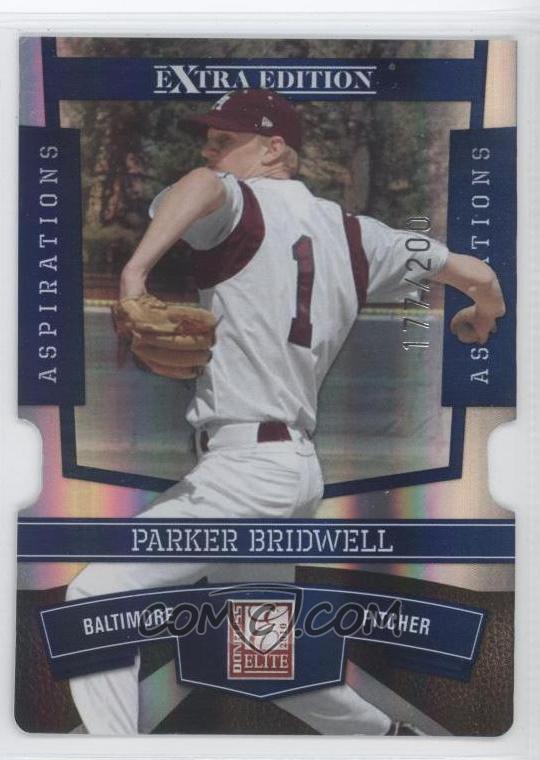
We begin our review of the 2011 Baltimore Orioles Minor League teams with a brief look at the three rookie/short-season squads. While talent in the system is generally thin, a handful of arms stand out in this grouping as possessing the potential to emerge as legit prospects, and eventually Major League contributors. These arms include Eduardo Rodriguez, Jaime Esquivel, Jose Nivar, Sebastian Vader, Parker Bridwell, Jake Cowan, Trent Howard, Mike Wright, and Tyler Wilson.

The bats are less interesting, though a couple standout as potential "guys" with continued growth, including Hector Veloz, Glynn Davis, Gabriel Lino, and Roderick Bernadina.

Dominican Summer League Orioles (Rookie)

DSL By the Numbers:
Record: 46-24 (division winner)
Top Arm: Jose Figuereo, rhp (2010, international FA)
Top Bat: Hector Veloz, 3b (2010, international FA)

Player of the Year:
Hector Veloz, 3b (275 PA, 227 AB, .225/.344/.322, 16 2B, 2 HR, 33 BB, 62 SO)

Hector Veloz saw his stock plummet in months leading-up to the 2010 international free agent signing date, after testing positive for Stanozolol (an anabolic steroid). Baltimore scooped-up the third baseman for $300,000 -- the highest bonus handed out by the organization to an international free agent -- and placed him in the Dominican Summer League for the 2011 season. At 17-years old, Veloz held his own, showing solid hands at the plate and a left side arm in the field, though his BP showings far outdistanced his in-game production.

Hitting out of an open stance, Veloz shows solid pull power and strength in his wrists, allowing him to transfer the energy from his strong core to the barrel at contact. He shows some leak in his weight transfer, can neglect to close his front side in his load, and generally falls into a bit of a one-piece swing (which explains some of his contact troubles this summer). He also has a tendency to make contact too far out in front of the plate, and would benefit from letting the call travel more, particularly on the outer-half. He's so young that none of this is particularly troubling from a developmental standpoint, though the swing quirks, when coupled with the already thick frame and history of steroid use, are cause for measured expectations. Veloz could develop into a usable bat, but there is a lot of work to come between that day and today.

Defensively, Veloz has a strong arm and hands suitable for third base. He struggles at times to get his feet set under him, and side-to-side he is not the smoothest, or quickest. Again, he is so young that there is no reason to torpedo the idea of him sticking at third base, long term. But it is at the same time quite possible he ends up in an outfield corner.

Players to follow:

There is limited "name" talent on the DSL squad, and a number of the more impressive lines came from young arms that are either old for the league or undersized. Jose Figuereo is the exception, though he through exclusively in relief, showing results and a solid, sturdy frame. Figuereo boasted a 3.11 SO/BB ratio over his 32.2 IP, striking out nearly a batter per inning and limited hitters to a .202 BAA. He should make his US-debut next year in the Gulf Coast League as a 20-year old, with a chance to move up to Aberdeen assuming he stays in a relief role.

Gulf Coast League Orioles (Rookie)

GCL By the Numbers:
Record: 38 - 22 (division winner)
Top Arm: Eduardo Rodriguez, lhp (2010, international FA)
Top Bat: Roderick Bernadina, of (2009, international FA)

Player of the Year:
Eduardo Rodriguez, lhp (44.2 IP, 28 H, 17 R, 9 ER, 17 BB, 46 SO)

Eduardo Rodriguez does not have putaway stuff, but there is a chance for three workable pitches and he had them all on display through his ten starts and one relief appearance in the 2011 GCL Orioles season. The 18-year old has a broad frame and thickening physique, which bodes well for his future physicality. His motion is generally loose and easy, coming with a clean three-quarters release and staying under control throughout.

He frequently fails to get on top of his breaking ball -- a pitch that will flash some bite but for now looks like a future average offering due to rotation and plane. His fastball is an upper-80s offering that bumps 91/92 mph, and he can spot it to both sides of the plate. His change-up has the potential to outdistance his breaker as his go-to secondary offering, and he shows feel for it at an early stage.

Roriguez likely tops out as a mid-rotation arm, more likely to fall somewhere in the back-end of a rotation. None of his offerings project to plus right now, but his fastball and offspeed good grade out as above-average as he continues to refine.

Players to follow:

Roderick Bernadina was the highest upside bat with the GCL O's, showing leverage in his swing and good natural lift. His strength is in his ability to accelerate the bat head through the hit zone, though his hands can lag some getting started. The longer swing causes him to commit early, making pitch-ID problematic for him thus far. Raw defensively, his arm is solid but may be fringy for right field at the highest level.

Miguel Chalas is an undersized righty with a whippy arm and a lively low-90s fastball that will bump 94/95 mph. His long arm action gives him trouble repeating his path to release, and results in bouts of wildness and overall inability to spot his pitches with any consistency. His power curve has slurvy plane and hard bite, but he struggles to throw the pitch for a strike and more advanced bats will have less trouble identifying and ignoring it. Chalas is destined for the pen, where he'll need to refine his control enough to throw strikes with both his fastball and breaking ball. It would be interesting to see him toy with a true side armed delivery to add another look to his fastball.

Cam Coffey looks like a future big leaguer, but his arm strength simply hasn't bounced back since his Tommy John surgery in 2009. Now an mid- to upper-80s arm, the chances of Coffey reverting to his brief low- to mid-90s velocity of early spring 2009 seem unlikely. But with continued growth and strengthening of his core, he could sit 88-91 mph when all is said and done. His change-up shows good fade and will flash disappearing action when he turns it over well. His breaking ball rolls and is a fringy offering at this point.

Jaime Esquivel has a pro body and a solid fastball-curveball combo to go with it. His heater generally sits 89-92 mph fastball, while his 80-81 mph curve shows solid shape and flashes plus. He hits the same slot with both pitches, making the breaking ball difficult to spot. Esquivel often fails to get out over his plant leg, driving his fastball up in the zone and making him more hittable than he should be. With a strong instructional league and spring, he could break camp in Delmarva. The more conservative approach would be to give him an extended look in Aberdeen, where the more patient college-heavy lineups would provide a new challenge.

The 20-year old Juan Guzman was all arms and legs out of GCL Orioles pen, flashing an 89-92 mph fastball and an upper-80s breaking ball. Guzman is all over the place, mechanically, showing a long arm action in the back with late (and sometimes violent) pronation and inconsistent arm path and release. His breaking ball comes with some bite when he hits his release, but he telegraphs the pitch and does not spot it particularly well. He lacks balance through his core rotation and follow-through, and struggles to keep his momentum towards home. Currently an org player, Guzman has middle-relief upside if he can iron out his mechanics and show more growth in his below-average breaking ball. A slider may fit his general arm action better than does his current curve.

Backstop Gabriel Lino has some offensive upside and a strong arm behind the dish, but may lack the lateral quickness needed to stick at catcher. He also lets his glove float a little too often when receiving, which he'll need to tighten. The power is still raw, and does not project particularly well to a corner infield spot. Just 18-years old this year, he has time to work on his problem areas. Should his power tool emerge, he could shift to first base in order to allow more developmental focus on his bat.

Converted outfielder Jose Nivar turned heads from the mound this summer, topping out in the upper-90s with some giddy-up. He is still learning his mechanics, as well as the basics in approach to the art of pitching, but will continue to get long looks so long as he is showing plus-plus raw velo. His breaking ball is gimmicky at this point, and he may ultimately benefit from playing around with a two-seam and cut fastball to show different looks. Nivar should benefit from fall instruction and will look to carve out time between Aberdeen and Delmarva next summer.

Jorge Rivera is an arm strength lefty that can push mid-90s with his fastball, but lacks command over the pitch. His slider is a tight little breaker, but like his fastball he is too imprecise with the offering for it to be effective against more advanced bats. He pitched primarily in relief this summer, and that is the best fit for him long term. He gives batters a good look at the ball twice on the back side, though hitters generally still had a tough time picking it up out of his hand. Rivera turns 22 later this month and will need to get moving up the ladder.

Lanky righty Sebastian Vader has value tied to his projection, with current stuff inconsistent. His fastball is an upper-80s offering with a hint of run. His breaking ball is a upper-70s slider that bumps 81 mph and can flash some tilt, though it's generally inconsistent and will often saucer in the zone. Mechanically, Vader is an arm strength guy that doesn't incorporate his lower half. He also comes with a wrist hook and dice roll that can both cause some strain on his elbow and affect the consistency of the balls bath through his release. At 6-foot-4, 175-pounds, he'll add some meat.

Aberdenn Ironbirds(NY-Penn League, Short-season A)

Aberdeen By the Numbers:
Record: 24 - 51
Top Arm: Parker Bridwell, rhp (2010, 9th Round)
Top Bat: Glynn Davis, of (2010, undrafted FA)

Player of the Year:
Parker Bridwell, rhp (53.2 IP, 56 H, 32 R, 27 ER, 22 BB, 57 SO)

Parker Bridwell garnered a good deal of attention from Orioles prospect followers after signing for $625,000 in 2010 and earning good reviews from fall workouts a month later. His 2011 was a mixed bag, as the young righty struggled to execute his pitches at low A Delmarva and was accordingly knocked around. After being demoted to short-season A Aberdeen, Bridwell showed a higher level of comfort on the mound, and more consistency in his arsenal. He returned to Delmarva to close out August and again struggled vacillating between catching too much of the plate and falling out of his control zone.

Bridwell's best offering is a heavy sinker generally in the 90-92 mph range, climbing to the mid-90s at various points this summer. When he drives the pitch down in the zone, he induces lots of soft contact -- a trend that should continue through the lower levels. Eventually he'll need to improve his command of the offering, as more discerning bats learn to lay off the pitch as it bores. His breaking ball is a slider that actually acts more like a deep cutter with late horizontal movement. Still a work in progress, Bridwell's change-up is now an adequate third offering with a chance to be average, and perhaps a tick above, as he continues to tinker.

Bridwell could be a solid mid-rotation starter down the line. He'll likely return to Delmarva in 2011 where he'll team up with 2011 1st Rounder Dylan Bundy, forming an interesting 1-2 at the top of the Shorebirds' rotation.

Players to know:

Jake Cowan utilizes a four pitch mix, often working backwards to help his average fastball play up. Cowan's best secondary is a snappy slider that has good arm slot deception. He'll also bring a 12-to-6 curve with average depth and bite. His offspeed looks like a variation of a circle or three-finger change, which he rolls over on occasion to elicit fade. Once thought of as projectable, Cowan hasn't bulked-up as expected, though there is still time for him to add some strength. He could develop into a back-end arm or swingman with four usable offerings.

2011 draftee and former Illinois Figthing Illini Adam Davis is a standout defensive backstop with limited offensive upside. Davis shows quick feet and a solid, accurate arm. He excels as a field general, was known around the Big 10 as a strong positive influence on his pitching staff, and shows comfort throwing the ball behind runners at all bases. At the plate, Davis has an unrefined slap approach, lacking real leverage and expanding the zone too often. Baltimore will work to make him adequate offensively, in an effort to mold him into a back-up catcher capable of providing plus defense behind the plate.

We were out in front on first year outfielder Glynn Davis, tabbing him as the 16th best prospect in O's system after he signed as an undrafted free agent out of Catonsville CC (Md.). The speedy Davis is a true "80" runner on the 20-80 scouting scale, and progressed in his approach this summer both offensively and defensively. He is similar in body type to Hunter Pence, though he lacks Pence's current physicality. Davis projects to above-average defense in center, elite speed and an average hit tool with fringe-average power. If he can develop an on-base approach, he could be useful as a #1 or #2 hitter capable of reaching base via infield hit and stretching extra bases as he works out the gaps. He'll need to add strength, but has time to do so. He should get the gig as starting center fielder in Delmarva next summer.

Mychal Givens bounced around between Aberdeen and Delmarva, struggling to build any momentum either in the field or at the plate. The compact middle-infielder has good arm strength, but doesn't set-up his throws well and utilizes an open, slingy arm action that cause throws from the left side to tail off target. Couple that with fringy range and a tendency to swipe, rather than field through the ball, and Givens fits best at second base, where he logged most of his time this summer. Offensively, Givens has a flat swing plane and can drag through the hit zone. He may get another year to prove himself in the field, but it can't be long before Baltimore decides to try him on the mound, where his side-armed delivery produces low- to mid-90s fastballs and a low-80s sweeping slider.

Trent Howard logged 14 appearances (all starts) for Central Michigan prior to being selected by Baltimore in the 2011 draft, and followed up those 87.1 innings with another 41.1 IP in Aberdeen. He projects as a back-end innings eater, and could move quickly through the system -- albeit with limited upside. His upper-80s sinker works well in tandem with his short slider, and he'll mix in a curve and a change-up throughout his starts, as well. He has a sturdy frame and simple mechanics that allow him to repeat and maintain throughout his starts. He shows above-average command, which helps the effectiveness of his average arsenal.

Connor Narron shows flashes of upside with the bat, but struggled this year to find any consistency at the plate. From the middle-out he handles the bat well and can push the ball to the opposite field when he needs to. There's leverage in his swing, and the former Carolina prepster can put a charge into the ball during BP. But he struggles to cover the inner-half of the plate and his swing got long this summer as he tried to hit for more power. Sometimes labeled by scouts as overly selective at the plate, Narron has to learn to be more aggressive in the right situations, and to more fully cover the hit zone.

Tyler Wilson served the Virginia Cavaliers in every capacity possible, logging innings as a starter, in long relief, middle relief, and as a late inning arm, over the course of his four-year career. As a pro, he has the four pitch mix to stick as a starter, but his average stuff across the board would probably play best in the pen. He was dominant for Virginia as a Sunday/weekday starter in the spring, and carried that success over into the summer where he logged six strong starts for Aberdeen. He spots his 88-91 mph fastball well, and will drop in a curve, slider or changeup in any count.

Aaron Wirsch was limited to just 10 IP this summer, suffering a UCL tear in his pitching elbow and underjoing Tommy John surgery, but is a name to know for 2013. A projectable lefty out of El Toro HS (Lake Forest, Calif.) in 2009, Wirsch has added 25-pounds over the past two years, now measuring in at 6-foot-5 and 215 pounds. The velocity increase has not accompanied the added mass, though the big southpaw has seen spotty action at best over the past three seasons, longing just under 40 IP total due to various ailments. Baltimore will look forward to having a healthy Wirsch back, who at his best brings an average fastball and two potential above-average secondaries in his deceptive change-up and curveball.

Mike Wright, another 2011 draftee, started seven games for Aberdeen but most likely fits better in relief, long term. He has a short arm circle on the back side and low arm slot, creating a tough angle for hitters to try and square his sinker/slider combo. His sinker is a low-90s offering that can bump mid-90s in short stints, and his slider compliments it well. He spots both pitches to both sides of the plate. His offspeed lags behind in development, and will likely be a focus for 2012.

07 October 2011

2011 Minor League Recap

Beginning Monday we will be reviewing this past season in the O's Minor League system. The breakdown will be as follows:

Monday (10/10) - Gulf Coast O's and NY-Penn (SS-A Aberdeen), with brief look at the DSL O's
Tuesday (10/11) - Sally (A Delmarva)
Wedensday (10/12) - Carolina League (A-Adv. Frederick)
Thursday (10/13) - Eastern League (AA Bowie)
Friday (10/14) - International League (AAA Norfolk)

The following week we'll look at the Minor League Player of the Year (as selected by us), and will give a quick recap of the O's prospects that did not log time in the system this year. I'm off to Jupiter, Florida for a scouting trip (WWBA World Championship) October 20-24, but we'll jump into our prospect rankings when I return.

Enjoy the playoffs; see you on Monday!

09 May 2010

Beneath the Surface: Frederick Keys Update


I think the big story here in Frederick is LJ Hoes. After being drafted in the third round of the 2008 draft, Hoes made quite a statement in the GCL with a slash of 308/416/390. As an 18yo, the lack of power was forgiven with the contact rate and walk rate taken notice. Hoes was also being introduced to second base. Keith Law mentioned Hoes as a favorite to break into his top 100 prospect list in 2009. We saw him as the 10th best prospect in the organization.

In 2009, Hoes was challenged with much adversity. The Orioles, impressed with what they saw in short season ball and spring training, decided to challenge Hoes in the South Atlantic League. At 19, he was one of the youngest players in the league. Performance-wise, it was rather horrific. The year before he earned 30 walks over 191 plate appearances. In Delmarva, he managed 23 walks in 465 plate appearances. He also showed less power. His final slash was 260/299/318. His defense was poor, but was a definite improvement from the season before. During the summer, he also had to deal with losses in his family. It was a very difficult season for him. The loss of plate discipline concerned me enough to drop him from 10th to 17th in our organizational rankings. The developmental staff was impressed though and thought he deserved to be promoted to HiA Frederick for the 2010 season.

In 2010, Hoes has basically made many of us look like we made a hasty judgment. No one had given up on him, but perhaps we too quickly downgraded him. The needed gap power has yet to arrive, but everything else came back in his performance. He currently is sitting at 301/429/398. He is getting good contact on the ball and is working the count. He is on pace to cut his error rate by more than half and his range has appeared to expand (small sample size) by about 25% (which means that his placement and footwork is better). If he continues to do this well, I know I will be arguing with Stotle about putting Hoes in our top 5 next season. I believe these traits are real and with a little more age on him, I think he will see a slight increase in his gap power. I imagine the year after next, Hoes will be in the top 100.

More thoughts after the jump.


Pitchers

Brandon Cooney - 63.4%GB, 9.8%LD, 9.5 k/9, 2.62 FIP
Impressive relief candidate.

Bats

Xavier Avery - LF/CF - 309/369/418, 384babip
Swing improving with more line drives, great contact, promising.
Kyle Hudson - LF/CF - 240/363/269, 316babip
Great fielder, no arm, great eye, no bat, great speed, poor baserunning. Going to be difficult for him.
Joe Mahoney - 1B - 277/333/479, 319babip
SB are gone and power appears to be back, sleeper who has a chance to break out.
Greg Miclat - SS - 314/397/392, 364babip
Some fielding troubles, offensive numbers appear unsustainable.
Billy Rowell - 3B/DH - 328/415/503, 434babip
Beginning to be noticed again, but without position and some batted ball luck.
Ronnie Welty - RF - 247/333/495, 296babip
Batting average should rise, good defense, interesting prospect.

11 April 2010

Minor League Recap

Eventually, I think this will turn into an every few days sort of thing, but I am running through the games and here are some quick thoughts.

Norfolk:
-Looks like Alfredo Simon was pretty sharp, but may have had some control issues. It would not surprising to see him log a couple starts in the Majors this year. He spent 72 pitches over 3 innings, notching 3 ks, 1 walk, and 3 hits.
-Kam Mickolio needed 38 pitches to go 1.1 innings. That is awful and it appears he continues to have issues with his control. Disappointing.
-Bell and Snyder both went 3 for 4 with a double a piece.
-Montanez continues to hit AAA pitching going 2 for 5.

Bowie:
-Caleb Joesph is looking strong early on. He popped into the discussion in a few top ten prospect lists for the Orioles this past year. He hit two doubles and a single in four plate appearances.
-Chorye Spoone put in a pedestrian performance. This is basically his make or break year. Walking two and striking out two over four innings won't cut it.
-Wilfredo Perez continues to dominate by getting save and striking out three in one inning of work.

Delmarva:
-From the reports I heard, Hobgood was very uneven. Inconsistent release point, but his pitches did look good . . . just without the command want. He went 4 innings walking 5 and striking out 4. Not ideal to say the least. He did induce 4 groundballs to only 1 fly. I also heard that he was very agile in the field.
- Dalles hit a home run. He might be the only Delmarva hitter of note this year.

10 April 2010

Minor League Recap

Norfolk Tides
-Lou Montanez went 3 for 3 with a triple and 2 rbis. He seems to be rather proficient against AAA pitching. On a less talented team with respect to outfielders, he could probably find a slot as a 4th outfielder.
-Arrieta was all over the place over 5 innings. I am now certain there is an 80 pitch limit for MiL pitchers as he too came out at 80 flat. He threw 42 for 80 pitches as strikes. That is not good at all.
-Alberto Castillo was the only reliever to come out well. Jim Miller was slugged.

Bowie Baysox
-The only good news from the Baysox game is that Steve Johnson struck out 6 over 5 innings and was fairly efficient.

Delmarva Shorebirds
-Steve Bumbry notched two triples.
-Levi Carolus did his Conley impersonation tonight going 3 for 5.
-Jake Cowan was all over the place. Over 4 innings struck out 5 and he walked 5. Not really the best thing to do. He did log 6 ground outs and no flyouts. Outside of the walks, it is encouraging. I have high hopes for him. Kendall Volz pitched for Greenville and was a player we had suggested in the shadow draft . . . he did quite well over four innings.

09 April 2010

Minor League Recap

Occasionally, I will go and post some thoughts about the Orioles MiL system. Last night was opening day for the full season affiliates and found the O's losers in both completed games, winning in a suspended one, and completely rained out in another.

From the Norfolk loss:
-Chris Tillman pitched 4 innings. He threw 81 pitches over 4 innings, which is pretty deep with the pitch per inning rate. Only one extra base hit and one walk to go along with 5 strikeouts. A good, but not dominant, performance.
-Scott Moore played short. No word on his defense, but he misthrew a ball for an error.
-Rhyne Hughes is playing right field. He logged in a hit and a stolen base at the plate.

From the Delmarva loss:
-Ryan Berry looks like he is too advanced for loA ball. Looks like there may be a rough 80 pitch count on the early season starts. With Berry's shoulder that might be a good idea. He struck out 4 over the 5 innings and did not give up any extra base hits. I think when he arrives in Bowie in a year or two, we will then know what he has to bring.
-Towson's Brian Conley went 4 for 4 with two doubles. Outside of a fielding error, it was a good night for him. He is probably an organizational player.
-Justin Dalles logged in his first hit of the season. I am very much interested in seeing how his bat develops. In a small sample size, he hit well off of college pitchers drafted along side him in 2009.
-Bobby Bundy is in the pen. I had high hopes for him. Maybe when Berry pushes someone out in the Frederick rotation, Bundy will get the call.

Extra Innings:
Zach Britton pitched 4.1 innings before the rain came in. He had a 7:3 GB:FB ration and K'd 3 batters. The line is a typical Zach Britton line. He should put up some interesting numbers this year and challenge for a Norfolk promotion as early as July.