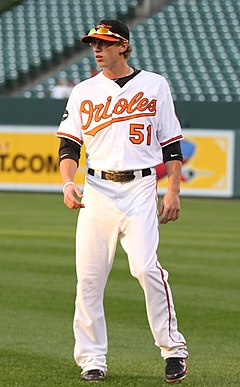
Showing posts with label Kyle Hudson. Show all posts

17 January 2012

Kyle Hudson's Draft Excluded Status

In one of his posts, Roch Kubatko wrote the following:
Hudson can't be placed on waivers and outrighted to the minors before March because he's "draft excluded." The Orioles must trade or release him. They can re-sign him if he's released, but he can't play for them before May 15.
Roch apparently believes that surrounding mystery around quotation marked designations improves the beauty of sports journalism, I guess.

What does it mean to be draft excluded?

It is a player who begins the season as a minor leaguer who would be eligible for that December's Rule 5 draft and is added to the 40 man roster between the draft signing date (August 15th) and the deadline for the Rule 5 draft.  This player can be traded at any time during his draft excluded status, but cannot be designated for assignment until 20 days prior to opening day.

Therefore, Kyle Hudson, a draft excluded player by being added to the 40 man roster in September, must pass through waivers and given his outright release.  Apparently, there is a May 15th deadline as well that I did not know was in effect.  This means that Kyle Hudson will not be an Orioles in 2012.  He will sign with someone else assuming the May 15th date is correct.

What is the specific language?

MLR 6 (e)
DRAFT-EXCLUDED PLAYERS. A player who is excluded from selection in a Rule 5 Selection Meeting because the player was promoted to a Major League Reserve List after August 15 of the championship season preceding the selection meeting and remains on a Major League Reserve List through the conclusion of such selection meeting shall be referred to as a "draft-excluded player." A draft-excluded player shall not be directed to perform for, assigned to, or otherwise transferred to a Minor League Club unless the player first receives a trial with the player's Major League Club lasting until 20 days before the opening day of the following Major League season. See Rule 10(e)(6) (Restrictions on Waiver Requests) for rules concerning when waivers may be requested on a player who would become a draft-excluded player and Rule 10(d)(5)(B) (Consideration for Assignment of Player; Selected or Draft-Excluded Player) for rules concerning the waiver claim price for a draft-excluded player.
Rule 10(e)(6)
Assignment waivers may not be requested on the contract of a player who stands to become a draft-excluded player, as described in Rule 6(e), during the period beginning five days following the last day of the World Series and ending 25 days prior to the opening of the championship season of the year following the year the player became a draft-excluded player. If waivers are obtained, no assignment may be made pursuant to such waivers until 20 days prior to the opening of the championship season of said year.
I do not see anything about May 15th.

25 June 2008

Draft Recap: Kyle Hudson, CF, University of Illinois

Introducing Kyle Hudson

5’11” – 165 lbs. – Bats/Throws (L/L)

In Round 4, Baltimore went with their second two-way D-I player (granted, Avery had not yet started his career at Georgia). Hudson spent three seasons as a wide receiver for the University of Illinois, as well as center-fielder for the baseball team. He leaves Illinois second in career batting (.376) and tied for first in stolen bases in a single-season (40). With this pick, Baltimore hopes to shape this elite athlete into a future lead-off hitter and plus-defender. Let's see what they have to work with...


The Statistics
AVG – .398
SLG – .482
AB – 191
H – 76
2B – 11
3B – 1
HR – 1
RBI – 26
R – 61
SB – 40

Two numbers jump out. First, the 40 stolen bases. As mentioned above, this ties the Illinois single-season record (he broke the conference record for stolen bases in conference play -- 25 SB -- as well). Hudson is a true burner with game-changing speed on Avery's level (I believe he's actually a slight step above). Second, the slugging percentage is a mere 84-points higher than his average. While the .398 AVG looks impressive, one has to take into account the fact that he was facing uninspired Big 10 pitching. To that point, the SLG is a bit troubling, as you'd expect the doubles and triples to pile up given his speed and the competition of a weaker conference. I think you'll see some power develop as he cleans-up his swing mechanics (see below), but it will likely be in the form of gap-to-gap rather than home run. He also lead the Big Ten in walks, with 39 -- another "plus" for an Orioles organization looking for its future lead-off hitter.

Grading Out
Hitting - 35
Power - 30
Fielding - 50
Arm - 30
Speed - 80

If Jordan and the Orioles were looking to get athletic this year, picks 2:5 through 4:5 is an incredible start. While Hudson is still a ways away from being a good hitter from the standpoint of mechanics and approach, keep in mind he has never devoted all of his attention to baseball. He posted a solid AVG and OBP in spite of his mechanics, and could be an exponential improver once he submerses himself in the baseball world. The development of his offensive game should dictate his ultimate ceiling -- either slap-hitting speedster with moderate success or solid candidate for a lead-off hitter. His speed easily plays in CF, though his arm strength summons visions of Juan Pierre.

Swing Mechanics
Scouting video available on the Orioles's Draft Tracker page at MLB.com

Load - Hudson begins with an open stance and closes with a leg raise (similar to Hoes's) as he loads. His hands start off in fine position, but he adds some extra movement and pulls them back towards the catcher as he lifts his leg, adding some length to his swing. As noted in our Hoes breakdown, the leg lift can be a good timing mechanism, but it requires attention to be paid to weight transfer.

Stride - His stride comes right from the leg lift, which is cleaner than Hoes's approach of tap and step/pivot. His timing is adequate and his hips do a decent job of staying closed (though he'll occasionally get a little lazy, especially on pitches he has given up on). His hands are too far back due to the extra motion at the end of his load, which greatly extends the length of the path from bat head to ball.

Swing - Hudson profiles as a bit of a slap hitter. He tends to come in too strongly with his top hand, which elevates his front shoulder and dirties his swing plane (at minimum flattening it), along with sapping some power. When he leads with his bottom hand, his swing is much more fluid and he is better positioned to make more consistent hard contact. There should be more emphasis on torque in his lower half, as his upper body has a tendency to throw him off balance. This results in less bat control and will affect his ability to stay on advanced pitching in the future.

Contact - He is inconsistent in his contact, sometimes coming in with too much weight up front and hitting off his lead foot. Other times, his upper body comes through too quickly (maybe over-swinging?) and his weight gets way back in his body. Rather than a perpendicular line from helmet to knee, Hudson is closer to 60-degrees. When coupled with a leading top hand, this could again be an obstacle to consistent hard contact against advanced pitching. Still other times, Hudson reverts more of a "slap" approach, throwing the bat head at the ball rather than attacking with a forceful plane. The Orioles will work to normalize his approach and get him into a more consistent routine from load to contact. This may be as simple as getting Hudson to do the reps in BP -- something that was likely cut into by the demands of his football commitment. Though he's a bit all over the place right now, there are enough "adequate" swings to give hope that a consistent professional hitter is buried in there.

Follow-Through - Again, Hudson is inconsistent. He finishes way up when he leads with his top hand. His flat swing lifts almost right at contact, taking force off of the swing and preventing him from maximizing his potential to drive the ball. The follow-through on his "slap" swings is short and tight in the upper body. Occasionally, he finishes with a nice clean stroke -- both one-handed and two-handed. As the rest of his mechanics are ironed out, his follow-through should fall into place.

Swing Grade - C-

Fielding
As you might expect from a wide receiver, Hudson tracks the ball very well. He takes solid routes and his plus-plus speed is an incredible asset in the field. He is capable of covering ground from gap-to-gap, and his ability to close quickly on base hits helps to prevent base runners from taking advantage of his below-average arm strength. Though his arm leaves something to be desired, his speed and reads would likely be wasted in LF. He should be a solid option in CF with the potential to save a fair number of extra-base hits in the gap.

Fielding Grade - B

Stotle's Notes
Hudson does not have the raw talent of Xavier Avery, and he is closer to fully-baked, limiting his ceiling a bit. Still, it will be interesting to see what happens now that he is devoting himself exclusively to baseball. His first 18 months in the organization will be telling. If everything starts to fall into place, Baltimore could have the makings of a future lead-off hitter with solid defense in the 8-spot. Even if his batting does not fully develop, he has the potential to carve out a 4th or 5th outfield spot on the merits of his defense and base running, alone. This is a decent high-upside pick, again heavily dependant on the ability of the Orioles low-minors system to lay the groundwork and begin the development of a player currently more athlete than baseball player.

Prospect Grade - C+
ETA - 2012

Next Up:
FRI 6/27 - Rick Zagone


20 June 2008

Draft Recap: A Primer from Paul DePodesta

Before we get into our breakdown of the Baltimore Orioles's 2008 Amateur Draft, I wanted to pass along an interesting draft-related article posted by Paul DePodesta (former GM of the LA Dodgers and current front office assistant for the Padres) on his blog.

DePodesta does a fantastic job of explaining the "draft process" and how you might go about examining whether a team is effective in its approach to the draft. He followed this up with a more in depth look at the Padres approach to the draft this year. While insightful, it may frustrate some Orioles fans who agree with his general premise that college hitters were the good "get" in this draft class (you'll note our Shadow Draft nabbed two in the first five rounds -- Kieschnick and Crawford -- and our "Rounds 2-5 targets" included 6 more -- Sobolewski, Adams, Mercer, Darnell, Flaherty and Danks).

Altogether, this is a good primer to Draft Grading and should help us all keep in mind a team's general process as well as its specific approach to a particular draft. We'll keep these two issues in mind as we step through the Orioles's draft over the next couple of weeks.

Draft Recap Schedule:
MON (6/23) - Xavier Avery
TUE (6/24) - L.J. Hoes
WED (6/25) - Kyle Hudson
THU (6/26) - Greg Miclat
FRI (6/27) - Rick Zagone