17 September 2011

A History of Moneyball

Scott Hatteberg
On ESPN's Baseball Today's podcast, Keith Law discussed Moneyball somewhat at length.  I found it interesting that his growth in his understanding of baseball mirrored my own.  Like most people in life, a set of ideals are often focused on in our youth and over time we recognize that such absolutism is misguided.  Absolutism is often kindled by a bit of truth and adherance is formed based on piecemeal evidence and ignoring things that disagree with our notions. 

Law talks about his first year in baseball with the Blue Jays.  He was a pure stats guy and an assistant to Ricciardi who was rather dismissive to scouts.  Often Law would be called into the GM's office and Ricciardi would go off on rants on evaluations, such as Eric Hinske.  He thought Hinske was a remarkable player who would be a major component of the future Jays' teams.  He deemed his scouts foolish for thinking Hinske was an organizational player.  At that time, the Jays' front office was a highly biased atmosphere toward scouting.  Unfortunately it was behind the curve of other organizations by a few years.  Over time Law recognized that their methods were unworkable and subsequently left.

Listen to the podcast, it is a very interesting response given by Law to an email by The Common Man, our friend over at one of our sister blogs on the Sweetspot.  What I am about to write are my thoughts on it and takes very,very little (almost nothing) from what Law said.

Unlike running for political office where it is a major hindrance on a career, successful people realize the folly of absolutism and begin to moderate their views.  Now, I think many ideas have to be chaotic and overly held onto in order to break through long held traditional views.  What winds up occurring is that the first line through is given some notice, but to have lasting power...it will also need a moment of success.  The A's success is what many sabermetric minded folks grabbed a hold of and, to their detriment, eschewed traditional approaches to assessing talent.  It is common to misunderstand how one single approach that succeeds often will succeed given a certain set of variables and that once that context is removed, the approach needs to be altered.  I think it is a major reason why many "Moneyball" teams have failed to equal what the A's did.

In the early to mid 90s, several important people began to see the importance of statistics in baseball and how some skills are being overlooked.  I do not know who were the first trailblazers, but most of the lines draw back to Sandy Alderson's crew in Oakland.  However, they were not alone.  Several clubhouses had elements of this minority held view.  The Indians come to mind for me as a front office who had one or two of these guys.  In the public sphere, you had guys like Bill James, Pete Palmer, and others who were pushing through the concept that statistics were useful and not being utilized.  It was an amazingly rich time where there was probably far more cutting edge information publicly available than proprietary within baseball.

The tide turned with the Oakland A's.  Their late 90s and early 00s benefited from some great amateur talent acquisition in the years before.  There were proto-Moneyball draftees like Jason Giambi and Ben Grieve who both did well for the A's.  There were traditional acquisitions like Miguel Tejada and Eric Chavez.  Part of this was an amazing hit on three young pitchers with Mark Mulder, Tim Hudson, and Barry Zito.  This combination of recognizing the benefits of a statistical approach, utilizing traditional scouting, and hitting on three pitchers created a vital core whose presence would be felt over roughly a decade in Oakland.  This club was set up by the collection of incredible talent and somewhat open mindedness of Sandy Alderson.

When Billy Beane took over, he had some strong ideas as to how to improve upon Alderson's model.  He could have gone and hired more scouts and taken the talent competition to every other team or he could go with a statistical perspective and find ways to exploits talent that was not properly valued.  Now, I think I am rationalizing this in a backward sense.  I imagine what the early tenets of applying statistics in the front office saw this as extraordinary and that other teams were foolish for not seeing it.  In this perspective, scouts have "no value" because improved scouting is often a razor thin improvement in the talent you are bringing back.  It is monetarily inefficient.  Whereas if you cut expenses and turn it over to the sabermetric crowd, you are investing in a field that few teams were doing and even fewer were actually using.  In short, Beane read the wave, rode it, and many within that group likely forgot that others will do likewise with the following waves.  Beane saw this.  He saw others liking what he was doing and he saw that teams like the Blue Jays would commit to it more so than he would.

The A's emphasis on college players in the draft preceded the "Moneyball" draft of 2002 by several years.  In fact, it likely happened in 1997.  When the ownership changed hands before the 1997 season, the new ownership let it be known that they were no longer going to green light a great deal of money for large free agent contracts.  Alderson looked at his amazing collection of talent in scouting and development; and made a decision.  He recognized that to maintain a successful organization that he was not going to be able to compete with other organizations and that he had to implement more cutting edge ideas.  Alderson turned the A's into a more sabermetric focused franchise.  This gave more power to Billy Beane who was an early convert.  When Alderson left shortly after implementing this plan, the owners hired Beane to take his place.

What Alderson started, Beane finished and probably in a way that Alderson could not have done himself.  The A's drafts began to focus almost solely on college talent.  The A's 1997 draft (Alderson's last) included only one high schooler in the first ten rounds.  If not for Hudson in the sixth, it would have resulted in 12 picks who would not contribute in MLB.  Beane's first draft in '98 was better with Mulder being selected.  In '99, Barry Zito was pretty much the lone prize.  In '00, no one in the top ten amounted to much, but they did select Rich Harden in the 17th round.  The controversial '01 draft resulted in Bobby Crosby, Jeremy Bonderman (which supposedly infuriated Beane), and Dan Johnson.  Nothing exceptional, but really not much different from the draft before.  In fact, the whole thing about the '02 draft focusing solely on college talent is likely overblown.  From '97 to '01, the A's selected six high schoolers in the first ten rounds in total.  If anything, what they found out was that a polished college pitcher is a better investment in the first round than an exciting, hard throwing high school pitcher.  Outside of that, the returns were not different from any other club.

However, people who commit to ideas often over commit and the A's went all college in the next draft to take advantage of Beane's maneuvering to acquire seven of the first 39 picks.  It did not go well, they wound up with Nick Swisher and Joe Blanton.  Those two alone made the draft valuable and worthwhile, but the A's were certainly expecting more.  Jeremy Brown probably could have been a useful backup, but I think there was a lot of Moneyball pressure on him that he did not handle well.  Anyway, we can continue on going through all of these drafts, but the point is clear to me that statistics certainly have their place in the draft although the benefit gained is marginal.  A stat-alone approach will not result in drafts that are significantly different from what would be expected on average.  As the Blue Jays would find out later, these returns are likely to become more marginalized if more people start taking this approach.

So I never mentioned the second part that made those A's teams successful.  The first part again was the draft approach instituted by the previous regime and the unlikely hits on three elite young pitchers.  That strong core was supplemented by the second part of the A's success: utilizing statistics in free agency.  Part of that emphasis was on the idea that collecting spare parts with certain lines would result in a cheap and fairly successful bullpen.  Chad Bradford was the flag bearer for this idea in the novel, but someone like Jeff Tam makes just as much sense.  The A's focused on players who were successful at keeping the ball on the ground and they did this while few teams were concerned directly about that.  It was a concept that was largely built off of the work Voros McCracken did with DIPS.  The other part of his free agent approach was to acquire players who could get on base.  Scott Hatteberg was the main focus in the novel for this approach, but again there are others.  Guys like Mike Stanley, Randy Valverde, what they thought they had in Johnny Damon, David Justice, and Ray Durham among others.

Of course, the benefit of this approach was dying out too when the book came out.  Again teams like the Red Sox, Yankees, Indians, Blue Jays, etc. all took notice and understood what was going on.  Statisticians were moving in droves to MLB teams with some teams knowing what to do with them and others not so sure.  Some GMs thought that a single stat guy "would replace 10 scouts."  At one time and in a limited context, that would be true.  However, with many of the teams understanding and using statistics, the margin of success became narrower and narrower.  As it showed at the end of the novel (as I remembered it or as I remember thinking after reading it) that Beane knew others were in on this approach and that he had to stay ahead of the curve.

Moneyball for Beane next became a focus on defense.  It has been only mildly successful.  The team has never gotten much help out of the minors and the returns they had on trading their three elite pitchers did not result in comparable value.  To say Moneyball led the MLB team to success is overselling that approach.  To say Moneyball did not amount to anything and was merely a product of the Big Three would be underselling it.  The truth, quite often most obviously, lies in the middle.

Beane also stepped back from his college only approach.  This saw major investment in 2005 in high school talent, but an easily seen direction is not apparent.  In 2007 and 2008, the team heavily focused on college players and the drafts since include a smattering of promising high school selections.  These selections typically are in the Max Stassi or Ian Krol variety.  They are highly talented prospects whose characteristics did not equal their asking price.  When you overslot players like that, you are betting that they will be worth that price with development or at least the whole portfolio of overslot talent you acquire will at least be equal to the amount you invested.  The new strategy might be one where they are still heavily scouting colleges while giving looks to overslot type talent in high school. 

This brings us back to the initial point I had which is that the idea of Moneyball is a fluid concept.  The most important number in baseball is cost efficiency.  Any team has there own set budget and it is the front office's job to determine how to effectively use that money to bring back wins for their teams and, to some extent, fans in the stands.  To do this, you need to be able to assess how talent is being valued in your market and determine if a certain aspect of talent is being undervalued.  If a competitor figures out what you figure out, your knowledge becomes somewhat marginalized.  If a competitor with significantly better resources finds out the same thing, you can be rest assured that you will be left with the scraps.

In that end, I think it becomes clear that way things work in baseball that it is grossly unfair for teams with revenue streams that pale in comparison to others.  This has always been the case.  It is a major reason why the Orioles were so successful in the 60s and 70s.  Pre-draft the team signed bonus babies left and right.  A front office needs luck and an elite level direction to be successful against these high revenue, intelligent clubs.  What the Rays have been able to do is incredibly remarkable.  What they have done though is being figured out by others and being exploited by teams with better cash streams (e.g. Blue Jays, BoSox).  The question then becomes where is the next innovation and is my sad sack team going to be ahead or behind the curve?  And, again, this is not anything new.

Moneyball is about one innovation and how a small player can become a big player by exploiting it.  Nothing more, nothing less.  Sometime this fall or winter, the book club will go back and reread this classic.

15 September 2011

CDOBC: But Didn't We Have Fun? Chapter 1

The first book I have chosen for this book club is one I am currently working my way through.  The way in which I plan to go through these chapters is one or two at a time with my general thoughts or ideas.  I am not necessarily doing a book report here, but providing a bit of a commentary.


But Didn't We Have Fun? An Informal History of Baseball's Pioneer Era 1843-1870
by Peter Morris

I chose this book as the new beginning for the book club because it gives light to a misconception of what baseball is or at least from where baseball emerged.  Originally, Earl Weaver's book was to be first, but I figured that might be a book more readers would want to be prepared to discuss.  Weaver is also a bit full of myth wrapped around a core truth.  Weaver and his success are in ways a lot like the beginnings of baseball.

Chapter 1: Before the Knickerbockers

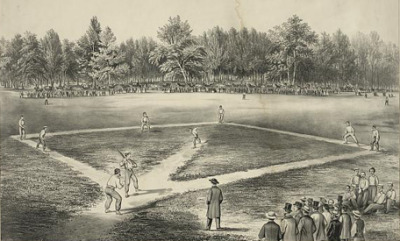
This chapter is largely concerned with the games that preceded what we would have some inkling of recognition of baseball.  What struck me as interesting about these games in the 1830s or so is how populist they were.  Young and old adults would get together in the morning before work in the city square or find an open space on Sunday and play a game.  This game consisted of a ball, typically quite soft, a bat, and some number of stakes or bases.  There were no rule books, but the game took up a number of different iterations and braced against any standardization.  The game was the antithesis of a national game.  It was different everywhere.  Rounders was not popular.  Cricket was not popular.  Rather it was a highly localized ball and bat game that was influenced by the English fare and the necessities of local elements.  Sometimes the number of players available were few or incredibly numerous and therefore rules had to change depending on whatever needs had to be met that particular day.

It is incredibly difficult to write a history of something that was not considered with much seriousness.  People simply do not write these things down.  It has made researching the foundation of the game as quite a difficult endeavor.  The evidence at hand is often patchy and filled with colored memories.  It reminds me of the plethora of games I invented in my youth.  Even being squarely involved in a game I played with my friends that involved using a bat and a football to play a kind of golf, I would be hard pressed to remember the rules or the name we called it.  I am not even sure we had a name for it.  We certainly had fun and that was the point.

As the author presents it, the standardization of baseball appears to have had a lot to do with legitimizing adults playing a children's game.  The Olympics of Philadelphia played their games across the river in New Jersey due to ball games being illegal in Philly.  Apparently, the members of the club were given a great deal of flack for spending so much time on a frivolous activity.  The result was for the club to write a constitution in 1838 to try to make their endeavor more respectable.  I find it interesting that baseball may have become baseball in part due to simple shame.

However, what I take from this most is this: baseball in its infancy was an abstract thing.  The ball, the bat, points, and running were all important aspects of it, but it was molded.  It makes me think how untenable it is for people to be traditionalists in baseball preaching for it to remain authentic.  Has there ever been an authentic thing about baseball?  The history of the game suggests otherwise.  Rules change dramatically.  Players change dramatically.  Fields change dramatically.  Everything about the game changes.  It is why we have tried so hard to develop ways to measure baseball where players are compared within their era against their colleagues.  Face it, Babe Ruth would be Matt Stairs at best.  Jim Palmer would be quite normal.  The game changes and often it grows more difficult or, at least, it becomes more competitive.  Those wishing for the authentic game are merely pining for a specific type of baseball that may or may not have existed for a brief moment in time.

14 September 2011

Re-Introducing the Camden Depot Oriole Book Club

With a tail between my legs, I have to admit that the origination incarnation of the Book Club quickly went through round after round of delays with Nick and I deluding ourselves that we would be able to hollow out time in our lives where we could both be present to do podcasts.  I still believe it is a good idea and I have interested to have some permutation of it to take place.  The current form is not how I intended it, but I think is useful nonetheless.  I will be writing posts for every chapter or two of a baseball book I am reading at the time.  I invite you all to go to the library or grab a copy from a book store.

It will take me about two to three weeks to make it through a book.

Here is the book list I will be working on:

But Didn't We Have Fun? An Informal History of Baseball's Pioneer Era 1843-1870
by Peter Morris

Weaver on Strategy: The Classic Work on the Art of Managing a Baseball Team
by Earl Weaver and Terry Pluto

The Extra 2%: How Wall Street Strategies Took a Major League Baseball Team from Worst to First
by Jonah Keri

Built to Win: Inside Stories and Leadership Strategies from Baseball's Winningest GM
by John Schuerholz, Bob Costas, and Larry Guest

Dollar Sign on the Muscle: the World of Baseball Scouting
by Kevin Kerrane

Odd Man Out: A Year on the Mound with a Minor League Misfit
by Matthew McCarthy

Venezuelan Bust, Baseball Boom: Andres Reiner and Scouting on the New Frontier
by Milton Jamail

13 September 2011

Is a draft pick worth the mean or median value?

A topic that has long be gnawing on me is whether or not it makes sense to value draft picks as many who connect a dollar sign to picks do.  To me there is an argument between using the mean (which is common) versus using median (which I have not seen).  Both are ways to measure central tendency.  Mean is often the best to use in order to either describe the population as a whole or to determine typical value if value are normally distributed.  Medians are used often when you want to determine what is a typical result when the population is distributed asymmetrically.

The following graph shows the difference between how we assign draft picks value either by mean or median.

click to make larger

In the first 30 selections from 1991-2000, there were only four instances where the median was higher than the mean.  Seventeen median values within the 30 picks were worth zero WAR or less.  In other words, a team is not likely to receive mean value for a pick.  Picks tend to be overvalued because a few individuals increase the worth of the pick within the population.

What is interesting here is how do you exactly come to a specific value for a pick?  Does a 33% chance of getting a useful MLB player mean that it is permissible to overvalue the population as a whole?  It is easy to see how many MLB teams deplore spending money in the draft because much of the money spent on individuals is wasted.  The question is whether or not the money spent on the entire portfolio is beneficial to the team.  I would say that if you are evaluating a single player, the median makes sense.  If you are evaluating the population, then the mean makes sense.  To look at it differently, it is like a lottery that benefits the buyer of the tickets.  Most likely, most of your tickets are worthless, but a couple might wind up bringing back a great deal of value.

12 September 2011

Expanded Roster: Why This Year Hurts More Than Usual

During the month of September, Camden Depot will expand our rosters beyond Nick Faleris and Jon Shepherd.  This will enable our audience to speak directly outside of the comment box as well as shine a light on other Orioles writers.  The second up in this series is Kevin Williams.  Previously, Ben Feldman wrote a piece on Matt Wieters.

When I meet fellow Orioles fans through work or on the golf course, the conversation usually goes about like this - I ask if they follow baseball, and they say something like, “Yeah, I’m an Orioles fan, but I usually stop following them by the all-star break.” Pretty understandable, given the team’s results over the past decade. And this year is no exception – even ignoring the record, all you have to do is glance at the pitching stats. They’re eerily similar to the numbers from just about every season since 2000. Every year you can pull out about 3-4 guys who might have a shot to pitch for a contender, and then you have about 20 players who between them didn’t even perform at replacement level. My new golf buddy, of course, wouldn’t be surprised. “Business as usual,” he might say. Unfortunately, I think this year’s results are quite a bit worse than business as usual.

Why? First of all, the 2011 season started with a lot of promise. Multiple national writers ranked the Orioles’ offseason as one of the best in baseball. Every win projection system I saw gave the team a pretty fair chance at finishing .500 for the first time since 1997. And the success of the young pitching staff at the end of 2010 gave fans reason to believe that even better days might lie in the future. I personally hoped that a .500 season plus another offseason splash might push that projected win total into the upper 80s, territory that could realistically yield a playoff team.

Unfortunately, here we are in August on pace to lose close to 100 games once again. How, exactly, did that happen? Much has been made about the lack of progress of the Orioles’ young pitchers, particularly Matusz and Tillman – that’s part of the problem, and it certainly explains some of the ugly pitching numbers. But the problem doesn’t end there. Without getting into the nitty gritty of who met their WAR projection and who didn’t, and without even mentioning any names, I’m pretty sure the Orioles got far less production than expected out of four other positions: LF, 2B, 1B, and DH. Add that to some lousy relief pitching and I think you can explain the difference between .500 ball and the 64-66 wins we sit at now. 

So, the question is, where do we go from here? And why is this season a bigger disaster than usual? Sadly, I don’t think there’s anywhere near enough talent on the current roster to project for 2012 the 80 wins I thought realistic for 2011. Just covering the positions I listed above – you’d need Luke Scott and Brian Roberts healthy and productive, Brian Matusz rediscovering himself, Chris Davis and Nolan Reimold turning into productive every-day players, a replacement for Koji Uehara… and some substantially better middle relief. Pretty unlikely to happen all at once. Even if you sign Prince Fielder and a middle of the rotation starter (my April dream), I still think you’re looking at a .500 club, not a playoff contender in the AL East.

So… we probably can’t compete in 2012 or even 2013. Again, not a shock to my new golf friend. But here’s where it gets really bad. The current roster is basically the result of the rebuilding effort Andy McPhail started in late 2007 with the Miguel Tejada and Erik Bedard trades. And by 2014, the core of that roster will be gone. Markakis, Jones, Roberts, Guthrie, Scott, Johnson - all above average players at one time or another - all gone. So, that effort, though it looked promising at the time, has likely failed to produce a winner. If I were an outside observer (or a candidate for new GM), I’d probably conclude that it’s time to start another rebuilding effort. We had some hope in 2011 – it didn’t work out, so let’s cut our losses and shoot for 2014. Listen to trade offers for everyone not named Britton or Wieters. Markakis, Jones, Roberts, Guthrie, Scott, Johnson – the players I just mentioned – all should have some value. In under a year the Orioles could have a top ten or even top five farm system. The 2014-2016 teams would feature a core including Machado, Bundy, Wieters, Britton, and hopefully some young talent infused into the system over the next year. Even next year’s team wouldn’t be a complete waste. The pitching staff would feature Britton, Arrieta, Hunter, and Simon, quite a bit better than Burres, Olson, Liz, and Trachsel. And you’d have the opportunity to give an extended look to players like Chris Davis, Nolan Reimold, Chris Tillman, and even Felix Pie.

Unfortunately, I’m afraid the organization as it stands now has about as much chance of blowing up the roster as Rick Perry does of devoting his presidential campaign to warning voters about the perils of global warming. The team just has too much invested, both financially and from a marketing perspective, in Jones, Markakis, Roberts, Guthrie, and now J.J. Hardy. And, speaking as a fan, I understand why the organization would want to continue to build around those players. It’s hard to part with young, charismatic, and likeable talent. But from a business perspective, I can’t help but think that an overhaul starting this off season would prove over time to be the right move. I just can’t see the current organization, still led by Peter Angelos, making that kind of a decision.

So what will the team do this offseason? There’s a saying that goes, when you don’t know what to do, don’t do anything. So I suspect next year’s roster will look a lot like this year’s – the organization will hold out hope that the young pitching will develop while Markakis, Jones, Roberts, and Hardy are still on the team. If we do sign free agents, I’d recommend players that either don’t cost too much (perhaps Mike Gonzalez in an incentive laden deal), or players that might help both over the next two years and in 2015 when the next wave of talent is ready. Does signing Prince Fielder to a 100 million plus contract make sense? If we sat at .500 now, I’d say definitely yes. Find a window to compete and go for it hard, even if you have to overpay. But looking at the next five years… I’d say no. For comparison’s sake, Prince’s father Cecil only had 500 at-bats once after age 29. And Ryan Howard, another easy comparison, has seen his production decline this year at age 31. Signing Mark Buehrle, age 32, to a long term deal? I’ll pass.

So why is this season such a disaster? For me, it points the organization squarely towards another five years of mediocrity. We probably won’t win in 2012 or 2013, and by the time Machado, Bundy, and Schoop are hopefully ready, we’ll have a whole new set of major holes to fill. Sadly, that might set up the worst outlook for the future we’ve had in some time. Even over the past decade, we’ve had a few bright spots. 2005 saw Miguel Tejada and Melvin Mora lead the team to contention in July. In 2008 a new general manager made widely applauded personnel moves. Early in 2011 we filled several long standing holes through free agency – just not enough to make us a contender. If it went my way, 2014 would usher in a new wave of talent with the potential to make a playoff run. But without a serious overhaul, and without 2012 or 2013 turning into one of those magical seasons that happens only once a generation, we might be headed for another decade of losing. Maybe the players will prove me wrong – maybe Matusz and Tillman will hold down spots in the rotation, maybe Bergesen and Patton turn out to be solutions in the bullpen. But if I had to make a prediction today, I’d say we’re headed for more years of frustration, and an entire generation of fans might not see .500 baseball at Camden Yards.

11 September 2011

Buck Supposedly Has the Option of Being GM and Manager Concurrently

Manager and GM Paul Richards
Yesterday, Ken Rosenthal reported that Buck Showalter will be given a free hand to turn the Orioles into a competitor.  This includes the option that Buck could serve as both the GM and manager.  This was a topic I brought up several weeks ago.  I could see this working out, but Buck would have to be more of GM that sets the general tone and direction for the franchise while someone else does the day-to-day activities that take up quite a bit of time.  In today's game, it is just impractical and largely impossible to do both jobs.  A GM's perspective is often broader and more forward thinking than the manager.  Second, it gives more opportunity for a player to be upset with his manager because the same guy is also determining things like salary.

Buck would be the first person to occupy this position since Paul Richards who was the Orioles GM and manager from 1955 to 1958 when Lee MacPhail took over the GM role, leaving Richards as only the manager of the team.  Even back in the 50s this was considered a unique situation.  There are just too many reasons for this not to be a good idea and it is why few have ever tried to do it.  The following is a list of individuals who I have found who have recently occupied both positions since 1980.

Whitey Herzog
1981-1982 St. Louis Cardinals
In the beginning of the 1980 season, Herzog took over as manager from Bobby Winkles.  In August, Herzog left the dugout to go to the front office as General Manager.  He assigned Red Schoendeist to take the helm.  However, during the offseason, Herzog felt that no one could manage better than he could, deciding to occupy both GM and manager positions.  In 1981, Herzog had the most wins in the NL East, but failed to win the division due to funky strike-shortened season rules.  In 1982, the Cardinals downed the Brewers in the World Series.  Herzog is one of the few (maybe only) person to win a World Series as both manager and General Manager in the same season.  It should be noted though that he did resign from his GM duties in April of 1982, so it may not be wholly accurate to refer to him as holding both titles for a championship team.

Gene Michael
1981 New York Yankees
The Yankees of the 70s and 80s were a dysfunctional mess.  This became readily apparent during the merry go round of coaching that Michael oversaw during his tenure as GM.  He performed poorly and Bob Lemon took over and took the Yankees to the World Series.  The Yankees lost and Michael was no longer the GM.

Paul Owens
1983 Philadelphia Phillies
Paul Owens thought the Phillies were underperforming and that he could bring more out of the team.  He helped them finished 47-30 and took them to the World Series where Rick Dempsey and the Orioles were waiting for him.  Encouraged by his performance as manager, he resigned from his front office position to dedicate himself to the dugout.  He finished the year 81-81 and was removed as manager.  From 1985 until his death, he was assigned as a senior adviser to the Phillies.

Jack McKeon
1988-1990 San Diego Padres
Year two of the Larry Bowa tenure went just as poorly as the first and McKeon brought down the ax.  He decided to take the reins himself and the team went 67-48 over the rest of the season, finishing in third place.  McKeon retained both titles in 1989 and the Padres went 89-73, second in the NL West.  1990 though was not as successful and McKeon resigned as manager after going 37-43.  After the season, he also had his GM duties taken away.

Bobby Cox
1990 Atlanta Braves
Bobby Cox oversaw several poor Atlanta Braves teams managed by Chuck Tanner and Russ Nixon.  As a fairly successful manager with the Toronto Blue Jays, it made sense for Cox to be rather critical of how the managers under him performed.  Cox decided to take matters into his own hands 66 games into 1990.  His presence did not remarkably improve the team's performance in 1990, but he felt he could do more to help the young players he had been accumulating of the past five years in the dugout as opposed to in the front office.  After the season, John Schuerholtz was lured from the Kansas City Royals to serve as the Braves GM with Bobby Cox remaining in the dugout.

Conclusion
I think it says a lot that 1990 was the last time a manager doubled as a GM.  Whitey Herzog and Jack McKeon were the only two who have ever done this over a whole season in the past 32 years.  They were both successful, but found it to be overwhelming and thought it best to concentrate on one position.  To me, it is inconceivable that one person could do both jobs adequately.  If Angelos does allow Buck to serve in both roles and Buck chooses that route, I do not think this team will be best served under that scenario.