After the jump I list my shadow 2010 MLB roster using the setup I laid out in an earlier post.
I set aside 60MM (spending 56.5MM) of the 70MM budget for the MLB roster. Without a good idea on how to run an expansion draft, I decided to just ignore it and go the route of free agency. The following team is not very good. Projected performance suggests this is a 66.3 win team. Only three players are signed to multi-year deals: Ryota Igarashi, Jason Marquis, and Aroldis Chapman (who will be given a chance to break camp with the team, but will most likely be in the minors). The fluidity of the team allows for the chance of type B compensation picks to arise as well as permits the team to easily discard players. At this stage in the franchise, some sort of an interesting product should be on the field . . . but that product should be flexible and easy to turn around to meet specific needs when they arise. A similar situation will also most likely present itself next offseason. The first season with a long term outlook at free agency would probably occur after the 2011 season. All players with mil are invited to camp as a non-roster invite. The fifth slot in the rotation will essentially be an open audition.
C Rod Barajas 1MM
1 Ryan Garko 0.75MM
2 Felipe Lopez 3MM
3 Juan Uribe 3.8MM
S Adam Everett 1.8MM
L Rick Ankiel 3.5MM
C Coco Crisp 6MM
R Ryan Church 1.7MM
D Russell Branyan 2.5MM
C Josh Bard 0.4MM mil
I Bobby Crosby 1MM
I Dallas McPherson 0.4MM mil
O Josh Anderson 0.4MM mil
S Jon Garland 5.8MM
S Tim Redding 0.5MM mil
S Justin Descherrer 2.5MM
S Jason Marquis 2/15MM
S Colby Lewis 2/6MM
R Josh Fogg 0.5MM mil
R Brian Bass 0.5MM mil
R Kiko Calero 0.5MM mil
R Jeff Weaver 0.5MM mil
R Wil Ohman 0.5MM mil
S Ryota Igarashi 2/4MM
C Matt Capps 3.5MM
FA – Aroldis Chapman 6/30MM
During the season, I will use the WAR prediction spreadsheets to predict how well this team would actually do. In June, the team will act with a 10MM draft budget that also must be used for international signings. Drafting at the end of the round again will probably result in 6-7MM in the rule 4 draft and the rest spent in the Caribbean. Anyway, I imagine the 2011 draft will be fun with this team.
29 March 2010
26 March 2010
AL East Best Under-26 Team: Part 4 - Third Base
To be alerted to all new postings, follow Camden Depot at Twitter (www.twitter.com/camdendepot)
Series Links
Intro / C / 1B / 2B / 3B / SS / OF / RHP / LHP / CL
There has been quite a layoff between pieces in this series, primarily due to some scouting trips I've taken on the amateur baseball front. We are going to keep on chugging through this series and will get through it before the start of the MLB regular season, including the selection of the All Under-26 AL East Team, as well as a quick breakdown of how each organization faired. The write-ups will be a little shorter, but hopefully we'll flesh out a little more in the comments section if they generate enough reader interest.
The third base list with brief write-ups after the jump...
1. Evan Longoria / Tampa Bay Rays (Major League)
Height/Weight - 6-2/210 / Born - 10/7/1985 / Bats/Throws - R/R
Stats - Fangraphs / Baseball-Reference / MinorLeagueSplits
Longoria has been nothing short of spectacular since joining the Rays for good in April of 2008. Tampa rolled the dice on the highly-touted rookie, immediately signing him to an extension upon arrival with the big club. Two years in, it looks to be a genius stroke from the front office, as the Rays have paid a meager $1.05 million over the past two seasons for elite offensive and defensive performance, and have the young third baseman under contract for an additional seven years -- four of those guaranteed for a total of around $14 million and the final three years with club options, totalling around $30 million with some escalator clauses that could bump it up to around $35million.
Series Links
Intro / C / 1B / 2B / 3B / SS / OF / RHP / LHP / CL
There has been quite a layoff between pieces in this series, primarily due to some scouting trips I've taken on the amateur baseball front. We are going to keep on chugging through this series and will get through it before the start of the MLB regular season, including the selection of the All Under-26 AL East Team, as well as a quick breakdown of how each organization faired. The write-ups will be a little shorter, but hopefully we'll flesh out a little more in the comments section if they generate enough reader interest.
The third base list with brief write-ups after the jump...
1. Evan Longoria / Tampa Bay Rays (Major League)
Height/Weight - 6-2/210 / Born - 10/7/1985 / Bats/Throws - R/R
Stats - Fangraphs / Baseball-Reference / MinorLeagueSplits
Longoria has been nothing short of spectacular since joining the Rays for good in April of 2008. Tampa rolled the dice on the highly-touted rookie, immediately signing him to an extension upon arrival with the big club. Two years in, it looks to be a genius stroke from the front office, as the Rays have paid a meager $1.05 million over the past two seasons for elite offensive and defensive performance, and have the young third baseman under contract for an additional seven years -- four of those guaranteed for a total of around $14 million and the final three years with club options, totalling around $30 million with some escalator clauses that could bump it up to around $35million.
Longo has everything you'd want in a young corner infielder: plus power to go with an above-average to plus hit tool, above-average defense and a strong and accurate arm. A tip of the hat is owed to the men up top in Tampa who decided Longoria was worth an extension before completing his first month of Major League ball -- the organization could potentially saved tens of millions of dollars if Longoria continues to play as the top AL third baseman not named Rodriguez, and could easily ascend to the throne before his first contract is up. 2. Josh Bell / Baltimore Orioles (AA/Bowie)
Height/Weight - 6-3/205 / Born - 11/13/1986 / Bats/Throws - B/R
Stats - Fangraphs / Baseball-Reference / MinorLeagueSplits
Baltimore's Josh Bell (pictured) has been discussed a fair amount here, among other Orioles bloggers, and of course on the message boards. He represents the potential for an average defensive third baseman with plus to plus-plus power and an above-average to plus hit tool. There are still, however, a fair number of pitfalls for Bell to avoid before realizing that upside. The first, and most glaring, area for improvement is his hit and power tools from the right side. A switch hitter, Bell has some one of the starkest split-lines you'll see, with his 2009 slash numbers coming to .340/.419/.625 from the left side and .198/.280/.267 from the right, with 19 of his 20 HRs and 31 of his 35 2B coming from the left. Bell also continues to work on his defensive game, which still remains choppy. He'll need some time at AAA Norfolk to get more third base reps, and will need to figure out his right-handed approach or ditch the switch hit gig before earning a promotion to the big club.
3. David Renfroe / Boston Red Sox (N/A)
Height/Weight - 6-3/200 / Born: 11/16/1990 / Bats/Throws - R/R
Stats - N/A
Renfroe ranked as the #2 performer at the 2008 Under Armour All-America Game, per PnRScouting.com (Camden Depot's unofficial sister site focusing on amateur baseball), and was the third round selection of the Boston Red Sox last June. A two-way player in high school, Renfroe profiles as a third baseman as a pro, with plenty of arm, soft hands and some good potential at the plate. He fits nicely into Boston's current m.o., potentially providing plus or better defense with a slash line around .290/.340/.460. There could be more juice in the bat than we're giving credit to here, but either way his total value could be significant taking defense and offense into account.  HM. Kevin Ahrens / Toronto Blue Jays (A-Adv./Dunedin)
Height/Weight - 6-1/190 / Born - 4/26/1989 / Bats/Throws - B/R
Stats - Fangraphs / Baseball-Reference / MinorLeagueSplits
Ahrens (pictured) finds himself as our honorable mention, and while some may contend he sits here as much because of the dearth of third base prospects in the division as anything else, we contend his 2009 was much more encouraging than his basic stats might imply. In spite of a slash line of .215/.282/.302 -- enough to make the most optimistic of Jays fans blush -- Ahrens showed improvement in his contact rate and strikezone command (decreasing his SO:BB ratio from an even 3:1 in 2008 to 2.05:1 in 2009, while maintaining his walk rate of around 11% of all plate appearances). Ahrens also may have been a victim of some bad luck, as he saw his BABIP drop from .301 in 2007 and .351 in 2008 to .259 in 2009. He plays an adequate defensive third, though the power may not be there for him to profile as more than an average regular. We expect improved numbers in 2010, and Toronto fans will undoubtedly hope to see that breakout year expected since his 1st round selection back in 2007 (16th overall).
24 March 2010
Shadow Expansion: Intro, 2008 Draft, and 2009 Draft
This is something I began on the side two years ago to see how well I could construct an organization. The idea is basically to act like you are in charge of an expansion team minus the expansion draft (which would be a bit too tedious to figure out a good approximate). Anyway, I drafted at the ends of the rounds in 2008 and 2009 as an expansion team is likely to do. This year would mark the first year a team would be fielded.
Anyway, this may be of no interest to you, but as an exercise . . . I figure I might as well just start posting these things for posterity. After the jump . . . basic rules and the minor league system as it stands.
Basic rules:
1. The team in question has been placed in the AL West.
2. Budget follows as 2008 (7.5MM), 2009 (10.5MM), and 2010 (70MM). Budgets cover MLB squad and all amateur signing bonuses for that year. After 2010, budget increases 5% each year unless that is found to be unrealistic.
3. Free agents can only be signed if it seems like a reasonable signing. For instance, it would be unlikely that Johnny Damon would choose an expansion team over the Tigers. Additional money is required to sign a player if said player chose a team based on competitive interest.
4. Trades initiated require for a trade to have happened and similar commodities are in the organization. If a real trade goes down that involves my own player, I can chose whether or not to accept. If my salary for the player is greater than the real salary of the player . . . extra players will need to be included or monetary considerations.
2008 Draft
This was probably the first year I paid attention to the draft and it appears quite obvious looking back that this is the first year I paid attention to the draft. I took charge for the first 10 rounds and then acquiesced the final rounds to the San Francisco Giants selections. Of this group, I am pleased with Flaherty, Keishnick, and Mitchell. Danks and Cook are about where I thought they would be. Gorgen and Nieto has disappointed me. I think I totally bought into the hype I heard about Thompson. Domoromo looks very promising, but Perez is very much a work in progress.
Players of note include:
Rd1 Ryan Flaherty INF B-
Rd2 Roger Keischnick OF B-
Rd3 Scott Gorgen P C
Rd4 Adrian Nieto C C
Rd5 Jordan Danks OF C+
Rd7 DJ Mitchell P C+
Rd8 Clayton Cook P C
Int Luis Domoromo RF not ranked, but promising
Int Carlos Perez P not ranked, but promising
Misses:
Rd6 Brett Thompson P not ranked
2009 Draft
The 2009 draft looks far more promising, but this may be due to me being more familiar with the players involved. The draft group looks like a lot of high potential, but low probability signings. It is risky. I'm very pleased with this draft and am not disappointed yet.
Players of note include:
Rd1 Matt Davidson 3B C+
Rd2 Todd Glaessman OF C+
Rd3 Max Stassi C B-
Rd4 Ian Krol P C
Rd5 Chris Herrman C/3B C
Rd6 Madison Younginer P C+
Rd8 Kendall Volz P not ranked
Rd9 Kyle Jenson OF C
Rd10 Graham Stoneburner P C
Int Miguel Jean OF C+
Misses:
Too soon.
Top 20 Prospects
This might be the thinnest MiLB system in baseball. There are certainly several individuals who could blow up big or become worthless. Beyond Flaherty, there is really no middle infield depth. It is a major weakness in the system and one that is often poorly solved in trade or free agency.
1. Roger Keischnick OF B-
2. Ryan Flaherty INF B-
3. Max Stassi C B-
4. Jordan Danks OF C+
5. Matt Davidson 3B C+
6. Madison Younginer P C+
7. Miguel Jean OF C+
8. Todd Glaessman OF C+
9. DJ Mitchell P C+
10. Ian Krol P C
11. Clayton Cook P C
12. Scott Gorgen P C
13. Chris Herrman C/1B/OF C
14. Adrian Nieto C C
15. Kyle Jenson OF C
16. Graham Stoneburner P C
17. Kendall Volz P
18. Luis Domoromo RF
19. Carlos Perez P
20. Isaac Hess P
Anyway, this may be of no interest to you, but as an exercise . . . I figure I might as well just start posting these things for posterity. After the jump . . . basic rules and the minor league system as it stands.
Basic rules:
1. The team in question has been placed in the AL West.
2. Budget follows as 2008 (7.5MM), 2009 (10.5MM), and 2010 (70MM). Budgets cover MLB squad and all amateur signing bonuses for that year. After 2010, budget increases 5% each year unless that is found to be unrealistic.
3. Free agents can only be signed if it seems like a reasonable signing. For instance, it would be unlikely that Johnny Damon would choose an expansion team over the Tigers. Additional money is required to sign a player if said player chose a team based on competitive interest.
4. Trades initiated require for a trade to have happened and similar commodities are in the organization. If a real trade goes down that involves my own player, I can chose whether or not to accept. If my salary for the player is greater than the real salary of the player . . . extra players will need to be included or monetary considerations.
2008 Draft
This was probably the first year I paid attention to the draft and it appears quite obvious looking back that this is the first year I paid attention to the draft. I took charge for the first 10 rounds and then acquiesced the final rounds to the San Francisco Giants selections. Of this group, I am pleased with Flaherty, Keishnick, and Mitchell. Danks and Cook are about where I thought they would be. Gorgen and Nieto has disappointed me. I think I totally bought into the hype I heard about Thompson. Domoromo looks very promising, but Perez is very much a work in progress.
Players of note include:
Rd1 Ryan Flaherty INF B-
Rd2 Roger Keischnick OF B-
Rd3 Scott Gorgen P C
Rd4 Adrian Nieto C C
Rd5 Jordan Danks OF C+
Rd7 DJ Mitchell P C+
Rd8 Clayton Cook P C
Int Luis Domoromo RF not ranked, but promising
Int Carlos Perez P not ranked, but promising
Misses:
Rd6 Brett Thompson P not ranked
2009 Draft
The 2009 draft looks far more promising, but this may be due to me being more familiar with the players involved. The draft group looks like a lot of high potential, but low probability signings. It is risky. I'm very pleased with this draft and am not disappointed yet.
Players of note include:
Rd1 Matt Davidson 3B C+
Rd2 Todd Glaessman OF C+
Rd3 Max Stassi C B-
Rd4 Ian Krol P C
Rd5 Chris Herrman C/3B C
Rd6 Madison Younginer P C+
Rd8 Kendall Volz P not ranked
Rd9 Kyle Jenson OF C
Rd10 Graham Stoneburner P C
Int Miguel Jean OF C+
Misses:
Too soon.
Top 20 Prospects
This might be the thinnest MiLB system in baseball. There are certainly several individuals who could blow up big or become worthless. Beyond Flaherty, there is really no middle infield depth. It is a major weakness in the system and one that is often poorly solved in trade or free agency.
1. Roger Keischnick OF B-
2. Ryan Flaherty INF B-
3. Max Stassi C B-
4. Jordan Danks OF C+
5. Matt Davidson 3B C+
6. Madison Younginer P C+
7. Miguel Jean OF C+
8. Todd Glaessman OF C+
9. DJ Mitchell P C+
10. Ian Krol P C
11. Clayton Cook P C
12. Scott Gorgen P C
13. Chris Herrman C/1B/OF C
14. Adrian Nieto C C
15. Kyle Jenson OF C
16. Graham Stoneburner P C
17. Kendall Volz P
18. Luis Domoromo RF
19. Carlos Perez P
20. Isaac Hess P
22 March 2010
Five to Watch in Bowie
The difference between Frederick and Bowie appears to be night and day. Where Frederick has a number of fringe prospects in the 15 and below on the organizational depth chart . . . Bowie has some top flight talent. One guy who I won't be talking about, but will mention here, is Luis Lebron. He is a reliever who has been talked up a lot this spring and really broke out last year when he began throwing a decent slider. He also sits in the mid 90s with his fastball. I rarely mention relievers though because the margin for error is so thin. Anyway, he is one of the many talented players on this roster.
After the jump, top five guys to keep a tab on.
1. Zach Britton LHSP Frederick
140.7 IP 3.29 FIP 8.1 k/9 3.3 bb/9 3.57 GB:FB +3 FIP (L)
The secret is apparently out on Britton as many folks go so far as to rank him as a top 25 prospect and name him as the O's best prospect outside of Brian Matusz whom still qualifies as a rookie. Much has been written on him and if you want to go to a game and see some nice pitching, he is the one you want to target. He has a plus offering in his two seamer and is able to get folks to chase pitches out of the zone. He has good feel for his slider and is slowly working on his change up. The biggest step for him this year is to hone his changeup so that he has a second quality pitch against right handed batters. As many have recognized I am toward the back end of the pack in how I view Britton. I have seen too many groundball specialists that feast on unpolished hitters who chase pitches low in the zone and wind up with weak contact results. Great success at AA and an improved changeup will certainly force me to alter my opinion. He needs to keep doing it is what he is doing.
2. Pedro Florimon Jr SS Frederick
257/321/411 over 448 AB; TZ: +4 runs over 150
Florimon, Jr. is the closest thing we have to a MLB ready prospect in the upper levels of the farm system. The next closest prospect is Mychal Givens who we have mentioned before. Last summer, Florimon raised a lot of hopes as he finally paired his excellent defense with an 873 ops performance in April and a 1046 ops performance in May. His performance then collapsed in June and July with a bounce back in August. It was really a difference of two hitting results: months with a 360 BABIP and months with a 300 BABIP. If he goes out and hits an 800 line or above in Bowie, it will be considered a success and will be moved into a conversation about how he fits in with the 2011 MLB club. If he shows power along with that, he may start sniffing a top 100 prospect ranking. A lot may depend on how well he plays this year. If he falters, we may see a major push to acquiring a SS outside of the organization.
3. Caleb Joseph C Frederick
283/337/440 over 448 AB; 34% CS
Joseph holds some promise as an offensive oriented backup catcher when he reaches the majors. He needs to work on his catching technique quite a bit. He also needs to increase his hit rate as he seems somewhat allergic to earning walks. For the first four months, Joseph was able to hit in the .330 range, but then he suffered a terrible August . . . so terrible it dropped his batting average down to 283. He needs to keep that average high in order to be useful with a bat in his hands. It may have simply just been a result of fatigue as he is relatively new at catching and an entire season behind the plate can be exhausting. What will be interesting in Bowie is how his defense improves as well as if he can build on his power display last year and send 15 or more out of the park.
4. Brandon Waring 1B/3B Frederick
272/349/521 over 493 AB; TZ: -6 runs over 150 at 3B
Waring was acquired in the Ramon Hernandez trade along with Justin Turner and Ryan Freel. Waring was known as a power hitter with below average contact and a high K rate. His defense was also a question mark. A year later, he is still trying to prove he can play third base, but the good news is that the Orioles are continuing letting him try that out. His ISO increased from .119 to .172, which is very good. He also cut his k rate from 32% to 24%. Waring was one of the older prospects in the league, but that improvement was noticed. He now must build on that success in AA and show that he was not just beating up on younger, less polished pitchers. A strong showing in Bowie will give him the Orioles more options.
5. Chorye Spoone RHSP Composite
31.3 IP 5.37 FIP 7.5 k/9 5.5 bb/9 1.31 GD:FB +0 FIP(L)
After the 2007 season, much was expected of Spoone. His ability then was somewhat similar to where Zach Britton is now. Spoone was just a shade behind where Britton is now. He was mentioned as an up and comer who could jump up the prospect lists with a good 2008 season showing more command and missing more bats. Instead, he suffered a severely injured shoulder. Now, he is a year removed from his recovery period and is expected to continue now where he left off. A successful season would mean better command of his fastball and the feel returning for his breaking ball. It would be an amazing season if he is capable of repeating the performance he had in 2007 at Frederick in 2010 at Bowie.
Others to watch:
Robert Widlansky 1B - High contact hitter, not much else.
Matt Angle CF - Very good plate discipline, OK contact, no power. Question is how much pitchers will be able to challenge him.
Billy Rowell RF - This might be Rowell's make or break season. He does well and he is on the 40 man roster. He doesn't and he will be an option for others in the Rule 5 . . . or he may just be released. He showed very little that was positive in his second stint at Frederick.
Steve Johnson RHSP - Back in Baltimore's system, trying to show his performance is better than his pitches.
Luis Lebron RHRP - As mentioned in the primer, he is a promising reliever.
Kenny Moreland RHSP - Fringe starter. Performance has exceeded his pitches.
After the jump, top five guys to keep a tab on.
1. Zach Britton LHSP Frederick
140.7 IP 3.29 FIP 8.1 k/9 3.3 bb/9 3.57 GB:FB +3 FIP (L)
The secret is apparently out on Britton as many folks go so far as to rank him as a top 25 prospect and name him as the O's best prospect outside of Brian Matusz whom still qualifies as a rookie. Much has been written on him and if you want to go to a game and see some nice pitching, he is the one you want to target. He has a plus offering in his two seamer and is able to get folks to chase pitches out of the zone. He has good feel for his slider and is slowly working on his change up. The biggest step for him this year is to hone his changeup so that he has a second quality pitch against right handed batters. As many have recognized I am toward the back end of the pack in how I view Britton. I have seen too many groundball specialists that feast on unpolished hitters who chase pitches low in the zone and wind up with weak contact results. Great success at AA and an improved changeup will certainly force me to alter my opinion. He needs to keep doing it is what he is doing.
2. Pedro Florimon Jr SS Frederick
257/321/411 over 448 AB; TZ: +4 runs over 150
Florimon, Jr. is the closest thing we have to a MLB ready prospect in the upper levels of the farm system. The next closest prospect is Mychal Givens who we have mentioned before. Last summer, Florimon raised a lot of hopes as he finally paired his excellent defense with an 873 ops performance in April and a 1046 ops performance in May. His performance then collapsed in June and July with a bounce back in August. It was really a difference of two hitting results: months with a 360 BABIP and months with a 300 BABIP. If he goes out and hits an 800 line or above in Bowie, it will be considered a success and will be moved into a conversation about how he fits in with the 2011 MLB club. If he shows power along with that, he may start sniffing a top 100 prospect ranking. A lot may depend on how well he plays this year. If he falters, we may see a major push to acquiring a SS outside of the organization.
3. Caleb Joseph C Frederick
283/337/440 over 448 AB; 34% CS
Joseph holds some promise as an offensive oriented backup catcher when he reaches the majors. He needs to work on his catching technique quite a bit. He also needs to increase his hit rate as he seems somewhat allergic to earning walks. For the first four months, Joseph was able to hit in the .330 range, but then he suffered a terrible August . . . so terrible it dropped his batting average down to 283. He needs to keep that average high in order to be useful with a bat in his hands. It may have simply just been a result of fatigue as he is relatively new at catching and an entire season behind the plate can be exhausting. What will be interesting in Bowie is how his defense improves as well as if he can build on his power display last year and send 15 or more out of the park.
4. Brandon Waring 1B/3B Frederick
272/349/521 over 493 AB; TZ: -6 runs over 150 at 3B
Waring was acquired in the Ramon Hernandez trade along with Justin Turner and Ryan Freel. Waring was known as a power hitter with below average contact and a high K rate. His defense was also a question mark. A year later, he is still trying to prove he can play third base, but the good news is that the Orioles are continuing letting him try that out. His ISO increased from .119 to .172, which is very good. He also cut his k rate from 32% to 24%. Waring was one of the older prospects in the league, but that improvement was noticed. He now must build on that success in AA and show that he was not just beating up on younger, less polished pitchers. A strong showing in Bowie will give him the Orioles more options.
5. Chorye Spoone RHSP Composite
31.3 IP 5.37 FIP 7.5 k/9 5.5 bb/9 1.31 GD:FB +0 FIP(L)
After the 2007 season, much was expected of Spoone. His ability then was somewhat similar to where Zach Britton is now. Spoone was just a shade behind where Britton is now. He was mentioned as an up and comer who could jump up the prospect lists with a good 2008 season showing more command and missing more bats. Instead, he suffered a severely injured shoulder. Now, he is a year removed from his recovery period and is expected to continue now where he left off. A successful season would mean better command of his fastball and the feel returning for his breaking ball. It would be an amazing season if he is capable of repeating the performance he had in 2007 at Frederick in 2010 at Bowie.
Others to watch:
Robert Widlansky 1B - High contact hitter, not much else.
Matt Angle CF - Very good plate discipline, OK contact, no power. Question is how much pitchers will be able to challenge him.
Billy Rowell RF - This might be Rowell's make or break season. He does well and he is on the 40 man roster. He doesn't and he will be an option for others in the Rule 5 . . . or he may just be released. He showed very little that was positive in his second stint at Frederick.
Steve Johnson RHSP - Back in Baltimore's system, trying to show his performance is better than his pitches.
Luis Lebron RHRP - As mentioned in the primer, he is a promising reliever.
Kenny Moreland RHSP - Fringe starter. Performance has exceeded his pitches.
19 March 2010
The 1st Rd of the 2009 Draft by John Sickels and Baseball Prospectus
The following graphic is a summation of the John Sickels and Baseball Prospectus lists. Be sure to click on the image to get a larger picture that is quite a bit more legible.

As Orioles fans may note, it appears that neither of these sources think very well of the Hobgood pick. Hopefully, he proves them wrong.
Nothing after the jump.

As Orioles fans may note, it appears that neither of these sources think very well of the Hobgood pick. Hopefully, he proves them wrong.
Nothing after the jump.
17 March 2010
Five to Watch in Frederick
As many who watched Delmarva would know, the Shorebirds lacked the talent that their opponents had. Much of this group is promoted up to Frederick, where fans there may get to see a large dose of mediocrity. That said, there are a few prospects in this bunch who could really break out. Ronnie Welty is certainly someone who has the tools needed, but has not yet been completely able to combine them with the needed skills. Xavier Avery is another who has a lot of raw ability, but needs to start translating that into actual performance.
After the jump, top five guys to keep a tab on.
1. Ronnie Welty RF Delmarva
291/373/427 over 426 AB; TZ: +1 run over 150
Welty's strikeout rate was a concern his first year in pro ball with Bluefield as he struck out 23% and walked 4% of the time. In 2009, he spent the entire season in Delmarva, which is usually the first place draftees see well polished off speed offerings. He k'd 25% and bb'd 10%. The walk rate was quite promising, but the inability to reduce strikeouts is tempering expectations. He stands right now as a fringe bat. There is good reason to think he can retain those rates and should build on the ISO as Delmarva is not a forgiving place for hitters. For this season to be a success, he needs to retain his walk rate and his ISO if not build on them. He also needs to start whittling down his strikeouts. Another aspect he needs to build on is his performance against right handed pitchers. Much of his offensive output last year was caused by him mashing lefties. Defensively, he is a solid outfielder in right and should be able to take his tool set quite easily to left field. Right now, he looks like he might be a poor man's Nick Markakis in terms of production and skills. That would be a fringe 4th outfielder type.
2. Xavier Avery CF Delmarva
264/309/343 over 469 AB; TZ: -3 runs over 150
Avery was a second round selection in the 2008 draft. He was a raw talent having spent a significant portion of his high school developmental time as a very talented football player. He flashes plus plus speed and is toolsy. His swing does not suggest power and his build indicates that he will most likely not acquire that. His success offensively has been mainly a product of utilizing his speed by hitting groundballs and beating them out. However, he has shown that when he is able to pull the ball he is capable of hitting low liners into right field at a rather successful rate. If he is able to build upon that and produce some marginal gap power, it might translate into greater success at the plate as it appears few pitchers are afraid to challenge him. His defense is equally raw. His missteps are often covered by his shear speed. Right now, he has the look of a marginal fourth outfielder. It is rare for someone who was so challenged in loA to become a top prospect even when they were aggressively promoted like Avery was. What would be good to see would be a batting average above .280 and an ISO over .100. If these two things happen, we can start looking forward to Avery as a potential solution for the Orioles. Most troubling would be a decrease in his contact rate and an increase in strikeouts. This really isn't "the" year for Avery to make or break, but he needs to start showing baseball skills as opposed to athletic ability.
3. LJ Hoes 2B Delmarva
263/303/322 over 429 AB; TZ: -6 runs over 150
Hoes was selected in the third round of the 2008 draft. A local guy who was selected for his polished bat and pitch recognition. He was largely without a position, so the Orioles slated him for second base as it meets his tool set and is an area of organizational need. His rookie year in Bluefield was very promising as he showed great pitch recognition and marginal gap power. His adjustment to playing second was somewhat difficult though. In Delmarva, off speed pitches ate him up and he saw his walk rate drop from 15% to 5%. For his age, it was an aggressive push. One could argue that extended spring training and a stop in Aberdeen would have suited Hoes better. Understanding that, it has been mentioned that scouts were pleased with his progression. I was unable to see him last season, so I am not sure what exactly they were impressed by. He did increase his contact rate as the seaosn progressed and was able to work deeper into the counts. He still appeared quite overmatched at the plate. His defense also continues to be a need area where he must improve. For this season to be a success, he'll never to improve his batting average past 280 and get his walk rate above 10% again. If he stumbles, he will probably see himself back in Frederick again next year.
4. Brandon Cooney
60.3 IP 3.28 FIP 7.2 k/9 2.8 bb/9 2.45 GB:FB +37 FIP(L)
Not to take anything away from Brandon Cooney, but when the fourth most interesting prospect on your team is a reliever . . . that really is not a very positive thing. Minor league relievers are pretty much a dime a dozen as their worth is directly related to the development of two pitches. At the MiL level, a reliever can often be quite successful with one good pitch and another average one. Similar to how a MiL starter can get by with two solid pitches. Trouble is that does not play well on a MLB scale. That MiL starter becomes a middle reliever and the MiL pitcher goes back to AAA. The margin of error just is quite tight for relievers in the minors and is a major reason why you typically do not see their names on any prospect list. That said, he throws hard and lives over a 2 seamer. From what I hear, he needs to command it a little better and develop a second offering. He may spend half a year in Frederick and should be the first in the bullpen to be promoted if a need arises in Bowie.
5. Oliver Drake RHSP Delmarva
134.7 IP 3.64 FIP 7.0 k/9 2.8 bb/9 1.59 GD:FB +17 FIP(L)
Drake was a surprise pick in the 2008 draft as it seems many teams did not realize he was draftable. His performance was what was largely expected last year as he succeeded against LoA hitters in a pitchers park. That success should translate to HiA as much of it was the result of inducing groundballs. As he stands right now, Drake looks to be a middle reliever when he reaches the Majors, but as a starter he probably won't face exceptional trouble until he reaches AAA. He is probably the Keys' best starter in 2010.
Others to watch:
Joe Mahoney 1B - Confused season as potential power hitter became more of a gap hitting base stealer. Need to see some power development.
Tyler Kolodny 3B - Good power, but very poor contact skills. Might stall out in Frederick.
Cole McCurry RHSP - Promising, but his fly ball tendencies will not play well as he moves up.
Patrick Kantakevich RHRP - Long road ahead as he looks to be an MiL RHRP. Not overpowering.
After the jump, top five guys to keep a tab on.
1. Ronnie Welty RF Delmarva
291/373/427 over 426 AB; TZ: +1 run over 150
Welty's strikeout rate was a concern his first year in pro ball with Bluefield as he struck out 23% and walked 4% of the time. In 2009, he spent the entire season in Delmarva, which is usually the first place draftees see well polished off speed offerings. He k'd 25% and bb'd 10%. The walk rate was quite promising, but the inability to reduce strikeouts is tempering expectations. He stands right now as a fringe bat. There is good reason to think he can retain those rates and should build on the ISO as Delmarva is not a forgiving place for hitters. For this season to be a success, he needs to retain his walk rate and his ISO if not build on them. He also needs to start whittling down his strikeouts. Another aspect he needs to build on is his performance against right handed pitchers. Much of his offensive output last year was caused by him mashing lefties. Defensively, he is a solid outfielder in right and should be able to take his tool set quite easily to left field. Right now, he looks like he might be a poor man's Nick Markakis in terms of production and skills. That would be a fringe 4th outfielder type.
2. Xavier Avery CF Delmarva
264/309/343 over 469 AB; TZ: -3 runs over 150
Avery was a second round selection in the 2008 draft. He was a raw talent having spent a significant portion of his high school developmental time as a very talented football player. He flashes plus plus speed and is toolsy. His swing does not suggest power and his build indicates that he will most likely not acquire that. His success offensively has been mainly a product of utilizing his speed by hitting groundballs and beating them out. However, he has shown that when he is able to pull the ball he is capable of hitting low liners into right field at a rather successful rate. If he is able to build upon that and produce some marginal gap power, it might translate into greater success at the plate as it appears few pitchers are afraid to challenge him. His defense is equally raw. His missteps are often covered by his shear speed. Right now, he has the look of a marginal fourth outfielder. It is rare for someone who was so challenged in loA to become a top prospect even when they were aggressively promoted like Avery was. What would be good to see would be a batting average above .280 and an ISO over .100. If these two things happen, we can start looking forward to Avery as a potential solution for the Orioles. Most troubling would be a decrease in his contact rate and an increase in strikeouts. This really isn't "the" year for Avery to make or break, but he needs to start showing baseball skills as opposed to athletic ability.
3. LJ Hoes 2B Delmarva
263/303/322 over 429 AB; TZ: -6 runs over 150
Hoes was selected in the third round of the 2008 draft. A local guy who was selected for his polished bat and pitch recognition. He was largely without a position, so the Orioles slated him for second base as it meets his tool set and is an area of organizational need. His rookie year in Bluefield was very promising as he showed great pitch recognition and marginal gap power. His adjustment to playing second was somewhat difficult though. In Delmarva, off speed pitches ate him up and he saw his walk rate drop from 15% to 5%. For his age, it was an aggressive push. One could argue that extended spring training and a stop in Aberdeen would have suited Hoes better. Understanding that, it has been mentioned that scouts were pleased with his progression. I was unable to see him last season, so I am not sure what exactly they were impressed by. He did increase his contact rate as the seaosn progressed and was able to work deeper into the counts. He still appeared quite overmatched at the plate. His defense also continues to be a need area where he must improve. For this season to be a success, he'll never to improve his batting average past 280 and get his walk rate above 10% again. If he stumbles, he will probably see himself back in Frederick again next year.
4. Brandon Cooney
60.3 IP 3.28 FIP 7.2 k/9 2.8 bb/9 2.45 GB:FB +37 FIP(L)
Not to take anything away from Brandon Cooney, but when the fourth most interesting prospect on your team is a reliever . . . that really is not a very positive thing. Minor league relievers are pretty much a dime a dozen as their worth is directly related to the development of two pitches. At the MiL level, a reliever can often be quite successful with one good pitch and another average one. Similar to how a MiL starter can get by with two solid pitches. Trouble is that does not play well on a MLB scale. That MiL starter becomes a middle reliever and the MiL pitcher goes back to AAA. The margin of error just is quite tight for relievers in the minors and is a major reason why you typically do not see their names on any prospect list. That said, he throws hard and lives over a 2 seamer. From what I hear, he needs to command it a little better and develop a second offering. He may spend half a year in Frederick and should be the first in the bullpen to be promoted if a need arises in Bowie.
5. Oliver Drake RHSP Delmarva
134.7 IP 3.64 FIP 7.0 k/9 2.8 bb/9 1.59 GD:FB +17 FIP(L)
Drake was a surprise pick in the 2008 draft as it seems many teams did not realize he was draftable. His performance was what was largely expected last year as he succeeded against LoA hitters in a pitchers park. That success should translate to HiA as much of it was the result of inducing groundballs. As he stands right now, Drake looks to be a middle reliever when he reaches the Majors, but as a starter he probably won't face exceptional trouble until he reaches AAA. He is probably the Keys' best starter in 2010.
Others to watch:
Joe Mahoney 1B - Confused season as potential power hitter became more of a gap hitting base stealer. Need to see some power development.
Tyler Kolodny 3B - Good power, but very poor contact skills. Might stall out in Frederick.
Cole McCurry RHSP - Promising, but his fly ball tendencies will not play well as he moves up.
Patrick Kantakevich RHRP - Long road ahead as he looks to be an MiL RHRP. Not overpowering.
15 March 2010
Comparison of Project Prospect and Baseball America Prospect Lists

Just a simple post here as I have not really found anything interesting with this data so far.
Project Prospect has been incredibly focused lately on similarities and differences between their list and others. For instance, PP makes an effort to put more positional talent in theirs as pitching has a higher attrition rate. I find it to be a rather arbitrary adjustment as it is applied across the board as no one really knows which pitchers are likely to get hurt, so what does it mean in terms of their value being compromised. There probably is a better qualitative concept in there somewhere, but I have yet to see it really eloquently put. It certainly makes sense to devalue a more volatile commodity, but there is an aspect of apples and oranges here. Certainly apples are better than rotten oranges or vice versa depending on your preference, so there is a correlation there. The issue is figuring out how they relate.
So, what simple things have I found comparing the two lists? Well, I focused on changes between 2009 and 2010 lists.
For Baseball America, I found that 30 graduated to the Majors and no longer qualify. 32 dropped off the list. 38 stayed. Of the new entries onto the list, 23 were draftees and 39 were professionals. For Project Prospect, 36% graduated to the majors. This is greater than BA's and is probably a characteristic that PP's lists with hold true on. They value floor more than they value ceiling and such a priority in criteria will result in a higher graduation rate and perhaps delayed value on prospects until they have proven themselves. 31 were dropped from the list, which is similar to BA. 33 remained on the list, which is less than BA . . . but is due more to PP graduating more players. PP also seems to have a wait and see approach with draftees as 16 were on the new top 100 list. The rest were made up with professionals.
Really nothing very interesting here. As PP has said themselves, they value the floor more than the ceiling and their goal is to predict future hard value. That more often than not means a track record. A track record will likely indicate more advanced players with professional history. I figure that PP will likely miss some less experienced players on the fringe that BA would pick up. I also think BA will ignore highly skilled players on the fringe and that PP would pick them up.
Which is better? Eh, it is apples and oranges.
12 March 2010
Five Guys to Watch in Delmarva
This will be the first of a four part series focusing on players of interest in several levels of the Orioles minor league system. Today, the first part of this series will focus on players we assume will be playing for the Delmarva Shorebirds. At this level there are a number of young players who are going to be thrown into the fire and challenged (i.e. Mychal Givens, Matt Hobgood) or are trying to make good on solid short seasons or rookie ball (i.e. Vito Frabizio, Jake Cowan).
After the jump, top five guys to keep a tab on.
1. Matt Hobgood RHSP Bluefield
27.2 IP 3.18 FIP 5.2 k/9 2.6 bb/9 2.21 GB:FB -21 FIP(L)
Matt Hobgood probably has had one of the worst looking professional debuts from those who signed last year, but it really was not that bad. He came in throwing about five miles per hour slower than he did in mid-season form as a prep, so a month of buffets probably did not help him. When he finally showed up at Bluefield, he did one thing well and another not so well. He induced groundballs, which is good. His 2 seamer will be what gets him to the Majors. At this level, though, groundballs wind up for hits at a much greater rate than they do at higher levels with better fielding. What Hobgood did not do so well at was missing bats. 5.2 k/9 is not going to get you anywhere near Norfolk much less Baltimore.
As mentioned in an earlier post, Hobgood has devoted himself to conditioning and is in better shape now than he was when he was pitching last year. He also claims to now be back past 90 mph with his fastball, which he will need. With a pitcher's palace like Delmarva's stadium (though it is more helpful for flyball pitchers like Cole McCurry), Hobgood should see a great change in his fortune and how Baltimore fans regard his selection in the 2009 draft. Although the general consensus among the national publications has him as the 8th best prep arm in last year's draft behind Chad James . . . I think some opinions might change. He is a great pitcher to look for when you are thinking about attending a Shorebird game.
 2. Jake Cowan RHSP Aberdeen
25 IP 3.41 FIP 9.7 k/9 4.0 bb/9 1.16 GB:FB -30 FIP(L)
Cowan was another pitcher selected in last year's draft. Somewhat overlooked by many casual fans, several of us were actually quite pleased with the selection. In Aberdeen, Cowan threw a few innings and showed that he is capable of missing bats and inducing some ground balls, which are both hallmarks of successful pitching. His main problem in that short amount of innings was command of his fastball. It should be an offering that develops significantly as his body fills out. He also has a pretty remarkable slider. If he can develop more consistency, he and Hobgood could make for a pretty devastating 1-2 tandem at Delmarva.
3. Mychal Givens SS
Did not play
Givens signing was a little tumultuous with him demanding more money than he has previously indicated to Jordan and some confusing words he sent out to the media. Joe Jordan at one time publicly announce that Givens was not signing and that the money budgeted for him would be spent elsewhere. Eventually, Givens relented and Jordan asked Andy MacPhail for a budget extension (as he had spent the money on other talents). By the time this happened, it was said that Givens was not in game shape (having not played all summer) and would be shelved until next season.
Here at Camden Depot, we have seen Givens more as a solid backend bullpen arm. The Orioles view him differently. As a SS, his form at short is a bit rough. His footwork is not ideal and that often leaves him slightly out of position with him swiping at the ball. We also feel that his lower body is going to thicken out and hurt his range. His bat is also a work in progress. He showed poor contact skills at the high school level and not much power. In short, the Orioles will need to teach him how to play short and how to hit. This is not a typical second round selection. As a power arm, he would be much better suited to reach the Majors at an earlier date.
So, this makes it very interesting to see how he does at Delmarva. With a great deal of instruction on his fielding and hitting, we should be able to either see some amazing progression as the season unfolds . . . or we may see the beginnings of doubt and a few omens that call him to put away the glove and break out his mid-90s heat. I hope I am wrong about him at short. The Orioles future is a bit simpler if he does belong there.
4. Vito Frabizio RHSP Bluefield
76 IP 3.61 FIP 8.2 k/9 2.1 bb/9 1.38 GB:FB +39 FIP(L)
Frabizio is another player that is very intriguing. He is a player who the Orioles signed as an undrafted free agent, largely overlooked because he had dropped out of high school. In his second year of pro ball, he showed he was able to miss bats, not give up walks, and induce more ground balls than flies. It was very impressive. If he is able to continue that in Delmarva, he may establish himself as a solid top 10/15 prospect in the Orioles system. He is certainly someone you should remember.
 5. Aaron Wirsch LHSP
18 IP 3.10 FIP 9.0 k/9 5.0 bb/9 3.37 GD:FB +62 FIP(L)
Some think it might be aggressive to put him in Delmarva. The other option would be extended spring training and then slotting him into the Aberdeen rotation. I think though that Wirsh, a 7th round pick last year out of El Toro HS, is advanced enough that he would be able to pitch in LoA. He needs to fill out and when he does that his fastball should break into the low 90s. He also has two secondary pitches which show some promise. If the Orioles do aggressively promote Wirsch, his development this year will be quite exciting.
Others to watch:
Tyler Townsend 1B - disappointing season last year, needs to establish his hit tools
Gery Helmick 2B - showed remarkable patience at the plate and could stick at second
Enrico Jimenez RHSP - never heard of him, but his peripherals in DSL are very promising
Jesse Beal RHSP - local amateur scouts love him, great GB:FB, does not miss a bat though
Reminder: Evaluations of these players are composites of public chats as well as consensus data collected from multiple trade journals. Specific evaluations by me or others at Camden Depot is typically mentioned specifically.
After the jump, top five guys to keep a tab on.
1. Matt Hobgood RHSP Bluefield
27.2 IP 3.18 FIP 5.2 k/9 2.6 bb/9 2.21 GB:FB -21 FIP(L)
Matt Hobgood probably has had one of the worst looking professional debuts from those who signed last year, but it really was not that bad. He came in throwing about five miles per hour slower than he did in mid-season form as a prep, so a month of buffets probably did not help him. When he finally showed up at Bluefield, he did one thing well and another not so well. He induced groundballs, which is good. His 2 seamer will be what gets him to the Majors. At this level, though, groundballs wind up for hits at a much greater rate than they do at higher levels with better fielding. What Hobgood did not do so well at was missing bats. 5.2 k/9 is not going to get you anywhere near Norfolk much less Baltimore.
As mentioned in an earlier post, Hobgood has devoted himself to conditioning and is in better shape now than he was when he was pitching last year. He also claims to now be back past 90 mph with his fastball, which he will need. With a pitcher's palace like Delmarva's stadium (though it is more helpful for flyball pitchers like Cole McCurry), Hobgood should see a great change in his fortune and how Baltimore fans regard his selection in the 2009 draft. Although the general consensus among the national publications has him as the 8th best prep arm in last year's draft behind Chad James . . . I think some opinions might change. He is a great pitcher to look for when you are thinking about attending a Shorebird game.
2. Jake Cowan RHSP Aberdeen25 IP 3.41 FIP 9.7 k/9 4.0 bb/9 1.16 GB:FB -30 FIP(L)
Cowan was another pitcher selected in last year's draft. Somewhat overlooked by many casual fans, several of us were actually quite pleased with the selection. In Aberdeen, Cowan threw a few innings and showed that he is capable of missing bats and inducing some ground balls, which are both hallmarks of successful pitching. His main problem in that short amount of innings was command of his fastball. It should be an offering that develops significantly as his body fills out. He also has a pretty remarkable slider. If he can develop more consistency, he and Hobgood could make for a pretty devastating 1-2 tandem at Delmarva.
3. Mychal Givens SS
Did not play
Givens signing was a little tumultuous with him demanding more money than he has previously indicated to Jordan and some confusing words he sent out to the media. Joe Jordan at one time publicly announce that Givens was not signing and that the money budgeted for him would be spent elsewhere. Eventually, Givens relented and Jordan asked Andy MacPhail for a budget extension (as he had spent the money on other talents). By the time this happened, it was said that Givens was not in game shape (having not played all summer) and would be shelved until next season.
Here at Camden Depot, we have seen Givens more as a solid backend bullpen arm. The Orioles view him differently. As a SS, his form at short is a bit rough. His footwork is not ideal and that often leaves him slightly out of position with him swiping at the ball. We also feel that his lower body is going to thicken out and hurt his range. His bat is also a work in progress. He showed poor contact skills at the high school level and not much power. In short, the Orioles will need to teach him how to play short and how to hit. This is not a typical second round selection. As a power arm, he would be much better suited to reach the Majors at an earlier date.
So, this makes it very interesting to see how he does at Delmarva. With a great deal of instruction on his fielding and hitting, we should be able to either see some amazing progression as the season unfolds . . . or we may see the beginnings of doubt and a few omens that call him to put away the glove and break out his mid-90s heat. I hope I am wrong about him at short. The Orioles future is a bit simpler if he does belong there.
4. Vito Frabizio RHSP Bluefield
76 IP 3.61 FIP 8.2 k/9 2.1 bb/9 1.38 GB:FB +39 FIP(L)
Frabizio is another player that is very intriguing. He is a player who the Orioles signed as an undrafted free agent, largely overlooked because he had dropped out of high school. In his second year of pro ball, he showed he was able to miss bats, not give up walks, and induce more ground balls than flies. It was very impressive. If he is able to continue that in Delmarva, he may establish himself as a solid top 10/15 prospect in the Orioles system. He is certainly someone you should remember.
5. Aaron Wirsch LHSP18 IP 3.10 FIP 9.0 k/9 5.0 bb/9 3.37 GD:FB +62 FIP(L)
Some think it might be aggressive to put him in Delmarva. The other option would be extended spring training and then slotting him into the Aberdeen rotation. I think though that Wirsh, a 7th round pick last year out of El Toro HS, is advanced enough that he would be able to pitch in LoA. He needs to fill out and when he does that his fastball should break into the low 90s. He also has two secondary pitches which show some promise. If the Orioles do aggressively promote Wirsch, his development this year will be quite exciting.
Others to watch:
Tyler Townsend 1B - disappointing season last year, needs to establish his hit tools
Gery Helmick 2B - showed remarkable patience at the plate and could stick at second
Enrico Jimenez RHSP - never heard of him, but his peripherals in DSL are very promising
Jesse Beal RHSP - local amateur scouts love him, great GB:FB, does not miss a bat though
Reminder: Evaluations of these players are composites of public chats as well as consensus data collected from multiple trade journals. Specific evaluations by me or others at Camden Depot is typically mentioned specifically.
11 March 2010
Options if Brian Roberts Cannot Play
Just a short post here. I really disagree with the names that Tim Dierkes and Dan Moroz have brought out as potential replacements for Brian Roberts. I think they rely a bit too much on salaried lists. I think the focus should be more on potential no option players who could be had for cheap or nearly nothing. On the O's options we agree.
In-house
Robert Andino
Ty Wigginton
Scott Moore
Justin Turner
Via Trade
Eric Patterson - A's
Joe Inglett - Brewers
Hernan Iribarren - Brewers
Jeff Baker - Cubs
Eugenio Velez - Giants
Clint Barmes - Rockies
Ramon Santiago - Tigers
Sergio Santos - White Sox
In-house
Robert Andino
Ty Wigginton
Scott Moore
Justin Turner
Via Trade
Eric Patterson - A's
Joe Inglett - Brewers
Hernan Iribarren - Brewers
Jeff Baker - Cubs
Eugenio Velez - Giants
Clint Barmes - Rockies
Ramon Santiago - Tigers
Sergio Santos - White Sox
10 March 2010
What happens if the Nationals don't select Bryce Harper?

This will be the first of perhaps many posts looking at the Orioles option in the draft. Today's exercise is to try to determine who might be available and who might the Orioles select in the draft . . . and, more specifically here, at 1:3.
It has been long supposed that JuCo phenom Bryce Harper will be selected by the Washington Nationals. That he and Strasburg will provide the Nationals with a solid 2009 and 2010 draft value and, hopefully, lead to a renaissance or, more apt, a beginning for the Nationals franchise. Lately though, there has been some backlash against Harper's value, which was to be expected. The Sports Illustrated article took to hyperbole and created a "Bryce Harper" for everyone to focus on. Also, if the world is dedicated to him as being a phenom then scouts and journalists can zero in and magnify any imperfections. To a lesser extent, I think this happened to both Tyler Matzek and Grant Green.
Jonathan Mayo, prospect analyst for MLBlogs.com, rated Harper as the 4th overall prospect to begin the amateur season. He placed Anthony Renaudo, Drew Pomeranz, and Jameson Taillon ahead of Harper. I can understand Renaudo (seems like a sure thing) and Taillon (great potential), but think Pomeranz might be given too much credit. We'll see about that. BP's Kevin Goldstein said in a chat, "I've talked to a lot of scouts, scouting directors and front office people who have seen Harper. His power is absolutely friggin' unreal, no doubt about it, but there are questions about his barrel control, the length of his swing, and his ability to be anything more than a 1B down the road." That concern was later repeated by Buster Olney who mentioned that many scouts doubt that when Harper finishes growing that he may not have the quickness to catch up to MLB quality fastball.
That said, I still think he goes number one. Why might he not and how does that affect the Orioles? After the jump.
Here is what goes against Harper being drafted by the Nationals.
Drafting Harper does not fit the M.O. of the Nationals front office.
Mike Rizzo and Kris Kline seem unlikely to draft expensive "prep" players. Harper may be a JuCo, but age-wise he is a Junior in high school. He is also likely to see something in the neighborhood of 7.5MM dollars (about a 20% increase from Donovan Tate's bonus). With potential changes to draft bonus structure, I think Harper would not press too much for money similar to Strasburg's. Rizzo/Kline are more likely to select a solid/elite college prospect, an established JuCo, or a slot prep. Who are those guys?
College Prospect?
Anthony Renaudo . . . the right hander will cost about 8MM or so with Boras calling the shots. He should be a fast riser and be a solid arm to slot right next to Strasburg. I think he rates out more as a workhorse number 3 pitcher. I am assuming his arm discomfort is not a long term issue. If the injury does become an issue, then the next closest ones fitting this mold are Drew Pomeranz and Deck McGwire. Neither of those profile quite the same way as a healthy Renaudo.
Established JuCo?
LeVon Washington . . . Washington just is not a quality number 1 pick and would be something Washington would do if it focused on being slot. Two things stand out against Washington: a severe arm injury (some say he currently rates as a 20, but that is sure to improve though not certain to what degree) and that he is largely without a position (most likely profiles as a LF, but some may try to shoehorn him in as a 2B). If the Nationals do go slot, I could see something more like Zach Cox or Chris Sale from the college ranks or a prep.
Prep for slot?
AJ Cole . . . he would be the signing here if the Nationals wanted to go for slot here. I don't think they do. Cole is a solid arm with projection left in his frame and offerings. As a pro, he profiles as having a great fastball and a potentially plus curve.
So, the only potential pick I see for them outside of Bryce Harper is Anthony Renaudo. For this to happen, Renaudo needs to bounce back from his elbow discomfort and show it is of no concern.
What does Pittsburgh do?
Pittsburgh has shown two styles with their draft: spend big on a polished, elite college player or go slot. Thinking this, I cannot see Bryce Harper being drafted by the Pirate brain trust. He has enough chinks in the armor for the small market Pirates to shift cost elsewhere. I'm sure a lot of gnashing of teeth will happen in lazy writers' columns across America, but it makes some sense and is a logical perspective.
Renaudo would be the obvious elite, polished prospect that the Pirates would attach themselves to. In his absence, I could see them pursuing Deck McGwire (RHP, Junior, Georgia Tech), Drew Pomeranz (LHP, Junior, University of Mississippi), or Christian Colon (SS, Junior, Cal State - Fullerton). I could also see LeVon Washington going here if the Pirates believe his arm is sound.
Now what do the Orioles do?
At this point, Bryce Harper has passed by the Nationals and the Pirates who probably both fear that he commands more in a signing bonus than what he is worth. Industry sources seem to think that the Orioles are willing to spend top dollar on an elite prospect, but there is some concern over the Matusz and, particularly, Hobgood picks that there may be some cost restraint. I can see this going three ways with the third way being a bit hard to determine.
Scenario 1: Fans Rejoice
Bryce Harper is selected by the Orioles and given a MLB contract in exchange for accepting a 6.5MM signing bonus. This leaves the Orioles with about 2.5MM left in their budget and they go slot for the rest of the draft with one or two moderate overslots. There would be nothing similar to the deals handed to Michael Ohlman and Cameron Coffey. If not selected here, I have a hard time seeing him get past the Royals.
Scenario 2: Fans Grumble
Jameson Taillon is selected and signs for 6.5MM to a MiL contract. Again, the rest of the way the Orioles choose to go slot. Taillon is a big, tall righty who is certainly an elite talent. He is current the player who most analysts assume the Orioles will select (with Harper going first). If not selected here, Taillon will probably go to either the Royals or may slip all the way down to 15 to the Rangers. He will demand a big pay day or else will go off to college.
Scenario 3: Fans Froth and Take to the Streets
The Orioles think that Harper's worth is severely limited if he is stuck at first base. They may also think that paying north of 6MM for Taillon is a poor use of their budget. In this case, they may go slot just like the Pirates. I can see them also being interested in McGwire, Pomeranz, and Colon. I could also see them being interested in AJ Cole or Stetson Allie (RHP, Senior, St. Edward HS OH). In this scenario, they would pay about 3MM to sign their player and then aggressively pursue several overslot prospects. Most of those this year will again be pitchers. In general, the talent level in this draft class is not considered as deep as last year's.
What do I think right now about this course of events?
I think they select whoever Joe Jordan can get for less in order to be able to sign one or two overslots later in the draft. There just will not be enough viable overslots in my opinion for that route to be taken. I think the Orioles will rate Harper and Taillon as 1A and 1B. Jordan leans toward pitching in his evaluation, so I think Taillon has the edge here. Jordan also seems to really focus on personal interaction with draftees. If Taillon players up his commitment, it might turn Jordan off even though it would be obvious that it would be a ploy. Taillon cannot earn more money by going to college. In part, I wonder if that is why the Orioles downgraded Matzek to such an extent. So, I haven't answered the question . . . Bryce Harper. He wants to sign. Though, he wants to sign for a lot of money.
08 March 2010
Japanese Baseball Blog: Yakyu Baka (interview)

To many in the United States, Japanese baseball is a rather vague concept. We are aware every once in a while of an impressive player like Yu Darvish, but often only pay attention when an individual is being posted or is an unrestricted free agent. It is rare for most MLB fans to pay attention to any player's career as it unfolds. Difficulties include finding comprehensive analysis packaged for a reader of English as well as just a basic understanding in the differences between the game in Japan and in the United States.
The past few years, we have seen more interest in international baseball as MLB teams are reaching into Europe, India, and with a rapid influx of Cuban talent after Dayan Viciendo signed. Greater awareness has also turned to Japan where youth (Junichi Tazawa) is beginning to trickle into the States. This has created a much broader and informed group of fans that actively search out information about baseball in these regions.
Earlier we discussed the game in Cuba with Cubano and today we are interviewing Gen, the author of the Japanese Baseball Blog Yakyu Baka. This web site is a great source of information for those of us who are taking more of an interest in the Japanese game. I suggest everyone to check it out.
After the jump, Gen answers several questions quite extensively. It is a great read.
Camden Depot: Can you introduce yourself, your background, and explain what you do with your website?
Gen: My name is Gen. I was born and raised by Japanese parents in New York. I was a huge Yankee fan (since the 1980s) before moving to Japan 6 years ago. I now find that I'm spending less time following the Yankees / MLB and more time following Japanese baseball.
I started providing daily coverage on as much as I can about Japanese baseball (or yakyu) about a year ago, beginning with the WBC. It wasn't until later that I started doing it under the Yakyubaka title. I'm just a one man show so there are obviously limits in what I can do, but I try my best. I'm also not a professional analyst, just a really big fan of baseball.
CD: When the Orioles' Koji Uehara was signed, it was mentioned that he threw a shuuto. It was roughly explained to me that a shuuto is similar to a screwball. It also appears that any Japanese pitcher that throws one, abandons the pitch when he moves over to Major League Baseball. Is this accurate? Why do you think the pitch is more effective in Japan?
G: The shuto (or shuuto) is a tough pitch to put your finger on. Mostly because different people have different opinions on it. If you talk to baseball people in the US, they'll probably say that the shuto looks like a sinker or a two-seam fastball. If you talk to baseball people in Japan, some will probably say there is no US equivalent, while others might agree that it's similar to a two-seamer. You'd figure by now that there would be some sort of general consensus, but that doesn't really appear to be the case. To make things even more complicated is that not every pitcher throws it the same exact way.
I found this video that might help explain the shuto a bit more. It's in Japanese, but I think you can get a feel for what they're saying just by watching. This particular video explains the shuto as being something opposite to the slider. Incidentally, during the graphic where they show the grips, they also mentions that some pitchers don't use the seems at all.
As for why pitchers might abandon the pitch... There's a difference in the style of play between the MLB and the NPB. Perhaps the following will help illustrate the point a little better.
Yu Darvish (Nippon Ham Fighters), Hideaki Wakui (Seibu Lions), and Masahiro Tanaka (Rakuten Eagles) are likely in the top for pitchers in the NPB right now. They're also all under 25. I suppose it should also be noted that they pitch in the Pacific League.
Now, as for why I bring them up, it's because of the following stat (from the 2009 season):
Darvish threw his fastball 34% of the time. Wakui 36%. Tanaka 38%.
While there are pitchers in Japan that throw a lot of fastballs, the fact that three of Japan's top pitchers throw the fastball less than 40% of the time shows a different trend than in the US.
To extend the thought further, according to data posted at Data Stadium's blog [ http://www.plus-blog.sportsnavi.com/input/article/70 ], the fastball was thrown 46% of the time (the data is for 2009 and only through to July 1). In comparison, based on what I could gather at Fangraphs [ http://www.fangraphs.com/teams.aspx?pos=all&stats=pit&lg=all&&type=4&season=2009&month=0 ], the fastball was thrown close to 60% of the time in the Majors in 2009. It seems pitchers in the NPB also throw a lot more sliders as well: 25% vs the MLB's 14% or so.
Of course, this is over just one year. And not even a complete year for the NPB, but I think its a good start in terms of showing how differently the game is played in Japan.
One other thing: I wonder if it might be possible that the shuto is getting "lost in translation" when it hits the Majors. In other words, how do we know if Japanese pitchers are abandoning their shutos if they're throwing two-seamers and sinkers? Couldn't it be possible that those pitches are just re-packaged shutos?
Incidentally, that Baseball Stadium chart also lists the shuto at 6%.
* for those that don't know, Baseball Stadium is the company that records / stores baseball data for the NPB.
CD: It has been mentioned (most recently with Dice-K) that rest between starts, pitches thrown per game, and pitching loads differ between Japan and the US. Could you elaborate on the differences that a pitcher might face?
G: Most teams in Japan tend to go with a 6-man rotation. And with at least one day off each week, that means pitchers usually have one start per week. There's also usually no such thing as a pitch limit, unless there's concern for an injury. For example, during Spring camp this year, there were pitchers that threw 200+ pitches in one bullpen session. I'm guessing that's something you would never see happen in the US. But in Japan, it shows fighting spirit and is considered one of the best way to improve stamina.
There are other things to take into consideration like longer travel times, longer seasons, different timezones, different diets, different training programs, different cultures, language barriers... All of these things can add up and create fluctuations in a pitcher's stamina.
I think there's also something to be said of the size of the balls and the mounds as well.
While the basic requirements for baseballs between the two countries are basically the same, Japanese baseball makers (ZETT, Mizuno, ASICS, Kubota) tend to make baseballs based on the minimum values while the US baseball maker (Rawlings) tend to make them based on the maximum values. This is why you hear lot about MLB baseball being bigger than Japanese baseballs. MLB baseballs also tend to have smoother surfaces with stitching that more pronounced. Depending on the pitcher, they may abandon certain pitchers based on whether or not they can comfortably throw it.
For a comparison, take a look here:
http://ecx.images-amazon.com/images/I/41AlFgveT-L.jpg
http://cobra65.org/CIMG2624.jpg
As for the mounds, based on things I've read, Japanese mounds tend to be softer than their MLB counterparts. I have no idea which is actually better for the leg, but it would seem a softer landing surface would be better suited to absorbing shock. I wouldn't be surprised if the harder mounds were causing more strain (or at least different kinds of strain) which could maybe explain why Japanese pitchers get tired more quickly.
These are just guesses though. Someone that knows more about muscles and surfaces would be better suited to diving further into this topic.
And to take all of this further, I think I might go so far as to say that NPB pitchers will never have pro-longed success AS STARTERS in the Majors. Age will of course determine length -- the older player is when they get to the Majors, the fewer years they'll have, in general, to have good years. But more than that, I think that by the time an NPB pitcher gets to the Majors, it's almost too late to re-program their bodies.
Maybe that's an extreme view to take. The jury is still out on Daisuke Matsuzaka. He could certainly break the mold.
A couple of players I'll be watching this season, with keen interest, will be Colby Lewis and Junichi Tazawa.
Lewis played under Marty Brown so there might not be much different with him (in terms of conditioning), but he did have success in Japan. I'm interested in seeing how that translates in the Majors. As for Tazawa, I hear the Red Sox might give him a look as a reliever. That could actually work out in favor of Tazawa. Let him get used to the rigors of the MLB as a reliever and once he does, shift him into the rotation when a spot opens up.
In fact, just on a whim, I think it might make more sense to start Japanese pitchers as relievers and then move them out once they get a hang of pitching in the Majors. It would take more time, but it would give them the prep time to make the conversion. Tazawa may be young, but he grew up playing baseball in Japan. If you think NPB practices can be tough, high school practices can sometimes be even tougher.
CD: What are your thoughts on the Gentleman's Agreement between the leagues in which MLB has agreed not to sign Japanese amateurs? From what I have seen (particularly with Junichi Tazawa) that teams will eventually ignore the agreement. What would that mean for Japanese baseball?
G: This is a tough one for me because I really love watching Japanese baseball. The last thing I want to see is the domestic talent pool drained because of the MLB. I don't know think that will necessarily happen, for a number of reasons which I won't get into here, but the fact that it can does bother me a little.
At the same time, I also understand why players would want to go the MLB -- more money, more security, better competition.
The biggest problem with the NPB faces right now is the 4 player limit on foreign players (you can also never have all four spots taken up by just pitchers or just position position players). If the NPB can either increase that number or get rid of the limit entirely, it would like boost the level of play across the board.
While I can't ever imagine the NPB removing the limit completely, I think even a slight increase, to say 6 players, could change things drastically.
CD: Long-term, what do you think will be the state of Japanese baseball? Some have compared it to the Pacific League in the 1940s and 1950s, which rivaled MLB until MLB relocated and established franchises on the West Coast of the United States.
G: This is a tough question. I think if nothing changes, the NPB will be in serious trouble (financially, it already sort of is). I tend to see the glass half-empty in these kinds of situations, so maybe things aren't quite as dark as I think they are, but I honestly do feel that what happens over the next 3-5 years will help determine which direction the NPB is really going. After all, there's only so many years a league can operate in the red. The NPB is hoping international tournaments can help bring in some extra revenue, just like the WBC did in 2009, but I think that's just a temporary solution to a much larger problem.
CD: Thanks again for your time, Gen.
Gen is the author behind the blog Yakyu Baka.
06 March 2010
Kiley McDaniel is Part of the Orioles Front Office
Kiley McDaniel is now with the Orioles. His responsibilities have not been announced to the public, but the gist most likely has something to do with amateur talent acquisition. Most recently, McDaniel was writing for Baseball Prospectus with a slant on the Latin American market. Before then, he was co-founder of SaberScouting.
His partner in crime there, Frankie Piliere, is now a writer with AOL Fanhouse and focusing on minor league prospects. We have linked to him before.
Anyway, we wish McDaniel the best and hope this is something that help boosts our amateur talent coming into the system.
His partner in crime there, Frankie Piliere, is now a writer with AOL Fanhouse and focusing on minor league prospects. We have linked to him before.
Anyway, we wish McDaniel the best and hope this is something that help boosts our amateur talent coming into the system.
03 March 2010
A somewhat blind stab at revenue sharing . . .

In a recent article at Baseball America, Maury Brown discusses revenue sharing. He wrote:
Revenue-sharing money comes from two pools. One is central fund revenue, which comes from national television and radio deals, Major League Baseball Advanced Media, merchandise sales and the newly formed MLB Network. Each of the 30 clubs got a check for about $30 million in 2009 through this arrangement.
The other pool is the one that has created tension between small- and large-revenue clubs, as it is the one that transfers money between franchises. This pool is made up of net local revenues, such as ticket sales, concessions and media deals that each club negotiates for television and radio.
What is uncertain is how the second pool is dispersed. The following numbers are based on the total of 433MM of revenue sharing reported in the Biz of Baseball. I then merely assumed the money was paid out similarly to the 2005 scheme, but that is probably a rather large assumption.
Tampa Bay Rays 45.9MM
Marlins 43.1MM
Blue Jays 43.1MM
Royals 41.7MM
Pirates 34.8MM
Tigers 34.8MM
Brewers 33.4MM
Twins 31.6MM
Athletics 26.4MM
Reds 22.3MM
Rangers 22.3MM
Diamondbacks 18.1MM
Indians 8.3MM
Phillies 8.3MM
Padres 8.3MM
Nationals 5.6MM
Orioles 2.8MM
This method would suggest that Scott Boras was correct in his assertations earlier this offseason. It also suggests that MLB cuts a check for the Orioles at the tune of 32.8MM.
There is no text after the jump.
Projected Season Wins: Vegas vs Diamond Mind Projections . . . Part II

Last week I compared actual season wins against projected seasons wins using projections systems and the Vegas Line. In general, what we found was that each system was pretty accurate. We also found that teams do not overperform considerably (exceeding one standard deviation) if either system predicts the team to win more than 90 games, but that there are several instances of underperformance for these teams (particularly with the projection-based system). Two interesting and most likely non-applicable observations were that Vegas lines tended to under estimate teams they predict to win 85-90 games while the Projection systems tend to underestimate teams in the 73-78 win range. I do not know why in either instance and think it may just be a statistical abnormality.
Today, after the jump, we will be comparing the Vegas line to the Projection system. Again, I have little to no clue about gambling, so I am not sure what it all means related to that . . . if someone wishes to guest blog something about that would be swell. For me, it has more to do with differences between the wisdom of the crowd and the wisdom of a carefully optimized set of algorithms as well as how that might apply to betting . . . which again is something I do not well understand. In this set of analysis, I will be looking for instances where the crowd wisdom would prevail in an over/under bet against the projection system.
The way I chose to compare the Vegas line against the Projection system is to look at instances where they differed against each other by a standard deviation (~8 wins) and then by an arbitrary number that sounds nice (5 wins).
There are 11 instances in which the two system disagreed by 8 or more wins. In three of these instances, siding in agreement with the projection system would win up with losses against the crowd line. I cannot find much in agreement with these three data points other than all three have Projection estimates of under .500 winning percentage. Limiting it to that criteria, we would get a 4-3 betting scenario. The data here is limited, but that might be a decent working hypothesis: trust the projection systems when there is an 8 game spread between the two and the projection system guesses a winning season. Another working hypothesis is to go with the projection system when the spread is 8 games and the projection system predicts fewer wins (5-1) as opposed to more wins (3-2) than the Vegas line. Still, the amount of data is not very great.

There are 27 instances in which the two systems disagreed by 5 or more wins and again the rate at which the Vegas line wins is about 25%. Using the working hypothesis generated above with 5 game or greater spread and a winning Projection-based record, 9-2 is slightly better than the entire data set. The second working hypothesis (5 or more spread with projection predicting less) winds up with a 10-2 result, which is better than the alternative 11-5). Again, the power of this study is pretty limited, but it is something that we will tease apart more so in the future.

When all of the projections come in, we'll comment on who fits into these classifications and follow how well the working hypotheses work.
02 March 2010
The Giants and Steve Johnson
Last December we explained why it made complete sense why Steve Johnson was left unprotected for the Rule 5 draft and why he was likely to return to the Orioles. Today, I'd like to explore Johnson's potential for sticking with the Giants this season. First off, the Giants will carry seven arms in their pen. Five are essentially locks to being the season. They include the closer Brian Wilson, whom many compare favorably to Jonathan Broxton. He has a live arm and was successful in the role last year for the Giants. Their set up also return. Jeremy Affeldt and Sergio Romo also had solid years and are definites. In middle relief, Brandon Medders solidified his role last year and Dan Runzler emerged as the minor league Giants pitcher of the year as well as being fairly unhittable in his short time in the Majors last year.
This leaves two slots open for Steve Johnson to fill: middle relief or long relief. With both Runzler and Affeldt as southpaws, Johnson's righthandedness should not impede him. It also helps that his role is one in which very little is expected. Merkin Valdez and Joe Martinez/Ryan Sandowski held down the middle relief and long relief/swingman roles, respectively. Of those players, only Joe Martinez remains. What also works for Johnson is that Giants personnel are very positive about Johnson after watching him for several seasons in the Dodgers' system.
After the jump, Johnson's competition for these two positions and what this may mean for the Orioles.
Todd Wellemeyer, RHRP (has started in the past)
Wellemeyer is a non-roster invite to the Giants camp. He came up as a reliever in the Cubs system. After winding up in St. Louis in midway through 2007, he proceeded to pitch quite effectively as a starter for a year and a half. He kept his strikeouts above 6 per 9 and did well to limit walks. That fell apart last year as he missed awfully few bats. Wellemeyer is something that the Giants brass are known to love . . . veterans. He has pitched for many years and has shown a great degree of competence. Todd Wellemeyer is basically Steve Johnson seven or so years from now.
Joe Martinez, RHRP (has started in the past)
Martinez filled the role of swingman and long relief last year. He did not do well posting a 7.50 ERA over 30 innings. Unless he shows some promise, he most likely will be sent down to AAA and be the first brought up. Based on my math, he should have 2 options left.
Kevin Pucetas, LHP (starter in minors)
Pucetas has rather average pitches, but was shown to pitch quite effectively in low and hi A ball. Last year, the Giants chose to skip him over AA and he proceeded to be rather ineffective at AAA Fresno. A conservative organization would allow him another year to start at Fresno. If the Giants think they are close to the playoffs, they might prefer having another left handed option in the pen. I'd be doubtful that he could start in the Majors with his repertoire.
Waldis Joaquin, RHRP
Joaquin threw 10.2 innings at the Major league level and showed that he could miss bats (10.1 k/9) and strike zones (5.9 bb/9). He tasted the Majors last year after dominating AAA for 8 innings. That may have been an aberration.
Guillermo Mota, RHRP
Mota just signed as an NRI and would be considered for the middle relief position. He is a veteran who has pitched as a closer and setup man. It is the typical M.O. for the Giants organization to employ a player like Mota in the pen. His peripherals have been slightly shaky the past two seasons, but he has been an integral part for the Dodgers and Brewers bullpens. I would be surprised if he did not wind up being the 6th man in the pen.
I doubt any of the non-roster invites will put up much competition to these guys. NRIs: Denny Bautista, Santiago Casilla, Rafael Cova, Steven Edlefsen, Eric Hacker, Osiris Matos, Tony Pena Jr., Felix Romero, Dan Turpen, Craig Whitaker, Craig Clark, and Clayton Tanner.
Who is likely to get the middle relief role?
1. Mota
2. Joaquin
3. Wellemeyer
4. Johnson
Who is likely to get the long relief role?
1. Wellemeyer
2. Martinez
3. Johnson
4. Bautista
I find it near impossible for him to win the last middle relief slot. I find there to be some chance he could stick on in the long relief role. My bet is that Mota and Wellemeyer wind up in these two slots. The Giants tend to embrace veterans and might be reluctant in giving slots for a rookie to hide and take his lumps. I do think the Giants value him and believe they will be looking to trade for him.
What is Steve Johnson worth and what do the Orioles need?
John Sickels rates Steve Johnson as a C+ prospect (all Sickels grades links here AL - NL). In return the Orioles would probably receive a prospect with a similar grade. Areas of organizational need for the Orioles would be second base, short stop, and left-handed relief. The following players fit that criteria:
2B Nick Noonan (C+) - Noonan has his supporters and is thought to be more valued in the Giants front office than elsewhere in baseball. It remains to be seen if they would entertain a straight trade for Johnson. Last season saw Noonan as a 20yo in HiA. Poor contact skills, good plate discipline, average power, below average speed, and very good base running. He seems to be a very smart player. He is a kind of prospect who could break out in the next season or two. He would slot in at AA and compete with Ryan Adams. Both profile as offensive 2B, but Noonan has much more speed. Noonan is an NRI this year.
LHSP Aaron King (C+) - King has a powerful arm and would be shoehorned into a tight starting rotation in Frederick. It might be more realistic though to begin shifting him toward being a potential dominant bullpen arm. The hope would be that pitching from the stretch and focusing on his low 90s sinker. His mechanics are a bit of a mess, so I doubt he will be valued by many as a starter.
LHSP Clayton Tanner (C+) - Tanner is similar to Johnson in that he is a lefty that is better known for pitchability than how impressive his actual pitches are. After repeating HiA and getting hit much harder the second time through (1hr in 2008 vs 18hr in 2009), he still managed to do pretty well. His soft spot was right handers hitting him hard. His FIP against lefties was 3.04, while it was 5.11 against righties. Only one lefties hit a home run off him. He will probably start in AA, but is beginning to look like someone who will eventually be shifted to a LOOGY role.
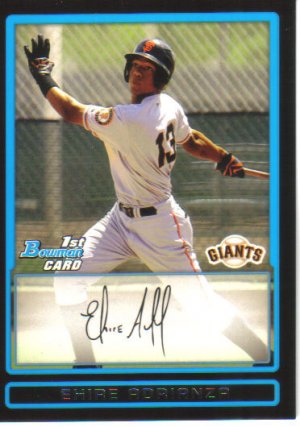 SS Ehire Adrianza (C) - His raw tools are very solid. His glove is excellent. He has an athletic body that can probably put on another 10-15 pounds. He also has shown very good plate discipline. At 19, he held his own quite well in loA with a 258/333/327 line. His contact rate is not good and I doubt he will develop much power. That said, a young SS with a solid glove and good discipline is a rare find.
SS Brandon Crawford (C) - Crawford, as you many remember, was our 4th round selection in the 2008 shadow draft we ran in real time. His glove is solid and compares rather well with Adrianza's. Both should be MLB quality in their defense. His bat? Back in 2008 we wrote this:
In HiA, Crawford was either excellent or was no match for the pitching at that level. He broke out with a 371/445/600 line in 105 at bats showing off very good power. He was then promoted to AA and struggled. He struck out 25% of the time. Had difficulty earning walks. He did show some gap power (ISO - .107), but nothing very extraordinary. It would probably benefit him repeating AA. He needs to show better plate discipline and a better contact rate. In the Baltimore system, he will be having to share time with Pedro Florimon, Jr., whom the Orioles seem to favor.
Who would I want?
1. Ehire Adrianza
2. Nick Noonan
3. Brandon Crawford
4. Aaron King
5. Clayton Tanner
I think the Giants would probably look to move Crawford or King from that group.
This leaves two slots open for Steve Johnson to fill: middle relief or long relief. With both Runzler and Affeldt as southpaws, Johnson's righthandedness should not impede him. It also helps that his role is one in which very little is expected. Merkin Valdez and Joe Martinez/Ryan Sandowski held down the middle relief and long relief/swingman roles, respectively. Of those players, only Joe Martinez remains. What also works for Johnson is that Giants personnel are very positive about Johnson after watching him for several seasons in the Dodgers' system.
After the jump, Johnson's competition for these two positions and what this may mean for the Orioles.
Todd Wellemeyer, RHRP (has started in the past)
Wellemeyer is a non-roster invite to the Giants camp. He came up as a reliever in the Cubs system. After winding up in St. Louis in midway through 2007, he proceeded to pitch quite effectively as a starter for a year and a half. He kept his strikeouts above 6 per 9 and did well to limit walks. That fell apart last year as he missed awfully few bats. Wellemeyer is something that the Giants brass are known to love . . . veterans. He has pitched for many years and has shown a great degree of competence. Todd Wellemeyer is basically Steve Johnson seven or so years from now.
Joe Martinez, RHRP (has started in the past)
Martinez filled the role of swingman and long relief last year. He did not do well posting a 7.50 ERA over 30 innings. Unless he shows some promise, he most likely will be sent down to AAA and be the first brought up. Based on my math, he should have 2 options left.
Kevin Pucetas, LHP (starter in minors)
Pucetas has rather average pitches, but was shown to pitch quite effectively in low and hi A ball. Last year, the Giants chose to skip him over AA and he proceeded to be rather ineffective at AAA Fresno. A conservative organization would allow him another year to start at Fresno. If the Giants think they are close to the playoffs, they might prefer having another left handed option in the pen. I'd be doubtful that he could start in the Majors with his repertoire.
Waldis Joaquin, RHRP
Joaquin threw 10.2 innings at the Major league level and showed that he could miss bats (10.1 k/9) and strike zones (5.9 bb/9). He tasted the Majors last year after dominating AAA for 8 innings. That may have been an aberration.
Guillermo Mota, RHRP
Mota just signed as an NRI and would be considered for the middle relief position. He is a veteran who has pitched as a closer and setup man. It is the typical M.O. for the Giants organization to employ a player like Mota in the pen. His peripherals have been slightly shaky the past two seasons, but he has been an integral part for the Dodgers and Brewers bullpens. I would be surprised if he did not wind up being the 6th man in the pen.
I doubt any of the non-roster invites will put up much competition to these guys. NRIs: Denny Bautista, Santiago Casilla, Rafael Cova, Steven Edlefsen, Eric Hacker, Osiris Matos, Tony Pena Jr., Felix Romero, Dan Turpen, Craig Whitaker, Craig Clark, and Clayton Tanner.
Who is likely to get the middle relief role?
1. Mota
2. Joaquin
3. Wellemeyer
4. Johnson
Who is likely to get the long relief role?
1. Wellemeyer
2. Martinez
3. Johnson
4. Bautista
I find it near impossible for him to win the last middle relief slot. I find there to be some chance he could stick on in the long relief role. My bet is that Mota and Wellemeyer wind up in these two slots. The Giants tend to embrace veterans and might be reluctant in giving slots for a rookie to hide and take his lumps. I do think the Giants value him and believe they will be looking to trade for him.
What is Steve Johnson worth and what do the Orioles need?
John Sickels rates Steve Johnson as a C+ prospect (all Sickels grades links here AL - NL). In return the Orioles would probably receive a prospect with a similar grade. Areas of organizational need for the Orioles would be second base, short stop, and left-handed relief. The following players fit that criteria:
2B Nick Noonan (C+) - Noonan has his supporters and is thought to be more valued in the Giants front office than elsewhere in baseball. It remains to be seen if they would entertain a straight trade for Johnson. Last season saw Noonan as a 20yo in HiA. Poor contact skills, good plate discipline, average power, below average speed, and very good base running. He seems to be a very smart player. He is a kind of prospect who could break out in the next season or two. He would slot in at AA and compete with Ryan Adams. Both profile as offensive 2B, but Noonan has much more speed. Noonan is an NRI this year.
LHSP Aaron King (C+) - King has a powerful arm and would be shoehorned into a tight starting rotation in Frederick. It might be more realistic though to begin shifting him toward being a potential dominant bullpen arm. The hope would be that pitching from the stretch and focusing on his low 90s sinker. His mechanics are a bit of a mess, so I doubt he will be valued by many as a starter.
LHSP Clayton Tanner (C+) - Tanner is similar to Johnson in that he is a lefty that is better known for pitchability than how impressive his actual pitches are. After repeating HiA and getting hit much harder the second time through (1hr in 2008 vs 18hr in 2009), he still managed to do pretty well. His soft spot was right handers hitting him hard. His FIP against lefties was 3.04, while it was 5.11 against righties. Only one lefties hit a home run off him. He will probably start in AA, but is beginning to look like someone who will eventually be shifted to a LOOGY role.
SS Ehire Adrianza (C) - His raw tools are very solid. His glove is excellent. He has an athletic body that can probably put on another 10-15 pounds. He also has shown very good plate discipline. At 19, he held his own quite well in loA with a 258/333/327 line. His contact rate is not good and I doubt he will develop much power. That said, a young SS with a solid glove and good discipline is a rare find.SS Brandon Crawford (C) - Crawford, as you many remember, was our 4th round selection in the 2008 shadow draft we ran in real time. His glove is solid and compares rather well with Adrianza's. Both should be MLB quality in their defense. His bat? Back in 2008 we wrote this:
Dating back to the Cape, he has been pressing rather than letting his game flow naturally. As his struggled continued, he pressed harder -- regularly lunging at pitches and frequently showing signs of frustration. He has demonstrated a potential for plus-power, but he'll have to improve his contact rate to realize it.
In HiA, Crawford was either excellent or was no match for the pitching at that level. He broke out with a 371/445/600 line in 105 at bats showing off very good power. He was then promoted to AA and struggled. He struck out 25% of the time. Had difficulty earning walks. He did show some gap power (ISO - .107), but nothing very extraordinary. It would probably benefit him repeating AA. He needs to show better plate discipline and a better contact rate. In the Baltimore system, he will be having to share time with Pedro Florimon, Jr., whom the Orioles seem to favor.
Who would I want?
1. Ehire Adrianza
2. Nick Noonan
3. Brandon Crawford
4. Aaron King
5. Clayton Tanner
I think the Giants would probably look to move Crawford or King from that group.
01 March 2010
Beyond Batting Average and interview with author Lee Panas
 As many of us who discuss sabermetrics and statistics in general and how they relate to baseball; it is a subject that carries a broad range of awareness and acceptance in conversations about the game. The most recent statistical discussions have occurred over the past decade and taken place on the internet. As conducive as the internet is to share information and quickly acclimate to new truths and create or discover new applications, it has some problems as it is a very ephemeral library. Little is written down and much is carried on in a digitalized form similar to Homer. Web sites close shop, people get hired and their work gets scrubbed, and many baseball critics do not follow rules of citation very well. It makes it difficult to get caught up to speed on the conversation even if you are interested in how to use metrics in baseball.
A problem I have often seen when a book is written about sabermetrics is that they are often grooved for those in the mid- to hi- level of competency in the field. Introductory level works are hard to find and are a major reason why many web sites are beginning to post running SABR 101 FAQ's on their sites. It has also led to SABR series on Yahoo! and other online publications. Thankfully, I think I have found an actual book that is somehow both a handy introduction to what statistics mean and their utility in baseball as well as a resource for more advanced users of metrics (which is quite needed as metrics are often used incorrectly). Lee Panas' Beyond Batting Average is this book.
Panas does well to present the historical time line of statistics from Chadwick's original descriptive statistics to Branch Rickey and his usage of ISO to present day concepts like linear and nonlinear metrics. One amusing side note indicates how folks complained about new metrics in the late 1800s just as people do now with stats like WAR or xFIP. Panas does well to give you the formulas for advanced stats if you wish to play around with them, but moreso they act as an illustration letting you know what each statistic accounts for and how they are weighted. In the text, he simply and straight-forwardly explains what the formulas mean and how that effects statistical outputs. He informs the reader what each stat does well and their limitations.
As you have noticed I rarely review a book, but this is one that I think merited that. It is a solid addition to anyone's library. The introductory baseball statistics reader who wants to learn more and be able to start engaging in conversations about metrics would find this most useful. More advanced readers will see this as being useful at times for the quick to grab metrics and have a solid citation when making a claim about repeatability for a certain statistic and how that might relate to a skill.
Lee was kind enough to take part in an interview with Camden Depot. It is shown in full after the jump.
Camden Depot: I often find it important when reading a book to understand who the author is and from where personal experience is he/she writing. I was hoping you could give us your background, information about the blog you write, and other items you think potential readers of your book would be interested in.
Lee Panas: I have been interested in sabermetrics since the early 1980s. Bill James was writing his Baseball Abstracts at the time and he was a big influence on me. In addition, I was studying mathematics and statistics in college and some of my classes required me to apply statistical methods to real data. So, I used baseball statistics in a few of my projects. This gave me the opportunity to prepare for my career as a research analyst while learning more about baseball at the same time.
I have been writing at DetroitTigerTales.com since 2005. I discuss a lot of topics besides statistics there - Tigers history, prospects, transactions, etc - but sabermetrics has always been the overriding theme. I have written a lot about baserunning and fielding statistics in particular. In addition to my blog , I am currently writing about the Tigers for John Burnson's Heater Magazine. I have also contributed to books such as Tigers Corner, Graphical Player and How Bill James Changed Our View of Baseball.
CD: From experience, I have found that taking on a large endeavor (i.e. a book) often comes from a moment of transcending excitement and then several months of trying to pay dues to that initial moment of inspiration. Was there a singular moment that convinced you that you had to write this book? If not, where do you think this urge originated?
LP: There was not really a single moment where I decided to write a book. It's something that has been building for a long time. I have avidly been discussing baseball on message boards and blogs for a couple of decades. Much of my time has involved explaining sabermetrics to people. In the early years, there wasn't a great deal of interest in the subject. However, I have noticed a lot more people getting curious about it in recent years. Blogging has been a good way to educate more people about the field but I can only give small does in that format. Thus, it became increasingly clear that I wanted to write a book where I could tie all the information together into a complete story.
CD: The sabermetric field has seemed to me that it is moving toward a goal that is to evaluate the true talent of a player. That is, a progression from simple descriptive statistics to predictive/evaluative ones. From what I have read in your book as well as the outline, it seems to me that you very much support this perspective on moving toward predictive statistics. Do you think anything (i.e. blind luck, MVPs) is lost or being lost (or devalued) in terms of appreciation by doing this and is that bad?
LP: For the most part, I think trying to evaluate a player with predictive statistics is a good thing. As you know, some of the more traditional statistics are based on things that are largely beyond a player's influence. It makes sense to eliminate as many outside factors as possible and to evaluate a player on things he can control most easily. I think that we are getting increasingly better at finding statistics which more accurately define a player's true talent.
There is, however, the potential for skills to get lost in this approach if we are not careful. I'll use ERA as an example. Statistics such as a strikeout rate, walk rate, ground ball percentage and FIP are more predictive than ERA for most pitchers. However, they don't take into account the ability of a pitcher to pump up his fastball or to induce a double play ball with runners on base. It has been shown that this has more to do with overall pitcher quality than clutch pitching ability. However, I think more work needs to be done to identify pitchers who may have more ability to pitch in high impact situations than others. For these pitchers, ERA might be telling us something that the so called true talent stats are missing.
CD: One of the more fearsome aspects of writing a book on baseball statistics is that the community is internet based and the level of information progresses so quickly. I think you have done a great job is writing something that is rather resilient in light of that. How did your recognition of the blinding pace of statistical innovation direct you in writing this book?
LP: First, I think the fast pace of sabermetrics has left some people frustrated because they can't keep up. That is one of the reasons I wrote the book. By organizing all the information in one place, I think it helps people catch up. I also hope through reading the book, fans will understand more about the reasoning behind the statistics. This should help readers make sense of future measures more quickly.
One thing I have done throughout the book is to include a bit of history showing the evolution from simple traditional measures to the more advanced measures of today. I think this better prepares readers for the future advances in statistics than if I just dove into the present and talked about the statistics developed in the last two years.
CD: You have mentioned before that you largely relied on peer review for this book. Can you tell us some of the people you consulted in writing this book?
LP: I think peer review is essential in this kind of effort. It's a complex subject and I wanted make sure I got everything right. There are a couple of important sections of the book that might have been left out if it were not for the suggestions of others. There was also a matter of educating myself in certain areas. I had a good handle on most of the statistics coming in but there were a couple of instances where I was not interpreting statistics as accurately as I could. So, I was glad to have the developers of the statistics correct me. Finally, I think peer review helped me write the book in a way that would make it accessible to as many people as possible. For example, there were some sections in early drafts which reviewers felt were a little too mathematical for my target audience. I either eliminated those sections or wrote them more simply.
The reviewers ranged anywhere from very talented sabermetricians who know the field better than I do to intelligent baseball fans who are relatively new to sabermetrics. Some of the key contributors in alphabetical order are John Dewan, Brandon Heipp (aka U.S. Patriot), Chuck Hildebrandt, Justin Inaz, Mitchel Lichtman, Kurt Mensching, Pete Palmer, Samara Pearlstein, Tom Tango and Geoff Young. There were many others but I think this gets the point across that I got input from a lot of different kinds of people.
CD: Thanks again Lee. Very well done.
LP: Thanks very much for the interview.
Lee Panas' blog is Tiger Tales and has recently written, Beyond Batting Average.
Subscribe to:
Posts (Atom)