A few items...
If you are in need of a comprehensive draft site, go here.
If you want a summary of potential Orioles selections, go here.
If you want to see some overslot targets after the first round, go here.
Feel free to leave questions on this post or later ones. Twitter might be a bit crazy for some of us today.
06 June 2011
Cup of jO's: No, Mr Jones. You Don't Have to Run Out Every Ball.
Yesterday, I was finally able to make use of my press pass again and make it to the rubber match between the Orioles and Blue Jays. Mark Reynolds crushed a home run. We do not need to speak of anything else.
Today is the draft and we aim to have a lot of draft items coming at you over the next couple days.
---
One thing I would like to rehash from yesterday's game was something that I wrote that resulted in a number of my readers becoming upset with me. In one of Adam Jones' plate appearances he hit a rocket to shortstop, Yunel Escobar. Escobar got good glove on the batted ball, Jones broke his stride, and then the ball popped out of Escobar's glove. Jones momentarily sped up until he saw that Escobar quickly recovered. Jones never had a shot at first whether he was running full speed the entire time or not.
In response, I wrote something close to the point of Jones really should not have been running that ball out at 100% because it really did not matter. This upset some people who follow my twitter account. I will try to go through my thinking on this one.
Chance of Success
 When I was in instructional league, I played for the First National Bank Brewers. It is a memorable year for two reasons: 1) other kids cried when they faced me because I threw hard for a third grader and 2) I managed to get on base every plate appearance except for one. Only the second feat is pertinent to this conversation. I got on base every time because I was in the left handed batter's box, I was reasonably fast, and fielders at the instructional level can barely field and are almost completely unable to throw a ball in the air on target to first base. You have to run out every single batted ball because the chances of success are great.
As you move up through the ranks, fielding becomes exponentially better until it begins to plateau after high school and flat lines at the MLB level. At the MLB level, a batter facing an average defense is likely to benefit from an error once every 75 times up to bat. At my high school over a decade ago, a batter had a chance for an error to occur once every 15 at bats. I think we can all appreciate that difference. The chances that hustling will result in a man on base at the MLB level is far, far below what that would be at the high school level just using these two teams as examples. It simply does not happen very often, so hustling on every play should not be valued equally at each level of play due to the diminishing value of the effort.
I will try to put a number here using some assumptions. We already established an error now occurs once every 75 plate appearances (9 times every 700 PA). Let's assume that 1970 was the golden age of hustling. Then a batter had a chance of benefiting from an error every 55 plate appearances (13 times every 700 PA). When these two numbers in mind, lets say a modern batter, if hustling, would get on base an extra four times a year. Reaching on base via error is worth about 0.5 runs per event. This would mean that a batter would produce two more runs a year if he hustled all the time. That would mean an additional 0.2 wins per player hustling. An entire teams of hustlers would give you almost two wins more a season. That would be consequential to teams right on the bubble.
What is the cost?
 It is also important to recognize that effort is not limitless. There is a cost. Players often speak of the grind of a season wearing down on them. Many will also speak of how a brutal sun and humidity leaves them barely hanging on at the end of a night. These qualitative assessments we have all heard and some of us have even felt these things. There is a cost to trying hard. Let's step through this in an extreme form of effect: injury.
Running out plays is a Cost / Benefit analysis
This last step is the most difficult one to take. I personally do not know how more likely a player is to be injured (or to become less effective) due to hustling. We can all agree there is a cost there, but I am not sure what that cost is. I am also sure we can agree that players should not fully hustle on every single play. It would be surprising to me to talk to someone who thinks a player should slide into the bag at the end of each play. It would simply make no sense because a player would be pointlessly increasing his chance of injury.
For me, a line drive straight at an infielder or a simple ground ball as occasions that would not make me demand a player to press his luck. I would prefer having his glove and his bat in the lineup instead of risking ineffectiveness by legging out a play that results in an out 98% of the time. I might be too conservative here. I don't think I am. To me, it seems like common sense. The problem is that hustling is risky for the team if the best players hustle. Their performance cannot be replaced and an extra ten runs a season is not worth a lot if there stands a small chance that a catastrophic injury might occur. It really is not about babying a player . . . it is about preserving your resources and employing them in a fashion to have the greatest chance of success.
One final thought, when I think of hustling I think of catchers and second basemen. These are rough and tumble positions. The career life span of players who play these positions are rather short. A career of getting bounced around at second base making the turn or getting hit by foul balls and barreling catchers at home results in a age curve where it is difficult to be a useful player past the age of 32. Although I have no proof that hustling causes similar effects, I think it is a reasonable position to assume that it does.
With that in mind, I must say: No, Mr. Jones, you do not have to run out every ball.
Today is the draft and we aim to have a lot of draft items coming at you over the next couple days.
---
One thing I would like to rehash from yesterday's game was something that I wrote that resulted in a number of my readers becoming upset with me. In one of Adam Jones' plate appearances he hit a rocket to shortstop, Yunel Escobar. Escobar got good glove on the batted ball, Jones broke his stride, and then the ball popped out of Escobar's glove. Jones momentarily sped up until he saw that Escobar quickly recovered. Jones never had a shot at first whether he was running full speed the entire time or not.
In response, I wrote something close to the point of Jones really should not have been running that ball out at 100% because it really did not matter. This upset some people who follow my twitter account. I will try to go through my thinking on this one.
Chance of Success
When I was in instructional league, I played for the First National Bank Brewers. It is a memorable year for two reasons: 1) other kids cried when they faced me because I threw hard for a third grader and 2) I managed to get on base every plate appearance except for one. Only the second feat is pertinent to this conversation. I got on base every time because I was in the left handed batter's box, I was reasonably fast, and fielders at the instructional level can barely field and are almost completely unable to throw a ball in the air on target to first base. You have to run out every single batted ball because the chances of success are great.As you move up through the ranks, fielding becomes exponentially better until it begins to plateau after high school and flat lines at the MLB level. At the MLB level, a batter facing an average defense is likely to benefit from an error once every 75 times up to bat. At my high school over a decade ago, a batter had a chance for an error to occur once every 15 at bats. I think we can all appreciate that difference. The chances that hustling will result in a man on base at the MLB level is far, far below what that would be at the high school level just using these two teams as examples. It simply does not happen very often, so hustling on every play should not be valued equally at each level of play due to the diminishing value of the effort.
I will try to put a number here using some assumptions. We already established an error now occurs once every 75 plate appearances (9 times every 700 PA). Let's assume that 1970 was the golden age of hustling. Then a batter had a chance of benefiting from an error every 55 plate appearances (13 times every 700 PA). When these two numbers in mind, lets say a modern batter, if hustling, would get on base an extra four times a year. Reaching on base via error is worth about 0.5 runs per event. This would mean that a batter would produce two more runs a year if he hustled all the time. That would mean an additional 0.2 wins per player hustling. An entire teams of hustlers would give you almost two wins more a season. That would be consequential to teams right on the bubble.
What is the cost?
a. At full exertion, we are forcing our body to our limits. This increases injury rate because we are challenging our tissues to withstand the stress we are placing on it. Simply put, you are more likely to injure yourself running a full sprint than you are walking.
b. As we tire, injury rates also increase. As our muscles fatigue, they are not able to access needed nutrients in a timely manner which increases chance of injury. As our muscles fatigue, we are less likely to be mechanically sound in our efforts. As we fatigue, our ability to focus decreases and we are more likely to put ourselves in situations that are not ideal. All of these increase the chance of injury.If a starter gets injured, it is likely that the player that will replace him in the lineup will be around replacement level. If you have a 3 WAR player (good but not great), the break even point would be losing 10 games to injury. If we are talking about an MVP caliber player, the break even point would be losing four games to injury. When you factor in the possibility of a catastrophic injury (career-ending or elite performance ending) the cost to a team's current play as well as creating a new need for the future along with enormous sunk cost resulting in roster inflexibility seems impossible to think that hustling all the time is beneficial.
Running out plays is a Cost / Benefit analysis
This last step is the most difficult one to take. I personally do not know how more likely a player is to be injured (or to become less effective) due to hustling. We can all agree there is a cost there, but I am not sure what that cost is. I am also sure we can agree that players should not fully hustle on every single play. It would be surprising to me to talk to someone who thinks a player should slide into the bag at the end of each play. It would simply make no sense because a player would be pointlessly increasing his chance of injury.
For me, a line drive straight at an infielder or a simple ground ball as occasions that would not make me demand a player to press his luck. I would prefer having his glove and his bat in the lineup instead of risking ineffectiveness by legging out a play that results in an out 98% of the time. I might be too conservative here. I don't think I am. To me, it seems like common sense. The problem is that hustling is risky for the team if the best players hustle. Their performance cannot be replaced and an extra ten runs a season is not worth a lot if there stands a small chance that a catastrophic injury might occur. It really is not about babying a player . . . it is about preserving your resources and employing them in a fashion to have the greatest chance of success.
One final thought, when I think of hustling I think of catchers and second basemen. These are rough and tumble positions. The career life span of players who play these positions are rather short. A career of getting bounced around at second base making the turn or getting hit by foul balls and barreling catchers at home results in a age curve where it is difficult to be a useful player past the age of 32. Although I have no proof that hustling causes similar effects, I think it is a reasonable position to assume that it does.
With that in mind, I must say: No, Mr. Jones, you do not have to run out every ball.
05 June 2011
Science of Baseball: June 5, 2011
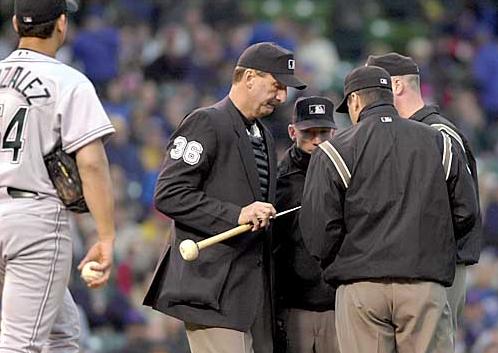 |
| Umps checking out a corked bat. |
Growth hormone and physical performance
Birzniece et al 2011. Trends Endocrin Metab 22:171-178
This review covers a great deal of territory we have covered before. The drug, hGH, is widely abused through sports due to a poor ability to detect this type of doping and as a result of uncertain effects. The science literature has found scant evidence of hGH helping improve athletic performance. It has been found not to affect muscle strength, power, or aerobic capacity. Ho's groups' own studies have observed that it does improve anaerobic capacity. However, his findings have not been duplicated (nor has anyone published anything attempting to duplicating them). This means there is a slim bit of hope that hGH might improve a baseball player's ability to sprint, but not much else. That improvement, if true, is likely to be largely ineffective. The effects they found could have ramifications in events for short distances in track and field, but would wind up being the difference of a half or a full step. As far as I am aware, there has not been a massive increase in infield singles in professional baseball.
Corked bats, juiced balls, and humidors: the physics of cheating in baseball.
Nathan et al. 2011. Am Ass. Phys. Teach. (pdf)
In this study, the researchers looked at how corking a bat affected how a ball traveled off a bat, compared how lively balls were between now and the 1970s, and to what degree a humidor affects the distance traveled by a baseball. They found that corked bats would result in a shorter distance traveled, but a faster bat speed. This reiterates what has been repeatedly found: corked bats help slap hitters, not home run hitters. With balls from different eras, they found essentially no difference between them. Studies focused on this question have run back and forth, it would be interesting to see a better done study on this with full characterizations of unused game balls over several eras. Finally, the ylooked into how humidors affect distance traveled. Unsurprisingly, they found that the use of a humidor can account for the decrease in home runs at Coors Field.
I think the first and third questions have been largely answered. I am not entirely pleased with how they answered the second question. I would have preferred a greater range of baseballs and a greater degree of characterization. Additionally, I would also like to see more information about how game used balls differ from unused ones.
Balance ability and athletic performance.
Hrysomallis 2011. Sports Med 41:221-232.
Previous studies have shown that in general, athletes of specific sports are less injury prone if they display better balance. In this study, they reviewed past articles on how balance could affect several skills in several sports. With respect to baseball, they reviewed a Marsh et al 2004 study. That study found that using several different balance metrics did not correlate to distance missed from a glove target when pitching. It is not an ideal study, but it certainly is an interesting question to pose an interesting way of answering it. Balance certainly predicts success with archers and sharpshooters. It might be good to expand this study beyond pitching accuracy to other aspects of the game (i.e. defense, contact rate) or including mechanics into the balance equation for pitching accuracy.
Cup of jO's: Father's Day Contest
First things first, Mark Reynolds had a thrilling grand slam last night that made the difference in the game. It has felt like this season has had a major effect on power hitters. Mark Reynolds is scuttling along on pace to barely break 20 home runs where he 76 the previous two seasons combined. Adam Dunn is lost and gone. ARod's production has decreased. Albert Pujols is going through his worst season as a pro. Hanley Ramirez is doing his best 2011 Nick Markakis at the plate. However, home runs per game have decreased from 0.97 to only 0.93. Doubles have also decreased from 1.77 to only 1.73 per game. It does not appear that there is any power outage. Yes, it has decrease slightly, but it may just be a squirrelly year where we see a downturn by several players. Hopefully, Reynolds and Markakis start lighting the world on fire.
---
Father's Day Contest
I am pleased to announce that we are able to provide four (4) DVDs of Baltimore Orioles Vintage World Series with the help of A&E Entertainment and MLB Productions. Surprising to us, four DVDs do not cover out daily readership, which now numbers in the hundreds (Thank You). This means we need to have a contest to determine where these DVDs go.
 More about the prize:
Good luck and we look forward to reading all of your stories on Camden Depot's Facebook page (you can access it from the Facebook inline on the left hand side of the screen).
---
The draft is soon approaching. Some things we will offer:
1. A few more draft pieces by me and Nick.
2. A co-hosting of a general MLB draft chat live on Monday with Diamondscape Scouting.
3. More specific draft chats focusing on the Orioles on Tuesday and maybe even Wednesday if everyone is diehard enough.
---
Father's Day Contest
I am pleased to announce that we are able to provide four (4) DVDs of Baltimore Orioles Vintage World Series with the help of A&E Entertainment and MLB Productions. Surprising to us, four DVDs do not cover out daily readership, which now numbers in the hundreds (Thank You). This means we need to have a contest to determine where these DVDs go.
All the glory and classic moments of the Orioles' World Series Championships from 1966 to 1983 are digitally preserved on this official DVD. Spanning three decades and three managers - Hank Bauer, Earl Weaver, and Joe Altobelli - the enduring, common trait of the Baltimore Orioles' success was stellar pitching, well-timed power, and peerless defense.
The arrival of Frank Robinson in 1966 catapulted the Orioles to their first Fall Classic. Baltimore's pitchers dominated, holding the Los Angeles Dodgers to just two runs for the entire four-game World Series. Four Octobers later, the Birds power hitting and fielding were on display. The rally-ending defense of Brooks Robinson and the club's 10 home runs in five games helped the O's to a second championship. In 1983, the familiar formula and a familiar face held an encore. The Orioles' staff, including Jim Palmer who provided a bridge to the 1966 victors, stifled the Philadelphia Phillies, allowing only seven runs in five games.To enter, like us on Facebook and post on our wall about a memory you cherish where a father or father figure (you can be the father figure, it can be an Uncle, neighbor, Grandfather, etc.) took a child to a baseball game. We did not have anything to give away on mother's day, so moms are certainly welcome here as well. There are not many rules . . . PG-rated stories only, at least as long as a haiku and try not to exceed three paragraphs. On Father's Day, we will highlight the stories randomly chosen on the blog and will then start getting information from the winners for the DVDs to be mailed directly to them.
Good luck and we look forward to reading all of your stories on Camden Depot's Facebook page (you can access it from the Facebook inline on the left hand side of the screen).
---
The draft is soon approaching. Some things we will offer:
1. A few more draft pieces by me and Nick.
2. A co-hosting of a general MLB draft chat live on Monday with Diamondscape Scouting.
3. More specific draft chats focusing on the Orioles on Tuesday and maybe even Wednesday if everyone is diehard enough.
04 June 2011
Cup of jO's: Final Leg into the Draft
Last night Zach Britton had another tough night that was a mix of poor luck and reduced command. For any pitcher, we should expect a couple games where these issues pop up. I think in the past he has had some good luck with bearing down and preventing base runners from scoring. He was outperforming his fielding independent pitching metrics, so some regression was certainly expected. It is highly unlikely he is a sub-3 ERA pitcher, but I can certainly see him in the upper 3's. I would not fret.
---
 As we began to stop counting down to the draft with days and switch over to hours, we generally see a tightening up of mock drafts. This tightening up is often due, in my opinion, to writers like Keith Law and Jim Callis getting slightly more information and the masses reacting to that and devising their own mock draft. I also think the major changes in the mock draft with high profile names dropping may be more a product of magnetic journalism as opposed to any real change, but I digress. This morning I am going to run over the two most recent mocks by Keith Law and Jim Callis with respect to whom the Orioles have available.
Keith Law
June 3, 2011 Mock Draft (insider access)
Keith has the Orioles options including Danny Hultzen (LHP, Virginia), Dylan Bundy (RHP, OK HS, O's farmhand Bobby Bundy's younger brother), Bubba Starling (OF, KS HS), and Archie Bradley (RHP, OK HS). I doubt the Orioles are looking for someone as raw as Bubba Starling with the first pick in the draft. In earlier years with the Orioles, Joe Jordan selected raw high schoolers in the first round, but he has never done so at the front end. The past few drafts, he typically focuses on players in that mold beginning in Round 2. Nick mentioned Derek Fisher (OF, PA HS) as a target in the third round, but it would not be surprising to see Jordan target a player like him in the second round.
Law sees, according to this mock draft, the Orioles selecting Danny Hultzen. This is a realistic scenario as long as Hultzen is not grabbed by the Pirates at number one or the Diamondbacks at number three. Personally, I am not as enamored with Hultzen. I think as the first tier college pitching prospects in the draft, he is the one I have the least faith in. Pitching once a week, he has been able to work in the 91-94 range while flirting with 95 and 96. A more regular pitching cycle typically shaves a few mph off a pitcher and, for me, that takes him from top of the rotation velocity to middle rotation velocity. Losing a few feet off your fastball enables batters more time to identify your pitches. He has a good change up, which helps. It is likely his best pitch. He is a good college pitcher merely using those two pitches. What has helped him greatly this year has been his ability to command his slider. It is not an impressive pitch, but a well located average slider is an effective weapon. As it stands, I see Hultzen as a high probability Major Leaguer, but a low probability star. With a draft as deep as this one, I would draft for players with better star potential. You become a first division team with great players, not average ones.
Jim Callis
June 3, 2011 Mock Draft
Callis sees the front end of the draft differently with Danny Hultzen going first, followed by Anthony Rendon (3B, Rice . . . Rendon going first or second is the only thing I think is certain in this draft), and Dylan Bundy going to the Diamondbacks. This adds Trevor Bauer (RHP, UCLA) and Gerrit Cole (RHP, UCLA) to the mix. The Orioles have been connected to both of these pitchers in the past. Callis goes with Bauer here. I can also see this as a possible outcome. However, it would be frustrating for me. I have no qualms with his unique pitching mechanics, but I am not fond of Bauer's 'overusage' this spring. His manager has let him stay out for about a half dozen outings of over 120 pitches. With a college starter's schedule, it is not as bad as a 20 year old throwing that many every fifth day in the professional ranks, but it is still a high number of pitches for a young arm. I also think he will suffer some velocity loss when he does convert over to the five day schedule. As opposed to Hultzen, I think Bauer will be more successful with lost velocity by relying on his slow curve. It is an impressive offering. However, I'm weary of the overusage and would not actually consider him as the fourth pick.
Gerrit Cole is the best case scenario for the Orioles that I see. I have Rendon as my top ranked player, but I see no chance he falls to us unless his medicals indicate he has no right arm and we have fallen victim to Rice using smoke and mirrors. Rendon will be a Pirate or Mariners with my bet on the latter. Cole, on the other hand, could fall. I doubt he will, but he could. He is likely to carry a large price tag, but most of these prospects will be gunning for a large payday. He is also hurt by other college pitchers putting up better numbers than he has, including his rotation mate Trevor Bauer. I contend that being a great college pitcher is not the same as being a great MLB pitcher. You need plus offerings and Cole is unique in that it appears he could harness three of them. He has a live fastball that he works in the mid 90s and flashes in the high 90s. If he loses velocity here, he still has top of the rotation velocity. He also has a plus slider that he throws with a similar delivery with his fastball. He has also shown the makings of a plus change up this year. If the Orioles let him slide by, I would be disappointed.
---
Note: I'll be selecting for the San Diego Padres on John Sickels' community mock draft today at 2 EST. The past two seasons I have handled the Orioles' selection, but thought that others should get a chance and tabbed James over at Camden Chat with the opportunity.
---
Keith Law
June 3, 2011 Mock Draft (insider access)
Keith has the Orioles options including Danny Hultzen (LHP, Virginia), Dylan Bundy (RHP, OK HS, O's farmhand Bobby Bundy's younger brother), Bubba Starling (OF, KS HS), and Archie Bradley (RHP, OK HS). I doubt the Orioles are looking for someone as raw as Bubba Starling with the first pick in the draft. In earlier years with the Orioles, Joe Jordan selected raw high schoolers in the first round, but he has never done so at the front end. The past few drafts, he typically focuses on players in that mold beginning in Round 2. Nick mentioned Derek Fisher (OF, PA HS) as a target in the third round, but it would not be surprising to see Jordan target a player like him in the second round.
Law sees, according to this mock draft, the Orioles selecting Danny Hultzen. This is a realistic scenario as long as Hultzen is not grabbed by the Pirates at number one or the Diamondbacks at number three. Personally, I am not as enamored with Hultzen. I think as the first tier college pitching prospects in the draft, he is the one I have the least faith in. Pitching once a week, he has been able to work in the 91-94 range while flirting with 95 and 96. A more regular pitching cycle typically shaves a few mph off a pitcher and, for me, that takes him from top of the rotation velocity to middle rotation velocity. Losing a few feet off your fastball enables batters more time to identify your pitches. He has a good change up, which helps. It is likely his best pitch. He is a good college pitcher merely using those two pitches. What has helped him greatly this year has been his ability to command his slider. It is not an impressive pitch, but a well located average slider is an effective weapon. As it stands, I see Hultzen as a high probability Major Leaguer, but a low probability star. With a draft as deep as this one, I would draft for players with better star potential. You become a first division team with great players, not average ones.
Jim Callis
June 3, 2011 Mock Draft
Callis sees the front end of the draft differently with Danny Hultzen going first, followed by Anthony Rendon (3B, Rice . . . Rendon going first or second is the only thing I think is certain in this draft), and Dylan Bundy going to the Diamondbacks. This adds Trevor Bauer (RHP, UCLA) and Gerrit Cole (RHP, UCLA) to the mix. The Orioles have been connected to both of these pitchers in the past. Callis goes with Bauer here. I can also see this as a possible outcome. However, it would be frustrating for me. I have no qualms with his unique pitching mechanics, but I am not fond of Bauer's 'overusage' this spring. His manager has let him stay out for about a half dozen outings of over 120 pitches. With a college starter's schedule, it is not as bad as a 20 year old throwing that many every fifth day in the professional ranks, but it is still a high number of pitches for a young arm. I also think he will suffer some velocity loss when he does convert over to the five day schedule. As opposed to Hultzen, I think Bauer will be more successful with lost velocity by relying on his slow curve. It is an impressive offering. However, I'm weary of the overusage and would not actually consider him as the fourth pick.
Gerrit Cole is the best case scenario for the Orioles that I see. I have Rendon as my top ranked player, but I see no chance he falls to us unless his medicals indicate he has no right arm and we have fallen victim to Rice using smoke and mirrors. Rendon will be a Pirate or Mariners with my bet on the latter. Cole, on the other hand, could fall. I doubt he will, but he could. He is likely to carry a large price tag, but most of these prospects will be gunning for a large payday. He is also hurt by other college pitchers putting up better numbers than he has, including his rotation mate Trevor Bauer. I contend that being a great college pitcher is not the same as being a great MLB pitcher. You need plus offerings and Cole is unique in that it appears he could harness three of them. He has a live fastball that he works in the mid 90s and flashes in the high 90s. If he loses velocity here, he still has top of the rotation velocity. He also has a plus slider that he throws with a similar delivery with his fastball. He has also shown the makings of a plus change up this year. If the Orioles let him slide by, I would be disappointed.
---
Note: I'll be selecting for the San Diego Padres on John Sickels' community mock draft today at 2 EST. The past two seasons I have handled the Orioles' selection, but thought that others should get a chance and tabbed James over at Camden Chat with the opportunity.
03 June 2011
Cup of jO's (June 3, 2011): Orioles violating MLB's debt service -- so what?
No game last night -- let's jump right into what caught my eye this morning...
What caught my eye...
Bill Shaikin of the L.A. Times wrote this morning that nine teams are reportedly in violation of MLB's debt service rules -- one the nine being the Baltimore Orioles. With dwindling season ticket sales and underwhelming performance of the MASN network (from a viewer and ad revenue standpoint), I don't think it comes as a surprise to many O's fans that Baltimore's financial cup doth not runneth over. Shaikin summarizes the rules MLB has in place as follows:
Shaikin also mentions that the individuals leaking this financial information about these nine teams were not authorized to do so? Put on your tinfoil hats -- it seems to me they most certainly were authorized to leak the info, and this is simply a first volley from ownership to frame the upcoming Collective Bargaining Agreement with the MLB Players' Association, due to be renegotiated this off-season. Jon and I will look at this more closely, but for today let's just get the basics out of the way.
Obviously the fluid nature of revenue streams in the sport make it such that teams debt leverage ratio will fluctuate -- potentially dramatically depending on the particular revenue streams on which the organization most depends. For the Orioles, it makes intuitive sense that diminished season ticket sales and in-season ticket sales could have a significant impact on the club's revenues. MASN, thought by many to be a stabilizing revenue stream once up and running, has struggled to attract advertising money due to poor viewership (who would have thought fans wouldn't necessarily be interested in watching the O's and Nats on a regular basis?). So it is quite possible that the team, run no worse than it has been in the past five years, could see its debt leverage ratio slip out of whack after prolonged fiscal seepage on the ticket and ad sales front.
This is all educated guesswork, and we'll dig into the details more in the coming weeks. The larger question -- are there financial troubles across the sport -- is the more interesting question, and I think an easy one to answer. Currently the Dodgers and Mets have received lots of ink relating to their dire financial straights, and it's quite possible that both franchises are in serious trouble, with the debt leverage report providing further evidence. For the other seven franchises listed in today's L.A. Times article, we have scenarios wherein teams have run up their debt past a level Major League Baseball set as "reasonable". At the same time. each of these teams have taken on this debt by entering into agreements with lenders who themselves have analyzed the credit risk and sided with the teams that they are in fine financial position to take on the debt.
Whatever work went into setting the recommended debt leverage ratio at 10-1 for MLB clubs was likely done with the interest of the sport in mind -- we don't want our teams running themselves into bankruptcy and forcing frequent changes in ownership. Stability is a good thing. But if financial institutions are sitting down with Major League teams, you can be sure they are aware of MLB's debt service guidelines. You can also be certain the due diligence run on the business of the borrowing team is thorough, particularly in this economic climate. So where does that leave us?
Essentially, we see banks are siding with the borrowing organizations in determining their business is sound and they will be able to pay off the debt they are accumulating. If banks are willing to take on these risks, it seems to me that it is unlikely these teams are in danger of folding any time soon (again, educated guesswork with more research to follow). But, wow, is it a nice storyline to start running out there if you are looking to construct a dialogue centered around ownership cutting costs in various areas. With issues surrounding the Dodgers and their ownership, and widely publicized financial woes plaguing the Mets, the media is ripe for an overarching story about desperate times facing MLB ownership on the whole.
Don't believe the hype...
What caught my eye...
Bill Shaikin of the L.A. Times wrote this morning that nine teams are reportedly in violation of MLB's debt service rules -- one the nine being the Baltimore Orioles. With dwindling season ticket sales and underwhelming performance of the MASN network (from a viewer and ad revenue standpoint), I don't think it comes as a surprise to many O's fans that Baltimore's financial cup doth not runneth over. Shaikin summarizes the rules MLB has in place as follows:
The rules, intended to ensure clubs have the resources to support their financial obligations, generally limit a team's debt to 10 times its annual earnings, although Selig has wide latitude to enforce those rules.
Shaikin also mentions that the individuals leaking this financial information about these nine teams were not authorized to do so? Put on your tinfoil hats -- it seems to me they most certainly were authorized to leak the info, and this is simply a first volley from ownership to frame the upcoming Collective Bargaining Agreement with the MLB Players' Association, due to be renegotiated this off-season. Jon and I will look at this more closely, but for today let's just get the basics out of the way.
Obviously the fluid nature of revenue streams in the sport make it such that teams debt leverage ratio will fluctuate -- potentially dramatically depending on the particular revenue streams on which the organization most depends. For the Orioles, it makes intuitive sense that diminished season ticket sales and in-season ticket sales could have a significant impact on the club's revenues. MASN, thought by many to be a stabilizing revenue stream once up and running, has struggled to attract advertising money due to poor viewership (who would have thought fans wouldn't necessarily be interested in watching the O's and Nats on a regular basis?). So it is quite possible that the team, run no worse than it has been in the past five years, could see its debt leverage ratio slip out of whack after prolonged fiscal seepage on the ticket and ad sales front.
This is all educated guesswork, and we'll dig into the details more in the coming weeks. The larger question -- are there financial troubles across the sport -- is the more interesting question, and I think an easy one to answer. Currently the Dodgers and Mets have received lots of ink relating to their dire financial straights, and it's quite possible that both franchises are in serious trouble, with the debt leverage report providing further evidence. For the other seven franchises listed in today's L.A. Times article, we have scenarios wherein teams have run up their debt past a level Major League Baseball set as "reasonable". At the same time. each of these teams have taken on this debt by entering into agreements with lenders who themselves have analyzed the credit risk and sided with the teams that they are in fine financial position to take on the debt.
Whatever work went into setting the recommended debt leverage ratio at 10-1 for MLB clubs was likely done with the interest of the sport in mind -- we don't want our teams running themselves into bankruptcy and forcing frequent changes in ownership. Stability is a good thing. But if financial institutions are sitting down with Major League teams, you can be sure they are aware of MLB's debt service guidelines. You can also be certain the due diligence run on the business of the borrowing team is thorough, particularly in this economic climate. So where does that leave us?
Essentially, we see banks are siding with the borrowing organizations in determining their business is sound and they will be able to pay off the debt they are accumulating. If banks are willing to take on these risks, it seems to me that it is unlikely these teams are in danger of folding any time soon (again, educated guesswork with more research to follow). But, wow, is it a nice storyline to start running out there if you are looking to construct a dialogue centered around ownership cutting costs in various areas. With issues surrounding the Dodgers and their ownership, and widely publicized financial woes plaguing the Mets, the media is ripe for an overarching story about desperate times facing MLB ownership on the whole.
Don't believe the hype...
02 June 2011
2011 Depot Draft Preview: Positional Targets (2:4 - 5:4)
Thus far, we have focused on targets for Baltimore at 1:4, arriving at the following preference list (which we may tweak Monday morning as bonus demands begin to leak):
Anthony Rendon / 3b / Rice Univ.
Gerrit Cole / rhp / UCLA
Bubba Starling / of/rhp / Gardner Edgerton HS (Gardner, Kan.)
Sonny Gray / rhp / Vanderbilt Univ.
Dylan Bundy / rhp / Owasso HS (Owasso, Okla.)
Jed Bradley / lhp / Georgia Tech
Taylor Jungmann / rhp / Univ. of Texas
Danny Hultzen / lhp / Univ. of Virginia
Click on the above names for our full scouting reports with video courteosy of DiamondScapeScouting.com
We now shift our focus to Rounds 2 through 5, which we will divvy up into two separate posts. This first post will look at 12 targets on the position player side. Tonight we'll focus on 12 pitchers to target for these same four slots.
Targets for 2:4
Joe Panik (ss, St. John’s Univ.) could easily be off the board in the Supplemental-1st Round, and he is well within the top 60 players on our preference list. But the experts chatting-up the front office folks seems to view him as more of an early-Day 2 talent, which would be terrific for Baltimore. Panik has the smooth hands and footwork to play as an average shortstop at the pro ranks, but could also slide across the bag to second base where his arm may play a little better. He is gap bat without big homerun pop, but the hit tool is one of the best in the draft class.
Baltimore has just one selection in the first 60 picks, while Tampa, Toronto and Boston will be in a position to load up on a deep draft class due to compensation picks in the 1st and Supplemental-1st Round. Accordingly, Baltimore should be looking to grab anything and everything that slips through Day 1 due to signability. The dream scenario has Blake Swihart (Cleveland HS, Rancho Rio, N.M.) falling to Baltimore due to his commitment to Texas and likely sizeable bonus demands. It’s anyone’s guess as to what number “sizeable” ultimate equates. If he’s still around, he’s a huge upside pick that would be equivalent to Baltimore landing two top 10 overall talents.
Number two, and not far behind Swihart, on the 2nd Round wish list is Joshua Bell (of, Jesuit Coll. Prep., Dallas, Texas). Bell has some of the highest offensive upside in the draft, and would be slated to come off the board in the early- to mid-1st Round had he not sent a letter to the MLB Scouting Bureau stating he had a strong desire to attend Texas and does not wish to sign a pro contract. Many see this as a negotiating ploy, perhaps suggested by advisor Scott Boras. If the goal is to push Bell down to hometown Texas in the Supplemental-1st Round, Baltimore won’t get the opportunity to grab him. If Joe Jordan and the Orioles Dallas Area Scout thinks he is signable, they should jump at the opportunity to grab him if he’s still on the board at 64 overall.
Targets for 3:4
Kyle Gaedele (of, Valparaiso Univ.) is another talent that could be off the board before the O’s pick for the third time, particularly if he is high enough on the preference list for Tampa, San Diego and Toronto (as teams with numerous extra picks in the Supplemental-1st). Gaedele has huge raw power, plus speed and potentially enough arm strength for right field, though it would be a bit of a stretch. His instincts in the outfield may limit him to corner, but the pick here is for power.
B.A. Vollmuth (3b, Univ. of Southern Mississippi), like Gaedele, is a play at a big power bat. Vollmuth is going to swing and miss, but the potential is there for a legit 25 – 30 homerun corner infielder. As a collegiate shortstop, Vollmuth has the arm for the left side. His range will limit him to third as a pro, but he should be able to stick there. Like many of the names we are listing, he could be off the board early if another team is particularly high on the stick, but he fits well on our preference list in early-3rd Round.
A soggy spring prevented extended looks at Derek Fisher (of, Cedar Crest HS, Lebanon, Penn.), who stood out both at the East Coast Pro showcase last August and the WWBA World Championship in Jupiter, Florida last October. Fisher is a potential five-tool talent that could potentially play center but likely fits better in right. He has some of the better power upside in the prep ranks, and could be a great “get” if he slips this far due to his strong commitment to the University of Virginia.
Targets for 4:4
Cody Asche (3b/1b, Univ. of Nebraska) is a big corner infielder likely to end-up at first base at the Major League level. He comes with a track record of performance in the prestigious summer wood bat Northwoods League, and a strong 2011 with the new BBCOR bats. There is still a lot of swing-and-miss here, but Asche handles the barrel well enough that he could grow into a future #5 hitter with 25 homerun upside (perhaps more with an improved contact rate). A solid gamble at this stage in the draft – particularly if Baltimore has yet to add “power” to their draft portfolio -- Asche would fill an organizational need on two fronts (first base and power).
Dan Vogelbach (1b, Bishop Verot Cath. HS, Ft. Myers, Fla.) is the other side of the “fisrt base/power” coin, as an all-bat prep talent with plus-plus raw power and a nice feel for the craft of hitting. He has showcased his power pre-game, in showcase settings and in homerun derbies, but also shows current ability to square-up good prep pitching in-game. Despite working hard to slim down to around 240 pounds (standing just 6-foot-1), his body type is always going to come with concerns as to his ability to keep the weight in check. He isn’t as advanced as Prince Fielder at the same time, and his upside is a step behind. But Vogelbach could be an interesting roll of the dice at this point in the draft if he hasn’t already been scooped.
With backstops always in demand, Brett Austin (c, Providence HS, Charlotte, N.C.) may come off the board as early as the sandwich round. We have him valued as a 2nd or 3rd Rounder, but hold out hope that he could slip due to his commitment to N.C. State. Austin shows a solid approach from both sides of the plate, profiling as a gap-to-gap hitter that could provide good offensive output for the position. There are enough questions with his receiving (he is a little stiff and his actions generally do not scream “athleticism”) that he could just as easily dip into the later rounds if the right organizational fit doesn’t line-up.
Targets for 5:4
Jason Coats (of, Texas Christian Univ.) looked to be lined-up potential top 50 selection after a strong summer on the Cape, but the production has not repeated this Spring. Coats has good pop from the right side, and when he squares it the ball really jumps. His value is hurt some due to his arm and foot speed limiting him to left field. It’s a “buy low” thought that could pay off with the right adjustments.
Kevin Cron (1b, Mountain Point HS, Phoenix, Ariz.), brother of potential 1st Rounder C.J. Cron (1b, Univ. of Utah) has a big swing and legit “70” raw power. He set single-season and career records for the State of Arizona and has parlayed his monstrous high school career into a scholarship to play at TCU. As you can tell, we are focusing heavily on potential power prospects, and Cron is yet another name Baltimore should consider if available.
Rookie Davis (1b/rhp, Dixon HS, Sneads Ferry, N.C.) is a two-way talent, sitting 89-92 on the mound with a very heavy fastball, and providing good power from the right side at the plate. Davis showed well in Under Armour All-America workouts, and again in Jupiter last October. While he received mixed grades from evaluators this spring, the return on investment at this point in the draft is well worth the investment. He is committed to play at ECU, but is generally considered signable if he goes high enough in the draft.
Next Up
Tonight's post will look at three potential pitching targets for each of the above rounds. Tomorrow we'll cover Rounds 6 through 10.
Anthony Rendon / 3b / Rice Univ.
Gerrit Cole / rhp / UCLA
Bubba Starling / of/rhp / Gardner Edgerton HS (Gardner, Kan.)
Sonny Gray / rhp / Vanderbilt Univ.
Dylan Bundy / rhp / Owasso HS (Owasso, Okla.)
Jed Bradley / lhp / Georgia Tech
Taylor Jungmann / rhp / Univ. of Texas
Danny Hultzen / lhp / Univ. of Virginia
Click on the above names for our full scouting reports with video courteosy of DiamondScapeScouting.com
We now shift our focus to Rounds 2 through 5, which we will divvy up into two separate posts. This first post will look at 12 targets on the position player side. Tonight we'll focus on 12 pitchers to target for these same four slots.
Targets for 2:4
Joe Panik (ss, St. John’s Univ.) could easily be off the board in the Supplemental-1st Round, and he is well within the top 60 players on our preference list. But the experts chatting-up the front office folks seems to view him as more of an early-Day 2 talent, which would be terrific for Baltimore. Panik has the smooth hands and footwork to play as an average shortstop at the pro ranks, but could also slide across the bag to second base where his arm may play a little better. He is gap bat without big homerun pop, but the hit tool is one of the best in the draft class.
Baltimore has just one selection in the first 60 picks, while Tampa, Toronto and Boston will be in a position to load up on a deep draft class due to compensation picks in the 1st and Supplemental-1st Round. Accordingly, Baltimore should be looking to grab anything and everything that slips through Day 1 due to signability. The dream scenario has Blake Swihart (Cleveland HS, Rancho Rio, N.M.) falling to Baltimore due to his commitment to Texas and likely sizeable bonus demands. It’s anyone’s guess as to what number “sizeable” ultimate equates. If he’s still around, he’s a huge upside pick that would be equivalent to Baltimore landing two top 10 overall talents.
Number two, and not far behind Swihart, on the 2nd Round wish list is Joshua Bell (of, Jesuit Coll. Prep., Dallas, Texas). Bell has some of the highest offensive upside in the draft, and would be slated to come off the board in the early- to mid-1st Round had he not sent a letter to the MLB Scouting Bureau stating he had a strong desire to attend Texas and does not wish to sign a pro contract. Many see this as a negotiating ploy, perhaps suggested by advisor Scott Boras. If the goal is to push Bell down to hometown Texas in the Supplemental-1st Round, Baltimore won’t get the opportunity to grab him. If Joe Jordan and the Orioles Dallas Area Scout thinks he is signable, they should jump at the opportunity to grab him if he’s still on the board at 64 overall.
Targets for 3:4
Kyle Gaedele (of, Valparaiso Univ.) is another talent that could be off the board before the O’s pick for the third time, particularly if he is high enough on the preference list for Tampa, San Diego and Toronto (as teams with numerous extra picks in the Supplemental-1st). Gaedele has huge raw power, plus speed and potentially enough arm strength for right field, though it would be a bit of a stretch. His instincts in the outfield may limit him to corner, but the pick here is for power.
B.A. Vollmuth (3b, Univ. of Southern Mississippi), like Gaedele, is a play at a big power bat. Vollmuth is going to swing and miss, but the potential is there for a legit 25 – 30 homerun corner infielder. As a collegiate shortstop, Vollmuth has the arm for the left side. His range will limit him to third as a pro, but he should be able to stick there. Like many of the names we are listing, he could be off the board early if another team is particularly high on the stick, but he fits well on our preference list in early-3rd Round.
A soggy spring prevented extended looks at Derek Fisher (of, Cedar Crest HS, Lebanon, Penn.), who stood out both at the East Coast Pro showcase last August and the WWBA World Championship in Jupiter, Florida last October. Fisher is a potential five-tool talent that could potentially play center but likely fits better in right. He has some of the better power upside in the prep ranks, and could be a great “get” if he slips this far due to his strong commitment to the University of Virginia.
Targets for 4:4
Cody Asche (3b/1b, Univ. of Nebraska) is a big corner infielder likely to end-up at first base at the Major League level. He comes with a track record of performance in the prestigious summer wood bat Northwoods League, and a strong 2011 with the new BBCOR bats. There is still a lot of swing-and-miss here, but Asche handles the barrel well enough that he could grow into a future #5 hitter with 25 homerun upside (perhaps more with an improved contact rate). A solid gamble at this stage in the draft – particularly if Baltimore has yet to add “power” to their draft portfolio -- Asche would fill an organizational need on two fronts (first base and power).
Dan Vogelbach (1b, Bishop Verot Cath. HS, Ft. Myers, Fla.) is the other side of the “fisrt base/power” coin, as an all-bat prep talent with plus-plus raw power and a nice feel for the craft of hitting. He has showcased his power pre-game, in showcase settings and in homerun derbies, but also shows current ability to square-up good prep pitching in-game. Despite working hard to slim down to around 240 pounds (standing just 6-foot-1), his body type is always going to come with concerns as to his ability to keep the weight in check. He isn’t as advanced as Prince Fielder at the same time, and his upside is a step behind. But Vogelbach could be an interesting roll of the dice at this point in the draft if he hasn’t already been scooped.
With backstops always in demand, Brett Austin (c, Providence HS, Charlotte, N.C.) may come off the board as early as the sandwich round. We have him valued as a 2nd or 3rd Rounder, but hold out hope that he could slip due to his commitment to N.C. State. Austin shows a solid approach from both sides of the plate, profiling as a gap-to-gap hitter that could provide good offensive output for the position. There are enough questions with his receiving (he is a little stiff and his actions generally do not scream “athleticism”) that he could just as easily dip into the later rounds if the right organizational fit doesn’t line-up.
Targets for 5:4
Jason Coats (of, Texas Christian Univ.) looked to be lined-up potential top 50 selection after a strong summer on the Cape, but the production has not repeated this Spring. Coats has good pop from the right side, and when he squares it the ball really jumps. His value is hurt some due to his arm and foot speed limiting him to left field. It’s a “buy low” thought that could pay off with the right adjustments.
Kevin Cron (1b, Mountain Point HS, Phoenix, Ariz.), brother of potential 1st Rounder C.J. Cron (1b, Univ. of Utah) has a big swing and legit “70” raw power. He set single-season and career records for the State of Arizona and has parlayed his monstrous high school career into a scholarship to play at TCU. As you can tell, we are focusing heavily on potential power prospects, and Cron is yet another name Baltimore should consider if available.
Rookie Davis (1b/rhp, Dixon HS, Sneads Ferry, N.C.) is a two-way talent, sitting 89-92 on the mound with a very heavy fastball, and providing good power from the right side at the plate. Davis showed well in Under Armour All-America workouts, and again in Jupiter last October. While he received mixed grades from evaluators this spring, the return on investment at this point in the draft is well worth the investment. He is committed to play at ECU, but is generally considered signable if he goes high enough in the draft.
Next Up
Tonight's post will look at three potential pitching targets for each of the above rounds. Tomorrow we'll cover Rounds 6 through 10.
Cup of jO's (June 2, 2011): Law Updates his Top 25
Oakland 1, Baltimore 2
Box Score / Play-By-Play / AP Recap
Yesterday's game was significant, not because the O's finally won a game on their road tripe (though that's nice), but because Brian Matusz made his return to Birds for his first start of 2011. Watching Matusz throw -- effective without his best stuff -- was a nice reminder of the front-end arm that emerged last season and has been largely absent thus far in 2011. The O's are lucky to have him back.
What caught my eye...
The item that caught my eye this morning was an updated top 25 prospects list from ESPN's Keith Law (requires ESPN Insider). Two big (pleasant) surprises for O's fans are Manny Machado (ss, A Delmarva) jumping sixteen spots from 26 to 10 overall, and Jonathan Schoop (3b, A Delmarva) being listed as someone Law is "watching for the next update."
While both Schoop and Machado have been terrific thus far in 2011, I have to say it was somewhat surprising to see both jump so dramatically in such a sort period of time -- Machado after just 25 games of action, having missed the past month with a displaced kneecap. Schoop's performance has a little more "meat" to it, as he has shown pop and a solid eye at the plate over 220+ plate appearances (essentially a third of a Major League season). Shifting over to shortstop in Machado's absence, Schoop has shown why third base is his long-term destination, but at the hot corner he has flashed workable hands and a strong arm.
Law is one of the most commonly sourced analysts when it comes to prospect rankings, so O's fans should be highly encouraged by the mentions of Machado and Schoop in his latest piece. The more conservative evaluator in me, however, is cautious to go overboard before Machado or Schoop have taken a second spin through the Sally. Perhaps more importantly, both Machado and Schoop have some questions as to whether they will stick at short and third, respectively. With two prospects three levels below the Majors, those concerns would cause me to a little more hesitancy in bumping their rankings so aggressively (Machado to a top 10 prospect in all of baseball and Schoop potentially from outside the top 100 to inside the top 25 overall). At the same time, the more carefree baseball fan in me is thrilled to see the two O's farmhands placed into a truly elite category of player. With lots of disappointments in "Birdland" this season, I'm inclined to go carefree for the day and place conservative evaluation on the back burner for the time being. Now, if we can only get Mr. Law to take a look at Bobby Bundy....
Box Score / Play-By-Play / AP Recap
Yesterday's game was significant, not because the O's finally won a game on their road tripe (though that's nice), but because Brian Matusz made his return to Birds for his first start of 2011. Watching Matusz throw -- effective without his best stuff -- was a nice reminder of the front-end arm that emerged last season and has been largely absent thus far in 2011. The O's are lucky to have him back.
What caught my eye...
The item that caught my eye this morning was an updated top 25 prospects list from ESPN's Keith Law (requires ESPN Insider). Two big (pleasant) surprises for O's fans are Manny Machado (ss, A Delmarva) jumping sixteen spots from 26 to 10 overall, and Jonathan Schoop (3b, A Delmarva) being listed as someone Law is "watching for the next update."
While both Schoop and Machado have been terrific thus far in 2011, I have to say it was somewhat surprising to see both jump so dramatically in such a sort period of time -- Machado after just 25 games of action, having missed the past month with a displaced kneecap. Schoop's performance has a little more "meat" to it, as he has shown pop and a solid eye at the plate over 220+ plate appearances (essentially a third of a Major League season). Shifting over to shortstop in Machado's absence, Schoop has shown why third base is his long-term destination, but at the hot corner he has flashed workable hands and a strong arm.
Law is one of the most commonly sourced analysts when it comes to prospect rankings, so O's fans should be highly encouraged by the mentions of Machado and Schoop in his latest piece. The more conservative evaluator in me, however, is cautious to go overboard before Machado or Schoop have taken a second spin through the Sally. Perhaps more importantly, both Machado and Schoop have some questions as to whether they will stick at short and third, respectively. With two prospects three levels below the Majors, those concerns would cause me to a little more hesitancy in bumping their rankings so aggressively (Machado to a top 10 prospect in all of baseball and Schoop potentially from outside the top 100 to inside the top 25 overall). At the same time, the more carefree baseball fan in me is thrilled to see the two O's farmhands placed into a truly elite category of player. With lots of disappointments in "Birdland" this season, I'm inclined to go carefree for the day and place conservative evaluation on the back burner for the time being. Now, if we can only get Mr. Law to take a look at Bobby Bundy....
01 June 2011
Cup of jO's: New morning format (complete with awful, gimmicky name)
Partly because this year has been less than thrilling on a game-by-game basis, partly because neither Jon nor I am particularly fond of "recapping" game action (that's why we provide the AP recap, box score and play-by-play) and partly because it's our blog and we want to bloviate from time to time, the morning recap/links are changing slightly in format. We will still be providing the typical links, game balls (Orioles and all MiL affiliates) and some links to notable reads for the day. The body of the morning posts, however, will have more of an op-ed feel, touching on the daily state of the Birds.
In all likelihood, this means the inspiration will be coming from the previous evening's game, unless there is a particularly interesting occurrence involving Baltimore (e.g. updated organization or prospect rankings from national analysts, promotions of prospects, MLB-wide events like the draft or All-Star Game, etc.). We'll start with this tomorrow morning, and will include some extra links to get everyone caught-up on the early week writings. If you haven't had a chance to catch the games, Baltimore is no 0-5 on their West Coast trip.
In all likelihood, this means the inspiration will be coming from the previous evening's game, unless there is a particularly interesting occurrence involving Baltimore (e.g. updated organization or prospect rankings from national analysts, promotions of prospects, MLB-wide events like the draft or All-Star Game, etc.). We'll start with this tomorrow morning, and will include some extra links to get everyone caught-up on the early week writings. If you haven't had a chance to catch the games, Baltimore is no 0-5 on their West Coast trip.
Cup of jO's: Billy Beane and Home Plate Collisions
Editor Note: We have made a decision to do away with the morning wraps as about every single publication known to man already does this and our version does not really improve upon them significantly. Instead, we are going to run a daily to be known as Cup of jO's. This is basically a morning feature where we give a short commentary on a pertinent topic.
 Billy Beane is often characterized as a great monolithic figure. He is thought by many to be a tragic genius and others as a tireless blowhard. To me, Lewis' cartoonish characterization of him in Moneyball focused my attention on how statistics apply to the game. I began challenging my traditional views as well as any new approaches. I think a lot of baseball is about the approach and very little is about monitoring the approach. You often here throwaway statements, such as the draft is a crapshoot or that you cannot predict injuries and aging. Baseball is not an arena where absolutes should be applied. It is not an arena where there is nothing to be learned. As such, the grand image of Beane (as opposed to the real person) is something I look up toward. Sometimes the real Beane matches that legendary figure.
This was write in the San Jose Mercury News:
I would add to this that there is no many of any size who can be a human wall to someone who is barrelling down to the plate at full speed and launching with his shoulder. This is particularly true of a 200 lb weight like Scott Cousins crashing at a speed above 15 miles per hour and at a point focused between Buster Posey's head and shoulder. People are told to wear seatbelts due to injuries resulting from crashes involving less momentum. Somehow we expect an unprotected catcher to protect the plate. It is an antiquated idea and something that should be acted on by the league. However, in a vacuum of leadership, individuals are required to insist upon those changes. Billy Beane is insisting on change within his own organization.
That is impressive. I hope Andy MacPhail recognizes this and directs the organizations to teach Matt Wieters how to protect himself while catching.
This was write in the San Jose Mercury News:
"You've got to give the runner an avenue to the plate," Beane said in a phone interview Tuesday. "A guy of Kurt's size, to plant himself in front of the plate is not a good idea. Kurt's a good athlete, and he needs to use that athleticism instead of becoming a human wall."
I would add to this that there is no many of any size who can be a human wall to someone who is barrelling down to the plate at full speed and launching with his shoulder. This is particularly true of a 200 lb weight like Scott Cousins crashing at a speed above 15 miles per hour and at a point focused between Buster Posey's head and shoulder. People are told to wear seatbelts due to injuries resulting from crashes involving less momentum. Somehow we expect an unprotected catcher to protect the plate. It is an antiquated idea and something that should be acted on by the league. However, in a vacuum of leadership, individuals are required to insist upon those changes. Billy Beane is insisting on change within his own organization.
That is impressive. I hope Andy MacPhail recognizes this and directs the organizations to teach Matt Wieters how to protect himself while catching.
Subscribe to:
Posts (Atom)