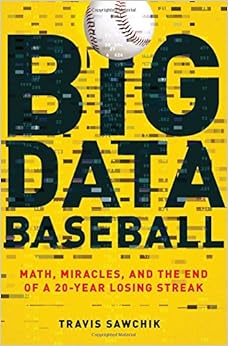
Travis Sawchik's Big Data Baseball: Math, Miracles, and the End of a 20-year Losing Streak is the next logical step in the Baseball Sabermetric non-fiction collection, preceded by Michael Lewis' Moneyball and Jonah Keri's The Extra 2%. Those books took meandering walks through concepts devised by the front office and how those were applied in the clubhouse and on the field while noting it was the perfect collection of personnel at the right time to make it all work. With Big Data Baseball, the premise is largely how there is a great deal of data points out there now and the key is knowing not only what to do with them, but, also, how you communicate what you learn to the people who actually step out onto the field. It is a story of how do you turn 10 million dollars into 10 additional wins...and having the right people just at the right time.
Perhaps the heart of this book is Clint Hurdle. He is the Billy Beane of this story. A man broken by the game and on his way who challenges his own convictions about the game. Hurdle overcame his failure as a player (if you can call making the Major Leagues and burning out being a failure) and his difficulties winning as a manager to fully embrace a deeper application of what the Pirates' data analysis department was coming up with. This not only included analytical scouting reports and frequent team meetings, but the actual inclusion of the data science team in the clubhouse and interacting with the players. This is presented as quite revolutionary.
For the non-narrative readers, the pull is by and large the focus on defensive shifts as well as the player development, acquisition, and application of players who fit the style of defensive shifts they are incorporating. After experimenting with minor league clubs, the organization decided to more fully adopt defensive shifting. They are certainly not on an island as other clubs like the Orioles have dedicated themselves to the shift as well. However, it is certainly true that the Pirates are one of the few teams on the tip of the shifting spear. Through the use of shifting, they essentially gained the plurality of those added wins.
The rest of those added wins were made up by Russell Martin who was a Yankees castoff. Martin's ability to pitch frame was able to give many runs back to the team simply by converting a few called balls to called strikes. This helped keep starters longer in the game by keeping hitters in pitcher's counts. It is a concept well-written about here at the Depot and elsewhere. As with shifting, it is also a concept that has become largely mainstream within the game. The part on Martin does get a little loose as the book tries to describe his pitch calling technique as being like Jazz even though Martin hates Jazz. It describes his way of calling pitches as for the pitcher to throw what the batter is not expecting, which is actually quite ordered.
The other aspect of the book that I found a little off was that this was a book about data science, but it did not seem to be edited by anyone well-versed in data science. For instance, a point was made of Pirates pitcher Gerrit Cole and how Cole's father was well studied in baseball analysis. The major point driven in this aside is how his dad instituted an application of the Verducci rule which largely centers on a gradual buildup of total innings year by year in order to prevent arm injuries. What is interesting is that the Verducci effect was initially poorly studied with an apparent confirmation bias. In the years past, it has been resoundingly discredited as being anything useful in application.
Perhaps truthing out the Verducci effect was not the place of this book, but I think it highlights something missing from the book as well as those written by Lewis and Keri. That would be that Science Fails. It fails a lot. It certainly is better than going blind into something, but the marvelous thing about scientific endeavors is that we refine reality as we know it as times moves on. While the book highlights how we have entered a new era of millions upon billions of data points to digest, it fails to note that having a lot of data points can also be problematic and wind up with a great deal of false positives. It is that false positive story that is needed here. Verducci's was a proto-big data false positive.
In the end, what this book does well is deliver a solid narrative with several interesting characters while also introducing many readers to more current thought of data analysis and market inefficiency opportunism. Travis Sawchik is able to take some relatively complicated concepts and provide a soft, inviting touch for less data obsessed readers. We are also quite pleased that former Camden Depot writer, Stuart Wallace, is name dropped in the book as a significant hire as the club moves forward.
Big Data Baseball: Math, Miracles, and the End of a 20-year Losing Streak
Travis Sawchik
Flatiron Books, 256 pg
Showing posts with label shift. Show all posts
19 May 2015
02 March 2015
Should Chris Davis Bunt More to Beat the Shift?
In a mid-February interview on 105.7 The Fan, Chris Davis discussed bunting and beating the shift:
"I think there are definitely situations where I need to bunt, and I know there was some frustration last year obviously with my batting average being as low as it was - not only on my part but the fan base and maybe even on some of my teammates' part - as far as me hitting into the shift . . .
First of all, when you're not swinging the bat well and you're kind of trying to find it, for me, I want to go up there and have an at-bat. I don't want to just lay a bunt down. There were times last year when I did lay a bunt down, but for me it's really a comfort thing. It's different going out there and working off a machine or even a BP arm and laying balls down the third base line and going into a game and doing it. For me, it was just a comfort thing and I have worked on it this offseason. I've probably worked on it more this offseason than I have in the past. If it's a one-run game, I'm probably not going to lay one down, but there are situations where unselfishly it's probably the best thing to do. It's definitely a weapon I can use against other teams."Judging by those comments, Davis seems open to bunting more in certain situations. He's also working on his bunting in spring training. Here's proof:
Will #Orioles Chris Davis bunt more against the shift this year? Here's him dropping some down 3B line in practice. pic.twitter.com/VgcsxmOljL
— Eduardo A. Encina (@EddieInTheYard) February 26, 2015
Whether that translates to him bunting more in actual game situations remains to be seen. So this could be something where Davis following through never materializes and it's a lot of talk over nothing.Davis doesn't want to endure another 94 wRC+ season, and him being an impending free agent could provide some extra motivation. So every little bit (even a few extra singles) matters, but it's worth wondering what "bunt more" means. Should he bunt every time there's a shift? When the stakes are low? When the Orioles could really use a run? Or perhaps just when Buck Showalter wants him to?
Jeff Sullivan of FanGraphs examined bunting to beat the shift in two posts last year. You should definitely read both, as with most things Sullivan writes, but here are some of his takeaways after breaking things down:
Bunting is a skill, and as with any skill, there’s a distribution in talent. But what’s made abundantly clear is that nothing about bunting is automatic, even for the most prolific bunters in the league. You’re still trying to bunt a really fast and moving baseball with a stick that isn’t that big. . . .
If the defense wants to give the hitter an easy hit, the hitter should take the easy hit, without question. I could never understand how hitters could be so stubborn in the face of a potentially high batting average. Turns out there’s no such thing as an easy hit after all. Oh, bunt singles against the shift look easy when they’re successful, but so do Chris Davis home runs. Most of the time, Chris Davis doesn’t homer.In his second post, Sullivan notes, "The math is still probably on the side of more bunt attempts. It’s definitely on the side of hitters practicing bunting more often so that they can be more successful when it counts." So Davis is preparing to bunt more often, even if he ends up not showcasing his newfound bunting skills much.
In 2014, only nine major leaguers faced more defensive shifts than Davis. Here are the number of times they bunted the ball fair, with the results in parentheses:
David Ortiz: 0
Ryan Howard: 0
Brian McCann: 3 (1 hit, 2 outs)
Albert Pujols: 0
Brandon Moss: 3 (2 hits, 1 out)
Lucas Duda: 1 (hit)
Mark Teixeira: 0
Adam LaRoche: 1 (hit)
Mike Moustakas: 2 (1 sacrifice, 1 out)
Chris Davis: 2 (1 hit, 1 sacrifice)
Also, here is Davis's bunt single, which also happens to be his only career bunt base hit:
Just because other players who face shifts often rarely bunt doesn't mean Davis shouldn't; perhaps he could even transform into a bunting trendsetter for similar sluggers. But it's extremely unlikely that he's going to start racking up bunt hits, not only because it's difficult, but also because it's more important that he hit the ball out of the ballpark.
Teams are willing to give up the occasional single to Davis. But they also don't think he'll be able to consistently bunt balls down the third-base line (or maybe even the first-base line) for hits. And they're probably right.
So yes, it probably would be smart for Davis to try to lay down a few more bunts in the future. Teams are not going to stop employing shifts against him unless he consistently starts spraying the ball all over the field, and that's not going to happen. The more hits, the better; but he's also not going to be successful on every bunt attempt, and he will make outs. Regardless, Davis's offensive success will be determined by whether he gets his power numbers back up, cuts down on strikeouts, makes better contact, and isn't nearly as bad against offspeed pitches (.051 ISO in 2014 vs. career .230). An open philosophy to bunting could help his overall numbers by some measure, but it's far from a panacea. Still, there's nothing wrong with being prepared.
Photo: Keith Allison
Subscribe to:
Posts (Atom)

