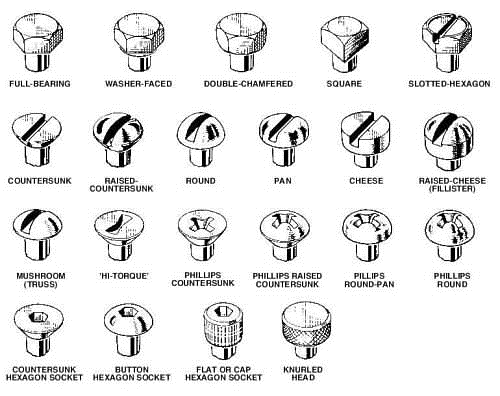
 When I was six, I decided to make my own GI Joe figures. I did this in a way similar to how the first Porches were reconfigured Volkswagons. I dismantled pre-existing products and then recombined them. This was a learning experience for me in that I was never really aware that the items that fall under the screw category are actually quite diverse. To that end, a screwdriver is a tool that likely cannot actually be used with every kind of screw. The simple terms for the tools are generic. In a grand sense, it often means little to provide more specificity than that, but at other times it is actually quite important. So, here I am in my bedroom trying my best to unscrew the Phillips raised counter sink crew with the flathead screwdriver of not exactly the right size I took from my father's toolbox. It was not exactly a successful venture. After an hour, I decided that it was pointless to continue with this screwdriver, so I snuck back and switched the flathead screw driver with an appropriately sized Phillips. I then made about two dozen of the most amazing GI Joes ever. Or, at least, that is what I remember.
Anyway, why am I telling you this story? To say that the graphic above contains 21 screws is essentially like saying the Orioles will have 13 or so outfielders in camp* or, if you prefer, 11 left fielders in camp. It may well be an accurate statement, but it rather betrays the functionality of those pieces. In a perhaps way too obvious statement, Adam Jones and Jack Cust are not the same in any way. Therefore, if you wish to discuss the glut of outfielders on the Spring Training invite list then we probably would need to be a bit more specific about what roles are available and what players can actually perform in those capacities.
* - At the time of this writing, no official decisions has been made on either Tyler Colvin or Jack Cust. However, they are including in this discussion as it makes sense to include them when discussing player specificity.
Positions to be filled
The main positions to consider among this group are: left field, center field, right field, backup outfielder, right handed designated hitter, and left handed designated hitter. Of those positions, center field and right field are spoken for by Adam Jones and Nick Markakis, respectively. From this point onward, we will not consider those players or positions for that are irrefutably locks on this roster and how it will be utilized. Below is a matrix identifying the invited players and where their skills may apply.
| LF | LF/CF | RH DH | LH DH | |
| Quintin Berry | * | X | * | |
| Julio Borbon | * | X | * | |
| Tyler Colvin 1 | X | X | X | |
| Jack Cust | X | |||
| David Lough | X | X | * | |
| Xavier Paul | X | X | ||
| Steve Pearce 0 | X | X | ||
| Francisco Peguero 0 | X | X | * | |
| Nolan Reimold 0 | X | X | ||
| Henry Urrutia 2 | * | X | ||
| Delmon Young | X |
The above matrix illustrates a variety of fascinating competitions for roster slots among fringe meaningful MLB players. Each of the above has a tool or two that have at one time or another been dreamed upon in making the player useful to any first division team. That they are all coming to camp as bubble 40 man roster guys and Spring Training invites shows the trouble they have had in fulfilling those front offices dreams and wishes. This tangled mass of fringe baseball players probably includes one or two or maybe even three players who, when used in the right manner, would be a boon to a team with playoff aspirations.
However, recognizing lightning in a bottle is something that is done much better in hindsight than in real time. Many in the stands as well as some in the field believe Spring Training is how one discerns differences in future performance among several similarly talented players. That simply is not true. I am not saying these at bats are meaningless, but they are affected by small sample sizes, variation in motivations behind defensive alignments/pitching/effort, and facing a wide range of talent on the mound. Even statisticians delude themselves with wanting to make the numbers meaningful. Last year for Baseball Prospectus, I dove into the problems with the Dewan Rule which states that exceptional power performance in Spring Training indicate power performance increases during the regular season. Simply put, Spring Training is gut time and gut time is a time in which choices between options of very similar value is pretty much a coin flip.
What does that mean? It means that what we have is more likely the illusion of a competitive Spring Training as opposed to real competition. The team should know the players at this moment as well as they will know them at the end of camp. Decisions are pretty much made at this point. They can change based on player attitude, conditioning, and even a complete loss in performance. That said, the team probably should ignore any remarkable performances. To beat that point further home, be sure to read this take down of the useless Dewan Rule. With that in mind, we will take each of the roles that need filling on the team and which players best fulfill them based on what we already know.
Left Field
When it comes to physically being able to play left field in a manner that is competent at the Major League level. We can immediately dismiss both Jack Cust and Delmon Young. They simply are bat only players. Sure, you may have then stand out in left field in a pinch, but they do not have the ability to play out there and still be a net positive player. The negative impact of the glove will overwhelm the value in the bat.
That leaves nine candidates to fill the left field position. I rank them as following:
| 1 | David Lough | L |
| 2 | Tyler Colvin | L |
| 3 | Nolan Reimold | R |
| Steve Pearce | R | |
| Francisco Peguero | R | |
| 4 | Henry Urrutia | L |
| 5 | Julio Borbon | L |
| Xavier Paul | L | |
| Quintin Berry | L |
When Dan Duquette made the Lough for Danny Valencia deal with the Kansas City Royals, several thought that he swindled them into handing over a starting corner outfielder in exchange for a limited designated hitter. Much of that sentiment was based on Lough putting up a 2.7 bWAR in less than 100 games. However, we should probably temper our expectations greatly if we think that performance is repeatable because so much of it is dependent on fielding. Fielding metrics tend to require a couple years worth of data to say anything substantial about a player.
Consider the following table which contains all outfield rookies ages 26 and older who had at least a 1.0 dWAR.
| Player | WAR/pos | dWAR | Year | Age | Tm | BB | SO | |||
|---|---|---|---|---|---|---|---|---|---|---|
| F.P. Santangelo (RoY-4th) | 3.3 | 1.3 | 1996 | 28 | MON | 49 | 61 | .277 | .369 | .407 |
| Wayne Kirby (RoY-4th) | 3.2 | 1.5 | 1993 | 29 | CLE | 37 | 58 | .269 | .323 | .371 |
| David Lough | 2.7 | 1.4 | 2013 | 27 | KCR | 10 | 52 | .286 | .311 | .413 |
| Brian Bogusevic | 2.0 | 1.0 | 2011 | 27 | HOU | 15 | 40 | .287 | .348 | .457 |
| Gary Pettis | 1.9 | 1.0 | 1984 | 26 | CAL | 60 | 115 | .227 | .332 | .300 |
| Tony Barron | 1.8 | 1.0 | 1997 | 30 | PHI | 12 | 38 | .286 | .330 | .423 |
| Brandon Barnes | 1.7 | 1.1 | 2013 | 27 | HOU | 21 | 127 | .240 | .289 | .346 |
| Terry Jones | 1.6 | 1.8 | 1998 | 27 | MON | 21 | 46 | .217 | .288 | .283 |
| Juan Perez | 1.1 | 1.1 | 2013 | 26 | SFG | 6 | 21 | .258 | .302 | .348 |
| Bobby Mitchell | 1.1 | 1.1 | 1982 | 27 | MIN | 54 | 53 | .249 | .331 | .313 |
| Jim Holt | 0.8 | 1.1 | 1970 | 26 | MIN | 17 | 32 | .266 | .300 | .342 |
| Logan Schafer | 0.7 | 1.0 | 2013 | 26 | MIL | 25 | 60 | .211 | .279 | .322 |
Lough ranks as one of the better players in this population, but it is not a promising collection of players. Of those players, only Gary Pettis continued to provide starting caliber value. In other words, older rookies who have breakout years with much depending on defense tend to be one season flukes. Lough should start out there with his defense providing some measure of worth, but if his bat collapses then Colvin and others will be given opportunities.
Colvin plays defense well and has plus power. Those things he does well though are mitigated by his extreme split (.333 wOBA vs RHP, .278 wOBA vs LHP) and has been ineffective in half of his seasons (last year his wRC+ was 6 with 100 being considered average). Nolan Reimold is a darkhorse whom we have long held a belief in here at the Depot due to his plus plus power, good understanding of the strikezone, and a strong arm. It is a concern that he has been out of baseball for a couple seasons with a neck injury and that his record of performance has been incredibly uneven when healthy. Bat only left fielders (i.e., Pearce, Urrutia, Paul) and glove only left fielders (i.e., Peguero, Borbon, Berry) are probably too limited to be trusted in a full left field role if this team desires to make the playoffs. As is, they are in enough trouble with Lough and/or Colvin out there.
Left Field / Center Field
In a backup role with the team, the Orioles can go two ways. One, they could keep a fourth outfielder who is able to cover in center for Adam Jones. Or, two, they can do what they did at times last year and have their left fielder cover for Jones. McLouth occasionally covered in center, but has obviously not been capable of defending that position for years. Lough and Colvin would be able to take care of that role better.
Here we consider five players:
| 1 | David Lough | L |
| 2 | Tyler Colvin | L |
| 3 | Francisco Peguero | R |
| Julio Borbon | L | |
| 5 | Quintin Berry | L |
This grouping can be divided into well rounded players (i.e. Lough, Colvin, Peguero) and defensive players (i.e., Borbon, Berry). For the reasons mentioned before, Lough and Colvin lead this group. Peguero slides in with Borbon as our next option. He still shows good speed after a tough knee injury a few years back. That speed can cover up a lot of mistakes in the field, but Peguero needs to improve on the route running that is ideal to play center. Offensively, he has always shown good contact and promising power in batting practice that has not exactly carried over into the field. His speed also has been mitigated in the basepaths as he has climbed up the ranks.
| Year | Age | Tm | Lev | PA | 2B | 3B | HR | SB | CS | BB | SO | |||
|---|---|---|---|---|---|---|---|---|---|---|---|---|---|---|
| 2006 | 18 | Giants | FRk | 196 | 10 | 3 | 4 | 3 | 2 | 6 | 37 | .275 | .307 | .429 |
| 2007 | 19 | Giants | FRk | 258 | 12 | 2 | 1 | 25 | 5 | 15 | 39 | .294 | .341 | .374 |
| 2008 | 20 | 2 Teams | A--A | 414 | 13 | 8 | 4 | 25 | 4 | 21 | 86 | .285 | .330 | .393 |
| 2009 | 21 | 2 Teams | A-A- | 328 | 15 | 5 | 1 | 22 | 5 | 8 | 48 | .353 | .373 | .443 |
| 2010 | 22 | San Jose | A+ | 538 | 19 | 16 | 10 | 40 | 22 | 18 | 88 | .329 | .358 | .488 |
| 2011 | 23 | 2 Teams | AA-A+ | 372 | 14 | 6 | 7 | 12 | 1 | 12 | 53 | .312 | .332 | .445 |
| 2012 | 24 | Fresno | AAA | 476 | 20 | 10 | 5 | 1 | 0 | 15 | 82 | .272 | .297 | .394 |
| 2013 | 25 | 2 Teams | AAA-Rk | 314 | 12 | 3 | 4 | 3 | 0 | 13 | 53 | .315 | .350 | .416 |
| 8 Seasons | 2896 | 115 | 53 | 36 | 131 | 39 | 108 | 486 | .306 | .337 | .427 | |||
As you can see, those numbers are fine for a player in Norfolk, but would need to improve a great deal to find himself as a very useful bench outfield option.
Julio Borbon has the history of good MLB play, but that player is not the one would walks out on the field these days. As a non-roster player, he will almost assuredly find himself back in AAA unless he does something very remarkable in Spring Training or the injury bug hits others.
Right Handed Designated Hitter
None of the favored players so far (i.e., Lough, Colvin) profiles well as a designated hitter against southpaws. Lough simply is not a good bat and Colvin is wholly ineffective against them. That will necessitate someone who can fill in here. Of all of the outfielders in camp looking for jobs, only four are right handed.
| 1 | Steve Pearce |
| Nolan Reimold | |
| 3 | Delmon Young |
| 4 | Francisco Peguero |
It can sometimes be difficult to see talent through the name. Delmon Young can be one of those guys whose history and perceived value can make him seem more desirable than he really is. One of the good benchmarks to use is what a player cost to acquire him. This does not always work, but typically good players require money. Delmon does not. In fact, he has not required much money for a while. Last year, the Phillies designated him for assignment in order to make room for Casper Wells. That should give you pause if you think Dan Duquette pulled a baseball mind trick here.
Below is a table for each player's career marks by hand and projected value in left field. Peguerro's numbers are italicized to denote them being minor league values.
| wOBA - RHP | wOBA - LHP | Proj. LF UZR/150 | |
| Steve Pearce | 0.276 | 0.349 | -5 |
| Francisco Peguerro | 0.326 | 0.337 | 5 |
| Nolan Reimold | 0.327 | 0.338 | -5 |
| Delmon Young | 0.309 | 0.348 | -15 |
On first look, Young seems like a rather decent option. He has hit lefties as well as Steve Pearce in the past and has not been as susceptible to right handed pitchers. With a short bench, Pearce adds value because he can potentially fill in as a corner outfielder or even as a corner infielder. If Pearce's issues at the plate are too problematic then a healthy Reimold should outpace Young.
I think if you are looking toward the future, Reimold is likely the one you would choose here as he is a more rounded player who could potentially become a starter. Pearce is more of an immediate impact player with his bat. Again, though, neither are exceptional designated hitters.
Left handed Designated Hitter
The group here has two somewhat interesting names. Players who could be rather impressive, but whose chances of that are incredibly slim.
| 1 | Tyler Colvin |
| 2 | Henry Urrutia |
| Xavier Paul | |
| 4 | Jack Cust |
Colvin (who has yet to finalize his deal) and Urrutia are the two most intriguing players. Colvin, we have already mentioned. Urrutia, we have not. He is interesting because he has been able to put on about 18 lbs of muscle in the off season (about 10% increase in weight). Assuming that does not negatively impact his mechanics, it should help in turning him into more than the away slap hitter we saw last summer in Baltimore. Of course, the added weight may make the already clunky defensive player even more clunkier and cementing himself as a bat only player.
The Final Score and What it Means
Left field is probably already figured out with David Lough logging most of the time out there. The left handed designated hitter situation will be Tyler Colvin if he is healthy and signs. Urrutia is likely to get more time in Norfolk and refine his hitting. With Colvin in the fold, the team would not need another player for center field. He and Lough could cover that. This means Peguero would be designated for assignment. Finally, the right handed designated hitter position will likely come down to whether help is needed in the infield (i.e., Pearce) or perhaps it depends on the health of Reimold.
What does this all mean? The Baltimore Orioles came into the off season knowing that left field and designated hitter were weak points on the roster (not to mean starting pitching and second base). In the end, they were unable to resolve those issues beyond stacking odds and ends that included fringe players already in the system as well as acquiring fringe players found on other teams. This way of devising a solution is perfectly fine for a team fighting to be above .500, a team that needs some exceptional luck to see the playoffs. It was a great solution and paid off in 2012. It was a poor solution last year and almost paid off due to the revelations that were Manny Machado and Chris Davis. It will work in 2014, if Machado, Davis, and someone else on the team make up three of the best performances in baseball. It is a roll of the dice and the odds are stacked against the team. For me, it is that action of a club looking to deal off significant pieces and retool for the 2016-2018 window that will include Jones, Machado, Gausman, Bundy, Schoop, and Harvey.