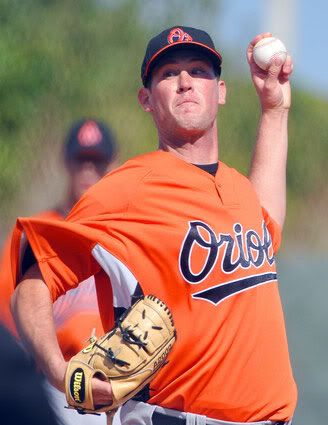
The team that most affects the Orioles' selection is the Pirates. Bryce Harper to the Nats is a foregone conclusion. The real question is whether hulking power pitcher Jameson Taillon or Miami prep SS Manny Machado goes second. Kieth Law flapped his wings on Friday with talk of the Pirates leaning toward Taillon and now everyone else is following. Conditional language is being used, but it would be a bit of a surprise right now if the first four picks in the draft are not:
1. Washington Nationals - Bryce Harper, c, JC of Southern Nevada
2. Pittsburgh Pirates - Jameson Taillon, rhp, The Woodlands (Texas) HS
3. Baltimore Orioles - Manny Machado, ss, Brito Miami Private HS
4. Kansas City Royals - Yasmani Grandal, c, Miami
After that, I think there is some considerable guesswork. Frankie Piliere is a good source for up to date information about the draft (Piliere used to run the site SaberScouting with current Orioles front office employee Kiley McDaniel). If you have been paying attention to what Stotle and I have been writing, we would not exactly be upset, but we would be disappointed in the Orioles selecting Machado. Stotle's board is in full view at his draft devoted site, PnR Scouting. You should bookmark that site as he will be quickly updating it close to a pick by pick basis. Very impressive.
Anyway, Stotle has Machado at 10. I have him at 6. In fact, here is my final board (and, yeah, it has changed since last week very slightly):
1. Bryce Harper, c, JC of Southern Nevada
2. Jameson Taillon, rhp, The Woodlands (Texas) HS
3. Chris Sale, lhp, Florida Gulf Coast
4. Karsten Whitson, rhp, Chipley (Fla.) HS
5. Zack Cox, 3b, Arkansas
6. Manny Machado, ss, Brito Miami Private HS
7. Deck McGuire, rhp, Georgia Tech
8. Drew Pomeranz, lhp, Mississippi
9. Christian Colon, ss, Cal State Fullerton
10. Nick Castellanos, 3b, Archbishop McCarthy HS, SW Ranches, Fla.
Now, Machado has been mentioned in the same breath as Alex Rodriguez. I think this has more to do with poor association. Both are coming out of Miami as preps, both have some power, and, honesty, I think them both being Hispanic is what is drawing those comparisons. Go through enough profiles and it becomes clear that unconscious racial associations are everywhere, but that is starting another conversation. Back to Machado, he is a big shortstop. He does have some power potential. He shows a good hit tool. I don't think he is anywhere near Arod. I think in last year's draft he would have gone about the same time as Grant Green. The year before, he easily would have gone after Gordon Beckham was selected. So, yes, Tim Beckham would have been viewed as a much better SS prospect than Machado. Why? The power that looks plus for short will be maybe above average at third base. Most disagree with me, but I just see his body filling out and that range collapsing. At third base, I see Zach Cox as a better bet to meet his potential.
That is really the problem I have. I think much of the value place in Machado is directly tied to him sticking at shortstop. The backup plan of him working at third is sustainable, but you will be paying a premium for the chance he could stick at short. Is that premium worth 3MM. The difference between Cox and Machado in signing bonus will probably be that amount. To be conservative, maybe 2MM. To me it is not worth that. So would I want Zach Cox? Actually, no. Last week, I suggested Drew Pomeranz, but now I am firmly in Chris Sale mode. Pomeranz' slight issues with command and he only has two solid pitches at the moment with his fastball and curveball. He is going to have a bake more in the minors than I thought. That changeup will have to come around. Sale has a nice 2 seamer and induces a lot of groundballs. His slider is progressing along well and I would consider it a plus pitch. He also has shown great touch for his changeup, but will need some work with his arm action to conceal it better. Sale would normally be a fringe top 10 pick in a normal draft year, but he would be my pick here and give me room to select about 3 overslots last in the draft. I would prefer something like Sale, Kevin Ziomek, Bobby Wahl, and Christian Yelich over just Manny Machado.
After the jump, summary of the John Sickel's community mock draft.
Community mock drafts are often a useless endeavor as it is more about advertising for the website than actually putting together a prediction. Participants vary widely in knowledge and predictably follow the main free list available . . . BA's draft chart. Personally, I put my draft board together by using BA, PnR Scouting, PG Crosschecker, and Keith Law as my 'scouts.' From there I draw up a composite board. I then make a likely targets list and view video and individual writeups on those players, massaging the list. So, I tend to view things differently than most on the boards. Also, some participants view the mock draft as an exercise in showing how well they can work the draft and others tend to view their draft budget as unreasonably high. So, yeah, community mocks are often worthless by ignoring budget and historical trends of certain team's scouting departments.
My picks . . .
1:3 Manny Machado, ss, Brito Miami Private HS
Shocking, eh? Well, part of the community mock experience is creating a thread on that site and taking in a consensus. Taillon was taken by the Pirates before me and the group who was in the Orioles thread felt very strongly about Machado. I would have taken Chris Sale, personally. But, I am not trying to personally outsmart the Orioles. The Orioles seem locked in on Taillon or Machado. With Taillon gone, Machado was the accurate pick in my estimation. He fills a minor league need in that he is a positional player and a middle infielder. Selecting him will mean that we would need to be more responsible in the following picks.
3:3 Kevin Chapman, lhp, Florida
Relief and, particularly, left-handed relief is in dire need in our system. To quote our piece from last week:
Chapman is a hard throwing fastball/slider arm, sitting 91-93 mph with his heater and touching 94 regularly. His slider is a second potential above-average to plus offering that can be effective both in and out of the zone. He shows solid command of both offerings and has been nearly untouchable in his first full season with the Gators (TJ surgery in the spring of 2008 and light usage in 2009). Chapman has been one of the most dominant relievers in 2010, sporting a .158 BAA to go along with an 8.71 SO/9 and 1.52 BB/9. He could shoot quickly through the minors, contributing to a big league club by the end of 2011.
I do think though that the mock yesterday was reliever averse to the extreme. They lasted way too long on the boards. I wonder if Chapman will be snatched up in the second round by a team with several selections, such as the Angels or Astros.
The draft ended after the third round, but Sickels and a few of us did one more round.
4:3 Will Swanner, c, La Costa Canyon HS, Carlsbad, Calif.
You might wonder why I would go with a slightly above slot catcher when we have Wieters, Joseph, Dalles, and Ohlman in the system. Personally, I think you can never have enough catchers. Particularly, when all of these catchers I mentioned are offensive oriented. Chances are they are not long term catching solutions and will be shifted off at some point in their careers. So, you should take on several in your system and see who sticks and who shifts. The following is part of a nice writeup found over at PnR Scouting:
Swanner isn't an elite backstop, but he shows an impressive collection of tools that could be shaped into an above-average overall pro player with some further instruction. His bat projects well in the power department and he has an ability to square the ball across the quadrants that bodes well for his future contact ability. Behind the plate, he's steady in all aspects and could be above-average if he can quicken his release some. The arm strength is average, but plays-up due to his accuracy, which stems entirely from his balance and advanced catch-and-throw actions. Swanner is a well-balanced collection of tools at a position where it's often difficult to find a player that isn't heavily slanted to either the offensive or defensive side of the spectrum. If the unpredictable world of prep catchers is the stock market, Swanner represents a conservative mutual fund -- odds are he won't let you retire at 30, but you feel comfortable that your investment is going to yield solid returns in the long run. Particularly at a premium position, that's an investment worth making.
The mock draft ended there, but I did put together a top three for the next round. Having taken on a middle infield prospect, advanced left handed relief, and a HS catcher . . . we have addressed most of our need areas. I'd say we still have middle infield, power, and starting pitching as targets. With that in mind, here is my top three selections for pick 5:3.
Jared LaKind, 1B/OF, Cypress Woods HS TX
LaKind has a good, but not great arm as evidenced by a no hitter he threw. His pro future lies in his bat. He is a big guy and stands to add some more weight on his frame. From what I hear, he looks for his pitches (I would not call him a mistake hitter), gets good contact, and may have 30-35 HR potential in his future. He looks like a solid selection in the 5th round. That said, he is not in many top 200s. He is 71st on my board and would be a great value pick here.
Bobby Wahl, RHP West Springfield HS VA
Wahl would be an above slot selection. Here is an excerpt from PnR's writeup:
Wahls is a fun collection of current skill and projection and has taken a nice step forward this spring. Though his stuff isn’t as overpowering as the more highly touted high school arms, he has already seen the beginning of the jump in velo projected last November when this report was originally filed. He flashes a legit four-pitch mix and shows enough feel for pitching for his arsenal to project well across the board. In addition, he has worked this spring at adding a cutter to his repertoire. His frame has room for growth, and his flexibility and body control should help him work through the transition. Wahl is set to attend Ole Miss, should he by-pass a shot at starting his professional career this upcoming summer. Were he to log three seasons with the Rebels, it wouldn’t be a surprise to see him among the better draft-eligible college arms come 2013. His spring performance was solid and the growth in the quality of his arsenal is exactly what scouts were looking for. While he is still a ways from a finished product, Wahl is heading in the right direction and at an impressive pace.
Wahl is 102nd on my board.
Daniel Tillman, rhp, Florida Southern
Some might bristle at the Tillman here as I took a reliever in Chapman in the third. Tillman is a good talent though with a fastball that jumps into the mid 90s and he has good command of that. He also has an above average curve that flashes as plus. He had a great Cape Cod season last summer and did nothing to disuade anyone from thinking he could be a fast moving reliever. It is possible the Orioles do not see slot driven advanced relief pitchers as a need, but I think in these mid-rounds they can be high value picks. For instance, over three years you could potentially pickup six advanced relievers in the mid-rounds for less than 3MM, which is more than half of what we are paying for a single year of Mike Gonzalez. It is difficult to pick up a reliever when there might be an exciting overslot available, but it certainly is sometimes the most prudent thing to do. That said, having already picked up Chapman, I would go after the two higher players left on my board. Tillman checks in at 115.