Showing posts with label Manager. Show all posts

10 April 2014

Can a Manager Really Impact a Team's Performance?

A couple weeks ago, we explored the idea that perhaps the deviation between the projected wins of a team and the actual wins a team accumulates during the season is somehow related to the manager.  As we expected, there was a considerable deal of derision in response to that article.  Some of the more extreme statements suggested that we must have never played the game (tell my busted left shoulder--more so, being great at farming does not make one great at agriculture policy and vice versa) or that there is no way that buck is not worth 20 or 25 wins to the Orioles.  Now, those were the extreme statements.  The kind of statements a writer brings up because they are so obviously ridiculous.

More considerate statements expressed doubt over the repeatability of the statistic year to year, which is actually a great point.  Career accumulation of extreme numbers, for instance Mike Scioscia's 47 wins above projected in the past eleven years, are easy to see as being of some worth and being the result of the manager, front office, or combination thereof.  What is less easy to see is whether perhaps Bobby Valentine's 2012 Red Sox season with -22 wins above projected is meaningful.

In order to address this is the most simple and straight forward way I could imagine, I decided to compare accumulations season by season.  In other words, I took a manager's first full season in my database of seasons since 2003 and compared it to his second season to generate an r value.  I then took the average of his first two seasons and compared it to the average from his first three seasons.  Finally, I took the average of his first three seasons and compared it to his first four seasons.  By doing this, we get a rough idea how repeatable the metric is and how many seasons of data are probably required before the statistic levels out.  The total number of managers in the data set with four seasons was 29.

Here is the r value table.


MWAP
1 season 0.64
2 seasons 0.85
3 seasons 0.86
For those who may be more visually inclined here is the graph that produced the middle value (two seasons versus three seasons).


There certainly is variability in this data set, but looking at it in a general sense, there is a great deal of fit there.  Even if you take it as a litmus test of good versus bad, there are only three points out of 29 that shift from a positive average to a negative average from the second to third season with only one of those making a major leap.  We may not know if a manager is fully behind this association, but he certainly is one of the common factors here.

To explore the impact of the front office, I took managers from the very same database who had spent two seasons with one club and then two with another.  The idea here is that perhaps the only similarity before the two situations is the manager.  It might help us discern whether the manager is really the one driving this difference in projected vs. actual results or not.  In other words, is Buck Showalter doing what Dave Trembley could not or maybe is Dan Duquette doing something Andy MacPhail could not.  I would not really too much into that sentence and what we are doing here.  I would only take into consideration that if there is no significant differences between experiences from the managers then maybe the difference has a good bit to do with them.

I only had 13 managers meet this criteria: Bob Melvin, Bruce Bochy, Buck Showalter, Clint Hurdle, Dusty Baker, Eric Wedge, Fredi Gonzalez, Jim Tracy, Joe Torre, Ken Macha, Lou Piniella, Manny Acta, and Ned Yost.  I compared their final two seasons with their first organization with the first two seasons of their second organization using a paired t-test.  Using this statistic, would we be inclined to think that the difference was mainly due to the front office if the value for this population was 0.10 or less.  What we actually find is that the value is 0.71.  This means that the last two seasons from team one are quite similar to the first two seasons of team two.  This suggests that the deviation from the projection win total and the actual win total is likely to do with the manager in that his ability to deviate is repeatable.  Therefore, it is a skill.

Finally, from the original data set of 29 managers, I thought it might be interesting to sub-select two year average and see how they compare the the second two year average.  I chose the average for the third and fourth seasons and compared it to the average from the fifth and sixth seasons.  24 managers fit this requirements.  The r value was determined to be 0.89.  Here is the graph:


Again, if we use this simply as a litmus test, we find that only three of the 24 managers crossed from one designation (above or below) to the other side of the axis.

This suggests that managers do have an actual impact on the team's performance and that this impact might actually be, to some extent, measurable.  Of course, having just one season of data does not appear to be ideal when attempting to figure out what exactly this value is.

27 March 2014

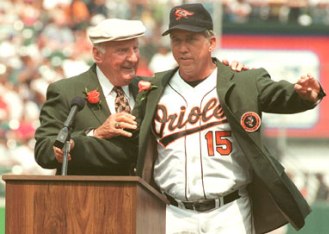
How Many Games Is a Buck Showalter Worth?

Buck | Keith Allison
A few weeks ago I looked at how well projections perform in comparison to the actual season ending tally of wins.  What we found was that the range was broad (about 75% of outcomes fall in a 20 game range), but that range is anchored strongly to the projection (aka the 50th percentile or push point).  In other words, a team slated to win 80 games is going to be between 70 and 90 wins three quarters of the time when the season ends.  A team slated to win 70 has a three quarter chance to find themselves between 60 and 80 wins.  In other words that connection is pretty accurate even though it severely lacks precision.  In other words, it is a fine baseline to use and indicates a good starting point when thinking about the level of talent for a team.

In that article I compiled projected and actual standings for every team since 2003.  I did not select one projection model over another as they all tend to be similarly accurate.  One thing that struck me about the projections for the Baltimore Orioles was how much this team consistently underperformed according to the preseason projections.


Year Manager exPct Actual Pct Diff Games
2003 Mike Hargrove .426 .438 2.0 162
2004 Lee Mazzilli .494 .481 -2.0 162
2005 Lee Mazzilli .481 .477 -0.5 107

Sam Perlozzo .481 .418 -3.5 55
2006 Sam Perlozzo .475 .432 -7.0 162
2007 Sam Perlozzo .463 .420 -2.9 69

Dave Trembley .463 .430 -3.1 93
2008 Dave Trembley .407 .420 2.0 162
2009 Dave Trembley .457 .395 -10 162
2010 Dave Trembley .457 .278 -9.7 54

Juan Samuel .457 .333 -6.3 51

Buck Showalter .457 .596 8.0 57
2011 Buck Showalter .488 .426 -10 162
2012 Buck Showalter .426 .574 24 162
2013 Buck Showalter .488 .525 6.0 162

In this data set, only three managers have ever outperformed the team's projected wins: Mike Hargrove (in his only season in the data set), Dave Trembley (amidst two and a half other underperforming years), and Buck Showalter.  Showalter has an interesting series of performances.  He had stellar over-performances in his short season debut in 2010 and the mesmerizing 2012 season (one of the greatest unexpected performances of the recent era).  Showalter also put in a very strong year last year.  In 2011, the team did horribly compared to expectations.  You can likely put a lot of that underperformance being associated with Brian Roberts' injuries, Brian Matusz' unraveling, and a couple black hole performances coming from Felix Pie and every pitcher making their way from Norfolk to fill out Matusz' spot.

Anyway, I figure beyond the Orioles' history, this database could be broken out to evaluate all managers as well as maybe how certain managers may affect their team's projections (something no projection attempts to do).  Below is the top 10 managers since 2003 in outperforming their team's expected wins with at least three seasons managed.


Manager Wins Games W/162
1 John Farrell 17.0 486 5.7
2 Fredi Gonzalez 35.4 1042 5.5
3 Tony LaRussa 45.0 1458 5.0
4 Don Mattingly 14.0 486 4.7
5 Ron Washington 31.0 1134 4.4
6 Mike Scioscia 47.0 1782 4.3
7 Jack McKeon 14.0 538 4.2
8 Buck Showalter 30.0 1191 4.1
9 Ozzie Guillen 35.0 1458 3.9
10 Bobby Cox 28.0 1296 3.5

Jim Leyland 28.0 1296 3.5

This list passes the sniff test quite well.  All of these managers are highly regarded at their craft.  The leading manager, John Farrell, has long been considered a great baseball man and only recently was given a chance to manage for the Blue Jays and Red Sox.  I had highly supported the Orioles in employing him over Buck.  Though more time may be needed to evaluate him with respect to this potential metric as he has two exceptional over-performance and one poor underperformance.

All of this said, these are actually some very fascinating numbers.  On the free agent market, a win this past offseason was worth about 6 MM.  If you would solely attribute any deviation from the expected wins to be the responsibility of the manager, then those top eight managers are worth over 20 MM per year.  That is rather remarkable and probably obscures true value of other personnel in the organization.  That said, I would be hard-pressed to say that the teams involved above are paying free agent prices for those increased wins.

Below are the bottom 10:


Manager Wins Games W/162
34 Buddy Black -7.0 1134 -1.0
35 Grady Little -6.0 486 -2.0
36 Dusty Baker -23.0 1620 -2.3

Jim Tracy -20.1 1412 -2.3
37 Eric Wedge -27.0 1620 -2.7
38 Alan Trammell -9.0 486 -3.0
39 Bob Geren -20.4 711 -4.7
40 Jerry Manuel -21.0 579 -5.9
41 John Russell -23.0 486 -7.7
42 Manny Acta -44.4 891 -8.1

Depending on your point of view, this list may not exactly pass the sniff test.  In order to put in three full seasons or more in the big leagues, teams have to think well of you.  The listing actually suggests that as well with 23 of 42 managers having positive W/162 values along with another nine within -1 win.  It appears few highly underperforming clubs' managers last long.  However, I'd also be hard-pressed to fully associate all of the misfortune to the manager alone.  That said, I think you would have a decent leg to stand on to say that Dusty Baker, Jim Tracy, Eric Wedge, Bob Geren, Jerry Manuel, John Russell, and Manny Acta have all managed some disappointing teams even though you do have a few playoff appearances within that group.  Just like the guys at the top of the list, it is probably a bit rash to say that these managers are completely responsible for the entirety of their team's underperformance when compared with their team's expected performance according to projection models.

In the end, I am unsure how many grains of salt to take this little exercise.  Maybe a sprinkle, maybe even a truckload.  I would suggest though to lean more in the sprinkle direction.  That said, Orioles fans should be quite content having a manager falling into the top 10 group as opposed to the bottom 10.

15 June 2010

Most managers in a single season for baseball: Part I - AL

With Juan Samuel reaching his 10th game and managerial veterans like Bobby Valentine and Eric Wedge casting their shadow over Camden Yards, the Orioles might do something that has been done fewer times in Major League Baseball than perfect games pitched. In fact, it is something the franchise has done before, but as the St. Louis Browns. This feat? To have at least three managers rack up 10 decisions or more in a single season.

Today is the first part of a two part series looking at the oddity of single seasons with multi-manager teams. Some of these events were caused by illnesses, extended interim managers, unique ideas, or an impatient front office.

After the jump, we will start of with the Baltimore Orioles history . . .


19 April 2010

Off Season Managerial Candidates

The calls for Dave Trembley's retire have softened just a bit after the Orioles victory yesterday, which should be tempered as much as the overall record. There really is not much of what Trembley has done that can be considered his fault for the Orioles current state. Similarly, the players have not shown to be listless or turned their backs on Trembley. He seems very well liked and the players do listen to him. That said, fans still like to see a good execution when their team fails and the Orioles have been failing a lot.

Last week, we looked at in season opportunity to replace Trembley. This week, we will lost at potential off season solutions.


Davey Johnson - Senior Adviser - Washington Nationals

Davey Johnson is someone who Orioles fans long for in that he was at the helm for the O's last winning season. The rocky breakup with Angelos is something any Oriole fan can still recount blow by blow. Johnson's name was one of the first to be mentioned when Perlozzo was fired several years ago. For unknown reasons, he was dropped from the running and the team focused on Joe Giraldi. That did not work out and MacPhail decided to keep with Trembley. Now, Johnson would be staring at age 68 next year, which is rather old for a manager. He has not managed in the Major Leagues since 2000, but has been very much involved in Team USA and the WBC. He would not be able to ride out the rest of 2010 as he has a contract with the Nationals. Some think that contract as a Senior Adviser is merely a holding maneuver for Johnson until current Nats manager Jim Riggleman inevitably fails, allowing Johnson to takes the reigns. That being said, if available, Johnson probably stands a decent chance to be rehired by the Orioles.

Tom Kelly - Special Assistant to GM - Minnesota Twins

Kelly was one of MacPhail's big hirings when he joined the Twins organizations. Kelly lasted his entire term as GM. Under Terry Ryan, Kelly was sort of like the GM's personal cross checker for internal minor leaguers. He worked part-time as a restricted evaluator. I am assuming that under Bill Smith, the same arrangement has been made. Since MacPhail's hiring, Kelly has repeatedly been asked about any potential openings within the Orioles organization, but he has routinely responded that he enjoys his semi-retirement and not having to travel as much as he used to. Based on the information we have, it seems unlikely he would now be interested in managing again.

Joey Cora - Bench Coach - Chicago White Sox

Cora was another coach that was linked to MacPhail when he took over the Orioles' GM position. After retirement as a player, he was groomed in the Mets minor league system until being promoted to the big leagues by Ozzie Guillen in 2003 as a third base coach. He was then promoted to being the bench coach in 2006. On several occaisions, Cora has served as the ChiSox's interim manager. He has also logged time as manager in Venezuela during the off season. His managerial perspective is somewhat of an unknown as Guillen's personality and perspective overwhelms the day to day operation of the team.


Bob Melvin - Scout - New York Mets

Melvin was part of the Why Not? team with the Orioles and played a total of three years in Baltimore. He spent several seasons as a coach in the Diamondbacks system. His MLB managerial career began with a two year stint in Seattle that was uneven with his first season winning 93 games and his second season with 99 loses. He was immediately hired after being let go by the Arizona Diamondbacks in the wake of the Wally Backman fiasco. Melvin led the Diamondbacks to 90 wins and a pennant in 2007, but lost in the NLCS. That year he was awarded the Sporting News and MLB National League Manager of the Year awards. He was fired form the position in 2009 after 29 games. Melvin's handling of a squad is considered a bit frantic. He will often tinker with the lineup and the bullpen to get the results he wants. To many, the results he gets from his tinkering have about the same effect on winning as a fan at home wearing his lucky shirt. This behavior looks genius when the team is winning and desperate when it is not. He is rather well regarded though and is on many GMs' short lists for any opening.

Tony Pena - Bench Coach - New York Yankees

Pena has early success during his tenure in Kansas City as head coach, winning Manger of the Year honors in 2003 with a young team. He is considered a strict disciplinarian with young players and gets a lot out of them. Of course, such a style often will get old without results. He also has a reputation for being a coach who burns out arms and somewhat unfriendly to more recent trends in managerial strategy. He was in the running for the Yankees job after Torre left, but lost out to Girardi. Pena stayed on, remaining as the bench coach. By all indications, he wants to get back to managing a team.

Alan Trammell - Bench Coach - Chicago Cubs

Trammell is perhaps the most underrated SS of all time. He is also largely given too much blame for the Tigers' woeful 2003-2005 time. After winning 5 out of their last 6 in 2003, his Tigers avoiding the embarrassment of finishing with fewer wins than the '62 Mets, Trammell was fired and offered a role in the Tigers front office. Trammell declined, wanting to get back into the saddle. He signed on as bench coach for the Cubs in hopes of restoring that dream and remains there. His teams consisted of young pitching rotations and was thought not to be too taxing on their arms (although almost every single Tigers pitcher from that time has come down with arm problems and have suffered incredibly underwhelming careers). It would be surprising if he did not wind up as the Cubs manager or somewhere else within the next five years.

Harold Baines - 1st base coach - Chicago White Sox

Baines would be a fan favorite. He has been a part of Guillien's coaching staff since the World Series 2005 win. His name rarely comes up for manager openings, but he could be another Eddie Murray or Rick Dempsey interview. His soft spoken style may not work well with the media or fan base. His skills as a manager are largely unknown and untested.

Rich Dauer - 3rd base coach - Colorado Rockies

Dauer would be another legacy interview. He too has been rather unassuming, but is well regarded in Denver.

Don Mattingly - Hitting Coach - LA Dodgers

Mattingly lost out to Girardi and has been thought to be biding his time in LA until he can find a coaching slot. It has been suggested that in the next year or two Torre will retire and Mattingly will take over. Having been burned by the new Steinbrenner/Cashman arrangement, he may have second thoughts trusting that the current Dodger leadership will remain with their owners' divorce proceedings. Baltimore may be interested in trying to hire him on as an offensive oriented manager with playoff experience, but Mr. Baseball probably wait for a better team to open up. Certainly, a better team if he was going to the AL East and having to face his Yankees.

Dave Martinez - Bench Coach - Tampa Bay Rays

Martinez and MacPhail know each other well from their Cubs years'. Martinez is often mentioned as a peripheral candidate for several teams, which may merely be due to the fact he has been associated with many teams over his career and has been thought of as being a manager type. He would be another untested commodity.

John Farrell - Pitching Coach - Boston Red Sox

Farrell would be the person I would be most interested in coming to the Orioles as a coach. He cut his teeth with the Indians as the Director of Player Development for the Cleveland Indians from 2001 to 2006. Not incredibly gifted in a Joe Jordan role in my opinion, but he certainly was competent. For the past three years he has been the pitching coach for the Red Sox. Coming up through player development, coaching young pitchers (i.e. Jon Lester), and being a part of a highly competitive and intense baseball environment (Boston); I think Farrell could be an excellent option as a manager. I think he would prove to be a very useful voice and give good feedback to our stable of young pitchers. His contract included a very strict retention clause and it was thought to prevent him being hired by the Indians this past off season. This upcoming off season, the contract is over and Farrell should be on of the most eagerly sought after rookie managers.

16 April 2010

If Trembley Goes . . . Who can replace him in-season?


It has been a rough start to the Orioles' season. As someone who is attuned to numbers, projections, and scouting reports . . . I am wincing a lot, but am generally unmoved in my assessment of the team long-term. The team is a 70s win team and what has happened has largely not been a product of anything Dave Trembley has or has not done. Still, some fans have been calling for the dugout to be cleared and new coaches to take their places.

Ken Rosenthal wrote a column the other day expressing his thoughts. Many think Trembley will be replaced in-season, but there really are not many candidates available and there is a great risk that any selection may do well and then prevent a wider search in the off season. Any new hire, then, will probably be someone who has experience and is someone whom the Orioles would be fine giving a multi-year contract.

An internal hire is also possible. One way would be to promote a current coach in the dugout to manager. Guys like Shelby and Samuel have some experience managing in the minors, but have been largely looked over at the Majors level. The new hire last offseason, Datz, has never been considered for a managerial position and is thought to be a bit bare bones in how he handles players. Alan Dunn might be the only other option and he seems like an afterthought here. The Orioles are just not very well set up with ex-coaches as positional coaches or "consultants" as other teams are.

The other way of doing an "internal" hire would be to hire an Orioles personality. Names on this short list would be guys like Eddie Murray, Cal Ripken, and Rick Dempsey.

After the jump, I'll go a bit more over the likely possibility of available talent for an in-season hire.


Eric Wedge
561-573 (.495) regular season; 6-5 postseason

Wedge got his start quickly making his way through the minors as a manager. In 2002, he was awarded Baseball America's and the Sporting News' Minor League Manager of the Year. That offseason he was hired to replace Charlie Manuel as manager of the Cleveland Indians. The team rebounded on strong play of guys like Sizemore, Sabathia, Lee, Hafner, and Carmona. In 2007, the Indians got edged out in 7 games to the Red Sox in the ALCS. Two lackluster seasons later and Wedge got the ax.

Wedge gas said he fully intends to stay out of the game in 2010 and reenter in 2011. I imagine though that a chance to audition for the Orioles position might be enticing to him. His strengths have largely been attributed to keeping the clubhouse loose and focused each day as well as being somewhat of an instructor. He is criticized for his in game play. Wedge does not like to play "small ball," yet seemed to religiously adhere to pitchers having certain roles. I'm not sure how much these two impressions hold water, but I have heard them enough to consider them to be the perception of his managerial style.

My bet is that Wedge stays retired until the off season when he reenters MLB as a bench coach for someone like the Rangers.

Jerry Narron
291-341 (.460) regular season

Narron has had two tours of duty. A two season span with the Rangers that sunk him when all of Hicks' toys could not be turned into a winner. He then put in two admirable years with the horribly mismanaged Reds before being fired mid-season. It seems that his hiring as Reds manager was perhaps an accident as he performed well enough that the interim tag had to be removed (which might sound familiar to O's fans). I remember him as a rather uninspiring manager who seemed somewhat detached from the players. Far more suited to the bench coach role than the managerial one. To be honest I don't really have a good read on it. As well as I look, it seems he has been out of the game for about two years. He would certainly be chomping at the bit to get back in the bigs. He used to coach Orioles minor leagues in the early 90s, but I imagine all of those guys are gone and we do not have a Reds presence in the front office anymore.

My bet is that if Narron finds his way back into baseball it will be as a bench or bullpen coach. I severely doubt he will be with the Orioles. I would think they would choose someone who at least has some sort of upside or post-season experience.

Phil Garner
903-974 (.481) regular season; 13-13 postseason

Garner is Rosenthal's choice as Dave Trembley's successor. He certainly does fit the mold in that he has had success with two Astros teams and he is a well known coach having been managing with 15 years of experience. He is currently unattached to any team. Also helping his cause is that he is an old school manager who highly values small ball and traditional strategy. I would personally find that to be a fault, but if MacPhail is still anything like he was with Chicago . . . Garner would seem to fit in with what he was. The only knock from MacPhail's perspective is that Garner might be seen by him as an NL-style coach.

What is perhaps slightly puzzling to me is that Garner has never really had much success. He coasted in the worst divisions in baseball and still only managed four winning records during his 15 year tenure. His success was mainly a product of Lance Berkman, Roy Oswalt, Roger Clemes, and Andy Pettite. Nothing else. True, he has always had to work with horrible GMs. It is hard to tell if he was a bad manager or if he just had lackluster teams. A question does beg to be answered though: why do awful GMs hire and retain Phil Garner? I think his style is somewhat too brash with his players and that he subscribes to outdated philosophies on baseball. He is not known to work well with young players and is way too invested in veterans, which has been a similar M.O. of Garner's GMs.

My bet is that if the Orioles are willing to sign a multi-year deal, Garner is on the short list. Wedge might be slightly more preferable as he could be pushed around by the organization a little easier.

Buck Showalter
882-853 (.514)

Showalter is another coached who is immediately recognized by fans and is considered a bit more of a hothead than Phil Garner. Rightly or wrongly, he is thought to be strong on fundamentals and brings the most out of his players. Some attribute the World Series wins in the year following his ousting in New York and Arizona as evidence that he is a great manager. For the Yankees teams of the early 90s, you really have to give some of that credit to their development system and player acquisition. With the Diamondbacks, it was really the act of bankrupting the team to sign marquis free agents that got them going. In Texas, Showalter could not improve the Rangers mess and did not much better than Narron.

As an analyst for ESPN, Showalter most likely has a clause to allow him to join a ballclub as manager. He would also most likely require a multiyear contract. As opposed to Garner, who I think is itching to get back into the game, I think Showalter would only consider going to the right situation. He has no qualms about going to a bad team as evidenced by the Dback and Ranger opportunities, but I do question whether he wants to face the uphill battle the Rays, BoSox, and Yanks present. I think he might be hard pressed to find another job.

Art Howe
1129-1137 (.498) regular season; 6-9 playoffs

Howe was last seen in the majors as Ron Washington's bench coach in 2007 and 2008 after spending a year with the Phillies as a third base coach. He is getting up there in age (63 years old) and is thought of much more as a caretaker with a traditional perspective. He sounds exactly like an Andy MacPhail kind of guy. He is low key and rather unimpressive in how he carries himself. He had a mediocre stint with the Astros, and excellent run that ended poorly between him and GM Billy Beane with the A's, and a disastrous run with the Mets. His success with the A's was largely a product of the Big Three. He also did very little in terms of in game strategy as that was dictated to him by the front office. Howe looked very much to the Mets position where he would have more of a free hand. It did not go well and it has been a bit of a black mark for him.

Howe could be had with a single season contract. He seems eager to get back into baseball and could look over the team as an interim. He may be OK with being reassessed at the end of the season. He seems like a convenient pick and he does have experience which will probably be a selling point.

The Unlikely Bunch:

Cal Ripken Jr.
This would be for the old school fans and for the casual fans with elephant memories. Ripken has no experience coaching at this level, but should not be too much of an issue. More so, I think he might be used to getting his way. It could potentially be a Michael Jordan - Wizards sort of situation.

Eddie Murray
This would also be for the fans. Murray has had plenty experience coaching, but has been looked over time and time again as manager material. There are some concerns about how well he could encourage chemistry and work public relations.

Rick Dempsey
Dempsey's post playing day dream appears to be managing the Orioles. He has lobbied hard for interviews every offseason when the manager is let go. He has never been successful and either does not wish to go elsewhere or is largely considered not a managerial prospect. He has plenty of experience with managing in the minors and coaching in the majors. Dempsey is a media guy, so he has that down.

Jim Palmer
Palmer often gets mentioned in the backwater of discussions for an Orioles manager. It seems unlikely that he would care much for it. The only prospect that would be enticing to him is that I severely doubt he would want to coach the team after the season concluded which would give MacPhail the Cheney/Biden option of not having to carry someone over to manager slot the following season. As we all know though, Palmer hates to travel.

Mike Flanagan
As long as there was not much of a falling out and as long as Flanny's guys were not responsible for all of the leaks at the beginning of MacPhail's tenure, this move might actually have more traction than you might think at first. He is an Angelos darling and he does seem to have good personal skills. MacPhail might bristle at another GM-type in the chain of command.

Gary Allenson
This would be a Trembley style move. To promote someone who has been a good teacher and solid manager in the minors. I doubt the O's would look to double up on this. I think he best profiles in the minors whereas a guy like Brad Komminsk could be someone to keep an eye on and promote to the MLB level as a coach in order to groom him as a manager.

Alan Dunn, Juan Samuel, Jeff Datz
All would be fine. Dunn probably has the best shot as both Samuel and Datz are not really known for good personal skills.

05 July 2007

Joe Girardi, Manager At Large

This is a few weeks late, but, eh, he is still on the market and he'll probably be facing the O's next year as Joe Torre's replacement (for some reason Don Mattingly has been knocked around a bit in the front office). Girardi was one of those not hit, some glove catchers who miraculously was allowed to be a full time player for the Cubs and Yanks, predominantly. He won some rings and is held highly within Steinbrenner's inner circle. He also performed well for Andy MacPhail's Cubs and somehow got an All-Star spot, though he never got in. It wasn't like he was the Cubs only rep either as Sosa was voted in. The team had 4 catchers on the squad. Not sure what was going on there. Anyway, he became the Marlins coach. He took a young squad to a fourth place finish, 19 games behind the Mets in the Nl East. This was so impressive that he won the Manager of the Year Award and is the only manager to win that award with a losing record. It was also noteworthy that he had an open feud with Jeffrey Loria, which pretty much led to his dismissal.

So are the Marlins wasting away again without their beloved captain? Not really. They are a little worse, but not too much. Their hitters are hitting, but their pitchers have underperformed. Hmmm and some are battling injuries. Oh my . . . I wonder if this is a case of pitcher overuse from last season. I wonder if deep sixing Girardi may have been easier to do because he killed a bunch of their pitchers.

Subject 1: Dontrelle Willis
Overrated might be a good word to use. A lot of people consider him to be an ace when he really only had elite numbers for one year and the others come in about average or below for a typical number one pitcher (115 ERA+ is typical for a team's no. 1). His 2005 season (1.13 whip; 2.53 ERA) was so extraordinary in comparison to his other seasons, I would expect there to be some craziness to the data. Over his career, Willis has usually given up 19% (18.9% - 19.5%) line drives which suggest a BA/BIP of .310 . . . which is exactly what we get . . . except for 2005.
In 2005, his line drive percentage bounced up to 23.8%, but his BA/BIP went down to .290 . . . weird. He also cut his walks down to 2.2/9 innings and kept in the 6s for k/9. Somehow he dropped his HR/Fly ratio nearly in half from his career values . . . which is weird. Now, what this tells me is that he learned to pitch . . . somewhat. He went longer into games by not walking guys, but keeping his K/9 up. Plus, he threw a lot of balls that died in the outfield . . . he plays in the NL East. Anyway, that season looks like nothing he is currently doing. So what about Joe?

2006 Willis looks in line with 2004 Willis. In '04 Willis was about a 100 pitch/game pitcher. In '05 he became a 110 pitch/game pitcher. Girardi used Willis at age 24 as a 118 pitch/game pitcher. These outings add up. This year he is a 100 pitch/game pitcher. I think he is injured. He has been their workhorse and they are just killing him with this routine. They are not even holding him back this year. They are trying to get what they can, but he falls apart at the end. He doesn't have the stamina he had a year or two ago. I think he has been misused since he came out in '05. Girardi didn't help things, but he certainly didn't start it. I just don't think he was smart enough to stop it. Willis workload increased as the season progressed in '06, which suggests that Girardi was really trying to win no matter the long term cost.

Conclusion . . . kind of bad management.

Subject #2: Scott Olsen

Not too many pitching prospects look as good as Scott Olsen. At 19, He killed the Salley League. At 20, he obliterated the FSL. At 21, he held his own at AA. So, hey let's call him up. He held his own, but didn't fair too well. The next year, Girardi liked him enough to put him in the rotation. There isn't a lot of data to go on here, but he certainly is getting hit . . . strangely a lot are line drives . . . but few homers. As opposed to Willis' '05 . . . these are actually falling in for hits. He has also lost 2 strikeouts per 9 innings. His peripherals do not suggest the 1 run difference in ERA is real . . . they suggest a 0.50 decline. So what about Joe?

The kid was kept to about 100 pitches/game. Never having pitched above AA . . . Joe upped his workload by 80 innings over the previous year. Not too smart. Typically, you want to stretch your guys about 30 innings up per year. And . . . that is all I got.

Conclusion . . . Joe did alright with him except pitching him way way too much. Scott's current problems probably do not stem from that overuse . . . though they might. We'll know more in a couple years because he is so young (23). He may have been exceptionally lucky last year or not so lucky this year. He still has some big K games . . . who knows. Scott had not suffered the excessive use Willis has been subjected to.

Subject #3: Josh Johnson
A marginal, but promising prospect (think a shinier version of Garrett Olson), who broke out big last year. His increase in workload was appropriate. He threw about 105 pitches per game. He started out well and was actually a bit lucky . . . then tailed off, but finished with a 3.10 ERA. Looking at peripherals . . . it was more accurate to call him a 4.00 ERA pitcher. This year he began on the DL and has proceeded to get knocked around. He has pitched in 4 games this year and only yesterday made it to 5 full innings. Control has never been his strong suit, but he is just walking so many people right now. Taking about 20 pitches to get out of an inning.

Conclusion: Nothing really hits you to pin this on Joe. 105 pitches per game just feels wrong to subject a 22 year old to in the majors. This isn't Dusty Baker killing the Cubs with 120 pitch outings . . . but . . . it's marginal. Definately not a smart thing to do if you are worried about your future.


So Blame Joe:
I just do not see enough evidence to say he buried his pitchers. Willis was being misused before. Olsen should not have been given so many innings. Johnson should not have been made to throw so many pitches. Oh, and Annibel Sanchez isnt that good to begin with. I guess we would have to see a few more years and just throw some more conjecture up there. Also, none of these guys falling to where they did is all that surprising. The difficulties Olsen and Johnson faced toward the end of their seasons could have been fatigue or it could have been the other teams figuring out their scouting report. Willis is close enough to his career norms and I wouldn't be shocked to learn he is hurt. Sanchez is a 4 or 5 guy, nothing more. Remember Bud Smith threw a no hitter.

Would I want Girardi?
I think he is overpriced in comparison to what he has done. I don't know why people think he is such a good manager. His team is playing just as well with the same components. The hitters are all doing well if not better. The pitching is a notch down, but lots of them look to have been lucky last year. It is similar to the ChiSox pitching during their World Series run and then the following year.