Jon and I are discussing how to switch things up a bit this year and keep presentation of content fresh. As a result, we punted on any big Opening Day blowout piece, projecting the season or selecting Orioles award winners. Instead, I am going to open up a chat in this space for the first half of the game (perhaps more). It's late notice, I know, but if you are reading this, please stop by 30 minutes prior to the game and we will talk 2012 Orioles, prospects and draft.
To the extent chat participation lags today due to the excitement of the game, I'll add some scouting thoughts, as well. Starting with the Yankees series, I'll also be preparing (hopefully at the beginning of each series) an advance scouting report on the team Baltimore is facing.
Happy Opening Day; hopefully see many of you in a couple of hours!
A collection of items and links about the Baltimore Orioles . . . sometimes, baseball in general.
06 April 2012
05 April 2012
2012 Draft Coverage: Finding 1:4, Weekly Pref List (April 6, 2012)
Apologies for the delay in updating the pref list -- I had an extended trip in Louisiana followed by an avalanche of work at the office. The good news is that, in addition to it being opening day, we have first hand updates on Kevin Gausman (rhp, LSU), Gavin Cecchini (ss, Barbe HS, Lake Charles, La.) and Stryker Trahan (c, Acadiana HS, Lafayette, La.).
Stop one on my Bayou baseball bender was Gavin Cecchini in action against Carencro High School in Lafayette, La. Cecchini was clean in the field and, as always, had a focused approach. He oozes confidence and comfort, and was effortless when tested. Most impressive on the day was his ability to turnover two difficult double-plays while registering solid velocity readings on the throw to first. It was far from an impressive display at the plate, as Cecchini struggled to square-up well below-par pitching, keeping open that bit of doubt that his offensive profile is top ten worthy (even at the shortstop position). Still, he remains one of the best make-up kids in the top of the class and should have no trouble sticking at short. He hit and hit well throughout the summer showcase circuit and in Jupiter, so his struggles on Thursday were more of a disappointment than a red flag.
Friday night saw Kevin Gausman take the mound for LSU against Arkansas. Gausman has shown some inconsistency throughout the first month of the season, but for the better part of 6.2 innings threw like a potential 1:1 arm last Friday. The LSU ace climbed to 98 mph with his fastball in the first and generally sat 94-96 mph for the remainder of the game. The biggest growth in Gausman's game since he was drafted out of high school in 2010 has been in his secondaries. Each of his breaking balls and his change-up all had above-average moments, and four of his final six strikeouts (he totaled twelve) came on sliders that he set-up beautifully with his fastball. Gausman has the highest ceiling of the top three college arms in this draft class, and is a legit option for Houston with the first overall pick. Over the next two months he'll look to show consistency and try to avoid the temporary lapses in command that can cause his stuff to hug too much of the plate.
The final pref list target I took in while in Louisiana was Acadiana catacher Stryker Trahan. Trahan was one of the most impressive performers this past summer, showing plus raw power and enough athleticism and arm strength to project at catcher, long term. Saturday's showing was not a strong one for the Ole Miss commit, and he showed an inability to corral almost anything in the dirt behind the plate, and had difficulty handling throws from the outfield. He flashed multiple pop times on the north side of 2-seconds -- primarily as a result of inconsistent footwork that cut-off his release -- but did manage to break off a 1.85 before the day was out. At the plate, Trahan was generally pitched around, but was able to show off his raw pop and ability to let the ball travel with a monstrous opposite field homerun. There is a lot to like about Trahan, but he struggled enough behind the plate to at least raise a question as to whether he has the feel to stick at catcher, long term.
One unfortunate note before jumping to the current preference list: Ohio prep southpaw Matt Smoral may be out the rest of the season after being diagnosed with a stress fracture in his foot. I've made the decision to drop him off the list, as it looks like he will likely not be able to throw prior to the draft, and had enough questions surrounding his game that I don't think it makes sense to consider him at 1:4 with no opportunity for him to show advances in his development. I'm still very much a believer in his ability, but he should no longer be considered a viable candidate for Baltimore. I've added Florida prep righty Zach Eflin in his place -- more on Eflin in the coming weeks.
Below is my updated preference list for 1:4 targets. In two weeks we will narrow to ten targets; the first week of May we will narrow to five targets.
Current Preference List (April 6, 2012)
1. Mark Appel, rhp, Stanford Univ.
2. Byron Buxton, of, Appling County HS (Baxley, Ga.)
3. Kevin Gausman, rhp, Louisiana St. Univ.
4. Kyle Zimmer, rhp, Univ. of San Francisco
5. Mike Zunino, c, Univ. of Florida
6. Albert Almora, of, Mater Acad. (Hialeah Gardens, Fla.)
7. Lucas Giolito, rhp, Harvard-Westlake HS (Studio City, Calif.)
8. Gavin Cecchini, ss, Barbe HS (Lake Charles, La.)
9. Deven Marrero, ss, Arizona St. Univ.
10. Max Fried, lhp, Harvard-Westlake HS (Studio City, Calif.)
11. Carlos Correa, ss, Puerto Rico Baseball Acad. (Gurabo, P.R.)
12. Stryker Trahan, c, Acadiana HS (Lafayette, La.)
13. Zach Eflin, rhp, Hagerty HS (Chuluota, Fla.)
14. David Dahl, of, Oak Mountain HS (Birmingham, Ala.)
15. Walker Weickel, rhp/1b, Olympia HS (Fla.)
Dropped-out: Matt Smoral, lhp, Solon HS (Solon, Ohio)
For today's draft video, here's the new addition to the pref list (Zach Eflin) in action at the WWBA World Championship in Jupiter this past October:
Stop one on my Bayou baseball bender was Gavin Cecchini in action against Carencro High School in Lafayette, La. Cecchini was clean in the field and, as always, had a focused approach. He oozes confidence and comfort, and was effortless when tested. Most impressive on the day was his ability to turnover two difficult double-plays while registering solid velocity readings on the throw to first. It was far from an impressive display at the plate, as Cecchini struggled to square-up well below-par pitching, keeping open that bit of doubt that his offensive profile is top ten worthy (even at the shortstop position). Still, he remains one of the best make-up kids in the top of the class and should have no trouble sticking at short. He hit and hit well throughout the summer showcase circuit and in Jupiter, so his struggles on Thursday were more of a disappointment than a red flag.
Friday night saw Kevin Gausman take the mound for LSU against Arkansas. Gausman has shown some inconsistency throughout the first month of the season, but for the better part of 6.2 innings threw like a potential 1:1 arm last Friday. The LSU ace climbed to 98 mph with his fastball in the first and generally sat 94-96 mph for the remainder of the game. The biggest growth in Gausman's game since he was drafted out of high school in 2010 has been in his secondaries. Each of his breaking balls and his change-up all had above-average moments, and four of his final six strikeouts (he totaled twelve) came on sliders that he set-up beautifully with his fastball. Gausman has the highest ceiling of the top three college arms in this draft class, and is a legit option for Houston with the first overall pick. Over the next two months he'll look to show consistency and try to avoid the temporary lapses in command that can cause his stuff to hug too much of the plate.
The final pref list target I took in while in Louisiana was Acadiana catacher Stryker Trahan. Trahan was one of the most impressive performers this past summer, showing plus raw power and enough athleticism and arm strength to project at catcher, long term. Saturday's showing was not a strong one for the Ole Miss commit, and he showed an inability to corral almost anything in the dirt behind the plate, and had difficulty handling throws from the outfield. He flashed multiple pop times on the north side of 2-seconds -- primarily as a result of inconsistent footwork that cut-off his release -- but did manage to break off a 1.85 before the day was out. At the plate, Trahan was generally pitched around, but was able to show off his raw pop and ability to let the ball travel with a monstrous opposite field homerun. There is a lot to like about Trahan, but he struggled enough behind the plate to at least raise a question as to whether he has the feel to stick at catcher, long term.
One unfortunate note before jumping to the current preference list: Ohio prep southpaw Matt Smoral may be out the rest of the season after being diagnosed with a stress fracture in his foot. I've made the decision to drop him off the list, as it looks like he will likely not be able to throw prior to the draft, and had enough questions surrounding his game that I don't think it makes sense to consider him at 1:4 with no opportunity for him to show advances in his development. I'm still very much a believer in his ability, but he should no longer be considered a viable candidate for Baltimore. I've added Florida prep righty Zach Eflin in his place -- more on Eflin in the coming weeks.
Below is my updated preference list for 1:4 targets. In two weeks we will narrow to ten targets; the first week of May we will narrow to five targets.
Current Preference List (April 6, 2012)
1. Mark Appel, rhp, Stanford Univ.
2. Byron Buxton, of, Appling County HS (Baxley, Ga.)
3. Kevin Gausman, rhp, Louisiana St. Univ.
4. Kyle Zimmer, rhp, Univ. of San Francisco
5. Mike Zunino, c, Univ. of Florida
6. Albert Almora, of, Mater Acad. (Hialeah Gardens, Fla.)
7. Lucas Giolito, rhp, Harvard-Westlake HS (Studio City, Calif.)
8. Gavin Cecchini, ss, Barbe HS (Lake Charles, La.)
9. Deven Marrero, ss, Arizona St. Univ.
10. Max Fried, lhp, Harvard-Westlake HS (Studio City, Calif.)
11. Carlos Correa, ss, Puerto Rico Baseball Acad. (Gurabo, P.R.)
12. Stryker Trahan, c, Acadiana HS (Lafayette, La.)
13. Zach Eflin, rhp, Hagerty HS (Chuluota, Fla.)
14. David Dahl, of, Oak Mountain HS (Birmingham, Ala.)
15. Walker Weickel, rhp/1b, Olympia HS (Fla.)
Dropped-out: Matt Smoral, lhp, Solon HS (Solon, Ohio)
For today's draft video, here's the new addition to the pref list (Zach Eflin) in action at the WWBA World Championship in Jupiter this past October:
03 April 2012
Science of Baseball: Zach Britton and Platelet Rich Plasma Injection
It was reported that Zach Britton was going to undergo platelet rich plasma injection on his shoulder to treat inflammation. This event has been covered by Brittany Ghiroli and Andrew Gibson. Britt's post includes a couple interviews and focuses on a pedestrian understanding of the process, why you might choose to do this over a cortisone injection, and its efficacy. It is a solid mainstream article on PRP. You should click on the link above and read it. Andrew's article, in a way, provides greater context to the procedure and you should read that one as well.
I have been asked to write on this by a few of my readers as I tend to write about scientific matters in baseball and this sort of thing speaks to my training. My research at the UMD-B's Medical School was focused on reproduction and DNA damage, but my class room training was a bit broader. This should clue you in on my perspective in that how I typically see things differently than a medical doctor. The best way I can explain it is that from my experience a medical doctor acts more as an advocate for the patient than as a strict scientist. This means that they tend to believe in the benefit of procedures before the science can weigh in on the matter.
Another comparison is the PED issue in baseball. There are the advocates (e.g. players, gym rats) and the science. Sometimes the advocates get ahead on a specific issue, such as steroids improving athletic performance. When the advocates get ahead of the curve though, they tend not to fully understand the procedure and can misapply it. Thus, a poorly understood application of steroids could result in worse performances. There is actually still much debate as to how effective steroids were for hitters generating power as well as other purported usage. There is still misinformation out there as to how steroids affects head size and eye sight. Science has largely caught up with this treatment and how to effectively use it in a clinical setting, but that often poorly translates as the message is transcribed into the gym locker room.
I do not see myself as an advocate. You probably already know this from my previous writings on PEDs. I like to see solid proof of something working. This means getting into the nuts and bolts, understanding the science with a critical view. After a quick overview, I will delve into some more recent journal articles.
Although summarized in Britt's and Andrew's articles, I think it might be beneficial to actually see an application of PRP. In the video below, a physician uses the treatment for a patient with tendinitis in the elbow. Tendinitis is an acute injury to the tendon that is accompanied by inflammation.
For Zach Britton, the inflammation is in his shoulder as opposed to his elbow. With the information we have at hand, it is difficult to know exactly what kind of damage has occurred. In fact, the physicians are probably unsure as well due to not being able to observe any damage. I think the two most likely issues would be minor tearing in his rotator cuff or a small lesion in his labrum. It might also have something to do with the biceps tendon, but I think that would be less likely than the other two. With a minor injury, it may be difficult to determine what exactly is the cause. As you can see, it is a rather busy joint.
The few articles I will be reviewing focus on injuries far more severe than what Britton currently has. There really are no good studies that evaluate the efficacy of PRP on minor injuries. The scant research available has been focused on major injuries, such as rotator cuff tears requiring surgery and ruptures of the Achilles tendon. I will focus on two recent ones: a study on rotator cuff repair and another on a comparison between different injection techniques. I will then follow up with my own thoughts on the treatment.
Platelet-Rich Plasma Augmentation for Arthroscopic Rotator Cuff Repair
Castricini et al. AJSM
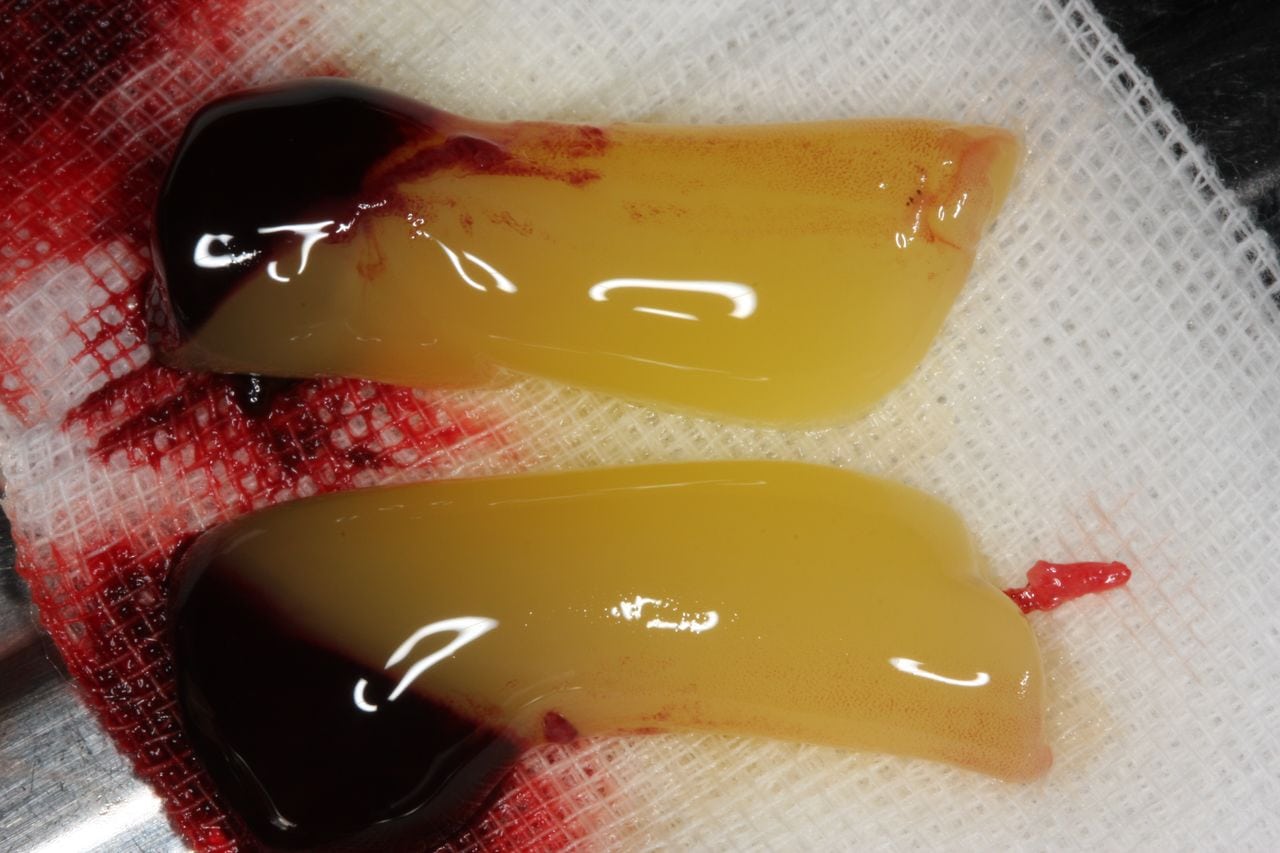
One thought about the slow healing process with any sort of tendon tear is that the tissue is poorly vasculated. In other words, little blood is getting to the area. Blood carries all sorts of proteins and other chemicals that aid in the healing process. The hypothesis is then that by concentrating the components of the blood largely responsible for healing (e.g., insulin growth factor, thrombin) and then applying them to the surgical site that it would then result is greater healing.
In this study, they are not looking at cases similar to Zach Britton's. They are looking at tears that required surgery. In this study, 88 patients were included with 45 given PRP in the form of a fibrin matrix. Basically, you use a polymerized fibrin matrix so that you are able to physically connect it to the repaired area. This is different from Britton's treatment where his PFP is not in a fibrin matrix and is instead directly injected at the site of inflammation. The PRFM look like this:
What they found was that after 16 months, there was no difference between the group that was given a PRFM and those that did not have that aspect of the treatment. However, the two caveats would be that these individuals were not athletes and rate of recovery within those 16 months was not evaluated. Another, more recent, article looked at the same procedure with a 12 month follow up and found no difference between groups of similar treated patients with the lone exception that the PRFM group had a greater likelihood for retears. These fall in line with the perspective of the physician that Britt interviewed. However, another study that would have done better with a bit larger of a sample size found that PRP (they injected the PRP and then used sterile air to form a clot) may be useful for low grade tears, but not more significant ones.
Again, Britton does not fit in any of these categories.
Growth Factor-based Therapies Provide Additional Benefit Beyond Physical Therapy in Resistant Elbow Tendinopathy
Creaney et al. 2011 BJSM
This article focuses on patients who have not found any success with traditional physical therapy techniques to heal their elbows. The researchers decided to compare PRP with ABI. PRP again is the injection of concentrated platelets and growth factors while ABI is whole blood injection. There was no control, placebo control, or comparison to a well known technique, such as administration of cortisone. The researchers felt it was not ethical to have a group in the study that would not receive any treatment. They found that both PRP and ABI produced similar results. They both had a success rate around 70% (success defined as improvement in a Tennis Elbow Evaluation metric) over the course of six months (injection was at 0 and 1 month). This looks like a solid result, but it hurts not having a control or traditional treatment comparison.
Conclusion
One of the first rules in treating someone is to do no harm. This is where I divide PRP from something like hGH. I have a difficult time seeing how currently applications of PRP could be dangerous to the patient. I think there is also some data out there that suggests that PRP might be of some use to the healing process. There are issues with knowing whether or not it works or how to use it best. For instance:
It might work for Britton, it might not. We really do not know. If he gets betters, it does not mean it worked. If he gets worse, it does not mean it didn't work.
I have been asked to write on this by a few of my readers as I tend to write about scientific matters in baseball and this sort of thing speaks to my training. My research at the UMD-B's Medical School was focused on reproduction and DNA damage, but my class room training was a bit broader. This should clue you in on my perspective in that how I typically see things differently than a medical doctor. The best way I can explain it is that from my experience a medical doctor acts more as an advocate for the patient than as a strict scientist. This means that they tend to believe in the benefit of procedures before the science can weigh in on the matter.
Another comparison is the PED issue in baseball. There are the advocates (e.g. players, gym rats) and the science. Sometimes the advocates get ahead on a specific issue, such as steroids improving athletic performance. When the advocates get ahead of the curve though, they tend not to fully understand the procedure and can misapply it. Thus, a poorly understood application of steroids could result in worse performances. There is actually still much debate as to how effective steroids were for hitters generating power as well as other purported usage. There is still misinformation out there as to how steroids affects head size and eye sight. Science has largely caught up with this treatment and how to effectively use it in a clinical setting, but that often poorly translates as the message is transcribed into the gym locker room.
I do not see myself as an advocate. You probably already know this from my previous writings on PEDs. I like to see solid proof of something working. This means getting into the nuts and bolts, understanding the science with a critical view. After a quick overview, I will delve into some more recent journal articles.
Although summarized in Britt's and Andrew's articles, I think it might be beneficial to actually see an application of PRP. In the video below, a physician uses the treatment for a patient with tendinitis in the elbow. Tendinitis is an acute injury to the tendon that is accompanied by inflammation.
Platelet-Rich Plasma Augmentation for Arthroscopic Rotator Cuff Repair
Castricini et al. AJSM
One thought about the slow healing process with any sort of tendon tear is that the tissue is poorly vasculated. In other words, little blood is getting to the area. Blood carries all sorts of proteins and other chemicals that aid in the healing process. The hypothesis is then that by concentrating the components of the blood largely responsible for healing (e.g., insulin growth factor, thrombin) and then applying them to the surgical site that it would then result is greater healing.
In this study, they are not looking at cases similar to Zach Britton's. They are looking at tears that required surgery. In this study, 88 patients were included with 45 given PRP in the form of a fibrin matrix. Basically, you use a polymerized fibrin matrix so that you are able to physically connect it to the repaired area. This is different from Britton's treatment where his PFP is not in a fibrin matrix and is instead directly injected at the site of inflammation. The PRFM look like this:
Again, Britton does not fit in any of these categories.
Growth Factor-based Therapies Provide Additional Benefit Beyond Physical Therapy in Resistant Elbow Tendinopathy
Creaney et al. 2011 BJSM
This article focuses on patients who have not found any success with traditional physical therapy techniques to heal their elbows. The researchers decided to compare PRP with ABI. PRP again is the injection of concentrated platelets and growth factors while ABI is whole blood injection. There was no control, placebo control, or comparison to a well known technique, such as administration of cortisone. The researchers felt it was not ethical to have a group in the study that would not receive any treatment. They found that both PRP and ABI produced similar results. They both had a success rate around 70% (success defined as improvement in a Tennis Elbow Evaluation metric) over the course of six months (injection was at 0 and 1 month). This looks like a solid result, but it hurts not having a control or traditional treatment comparison.
Conclusion
One of the first rules in treating someone is to do no harm. This is where I divide PRP from something like hGH. I have a difficult time seeing how currently applications of PRP could be dangerous to the patient. I think there is also some data out there that suggests that PRP might be of some use to the healing process. There are issues with knowing whether or not it works or how to use it best. For instance:
- No information on the level of concentration that is important for creating the PRP fraction,
- No observations of the mechanisms of action for this treatment,
- Few randomized studies and the existing randomized studies do not show a clear benefit, and
- No consensus on injection site or frequency.
It might work for Britton, it might not. We really do not know. If he gets betters, it does not mean it worked. If he gets worse, it does not mean it didn't work.
02 April 2012
News and Notes
by Tom Peace
The
Orioles are five days away from Opening Day and the ballclub still
needs to make some roster moves. Here are the moves the have made in the
last week to get ready for the season.
The
long wait is over on who will be the Opening Day starter for the
Baltimore Orioles. Jake Arrieta was given the nod from manager Buck
Showalter to take the hill this Friday against the Minnesota Twins.
Arrieta started in 4 games this spring for the ballclub going 1-0 with a
6.14 ERA. Though, the right-hander stuck out 12 batters and only walked 4.
Starting pitcher Chris Tillman was optioned to AAA Norfolk. The right-hander had moderate
spring training. According to Orioles.com, the Orioles want him to be a
starter and get some more innings down on the farm before being brought
back up to the majors.
The Orioles’ designated Dana Eveland, 28,
for assignment last week after going 1-2 with a 3.46 ERA in six games
(three starts). The Orioles then claimed utility infielder Zelous
Wheeler off waivers from the Milwaukee Brewers.
Baltimore
acquired Eveland in a trade during the Winter Meetings back in
December. Wheeler, in five Minor league seasons batted .271 and had a
.371 OBP. The young third baseman is another example of Executive Vice
President Dan Duquette going after high on-base percentage guys.
The
chances of non-roster invitee, catcher Ronny Paulino making the 25 man
Opening Day roster improved this past week as Taylor Teagarden was
placed on the disabled list. Teagarden hasn’t played in a game since
March 6th and will have a second epidural in his lower back.
AL Team FIP by Pitching Postion
Keep an eye on the y-axis. It changes from one graph to the next. Also, the order of the teams change as well except for the Orioles who ranked as having the worst pitching by slot for every slot.
First Slot
Second Slot
Third Slot
Fourth Slot
Fifth Slot
As a little extra...here is the Orioles xWAR vs the World
First Slot
Second Slot
Third Slot
Fourth Slot
Fifth Slot
As a little extra...here is the Orioles xWAR vs the World
| Click to Enlarge |
Subscribe to:
Posts (Atom)