01 October 2011

CDOBC: But Didn't We Have Fun Chps 6-8

For more about the book club and books on the agenda click here.

But Didn't We Have Fun? An Informal History of Baseball's Pioneer Era 1843-1870
by Peter Morris

Chapter: 1 | 2 | 3 | 4 | 5 | 6, 7, 8 | 9 | 10 | 11 | 12 | 13


For this post, I am collapsing a few of the chapter where I have not much to add.

Chapter 6: Customs and Rituals

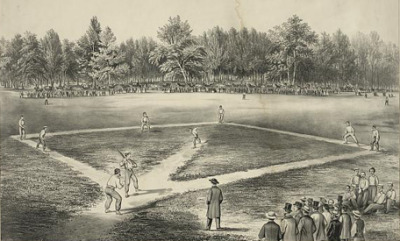
This chapter is about how baseball was involved in courting and other social ceremonies.  Baseball clubs were, in some places, certainly treated as well respected clubs.

Chapter 7: Club Life

One of the major take home points in this chapter is that the history of baseball is limited to those who thought it worthwhile mentioning.  To many, this was a simple game for fun and exercise.  It was not considered more than that.

Chapter 8: Intercity Competition and Civic Pride

In the mid 1800s, many towns were fighting for a larger population to provide manual labor for whatever industries were important in the town.  Many saw baseball clubs as a way to promote their town and encourage others to immigrate.  This was truly a matter of life and death for many places.  The more people you had, the more your town could produce.  The more your town produced, the more money it had.  The more money it had, your needs your more likely represented in state and federal efforts.  If a baseball club could get a town a railroad or a major road coming through, they were going to use it.

It reminds me of an ancestor of mine who held some sway in Virginia.  He was actually able to get the small little road in front of our ancestral estate to be chosen for a section of US 15.  It would be unheard of these days for any home owner to want a major highway be built within a stone's throw of the front door of your mansion and 600 acre home.  Back then, it was a boon.  More business passed through town and more important people on their way to Richmond or Washington DC would have to make its way through.  The town today is no longer very important.  The mills burned down (as did most of the town) and the water diverted, but it still is retained as the county seat.

As peculiar as that seems now, it also seems peculiar for a city to acquire a team for the purpose of promoting the city.  Teams just are not ambassadors anymore.  I think they are solely acquired for the enjoyment of the local city and to try to draw more recreational funds from the greater city and into the inner city.

30 September 2011

With Reynolds in left and Fielder at first, O's improve by 12 games

Mark Reynolds had a very good year at the plate.  He hit 37 home runs, helping himself to a .483 slugging percentage and he walked 12.1% of the time that counteracted his low batting average.  It was in fact his second best offensive year in his career worth about 31 runs over a replacement third baseman.  However, his defense nearly negated his offensive worth.

Defensive Metric          1B (375.2 inn)      3B (984.1 inn)    proj 3B (1360 inn)   
UZR                                   -5.3 runs              -22.8 runs               -31.5 runs
Total Zone                          -6                        -18                           -25
DRS                                    -4                        -29                           -40

I typically like to have about 3000 innings to determine how well a player performs at an infield position.  If you include his season last year, you will wind up with about -15 to -20 runs.  Reynolds at his best provides about 30 runs above replacement level and with that level of defensive ineptitude, it is difficult to match what is passable for an average player (+20 runs above replacement).

However, the Orioles have the ability to make him a more valuable player.  By switching him to another position, his glove may not be as much of a hindrance on the team.  The Orioles did that by playing Reynolds at first base about 30% of the time.  With time, I think it is not unthinkable that Reynolds could be an average first baseman defensively.  That alone would save the team three wins assuming that his replacement at third base is average defensively and provides the same offense from first base that Reynolds in replacing (Derrek Lee's 706 OPS).

A shift to first base and maintaining his offensive production does not make Mark Reynolds a 3.1 WAR player because it is far easier to find offensive production at first than it is at third.  Due to this shift in expected offensive production for a replacement player, Reynolds' worth would actually be 1.8 wins above replacement, 1.3 wins less than if he was at third.  If you put him in as a DH, that value is 1.2 wins above replacement.  As a 3B, 1B, or DH, Reynolds is not an average player (~2 wins above replacement).

Reynolds would rate as an average or above player if he was capable of playing an average left field.  He has played three innings in the Majors, twenty three games in the Minors, and, as far as I can tell, he did not log any notable time in the outfield during college.  Reynolds should have the tools to play left field though.  He has good speed for a big man.  He has swiped over twenty bases during a season and collects a couple triples every year.  He also has a strong arm.  Although he has not logged any significant time out there, I think it could be a position he could handle.  In that case, he would be worth 2.3 wins above replacement.  These numbers should not be treated as guarantees, but the take home point is that Reynolds likely has a better chance of being useful as a LF than as a 1B, 3B, or DH.

Of course, these values rely on an abstract situation.  A major issue is to figure out who exactly would be playing at 1B, 3B, LF, and DH.  I will go through a few options for each position and then can determine which would be the best mix.

1B
Reynolds (1.8 WAR; 7.5 MM), Prince Fielder (5.0; 20),
Chris Davis (0.5; 0.4), Carlos Pena (2.6; 10)
3B
Reynolds (0.3 WAR; 7.5 MM), Aramis Ramirez (2.5; 15),
Robert Andino (1.0; 1), Marco Scutaro (2.8; 6)
DH
Reynolds (1.2 WAR; 7.5 MM), Jason Kubel (1.5; 5),
Luke Scott (2.0; 6.4), Nolan Reimold (1.2; 0.5)
LF
Reynolds (2.3 WAR; 7.5 MM), Michael Cuddyer (2.5; 10),
Scott (2.6; 6.4), Reimold (1.8; 0.5)

It is easy to see that if Marco Scutaro makes it to free agency, that he might be best suited for the Orioles.  There is doubt that the Red Sox will tender him a contract.  It might make sense to offer them something in a deal for him.  Scutaro actually has a decent amount of worth and has experience at third base.  The rest is a bit of mix and match.  The most reasonable set up would be to have Reynolds in left and Pena at first with Scott and Reimold working with the DH spot and Reimold backing up left and right field.  Adding Fielder in lieu of Pena, gives the team 2-3 more wins.

The most accomplished squad would deliver about 12 WAR.  Last year, the O's managed approximately 0.7 WAR total from those positions.  You read that right.  This team can go from a high 60s team to a low 80s team by merely adding Prince Fielder and Marco Scutaro in place of Derrek Lee and Mark Reynolds, shifting players around, and Scott getting healthy.

That is stunning to me.

28 September 2011

Expanded Roster: MacPhail's Arms

During the month of September, Camden Depot expanded the rosters beyond Nick Faleris and Jon Shepherd.  This enabled our audience to speak directly outside of the comment box as well as shine a light on other Orioles writers.  The final article is from Will BeaudouinBen Feldman and Kevin Williams wrote pieces.  I would like to thank everyone who submitted pieces.  They all made me think and consider new ideas or new ways of presenting old ideas.  However, we limited space we had to select the three best.  Also, congratulations to Kevin Williams whose piece was also publicized on our home ESPN MLB site in a Sweet Spot article.  Thanks again and we might look into this again when Spring Training comes around.

MacPhail's Arms
by Will Beaudoin

MacPhail's first arm - Rocky Cherry
If the reports and rumors that have surfaced in recent weeks are to be believed, Andy MacPhail’s tenure as President of Baseball Operations will soon come to an end. MacPhail, first hired in June of 2007, is well known for having preached his oft-repeated mantra of “grow the arms and buy the bats” as well as his claims that the Orioles needed to acquire more “pitching inventory”. At face value it seemed that MacPhail desired to accumulate enough quality organizational pitching depth in order to prevent the Paul Shuey’s of the world from being called upon when ranks inevitably thinned.

The objective of this piece is to look back at the pitching inventory acquired during the MacPhail era and evaluate said inventories potential moving forward. Starting in June of 2007 through the present day, I’ve compiled a list of every pitcher acquired by MacPhail who’s pitched thirty or more major league innings as an Oriole. For the sake of simplicity I’ll be using Fangraphs’ fWAR to quantify value. This isn’t a cost-benefit analysis—salaries will be ignored for this exercise. Many of the pitchers who didn’t pan out were smart pickups at the time of their acquisition and vice versa. I simply want to look at the raw value these pitchers brought to the club during their time in Baltimore.

Note: Players are listed under the first year they were acquired starting June 20th, 2007. Innings pitched and fWAR totals are their Oriole career numbers. Players subsequently reacquired (e.g. Hendrickson, Uehara) are only listed the first year they were acquired. [edit - The end date for the fWAR time frame is September 6th, 2011].

2007 Regular Season Acquisitions
  • Rocky Cherry: 33.1 IP, fWAR -.7
  • Fernando Cabrera: 38.1 IP, -.6 fWAR

07/08 Offseason/Regular Season Acquisitions
  • George Sherrill: 95 IP, 1.4 fWAR
  • Chris Tillman: 180.2 IP, .7 fWAR
  • Brian Matusz: 262 IP, 2.9 fWAR
  • Brian Bass: 107.1 IP, .1 fWAR
  • Lance Cormier: 71.2 IP, .7 fWAR
  • Alberto Castillo: 48.2 IP, -.1 fWAR
  • Matt Albers: 191.2 IP, 1.3 fWAR
  • Dennis Sarfate: 102.2 IP, .2 fWAR
  • Randor Bierd: 26.2 IP, .1 fWAR
  • Steve Trachsel: 39.2 IP, .1 fWAR
  • Alfredo Simon: 156 IP, -.1 fWAR

08/09 Offseason/Regular Season Acquisitions
  • Mark Hendrickson: 191.1 IP, 1 fWAR
  • Koji Uehara: 216 IP, 4.2 fWAR
  • Rich Hill: 57.2 IP, .4 fWAR
  • Adam Eaton: 41 IP, 0 fWAR
  • Cla Meredith: 43.2 IP, -.3 fWAR


09/10 Offseason/Regular Season Acquisitions
  • Mike Gonzalez: 48 IP, .8 fWAR
  • Will Ohman: 30 IP, .1 fWAR
  • Kevin Millwood: 190.2 IP, 1.3 fWAR

10/11 Offseason/Regular Season Acquisitions To Date
  • Chris Jakubauskas: 67.2 IP, .2 fWAR
  • Tommy Hunter: 37.2 IP, .4 fWAR
  • Jeremy Accardo: 32.1 IP, -.2 fWAR
  • Kevin Gregg: 52 IP, -.4 fWAR

TOTAL: 25 pitchers acquired (30 IP minimum), 2,371.2 Total IP, 12.7 Total fWAR

Before any substantial analysis, a few disclaimers: I realize assigning sole responsibility for performance of these players to Andy MacPhail is foolish. It’s impossible to know how many he specifically targeted, how many were suggested by his staff, etc. I also realize that there’s a very strong argument against attributing Matusz to MacPhail. I agree that Joe Jordan should receive the credit for drafting Brian and bringing him into the organization, but considering the scope of this analysis I think it’s fair to include him. Finally, many of these players have a chance to contribute to the organization in the future. Chris Tillman could still put it together and live up to his potential. If this happens, MacPhail will be the one to thank. I’m not trying to assign a final grade to every acquisition.

Brief Observations

Over the course of his four and a half years in the organization, MacPhail brought in roughly 2.8 pitching wins a year and roughly half a win for every transaction made.

Seventeen of the listed players were predominantly relievers while only eight were predominantly starters

Of the twenty-five players listed, only six have been worth one win or more: Sherrill, Matusz, Albers, Uehara, Hendrickson and Millwood. Of these six only Uehara and Hendrickson were acquired through free agency and only Millwood and Matusz were starters.

Eight players have had a negative total value: Rocky Cherry, Fernando Cabrera, Alberto Castillo, Steve Trachsel, Cla Meradith, Jeremy Accardo, and Kevin Gregg. Together these players have been worth a total of -3.1 wins.

Conclusion

The fact that only 12.7 wins were brought in over the course of four and a half year is astounding. The pitching staffs of the Rays, Red Sox, and Yankees have all been worth more than twelve wins this year alone. Taken with the fact that the Orioles were ranked 21st in staff fWAR at the end of 2007—MacPhail’s first half season—it becomes obvious why the Orioles have been so poor in recent years.

It’s obvious that MacPhail wanted a homegrown pitching staff, but when that plan failed (or faltered if you’re optimistic) there was no plan B. When Tillman struggled there was no promising prospect behind him to take his place. The same could be said of Matusz this year. MacPhail pinned the hope of the organization onto a handful of top pitching prospects and seemingly stopped accumulating any meaningful talent beyond that. While other organizations have more pitching prospects than spots in the rotation to fill the Orioles have experienced the exact opposite.

Moving forward, of the twenty-five pitchers listed, only Hunter, Matusz, and Tillman could be considered possible pieces for the future. The minors are barren in the upper levels as well. Where is the next wave of reinforcements coming from? Obviously MacPhail has had his share of bad luck, but for a man whose goal was to acquire “inventory” there’s relatively little to show for it throughout the entire organization. There are other promising arms acquired before MacPhail, of course. I hold out hope that a fully healthy Jake Arrieta can be an effective pitcher while Zach Britton’s up and down season has me excited about his future potential. But even when you take Arrieta and Britton into consideration you’re left with five potential long-term pieces and four spots empty in the rotation. Unless the Orioles get extremely lucky that’s not going to cut it. Building a pitching staff is a game of attrition, and as they’ve been in years past, the organization under MacPhail was once again ill-adept to deal with this reality.

26 September 2011

Matusz actually did not have the worst season ever.

Steve Blass
Much has been made of Brian Matusz' ERA of 10.69 being the worst ever for a pitcher who has started at least 10 games and logged at least 40 innings.  However, why are we using ERA here?  It seems quite intellectually lazy (and I had done it a week or so ago), but why use a statistic that most of us recognize as being highly flawed when there are far better ones available?  Probably because it makes an easy and sensational point.  However, I plan to make ammends.  According to rWAR, Brian Matusz will likely finish with the 66th worst season for a pitcher at -2.6, tying such luminaries as Jim Bullinger, Ross Grimsley, and Dick Pole. 

That is a horrible season.  There are probably about 200,000 seasons on record for a starting pitcher with 10 starts and 40 innings, so scoring in the 0.03 percentile is bad enough without resorting to a misguided statistic like ERA.  It should be noted that Matusz had a long way to go before he assumed the worst rWAR ever for a pitcher.  The worst season is Steve Blass at -5.8 rWAR.  Matusz would have needed 112 innings pitched to have achieved what Blass did.  Blass accomplished his feat in 88.2 innings.  Matusz was bad, but he was not Steve Blass bad.

Using the 200 worst rWAR seasons on record for starting pitchers, I created a rWAR-A by divided rWAR by innings pitched and multiplying that by nine.  By turning it into a rate statistic, we can normalize pitching opportunity and hopefully put all of these pitchers on equal footing.  The following are the worst seasons for a pitching according to this rate (min 10 games and 40 innings pitched):

1. Steve Blass 1973 -0.592
2. Andy Larkin 1998 -0.558
3. Brian Matusz 2011 -0.476
4. Luis Mendoza 2008 -0.442
5. Micah Bowie 1999 -0.441
6. Roy Halladay 2000 -0.429
7. Cal McLish 1944 -0.407
8. Dick Conger 1943 -0.365
9. Tony Kaufman 1927 -0.362
10. Hideo Nomo 2004 -0.343

Other Orioles
63. Dave Johnson 1991 -0.214
111. Jeff Ballard 1991 -0.168
151. Jack Fisher 1962 -0.130
160. Dennis Martinez 1983 -0.124

What we can take home from this is that we have witnessed one of the worst seasons on record for a pitcher, but, alas, not the worst.  Rough year for Matusz.  I hope he gets himself back on track.

25 September 2011

CDOBC: But Didn't We Have Fun? Chapter 5

For more about the book club and books on the agenda click here.

But Didn't We Have Fun? An Informal History of Baseball's Pioneer Era 1843-1870
by Peter Morris

Chapter: 1 | 2 | 3 | 4 | 5 | 6 | 7 | 8 | 9 | 10 | 11 | 12 | 13

"Lemon Peel" baseball
Chapter 5: Balls, Bats, Bases, and the Playing Field

This is a great chapter.  If you ever find yourself in a library waiting for your significant other to find an audiobook she would like for her commute, you will likely have enough time to sit and make your way through these pages.  As cleanly summarized in the title, it is a brief description of the types of balls, bats, bases, and playing fields that were in use in baseball during this period in the mid-1800s.  As shown before, the simple rules that the Knickerbockers' devised and dispersed standardized many aspects of the game, but left many open for interpretation.  For a single team or field, this makes complete sense as selection of ball, bat, bases, and field are largely without choice or can be quickly determined and followed from there on out.  However, if two different populations of ball players never much interacted then you are likely to have two wildly different implements for your game.

Two major extremes are present in this chapter.  In one locale, I believe Michigan, the version of baseball played there was with a 10 inch diameter baseball whose core was a melted down rubber shoe with yarn tied around it and leather keeping it together.  They had one ball and it was highly treasured (in fact, it was common during this time that when a team won a game, the winners were awarded with a baseball).  On the other end was a group of rural folk who supposedly wrapped twine around a bullet to form a small little ball that injured many a player's hands.  As you can imagine, these two games would be played in vastly different ways and players accustomed to one would be at a significant disadvantage to play it a different way.

The use of a harder ball often resulted in a more destructive projectile.  Where the town ball game could be played in the commons, town square, or on a vacant sand lot, the new baseball game was wont to break windows and terrorize residents.  One part of the book that stuck close to one of my own experiences is from a first hand account of a ball player who was kicked out of his town square because an elderly gentleman was concerned about them hitting balls into the trees, knocking down branches, and potentially killing the trees.  The same thing happened to me in a park near Capitol South where my softball team captain this past summer had us practice in a small park with dogs, babies, and people playing boche ball running around.  An elderly man walked up to us and said the same thing.  I was actually quite glad that no one got hurt as there was no good reason why we were out there.  I felt at one with those 1850's ball players.

Anyway, the transition resulted in many more towns and cities to ban all ball playing within their limits.  Many compromises began coming into play as many clubs began using dead balls to keep them closer to the confines of the city.  The 10 inch diameter ball with a seven inch chunk of rubber in the middle was discarded for one with less rubber and more yarn.  "Bullet balls" and other small projectile were being replaced by larger balls that traveled less distance.  It is actually amazing to think how often during this time the types of balls changed whereas in MLB there appears to be only four or five changes to the ball in the past five years (with most of them being completely unintentional).  Very different.

CDOBC: But Didn't We Have Fun? Chapter 4

For more about the book club and books on the agenda click here.

But Didn't We Have Fun? An Informal History of Baseball's Pioneer Era 1843-1870
by Peter Morris

Chapter: 1 | 2 | 3 | 4 | 5 | 6 | 7 | 8 | 9 | 10 | 11 | 12 | 13

Chapter 4: How the Game was Played

As peculiar and momentous as it was to write down rules to a simple game, perhaps more interesting is how the rest of the game was played.  In today's environment, the rule book is dense.  What started as one sheet of paper has grown into a 130 page document.  This is also not entirely correct as the original rule book also included items that would eventually evolve into aspects of the collective bargaining agreement (CBA).  The CBA is 241 pages in length.  There are also a plethora of other documents that ownership uses to self-regulate, players use to self-regulate, umpires use to self-regulate, an MLB agreement with umpires, teams use to self-regulate, and so on and so on.  So, it could be seen that that single page has become a few thousands pages of rules and regulation.  What spurned that growth was what caused those initial rules to be put into place: arguments getting in the way of the game. 

Perhaps one of the more interesting parts of the early regulation of the game was the role of umpires.  Umpires were usually seated thirty feet from the plate under an umbrella with drink and food at his disposal.  They did not call balls or strikes (as there were no called pitches).  They never actively engaged themselves into the game.  Instead, they were largely ceremonious and were only involved in the game when there was a close play and the player yelled for a "judgement."  Typically, the umpire was a well known individual and a pillar of the community.  The umpire typically knew very little about the game.  His role was to make sure the spirit of fair play was maintained and that all participants were to remain gentlemanly in conduct.

A primary problem with this was that baseball was as much about winning as it was about having "fun."  Such a situation means that players began doing what they could to win without appearing to cross the line of being a gentleman.  One problem occurred as the conversion from rocks, stumps, and stakes to sand or sawdust bag bases occurred.  This combined with the emergence of better kept fields resulted in the strategy of sliding to decelerate quickly as well as to avoid a tag.  Crowds were often surprised by this technique and often assumed a player stumbled, rolled, and fortuitously avoided a tag.  Blowback against this technique and the way fields were maintained kept this to a minimum until professionalism occurred.

A second, and more prominent, issue was that pitchers were beginning to establish themselves as one of the more important defenders.  There were no called pitches, but pitchers would try to get batters to swing at bad pitches and not hit the ball so solidly.  In response to this, batters would merely wait until they found a pitch to their liking.  It was not unheard of for single innings to involve a hundred pitches.  Obviously, this would likely make the play less interesting as crowds would sit and wait for a dozen or so pitches before a batter would swing.  This largely took the umpire off his pampered life and into the fray behind the catcher for pitches to be called.

CDOBC: But Didn't We Have Fun? Chapter 3

For more about the book club and books on the agenda click here.

But Didn't We Have Fun? An Informal History of Baseball's Pioneer Era 1843-1870
by Peter Morris

Chapter: 1 | 2 | 3 | 4 | 5 | 6 | 7 | 8 | 9 | 10 | 11 | 12 | 13 | App 1

Chapter 3: The New York Game Becomes America's Game

One of the major reasons why the Knickerbocker's style of play grew beyond their influence on the Burroughs was the transition between centralized news and the telegraph.  On December 6, 1856, the newspaper Porter's Spirit of the Times printed the Knickerbocker rules.  Oral transmission of the rules of the game limited how far the game could travel and how accurate the transmission of these rules would be.  By using print, the rules could be effectively communicated by the letter.  News at this point was beginning to be decentralized from Washington and New York with the development of the telegraph system, allowing newspapers in Boston, Chicago, St. Louis, etc. to have first hand accounts with their own perspective as well as being able to join news associations who would offer stories for print.  This period of transition allowed for the exact Knickerbocker rules to spread across the country.  The aura of New York sophistication could be helpful to ball players who were maligned for spending time playing a children's game.  If you can point to New York and say this is played there, it gives you more credibility.

However, technological achievements and a country still somewhat looking to the East Coast for instruction were not alone in spreading the game.  These things help convince people to try a game that is played in New York City as their was certainly respect for a perceived sophistication back east, but it would not make people continue playing the game.  It had to be enjoyable as well.

I touched on it slightly in the last chapter review, but I think the spread primarily had to do with this: no soaking, foul balls, and what became the use of a harder ball.  With the elimination of soaking, there was no longer a need for a fairly soft ball.  No longer worried about injuring a person with a hard one, they could use balls that could travel a greater distance.  This is important because there was no longer foul territory.  The field would be too collapse with a short distance ball, a harder ball extended the field of play.  This meant that you no longer had to be a lean, athletic, and fast person to be able to play.  The importance of power and speed became far more balanced.

By balancing power and speed, it enabled a few things that make the game enjoyable.  First of all, it increased the population able to play the game.  People with body types that are not especially suited for chasing down runners and then soaking them were not well suited for the town ball games.  Baseball enabled them to hit the ball far to avoid being chased down as well as allowed them to use their arm to throw at the bases which required less skill than throwing at a moving target.  Second, I think it made baseball more enjoyable for spectators.  Town ball was a spectacle of players hitting the ball in front of and behind home plate, often intentionally glancing batted balls to go no further than 50 feet.  The idea was often just to get to first and successfully get to bases in run downs.  If one chose to hit the ball well, it would go about 120 to 150 feet.  Town ball was essentially a series of guys chasing each other and hitting them with balls.  The Knickerbocker rules lengthen the field and the fans largely enjoyed the long ball.  Everyone seems to love a good feat of strength.

What I find interesting is how a major current discussion in baseball is the relative worth of a game relying on good pitching versus good hitting.  That is where we are now.  Back then, it was about good fielding versus good hitting.  Pitchers were considered merely one of the nine fielders.  The spirit of the rules primarily limited a pitcher back then to merely serve up balls for batters to hit and fielders to field.  Over the next few chapters we are bound to see the development of pitchers changing their own role.